US Airways Flight 1549
- Date
- Phase of flight
- Climb
- Location
- Hudson River, off Weehawken, New Jersey, United States
- Aircraft
- Airbus A320-214
- Registration
- N106US
- Operator
- US Airways
- Flight
- US Airways 1549
- Occupants
- 155
- Fatalities
- 0No fatalities; 1 flight attendant and 4 passengers seriously injured
- Investigating body
- National Transportation Safety Board (United States)
- Final report
- NTSB/AAR-10/03
- Report date
- Report title
- Loss of Thrust in Both Engines After Encountering a Flock of Birds and Subsequent Ditching on the Hudson River, US Airways Flight 1549, Airbus A320-214, N106US, Weehawken, New Jersey, January 15, 2009
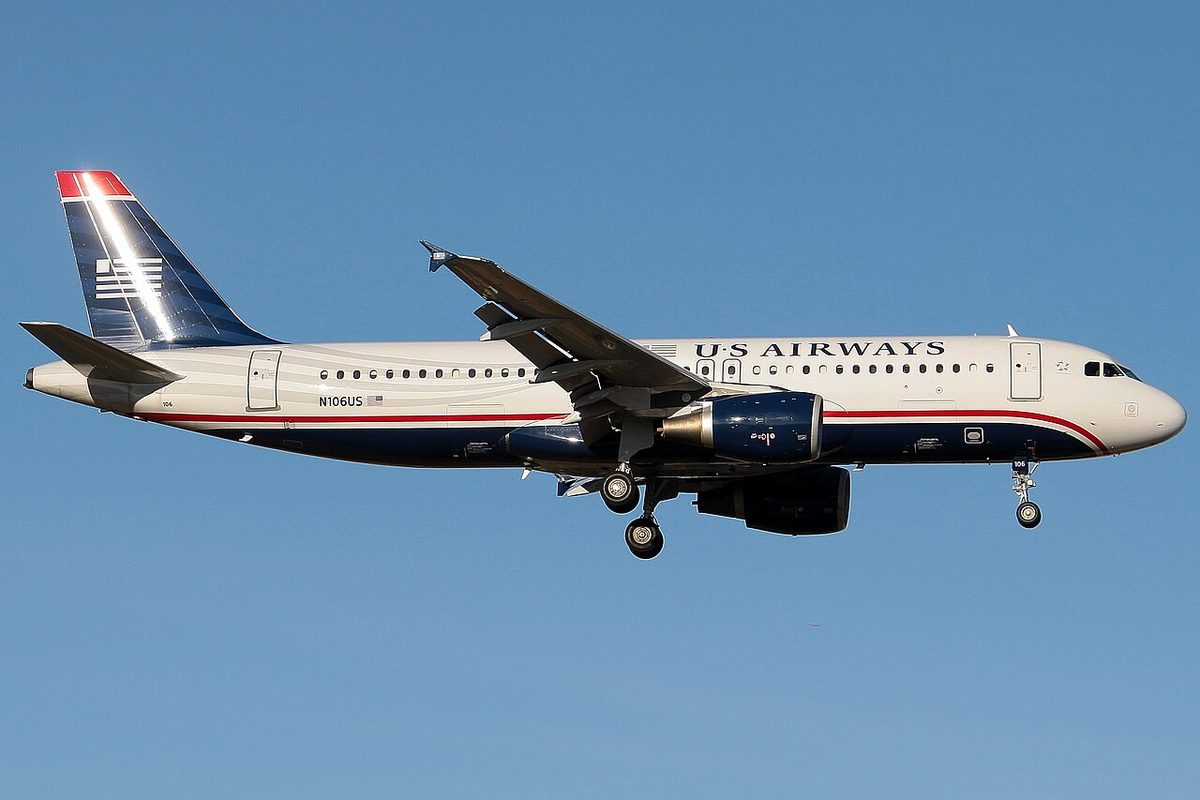
US Airways flight 1549, an Airbus A320, lost almost all thrust in both engines after striking Canada geese two minutes after take-off from LaGuardia on 15 January 2009. The crew ditched on the Hudson River and all 155 occupants survived. The NTSB found the cause to be the ingestion of large birds into each engine.
On 15 January 2009, at about 15:27 local time (EST), US Airways flight 1549, an Airbus A320-214 registered N106US, struck a flock of Canada geese while climbing out of LaGuardia Airport, New York, for Charlotte, North Carolina. Both engines lost almost all their thrust. At 15:30:43, about three and a half minutes after the strike, the crew ditched the aeroplane on the Hudson River, off Weehawken, New Jersey, about 8.5 miles from LaGuardia.
All 150 passengers, including a child held on a lap, and the 5 crew members evacuated through the forward and overwing exits and were rescued by boats that reached the scene within minutes. One flight attendant and four passengers were seriously injured. The aeroplane was substantially damaged.
The NTSB report is as useful for what nearly went wrong as for the outcome: a checklist written for a failure at high altitude, a descent flown below the intended speed, a touchdown at more than three times the descent rate assumed for ditching certification, and aft slide/rafts lost to water entering the fuselage.
The flight
The flight was the last of a four-day trip, the first that the captain and first officer had flown together, and the second flight of the day in N106US. The first officer was pilot flying for the take-off from runway 4, and the captain was pilot monitoring.
| Pilot | Age | Total hours | Hours on the A320 |
|---|---|---|---|
| Captain | 57 | 19,663 | 4,765 |
| First officer | 49 | 15,643 | 37 |
The first officer was new to the A320: his last proficiency check was on 31 December 2008 and his last line check on 8 January 2009. The weather was good, with visual meteorological conditions; the water temperature of the Hudson was about 5.2 °C.
The tower cleared the flight for take-off at 15:24:54. The take-off and initial climb were normal. At 15:25:51 the captain reported to the departure controller climbing through 700 ft for 5,000 ft, and the flight was cleared to 15,000 ft.
The accident
At 15:27:10 the captain said "birds". One second later the cockpit voice recorder captured thumps, thuds and a shuddering sound. The encounter occurred at 2,818 ft above ground level, about 4.5 miles north-north-west of the approach end of runway 22 at LaGuardia. The fan and core speeds of both engines immediately began to decrease.
| Time (EST) | Event |
|---|---|
| 15:27:10 | Captain: "birds"; bird strike at 2,818 ft above ground level |
| 15:27:19 | Captain calls "ignition, start" and, about 2 seconds later, starts the APU |
| 15:27:23 | Captain takes control: "my aircraft" |
| 15:27:28 | Captain calls for the QRH checklist for loss of thrust on both engines |
| 15:27:33 | Captain to ATC: "hit birds, we've lost thrust in both engines, we're turning back towards LaGuardia" |
| 15:28:05 | Offered runway 13 at LaGuardia; captain: "we're unable. we may end up in the Hudson" |
| 15:28:46 | Captain asks about New Jersey, "maybe Teterboro?", and accepts it |
| 15:29:11 | Captain on the PA: "brace for impact" |
| 15:29:21 | Offered runway 1 at Teterboro; captain: "we can't do it", then "we're gonna be in the Hudson" |
| 15:29:44 | First officer: "no relight"; captain calls for flaps |
| 15:30:24 | GPWS "terrain, terrain" and "pull up" warnings, repeating to the end of the recording |
| 15:30:43 | Touchdown on the Hudson River |
The first officer began the Engine Dual Failure checklist at 15:27:50. Its first items concerned relighting the engines, and it gave 300 kt as the optimum airspeed for a windmilling relight. The aeroplane never exceeded 214 kt after the strike, and the first officer answered, "we don't have that". While the captain spoke to ATC, the first officer continued the relight steps, including turning the engine master switches off and back on. Immediately after the strike the left engine's fan speed had fallen from 82 to 35 % N1 and the right engine's from 82 to 15 % N1, and neither engine again produced enough thrust to sustain flight.
The controller offered LaGuardia runways 13, 31 and 4, which the captain declined; he first accepted Teterboro, then told the controller at about 15:29:25 that they could not reach it. He told investigators that a turn back towards LaGuardia would have been an irrevocable choice and that Teterboro was too far away; the NTSB noted that a return to LaGuardia would also have meant crossing Manhattan.
The flaps were selected to position 2 as the aeroplane descended through about 270 ft. At 15:30:16 the first officer called 150 kt. The captain chose to stay at flaps 2 and asked, "got any ideas?"; the first officer replied, "actually not." The GPWS then sounded repeatedly. In the last 100 ft the captain pulled the sidestick progressively back, reaching its aft stop in the last seconds. The aeroplane touched down at 125 kt, with a pitch attitude of 9.5°, almost wings level, and a descent rate of 12.5 ft per second.
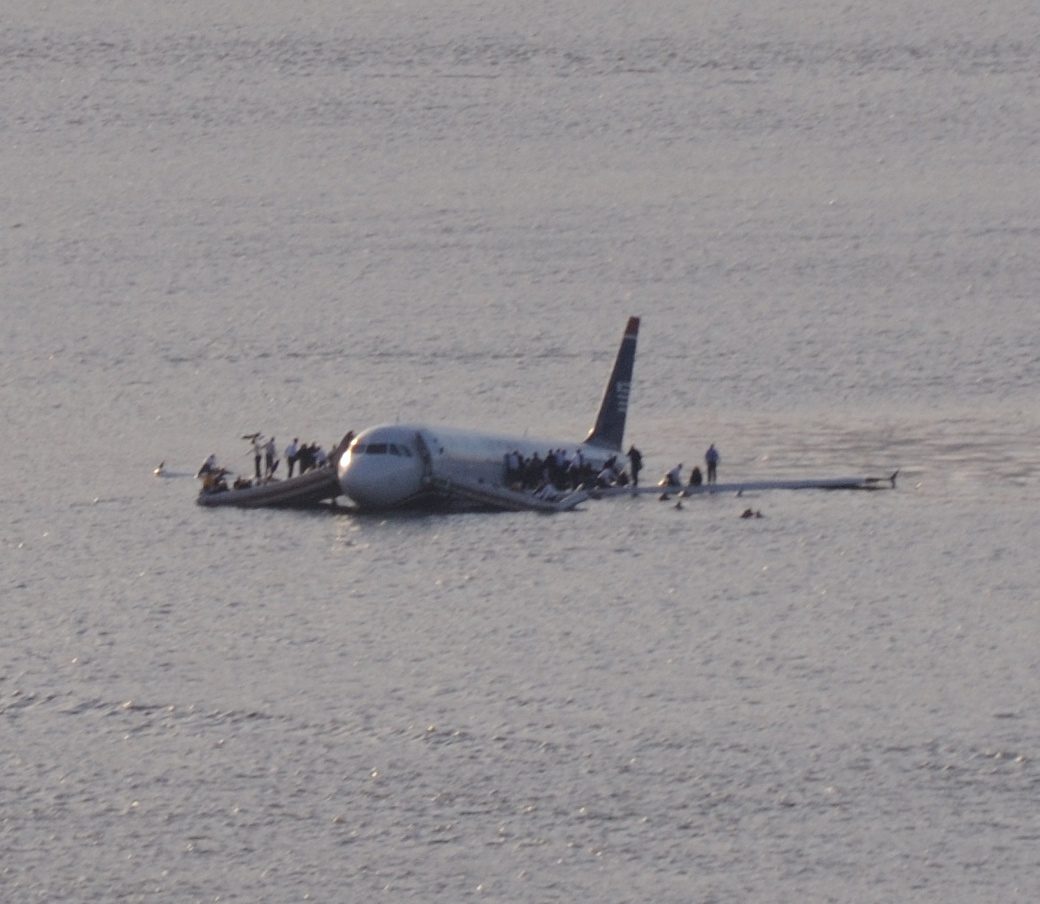
The high-energy impact was taken by the aft fuselage, and the lower part of the fuselage was torn in the aft direction. Water entered the rear of the cabin, so the aft slide/rafts could not be used. A vertical beam at frame 65 punctured the cabin floor and seriously injured the flight attendant in the aft jump seat. Occupants left through the forward doors, onto the forward slide/rafts, and through the overwing exits onto the wings, where many stood in water up to their waists within 2 minutes. The first ferry reached the aeroplane at about 15:34, and seven ferries, a fire department boat and Coast Guard boats took part in the rescue.
The investigation
The birds and the engines
The Smithsonian Institution identified the remains in both engines as Canada geese, whose average weight is 7.3 to 9.2 lb depending on the sex. The NTSB found that each engine had ingested at least two birds of about 8 lb, one of which went into each engine core and caused mechanical damage that prevented the engines from producing enough thrust to sustain flight. The CFM56-5B4/P engines met the bird-ingestion standards in force at their certification, and an anticipated additional regulation that they were not yet required to meet, but the size and number of the birds well exceeded those standards. The large flocking bird test did not apply to engines with an inlet area as small as that of the accident engines (3,077 square inches), and it did not test the core.
The strike occurred beyond the distance and altitude covered by LaGuardia's wildlife hazard management, so the NTSB found that the airport's practices would not have mitigated it. It concluded that "a bird strike does not need to be typical to be hazardous."
Could the aeroplane have reached a runway?
Simulator sessions at the Airbus training centre in Toulouse tested returns to LaGuardia and Teterboro. Of 15 valid runs in which the pilot turned towards an airport immediately after the loss of thrust, 8 ended in a successful landing. Those runs did not include any time to recognise the failure and decide. The one run flown after a 35-second delay, to LaGuardia runway 13, did not succeed. The NTSB concluded that the captain's decision to ditch "provided the highest probability that the accident would be survivable."
The checklist and the APU
The Engine Dual Failure checklist had 3 parts over 3 pages and was designed on the assumption that a dual-engine failure would occur above 20,000 ft. The crew completed most of part 1, spending about 30 to 40 seconds on relight attempts, and never reached the ditching part. Before starting the checklist, however, the captain had started the APU. The NTSB found that this ensured a primary source of electrical power and kept the aeroplane in normal law, with its flight envelope protections, including protection against a stall. That step would not have been completed if the crew had simply followed the order of the checklist items.
The approach to the water
The captain said he believed he had flown at green dot speed and then "safely above" VLS. The flight data showed that the aeroplane was below green dot and at VLS or slightly less for most of the descent, and 15 to 19 kt below VLS in the last 200 ft. The resulting high angle of attack made the flare harder and raised the descent rate at touchdown. The NTSB attributed the difficulty in part to high workload, stress and task saturation. The A320's low-speed aural warning was likely inhibited by the GPWS alerts, 15 of which sounded between 300 ft and touchdown.
From 150 ft the aeroplane was in the alpha protection mode of normal law. The flight control system attenuated the captain's nose-up sidestick inputs in the last 100 ft, so the aeroplane did not reach the maximum angle of attack of 17.5° for its weight and configuration; it touched down at 13° to 14°. The protection also let him pull fully back without any risk of stalling.
The table compares the conditions assumed in the A320's ditching certification with those of the accident:
| Parameter | Certification | Flight 1549 |
|---|---|---|
| Pitch attitude | 11° | 9.5° |
| Airspeed | 118 kt | 125 kt |
| Descent rate | 3.5 ft/s | 12.5 ft/s |
| Average external pressure on the lower fuselage | 7.3 psi | 15.1 psi |
Certification had assumed engine power and a flight path angle of −0.5°. In the simulator, 11 of 12 valid ditching runs ended with flight path angles between −1.5° and −3.6°, against −3.4° on the accident flight; only an Airbus test pilot using a special technique achieved −0.2°. The NTSB concluded that it is possible but unlikely that pilots will attain all the Airbus ditching parameters without engine power, and that this had not been evaluated during certification.
Survival
The aeroplane was equipped for extended overwater operations, although the flight did not require it, and about 64 occupants used the forward slide/rafts. The NTSB also found that most passengers had not paid attention to the safety briefing, that only about 10 passengers retrieved a life vest themselves after the impact, and that the FAA's recommended brace position might have contributed to the shoulder fractures of two passengers.
Probable cause and contributing factors
The NTSB determined that the probable cause was "the ingestion of large birds into each engine, which resulted in an almost total loss of thrust in both engines and the subsequent ditching on the Hudson River."
Contributing to the fuselage damage and the loss of the aft slide/rafts were:
- the FAA's approval of ditching certification without determining whether pilots could attain the ditching parameters without engine thrust;
- the lack of industry flight crew training and guidance on ditching techniques;
- the captain's resulting difficulty maintaining his intended airspeed on final approach, due to the task saturation of the emergency.
Contributing to survivability were the crew's decision-making and crew resource management; the fortuitous use of an aeroplane equipped for extended overwater flight; the performance of the cabin crew during the evacuation; and the proximity and immediate response of the emergency responders.
Safety recommendations and what changed
The NTSB issued 34 new safety recommendations: A-10-62 to A-10-86 to the FAA, A-10-87 to the US Department of Agriculture and A-10-88 to A-10-95 to EASA. They asked for:
- Engines: technology to tell pilots whether an engine can still operate, fitted to engines with full-authority digital engine control (A-10-62, -63); small and medium flocking bird tests at the lowest expected fan speed for the minimum climb rate instead of 100 % fan speed; and a review of large flocking bird tests for smaller engines and for the core (A-10-64, -65, -88, -89).
- Checklists and training: a checklist and procedure for a dual-engine failure at low altitude (A-10-66, -67, -90); guidelines on checklist design, including the order of critical items such as starting the APU (A-10-68); low-altitude dual-engine failure scenarios in training (A-10-69); training on visual illusions over water and ditching techniques with and without power (A-10-70); work on whether recommended practices are needed for forced landings without power on water and land (A-10-71); a GPWS off step in the ditching part of the Airbus dual failure checklist (A-10-73); and training on how alpha protection can attenuate sidestick inputs (A-10-74).
- Certification: proof that ditching parameters can be attained without engine power by pilots without exceptional skill or strength (A-10-72, -91), and a redesign of the frame 65 vertical beam (A-10-77, -92).
- Cabin and survival: slide/raft stowage usable after a ditching, flotation seat cushions and life vests on all flights, better life vest stowage and design, briefings on all flotation equipment, and research on brace positions (A-10-78 to -86, -93 to -95).
- Wildlife: wildlife hazard assessments at all certificated airports, and aircraft-mounted technology to reduce bird strikes (A-10-75, -76, -87).
Lessons for pilots
Aviate first, and do the high-value items early. Within about 12 seconds of the strike the captain had taken control, selected ignition and started the APU. That single early action kept the electrical power and the normal law protections that he relied on at the flare. Know which items in your dual engine failure drill protect the aeroplane, and why. See fly-by-wire.
Exam tip: A windmilling relight needs airspeed: here the checklist wanted 300 kt, while the aeroplane never exceeded 214 kt. Below that speed the APU provides electrical power and, where the procedure allows, bleed air for an assisted start.
Decide early, and commit. Every runway offered required a turn and a glide that the simulations showed was possible only with an immediate turn. Although the crew could not complete the checklist, the NTSB noted that they had time to decide on a landing strategy, configure the aeroplane for the ditching and warn the cabin to brace. See forced landing and ditching.
Energy management does not stop when the engines do. Flying at or below VLS left little energy for the flare and produced a touchdown at 12.5 ft per second. In a glide, fly the recommended speed and keep it until the flare; once a relight is considered impossible, the A320 checklist gives green dot as the optimum speed.
Warning: Alert priorities can hide warnings. On flight 1549 the low-speed aural warning was likely inhibited by GPWS alerts. The Airbus Ditching checklist includes switching the GPWS off; the ditching part of the dual failure checklist did not.
Share the work. The captain flew and talked to ATC while the first officer worked the checklist. The NTSB credited the crew's crew resource management as a factor in survival.
Bird strikes need not be typical to be dangerous. Birds larger or more numerous than the certification standards assume can disable both engines at once, and they can be met well outside the area an airport's wildlife management covers. See bird strike and foreign object damage.
Note: In a ditching, the aft slide/rafts may be under water. Know which exits and rafts can be used and where the life vests and life lines are.
The NTSB determined that the probable cause was "the ingestion of large birds into each engine, which resulted in an almost total loss of thrust in both engines and the subsequent ditching on the Hudson River." It found that the FAA's approval of ditching certification without determining whether pilots could attain the ditching parameters without engine thrust, the lack of industry flight crew training and guidance on ditching techniques, and the captain's resulting difficulty maintaining his intended airspeed on final approach, due to task saturation, contributed to the fuselage damage and the resulting unavailability of the aft slide/rafts.
Train this on v1prep
The theory behind this accident and the questions that test it, each with a worked explanation.
Question banks
- ATPL Operational Procedures482 questions with worked explanations
- A320 Abnormal / Memory Items126 questions with worked explanations
- ATPL Human Factors494 questions with worked explanations
In the Library
- Bird Strike and Foreign Object DamageCovers the hazards of bird strikes and foreign object debris, how they are reported and prevented, and the operational response after a strike or ingestion.
- Forced Landing and DitchingCovers off-aerodrome emergency landings, from precautionary and forced landings, field selection and the impossible turn to ditching technique and the life jackets, life rafts and survival equipment required over water.
- Fly-by-Wire and Flight Envelope ProtectionHow fly-by-wire replaces mechanical linkages with computers and electrical signals, the redundancy that makes it safe, the Airbus control laws and the flight envelope protection they provide.
- Crew Resource Management (CRM)Covers the aims and skills of CRM, crew coordination and cross-monitoring, group decision-making pitfalls, debriefing, and single-pilot resource management.
Frequently asked questions
What caused US Airways flight 1549 to land in the Hudson River?
The NTSB determined that the probable cause was the ingestion of large birds into each engine, which caused an almost total loss of thrust in both engines and the subsequent ditching on the Hudson River. Each engine ingested at least two Canada geese of about 8 pounds, well beyond the engine certification standards, and one bird went into each engine core. Both engines had been operating normally until then.
Could US Airways 1549 have made it back to LaGuardia?
Simulator runs showed that a landing at LaGuardia or Teterboro was possible only with a turn towards the airport immediately after the bird strike, which did not allow for the time needed to recognise the situation and decide. The one run flown after a 35-second delay, to LaGuardia runway 13, was not successful. The NTSB concluded that the decision to ditch gave the highest probability of survival.
How high was US Airways 1549 when it hit the birds?
According to the flight data recorder, the bird encounter occurred at 2,818 ft above ground level, about 4.5 miles north-north-west of the approach end of runway 22 at LaGuardia, about 2 minutes after take-off. The aeroplane reached a maximum airspeed of 214 knots after the birds were ingested, below the 300 knots the checklist gave as the optimum speed for a windmilling relight.
Why was starting the APU important on US Airways 1549?
The captain started the auxiliary power unit within seconds of the bird strike, before the checklist reached that step. The NTSB found that this ensured a primary source of electrical power and kept the A320 in normal law, with its flight envelope protections, including protection against a stall. The crew never reached the APU step of the Engine Dual Failure checklist, which was designed for a failure above 20,000 feet.
What changed after the US Airways 1549 ditching?
The NTSB made 34 recommendations, to the FAA, the US Department of Agriculture and EASA. They asked for a checklist and training for dual-engine failures at low altitude, technology to tell pilots whether an engine can still operate, tougher bird-ingestion tests, proof that ditching parameters can be flown without engine power, training on water landing techniques, and changes to life vests, slide/raft stowage and passenger safety briefings.
Sources and further reading
Crash Investigations pages summarise official investigation reports for study and exam preparation. The investigating body's report is the authoritative account and prevails wherever it differs from this page. Under ICAO Annex 13, an investigation exists to prevent accidents, not to apportion blame or liability.