Colgan Air Flight 3407
- Date
- Phase of flight
- Approach
- Location
- Clarence Center, near Buffalo, New York, United States
- Aircraft
- Bombardier DHC-8-402 (Q400)
- Registration
- N200WQ
- Operator
- Colgan Air, operating as Continental Connection
- Flight
- Colgan Air 3407 (Continental Connection 3407)
- Occupants
- 49
- Fatalities
- 5049 on board and 1 on the ground
- Investigating body
- National Transportation Safety Board (United States)
- Final report
- NTSB/AAR-10/01
- Report date
- Report title
- Loss of Control on Approach, Colgan Air, Inc., Operating as Continental Connection Flight 3407, Bombardier DHC-8-400, N200WQ, Clarence Center, New York, February 12, 2009
Colgan Air flight 3407, a Bombardier Q400 on approach to Buffalo, crashed into a house in Clarence Center, New York, on 12 February 2009, killing 50 people. The NTSB found that the captain responded to the stick shaker by pulling back, which stalled the wing, and that the aeroplane did not recover.
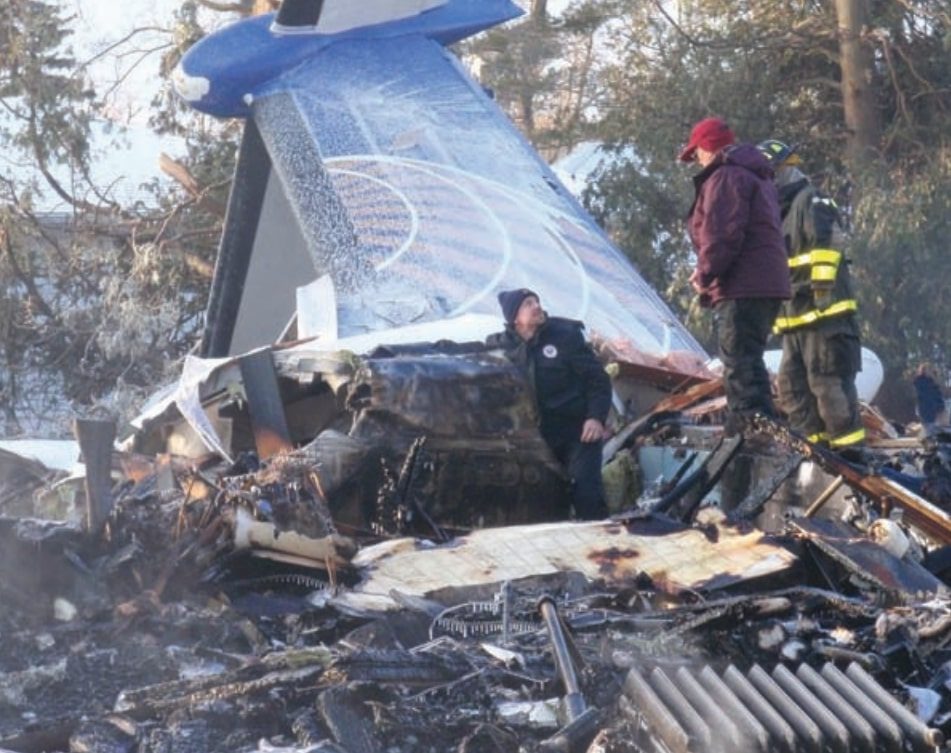
On 12 February 2009, at about 22:17 local time (EST), a Bombardier DHC-8-400 (Q400) registered N200WQ, operated by Colgan Air as Continental Connection flight 3407, crashed into a house in Clarence Center, New York, about 5 NM north-east of Buffalo-Niagara International Airport. The 2 pilots, 2 flight attendants and 45 passengers were killed, as was one person in the house. The aeroplane was destroyed by the impact and a post-crash fire.
The approach was flown at night in visual conditions, with light to moderate icing reported in the area. Nothing was wrong with the aeroplane. As it slowed on the ILS approach to runway 23, neither pilot responded to the airspeed falling towards the low-speed cue until the stick shaker activated. The captain pulled back, the wing stalled, and he pulled against the stick pusher three times. The cockpit voice recording ended at about 22:16:54, less than half a minute after the first stick shaker.
The NTSB investigation examined far more than the final half-minute: monitoring and sterile cockpit discipline, commuting and fatigue, a captain's training history, stall and stick pusher training, and how airspeeds are set in icing conditions.
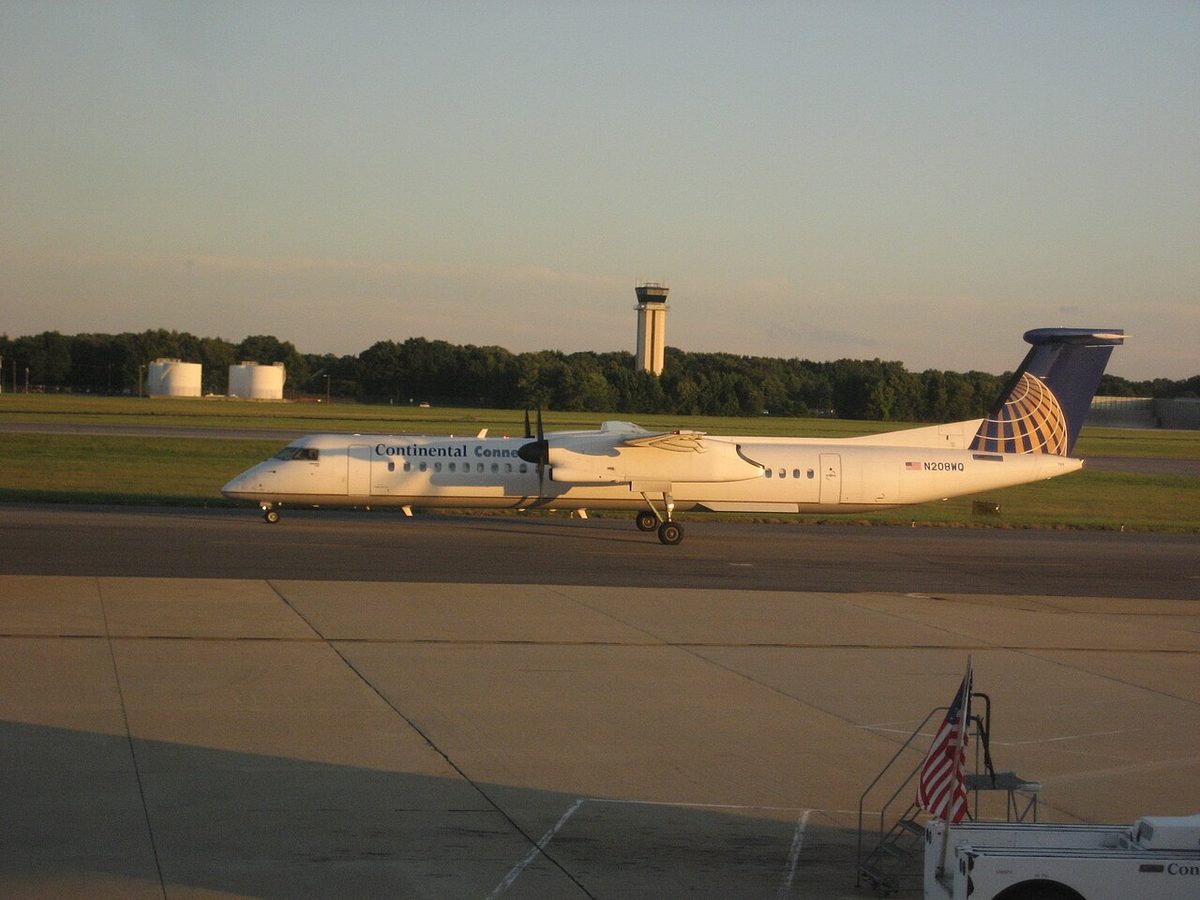
The flight
Both pilots were based at Newark (EWR). The captain commuted from the Tampa area and the first officer from near Seattle; she flew overnight via Memphis and arrived at Newark at 06:23 on the day of the accident. Both were seen in the company crew room before their 13:30 report time. Their first two flights of the day were cancelled because of high winds at Newark.
| Pilot | Age | Total hours | Hours on the Q400 |
|---|---|---|---|
| Captain (pilot flying) | 47 | 3,379 | 111 |
| First officer (pilot monitoring) | 24 | 2,244 | 774 |
Flight 3407 was cleared for take-off from Newark at about 21:18. The pilots switched on the airframe and propeller de-ice equipment during the climb, and the captain would also have set the reference speeds switch to its increase (INCR) position. The aeroplane reached its cruising altitude of 16,000 ft at 21:34 with the autopilot engaged. The cruise was uneventful.
At 21:53 the first officer briefed the landing speeds for flaps 15: a reference speed (VREF) of 118 kt and a go-around speed of 114 kt. These came from Colgan's automated performance system, AeroData. Had the crew entered the keyword "icing" in the request, AeroData would have returned a VREF of 138 kt, including a 20 kt icing increment. The captain did not challenge the speeds.
The aeroplane descended through 10,000 ft at 22:06, the point below which the sterile cockpit rule prohibits conversation not related to the flight. At 22:10 the pilots discussed the ice on the windscreen and the leading edges, then began a conversation unrelated to their duties that continued alongside flight-related tasks during the descent. The first officer said that before her initial operating experience with Colgan she had never seen icing conditions or been de-iced.
The accident
The aeroplane levelled at 2,300 ft at about 22:14:30, at about 180 kt, with the autopilot in altitude hold. At 22:15:14 the controller cleared the flight for the ILS approach to runway 23, 3 miles from the outer marker. The aeroplane was at 184 kt, 46 kt above Colgan's maximum approach speed on the glideslope, so the captain had to slow down quickly. Flaps 5 had been selected at 22:15:06; at about 22:16:00 the power levers were reduced to near flight idle, then the landing gear was lowered and the propellers were set to maximum rpm.
With the power at idle and the autopilot holding altitude, the speed decayed and the autopilot trimmed nose-up to keep the aeroplane level. From 22:16:09 the red and black low-speed cue rose on the airspeed displays for 18 seconds; the pitch trim went from 1° to 7° nose-up and the pitch attitude from 3° to 9°. Neither pilot commented.
| Time (EST) | Event |
|---|---|
| 22:16:21 | First officer: gear down; airspeed about 145 kt; "ice detected" message; captain calls flaps 15 and the before landing checklist |
| 22:16:27.4 | Stick shaker; autopilot disconnects at 131 kt |
| 22:16:27.8 | Control column moves aft; power levers advanced to about 70° a second later |
| about 22:16:34 | First stick pusher activation; flaps 0 selected |
| about 22:16:40 | Second stick pusher activation; roll had reached 105° right |
| about 22:16:50 | Third stick pusher activation; steep descent, about 25° nose-down |
| about 22:16:54 | End of the cockpit voice recording |
The stick shaker activated at an angle of attack of about 8°, at 1 g and 131 kt. The aeroplane was not close to stalling. Because the ref speeds switch was in the increase position, the shaker came about 15 kt earlier than it would for a clean aeroplane; instead of the usual 5 to 7 kt of warning, the crew had 20 to 22 kt.
The captain responded with a 37 lb pull on the control column and added power. The angle of attack rose to 13°, the pitch attitude to about 18° and the load factor to about 1.4 g, while the speed fell to 125 kt. The pull raised the stalling speed and consumed the stall warning margin: the wing stalled at a speed far above the 1 g stall speed, which the NTSB estimated at 107 kt for the flap setting and weight. The aeroplane rolled 45° left wing down, then back to the right.
The stick pusher, which pushes the column forward once the aeroplane has stalled, activated three times. Each time the captain pulled against it, with forces of 41, 90 and 160 lb. As the first pusher activated the first officer retracted the flaps, and she later asked whether to raise the landing gear. The roll reached 105° right wing down, then about 35° left and 100° right. The aeroplane entered a steep descent, about 25° nose-down, and struck a single-family house. A severed natural gas service line at the house added to the post-crash fire.
The investigation
The NTSB found no pre-impact failure of the structure, engines or systems, and no problem with the ice protection system. Air traffic controllers had handled the flight properly. The accident was not survivable.
Icing and the stall
Performance simulations showed that the ice on the aeroplane had caused only minimal degradation. The wing stalled at an angle of attack about 1° above the stick shaker angle for a clean wing, and with appropriate pitch inputs the aeroplane could have held altitude or a steady pitch attitude. The NTSB concluded that ice did not affect the crew's ability to fly and control the aeroplane. The stall was caused by the captain's aft column inputs.
The ref speeds switch and the missed cues
On the Q400, the ref speeds switch set to INCR lowers the angle of attack at which the stick shaker activates, so that the aeroplane keeps the same margin above the stall in icing conditions as a clean aeroplane. Pilots must fly correspondingly higher approach speeds, between 15 and 25 kt higher depending on the flap setting. The switch does not change the pusher threshold. In a simulator demonstration with flaps and gear up, the shaker activated at 125 kt with the switch off and at 142 kt with it set to INCR.
The crew had set the non-icing VREF of 118 kt while the switch was in INCR. The airspeed was below the minimum icing approach speed for about 8 seconds before the stick shaker. The NTSB found that explicit cues were displayed in time for the crew to act: the shrinking margin between the airspeed and the low-speed cue, the trend vector pointing into the cue, the airspeed digits changing colour, and the excessive nose-up attitude. It also found that the Q400 display lacked an amber caution band above the low-speed cue, and that an aural alert before the stick shaker might have prompted a response.
The response to the stick shaker
The NTSB found that the captain's response "should have been automatic" but was "consistent with startle and confusion". He did not recognise the pusher's nose-down action as part of the recovery. The first officer's retraction of the flaps and her suggestion to raise the gear were inconsistent with Colgan's stall recovery procedures and training.
Colgan's winter training included a NASA icing video that described tailplane stall. The NTSB found no evidence that the Q400 was susceptible to tailplane stall and judged it unlikely that the captain was deliberately flying a tailplane stall recovery, but it warned that the video could lead pilots to assume such a stall was possible on the Q400. A check airman told investigators that about 75 % of pilots shown the pusher in the simulator tried to override it, and pusher training had not been consistently provided.
Monitoring, professionalism and fatigue
The NTSB found that the captain's management of the flight allowed conversation that delayed checklists and breached the sterile cockpit rule, and created an environment that impeded error detection. Both pilots had spent their last rest period in the crew room, which the NTSB judged an inappropriate facility. It concluded that their performance was "likely impaired because of fatigue", although the extent could not be determined, and that Colgan had not addressed the fatigue risks of a base where most pilots commuted. Fatigue is not among the contributing factors: in a concurring statement appended to the report, the NTSB Chairman explained that she had proposed adding it as a fifth contributing factor and that the Board rejected the amendment 2 to 1.
The captain had received several FAA notices of disapproval on earlier flight checks. The NTSB found that his weaknesses in basic aircraft control and instrument flying had not been identified and adequately addressed, and that Colgan's electronic training records did not contain enough detail to reveal the trend.
Probable cause and contributing factors
The NTSB determined that the probable cause of the accident was "the captain's inappropriate response to the activation of the stick shaker, which led to an aerodynamic stall from which the airplane did not recover."
Contributing to the accident were:
- the flight crew's failure to monitor airspeed in relation to the rising position of the low-speed cue;
- the flight crew's failure to adhere to sterile cockpit procedures;
- the captain's failure to effectively manage the flight;
- Colgan Air's inadequate procedures for airspeed selection and management during approaches in icing conditions.
Safety recommendations and what changed
The NTSB issued 25 new safety recommendations to the FAA, A-10-10 to A-10-34. Among them:
- Low-speed awareness: an amber caution band above the low-speed cue on electronic airspeed displays (A-10-11) and low-airspeed alert systems with aural and visual warnings on aeroplanes in commercial service (A-10-12).
- Stall training: training with stalls that are fully developed, unexpected, involve autopilot disengagement and include aeroplane-specific features such as a ref speeds switch (A-10-22); stick pusher familiarisation in the simulator (A-10-23); and simulator models that support recovery from fully developed stalls (A-10-24).
- Reference speeds: procedures and training to keep approach speed bugs matched to the ref speeds switch (A-10-21).
- Tailplane stall: identification of the types that are susceptible, and removal of tailplane stall recovery guidance for those that are not (A-10-25).
- Crew performance: monitoring techniques in operators' procedures (A-10-10), leadership training for upgrading captains (A-10-13, -14), professionalism and sterile cockpit guidance (A-10-15), and guidance prohibiting personal portable electronic devices on the flight deck (A-10-30).
- Fatigue and records: mitigation of fatigue risks for commuting pilots (A-10-16), and detailed pilot training records shared with hiring carriers (A-10-17 to -20).
- Oversight and data: closer FAA surveillance of fast-growing operators (A-10-26) and flight operational quality assurance programmes (A-10-27 to -29).
After the accident Colgan added a ref speeds switch callout to its approach checklist, prohibited changing the switch position below 1,000 ft above ground level, briefed its Q400 pilots on setting speed bugs in icing, and introduced stick pusher familiarisation training for its fleets. It also raised its hiring minimums to 1,000 hours total time and 100 hours multi-engine. In June 2009 the Secretary of Transportation and the FAA Administrator launched a Call to Action on Airline Safety and Pilot Training.
Lessons for pilots
A stick shaker demands a reduction in angle of attack. The shaker came with a margin of 20 to 22 kt; the aeroplane was flying. In the NTSB's simulator observations, recoveries from the shaker needed only forward column pressure and nose-down trim, without large or dynamic inputs. Pulling back raised the load factor and the stall speed together, and turned a warning into a stall. See stall.
Exam tip: Stall speed rises with the square root of the load factor, so a pull to about 1.4 g raises it by roughly 18 %. That is why the wing stalled at about 125 kt although its 1 g stall speed was about 107 kt: a stall is always an angle of attack, never a speed.
Let the pusher work. On the Q400 the pusher acts only once the wing has stalled. Its nose-down push is the recovery, not a fault to be overridden. On a pusher-equipped type, know how the pusher feels and how the aeroplane responds before you meet it for real.
Know what your ice protection selections do to your speeds. The ref speeds switch moved the stall warning to protect an iced wing; the speed bugs had to move with it. Any mismatch between configuration, selected protection and target speeds is an early stall warning waiting to happen. Distinguish a wing stall from a tailplane stall: their recoveries are opposite, and the NTSB found no evidence that the Q400 was susceptible to the second.
Warning: In altitude hold with the power at idle, the autopilot kept trimming nose-up as the speed decayed, until the stick shaker disconnected it. A rising nose attitude with low power is itself an airspeed cue.
Monitor, especially in the last minutes. The low-speed cue climbed for 18 seconds and the pitch attitude rose by 6° without comment. Below 10,000 ft, conversation that is not about the flight competes with monitoring. See crew resource management.
Arrive fit to fly. The NTSB was explicit that all pilots, including commuters, are personally responsible for using their rest so that they report fit for duty, and that operators must manage commuting risks. See fatigue.
Note: A stabilised approach includes the correct speed for the configuration and conditions. Check VREF against icing, the ref speeds switch and the flap setting before the approach, not after the stick shaker.
The NTSB determined that the probable cause was "the captain's inappropriate response to the activation of the stick shaker, which led to an aerodynamic stall from which the airplane did not recover." Contributing factors were the crew's failure to monitor airspeed against the rising low-speed cue, their failure to adhere to sterile cockpit procedures, the captain's failure to manage the flight effectively, and Colgan Air's inadequate procedures for airspeed selection and management during approaches in icing conditions.
Train this on v1prep
The theory behind this accident and the questions that test it, each with a worked explanation.
Question banks
- ATPL Principles of Flight488 questions with worked explanations
- ATPL Human Factors494 questions with worked explanations
- ATPL Meteorology518 questions with worked explanations
In the Library
- StallWhat happens at the critical angle of attack, how stall speed changes with weight, load factor and power, stall warning and wing drop, and how to recover.
- Airframe IcingHow supercooled water and freezing precipitation form ice on aircraft, the types and intensities of icing, frost, SLD and ice-crystal icing, and the products that forecast it.
- Crew Resource Management (CRM)Covers the aims and skills of CRM, crew coordination and cross-monitoring, group decision-making pitfalls, debriefing, and single-pilot resource management.
- FatigueDefines pilot fatigue and its causes and effects, and covers controlled rest, fatigue reporting and fatigue risk management systems.
Frequently asked questions
What caused the Colgan Air 3407 crash?
The NTSB determined that the probable cause was the captain's inappropriate response to the stick shaker, which led to an aerodynamic stall from which the aeroplane did not recover. The captain pulled the control column back instead of lowering the nose. Contributing factors were the crew's failure to monitor airspeed against the rising low-speed cue, their failure to adhere to sterile cockpit procedures, the captain's failure to manage the flight effectively and Colgan's inadequate procedures for airspeed selection in icing conditions.
Did ice cause the Colgan Air 3407 crash?
No. The NTSB found that some ice was likely on the aeroplane but that the resulting performance degradation was minimal and did not affect the crew's ability to fly and control it. The wing stalled at an angle of attack only about 1 degree above the clean-wing stall warning angle, after the captain pulled back in response to the stick shaker.
What was the ref speeds switch on the Colgan Q400?
The Q400 reference speeds switch, set to INCR for icing conditions, makes the stick shaker activate at a lower angle of attack and raised the low-speed cue on the accident aeroplane by about 15 knots. The switch was in the increase position, but the crew had set a reference speed of 118 knots instead of the 138 knots used in icing, so the shaker activated at 131 knots, well above the stall.
What did the pilots do when the stick pusher activated?
The Q400 stick pusher pushes the column forward to reduce the angle of attack after a stall. It activated three times. Each time the captain pulled against it, with pull forces of 41, 90 and 160 pounds. The NTSB found that he did not recognise the pusher as a proper step in stall recovery and that overriding it made the situation worse. The first officer retracted the flaps.
What changed after the Colgan Air 3407 accident?
The NTSB made 25 new recommendations to the FAA, including low-airspeed alerts, stall training with fully developed and unexpected stalls, stick pusher familiarisation, better simulator stall models, leadership training for upgrading captains, fatigue measures for commuting pilots, fuller training records and flight data monitoring programmes. Colgan changed its reference speed procedures and added stick pusher training, and the FAA launched a Call to Action on airline safety and pilot training.
Sources and further reading
Crash Investigations pages summarise official investigation reports for study and exam preparation. The investigating body's report is the authoritative account and prevails wherever it differs from this page. Under ICAO Annex 13, an investigation exists to prevent accidents, not to apportion blame or liability.