Crew Resource Management (CRM)
Crew resource management (CRM) is the effective use by a flight crew of all the resources available to it, including people, equipment, procedures and information, to operate safely and efficiently. It covers the cognitive and interpersonal skills, known as non-technical skills, that complement handling and systems knowledge.
Crew resource management (CRM) is the use of every resource available to a flight crew, including the other pilot, cabin crew, air traffic control, maintenance and dispatch, automation, procedures and information, to conduct a flight safely and efficiently. It deals with the thinking and interpersonal skills needed to manage a flight as a team rather than the knowledge needed to fly the aeroplane, although the two are trained and assessed together.
CRM grew out of accident investigations in the 1970s that kept finding serviceable aircraft and competent pilots in crews that failed to use what they collectively knew. It is now required for commercial crews by EASA and the FAA, is examined in the EASA Human Performance and Limitations (040) syllabus and in FAA knowledge tests, and underpins threat and error management.
- Origins and aims of CRM
- Regulation and training
- Non-technical skills and airmanship
- Crew coordination and synergy
- Cognitive and temporal synchronisation
- Cross-monitoring and assertiveness
- Group decision-making, groupthink and risky shift
- Conflict resolution
- Debriefing and self-critique
- Single-pilot resource management
- Frequently asked questions
Origins and aims of CRM
On 27 March 1977 two Boeing 747s collided on a fog-bound runway at Tenerife, killing 583 people. The KLM captain began the take-off without a take-off clearance; the flight engineer asked whether the Pan Am aircraft was clear of the runway, and the captain emphatically said it was. On 28 December 1978 United Airlines Flight 173, a DC-8, held near Portland, Oregon, for about an hour while the crew dealt with a landing gear indication, and ran out of fuel; ten people died. The first officer and flight engineer mentioned the fuel state but never pressed the point. The NTSB asked the FAA to urge airlines to train captains in participative management and other crew members in assertiveness.
In 1979 a NASA workshop, Resource Management on the Flightdeck, brought together research showing that most accidents involved failures of communication, decision making and leadership rather than of stick-and-rudder skill. The term cockpit resource management dates from it, and United Airlines began one of the first comprehensive airline programmes in 1981.
Robert Helmreich and colleagues later described CRM in generations. The first, in the early 1980s, focused on the captain's managerial style. The second renamed it crew resource management and taught team skills, briefings and situation awareness. The third widened it to cabin crew, dispatchers, maintenance and organisational culture. The fourth built CRM into procedures, checklists and proficiency training, and the fifth reframed it as error management: errors are inevitable, so crews are trained to avoid, trap and mitigate them. Threat and error management is often called the sixth generation. Throughout, the aim has never been to flatten the command structure; the captain keeps final authority.
Regulation and training
Under EASA, ORO.FC.115 requires every flight crew member to complete CRM training appropriate to the role, with CRM elements built into type or class, recurrent and command training. ORO.FC.215 adds an initial operator's CRM course before unsupervised line flying in commercial air transport, delivered by a qualified CRM trainer. The AMC lists the topics, among them human error and reliability, safety culture and SOPs, stress, fatigue, situation awareness and workload, decision making, communication, leadership and team behaviour, automation, surprise and startle, resilience and cultural differences.
In the United States, 14 CFR 121.404 requires approved CRM training for Part 121 pilots and flight attendants and dispatcher resource management for dispatchers, and 135.330 extends CRM to Part 135. Advisory Circular 120-51E describes three phases: initial awareness, recurrent practice and feedback, and continuing reinforcement. The Advanced Qualification Program (AQP) integrates CRM into proficiency-based training and line operational evaluation.
Line-Oriented Flight Training (LOFT) is a full-mission simulator session flown in real time, from briefing to shutdown, with realistic threats, in which the instructor does not intervene; the crew then reviews its own performance, often from video. A Line Operations Safety Audit (LOSA) places trained observers on the jump seat of normal flights, under non-jeopardy conditions, to record threats, errors and crew responses.
Non-technical skills and airmanship
Non-technical skills (NTS) are the cognitive and social skills that complement technical proficiency. Europe assesses them with NOTECHS, developed in the late 1990s for the JAA, which groups them into four categories of observable behaviour:
| Category | Elements |
|---|---|
| Co-operation | Team building and maintaining, considering others, supporting others, conflict solving |
| Leadership and managerial skills | Use of authority and assertiveness, maintaining standards, planning and co-ordination, workload management |
| Situation awareness | Awareness of aircraft systems, of the external environment and of time |
| Decision making | Problem definition and diagnosis, option generation, risk assessment and option choice, outcome review |
The NASA team skills, behavioural markers from the NASA and University of Texas crew performance research, cover similar ground: briefing, inquiry, advocacy and assertion, communications and decisions, leadership and followership, workload distribution, preparation, planning and vigilance, and crew self-critique. Evidence-based training, following ICAO Doc 9995, assesses competencies including communication, leadership and teamwork, problem solving and decision making, situation awareness and workload management alongside procedures and flight path management.

Airmanship is the older, individual counterpart of CRM: sound knowledge of the aeroplane and the principles of flight, precise handling, and consistently good judgement and discipline. A pilot with excellent handling but poor judgement lacks airmanship, whatever the logbook says.
Crew coordination and synergy
Teamwork works when objectives are clear and shared, members trust and support each other, communication is open, and disagreement is aired and worked through. Crew synergy is the result: the crew performs better than the sum of its members, often written 1 + 1 > 2. Poor coordination produces the opposite, 1 + 1 < 2, where two able pilots do worse together than either would alone.
Human performance texts for the EASA syllabus distinguish three crew coordination types. Redundant actions are duplications, such as both pilots reaching for the same control. Coaction is parallel work towards a common goal by people who act largely independently, typical of flight crew and cabin crew. Collaboration, or general co-operation, consists of different but complementary actions by the two pilots and depends on constant communication.
Group cohesion, the sum of the forces that bind a crew together, helps under stress but becomes a hazard when it silences doubt. The cockpit authority gradient, a term traced to Elwyn Edwards, describes the balance of authority between captain and first officer. Too steep, in an autocratic cockpit, and the first officer stops speaking up; too flat, in a laissez-faire cockpit, and nobody leads. The ideal is the synergistic cockpit, in which the captain leads, invites contribution and still decides.
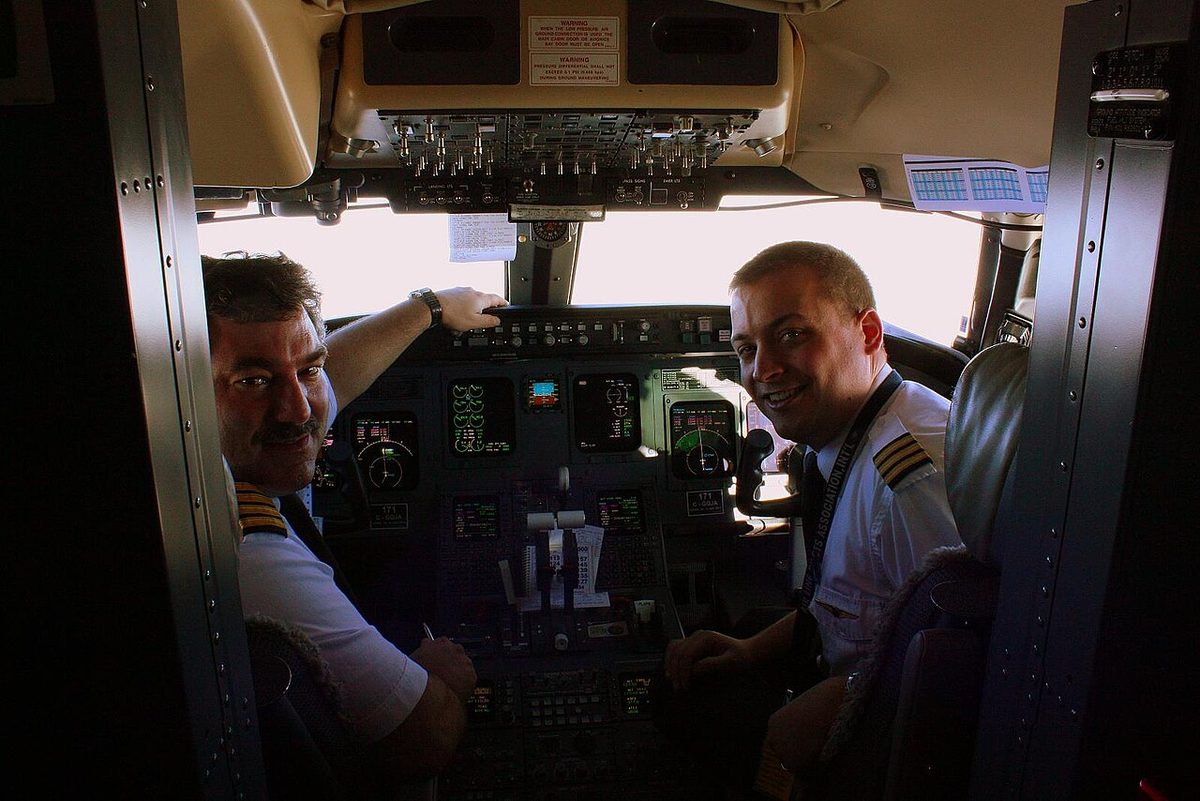
United Airlines Flight 232 shows synergy at its best. On 19 July 1989 the uncontained failure of a fan disc in the tail-mounted engine of a DC-10 severed the lines of all three hydraulic systems. The crew, joined by a DC-10 training captain travelling as a passenger, steered by varying the thrust of the two wing engines and crash-landed at Sioux City; most of those on board survived. The NTSB praised the crew's performance, and the captain credited the airline's CRM training.
Cognitive and temporal synchronisation
Cognitive synchronisation keeps both pilots working from the same mental picture. Briefings, checklists and standard callouts build it; a briefing works when it is short, specific to the flight and understood by everyone, and when it highlights where the crew will need to co-operate. Temporal synchronisation makes actions happen at the right moment and in the right order: simultaneous actions on a command, or one drill waiting until a safe height is reached. Standard callouts, closed-loop communication and the sterile flight deck rule (in the FAA's 14 CFR 121.542, no non-essential activity during taxi, take-off, landing and flight below 10,000 ft except cruise) protect both.
Cross-monitoring and assertiveness
Cross-monitoring is the continuous check each pilot keeps on the other's actions and on the flight path. The pilot flying flies; the pilot monitoring watches, calls deviations and handles radio and configuration. Under most airline SOPs either pilot may call a go-around and the pilot flying complies.
Monitoring works only if concerns are voiced. Graded assertiveness models such as PACE (probe, alert, challenge, emergency) escalate from a question to a direct statement and, finally, to action; the two-challenge rule tells a pilot whose two challenges go unanswered to assume incapacitation and take control. Air Florida Flight 90 shows the cost of weak challenge. On 13 January 1982 the Boeing 737 took off from Washington National in snow with ice on the wings and engine anti-ice off, so iced probes gave false high thrust readings. The first officer remarked several times that the indications did not look right, but the take-off continued; the aircraft struck a bridge and fell into the Potomac, killing 78 people, four of them on the bridge.
Group decision-making, groupthink and risky shift
Group decision making usually beats the average individual because it pools information, provided the group treats differences of opinion as useful and decides on facts rather than by majority vote. Structured models such as FOR-DEC (facts, options, risks and benefits, decision, execution, check) help; for non-urgent decisions the captain should hear the crew's views before giving his or her own.
Groupthink, described by Irving Janis, is the tendency of a cohesive group to seek agreement at the cost of critical thought: an illusion of invulnerability and unanimity, self-censorship and pressure on dissenters. Risky shift is the finding that groups often choose riskier courses than their members would alone. One cause is diffusion of responsibility, since no individual feels that the outcome is theirs; another is that bold members tend to dominate discussion. Role conflict arises when a person's roles pull different ways, for example a senior training captain rostered as first officer, or a manager whose company role colours his or her judgement as commander.
Conflict resolution
Conflict resolution on the flight deck starts from "what is right, not who is right". Negotiation, trading concessions, belongs on the ground; in flight the commander acts as arbiter, makes the decision and explains the reasons, after landing if there is no time before. Tone of voice and body language, sometimes called metacommunication, can defuse a disagreement, and asking for feedback confirms that a message has been understood.
Exam tip: in EASA human performance questions, coaction means parallel, largely independent work towards a shared goal; risky shift is driven by diffusion of responsibility; and in flight the commander arbitrates rather than negotiates.
Debriefing and self-critique
A crew debriefing turns experience into learning. An effective debriefing covers what went well as well as what did not, focuses on issues rather than people, and considers why, what, how and when to raise each point. Feedback (crew self-critique), one of the NASA team skills, is given tactfully and received without defensiveness. A post-flight debrief at a quiet moment after landing works better than critique while the crew is busy. After LOFT an instructor facilitates, letting the crew identify its own strengths and weaknesses.
Single-pilot resource management
Single-Pilot Resource Management (SRM) is the FAA's adaptation of CRM for aircraft flown by one pilot. The Pilot's Handbook of Aeronautical Knowledge groups it into aeronautical decision making, risk management, task management, automation management, controlled flight into terrain awareness and situational awareness. Without a second pilot to cross-check, the single pilot uses ATC, flight service, the avionics and briefed passengers as resources, and tools such as the PAVE checklist and the 5P check (plan, plane, pilot, passengers, programming). EASA covers single-pilot operations within its CRM training rules, adapted to the absence of a second crew member. See also situational awareness, human error and fatigue.
Frequently asked questions
What is crew resource management in aviation?
Crew resource management is the use of every resource a crew has, including the other pilot, cabin crew, air traffic control, procedures, automation and information, to run a flight safely. It trains non-technical skills such as communication, leadership, teamwork, situation awareness and decision making. It does not remove the captain's authority; it aims to make sure the captain decides with the best information the whole crew can provide.
Why was CRM introduced?
Investigators in the 1970s found that many accidents happened to serviceable aircraft flown by competent pilots whose crews failed to communicate, challenge or manage workload. Tenerife in 1977 and the fuel exhaustion of United Airlines Flight 173 near Portland in 1978 were landmark cases. A NASA workshop in 1979, Resource Management on the Flightdeck, launched cockpit resource management training, later renamed crew resource management.
What are the four NOTECHS categories?
NOTECHS, the European framework for assessing pilots' non-technical skills, has four categories. Co-operation and leadership and managerial skills are social skills; situation awareness and decision making are cognitive skills. Each category is broken down into observable elements, such as conflict solving, workload management, awareness of time and option generation, so that an examiner can rate behaviour rather than personality.
What is the difference between groupthink and risky shift?
Groupthink is the tendency of a close-knit group to value agreement so highly that doubts are not voiced and warning signs are rationalised away. Risky shift is the finding that a group often settles on a riskier course than its members would choose alone, partly because responsibility is shared and partly because bold members tend to dominate discussion. Both are countered by inviting dissent and deciding on facts.
What is the two-challenge rule?
The two-challenge rule says that if a pilot fails to respond to two clear challenges about a significant deviation, such as a flight path or speed error, the other pilot should assume incapacitation, subtle or otherwise, and take control. It sits at the top of graded assertiveness models such as PACE, which escalate from a probing question through an alert and a direct challenge to taking action.
What is single-pilot resource management?
Single-pilot resource management (SRM) is the FAA's adaptation of CRM to aircraft flown by one pilot. It covers aeronautical decision making, risk management, task management, automation management, awareness of controlled flight into terrain, and situational awareness. The pilot uses ATC, flight service, avionics and briefed passengers as resources, and tools such as the 5P check keep the plan under review.
Test yourself on Crew Resource Management (CRM)
The v1prep banks cover this topic in Human Performance and Limitations (040), with a worked explanation for every answer. EASA ATPL, PPL, IR and CPL, the FAA written tests and A320/B737 type ratings.
Start practising →Sources and further reading
- FAA Advisory Circular 120-51E, Crew Resource Management Training
- EASA Easy Access Rules for Air Operations (ORO.FC.115, ORO.FC.215 and AMC)
- 14 CFR 121.404, Compliance dates, crew and dispatcher resource management training
- SKYbrary, Crew Resource Management (CRM)
- NTSB AAR-79-07, United Airlines Flight 173, Portland, Oregon, 28 December 1978
- NTSB AAR-82-08, Air Florida Flight 90, Washington National Airport, 13 January 1982
- NTSB AAR-90-06, United Airlines Flight 232, Sioux City, Iowa, 19 July 1989
- FAA Pilot's Handbook of Aeronautical Knowledge, Chapter 2, Aeronautical Decision-Making
Library articles are written for study and exam preparation. They do not replace your aircraft's approved documentation, your operator's procedures or the regulations themselves.