Forced Landing and Ditching
A forced landing is an immediate landing, on or off an aerodrome, made because the aircraft cannot continue flying; a precautionary landing is a planned landing made while flight is still possible but unwise. A ditching is either kind of landing on water.
An engine may stop over open country, weather may close in with no aerodrome in reach, or a fire may make any landing better than staying airborne. An emergency landing off an aerodrome, on land or on water, is then the pilot's last means of bringing everyone home. Its outcome depends above all on the aircraft arriving under control, at the lowest safe speed, on the best surface within reach.
The skills are taught early in PPL training, practised as the practice forced landing (PFL), and revisited in airline training for ditching. The rules around them decide what equipment is carried over water and where single-engine aeroplanes may fly at all.
- Forced, precautionary and emergency landings
- After an engine failure: glide, checks and the call
- Selecting a forced landing area
- Flying the approach and landing
- The impossible turn
- Precautionary landing
- Ditching technique
- Over-water operations requirements
- Life jackets, life rafts and survival equipment
- Frequently asked questions
Forced, precautionary and emergency landings
FAA training material divides emergency landings into three kinds:
- a forced landing is an immediate landing, on or off an aerodrome, made because the aircraft cannot continue flying, as after an engine failure;
- a precautionary landing is a planned landing, on or off an aerodrome, made while flight is still possible but inadvisable, for example because of deteriorating weather, being lost, fuel running short or gradually developing engine trouble;
- a ditching is a forced or precautionary landing on water.
ICAO Annex 6 and the EASA air operations rules define a safe forced landing as "an unavoidable landing or ditching with a reasonable expectancy of no injuries to persons in the aircraft or on the surface". It sets the standard for single-engine commercial flying. A single-engine aeroplane has no way of continuing after a power loss, so it may carry passengers commercially only in weather, light and over routes that allow a safe forced landing; the route must stay within reach of a safe forced landing area, such as an aerodrome, a suitable airstrip or open ground on which a survivable emergency landing can be made. Mountains, forests, towns and large expanses of water do not qualify. Extending such operations into night or instrument conditions needs a specific approval.
After an engine failure: glide, checks and the call
The first action is to hold the best glide speed, the speed for the best lift/drag ratio, which gives the greatest distance in still air. A typical light single glides at about 9:1 to 12:1, roughly 1.5 to 2 NM for every 1,000 ft of height. Three corrections apply:
- Mass. A lighter aeroplane glides the same distance but at a lower speed, so the published speed for maximum mass is reduced slightly when light.
- Wind. Into a strong headwind, glide somewhat faster than the still-air speed to reach further over the ground; with a tailwind, slightly slower.
- Propeller. A windmilling propeller causes a great deal of drag. A stopped propeller causes much less, and on a variable-pitch propeller selecting fully coarse reduces the drag and extends the glide.
If time allows, the flow checks the likely causes of the failure, typically the fuel selector and pump, mixture, carburettor heat and magnetos (see carburettor icing explained). An engine failure with a forced landing imminent is distress: a MAYDAY on the frequency in use, or on 121.5 MHz if there is no reply, and squawk 7700 (see distress and urgency communications).

Selecting a forced landing area
The best field is the one the pilot can reach with height to spare and land in under control. The factors are:
- wind, to land into it and shorten the ground roll;
- size and slope, enough length for the ground roll, ideally level or uphill;
- surface: firm grass or stubble is good, ploughed ground is soft and can flip the aircraft, and furrows should be followed, not crossed;
- obstacles on the approach and in the field: wires, trees, buildings, livestock;
- roads, which look inviting but carry wires, poles, signs and traffic.
The pilot chooses early, from high, and then commits. Changing fields low down invites a stall or an undershoot.
Flying the approach and landing
The approach is planned to arrive with height in hand, which can be lost with flap or a sideslip; height that is missing cannot be recovered. Before touchdown the aircraft is secured to reduce the risk of fire: fuel off, mixture to idle cut-off, magnetos off, and the master switch off once any electric flaps are set. Harnesses are tightened and doors unlatched, because the impact can distort the fuselage and jam a latched door.
The touchdown is made in the normal landing attitude at the slowest controllable speed, into wind if possible. On land, retractable gear is normally lowered unless the flight manual says otherwise; it absorbs energy and protects the cabin. At night, the pilot turns towards an aerodrome or away from built-up areas and switches on the landing light in time to see the ground.
The impossible turn
After an engine failure after take-off, the instinct is to turn back to the runway. This impossible turn has killed many pilots. At low height it needs a steep turn, 50° or more of bank, at low speed: the load factor raises the stalling speed, by about 25 per cent at 50° of bank, the sink rate is high, and the return leg is usually flown downwind. The aircraft must also turn well over 180° to line up with the runway it has left. Figures of 800 to 1,000 ft above the ground are commonly quoted as the minimum for many light aeroplanes to get back.
The defence is a decision made before take-off. Pilots brief themselves on a height below which they will lower the nose at once and land ahead, or within about 30° either side, and above which other options may be considered. The height is type-specific and should be set conservatively.
Precautionary landing
A precautionary landing is a choice, not a failure: continuing with a problem until it becomes a forced landing is the real mistake. With power available the pilot has time to do it well. The field is chosen as for a forced landing, then inspected from low passes along its length at a safe speed with some flap, looking for wires, slope, surface and obstructions, before a normal approach and short-field landing. Once down, the pilot tells ATS or someone who can alert them. A pilot who is unhurt but needs help lays out a V, the ground-air signal for assistance required; an X means medical assistance is required.
Ditching technique
About 88 per cent of ditchings, according to UK and US data quoted in exam material, end with few if any injuries; where people die, it is mostly by drowning afterwards. The technique:
- Heading. Land along the swell, touching down on its crest or back and never into its face, which is like flying into a moving wall. The FAA's AIM notes that, when landing parallel to the swell, it makes little difference whether the touchdown is on the crest or in the trough, although the top or back of the swell is preferred. In a strong wind an into-wind landing becomes the better compromise.
- Configuration. Landing gear up, whatever the aircraft. On many transport aircraft a ditching control closes the outflow valves and other openings so that water enters the cabin more slowly.
- Speed and attitude. Fly the aircraft onto the water at the lowest possible speed, in a tail-low attitude, rather than stalling onto it.
- Cabin. Harnesses tight, loose articles stowed, doors unlatched, brace position before impact. Life jackets are put on before touchdown but inflated only at the exit or outside, because an inflated jacket can trap its wearer against the roof of a flooding cabin. For the same reason a life raft is never inflated inside.
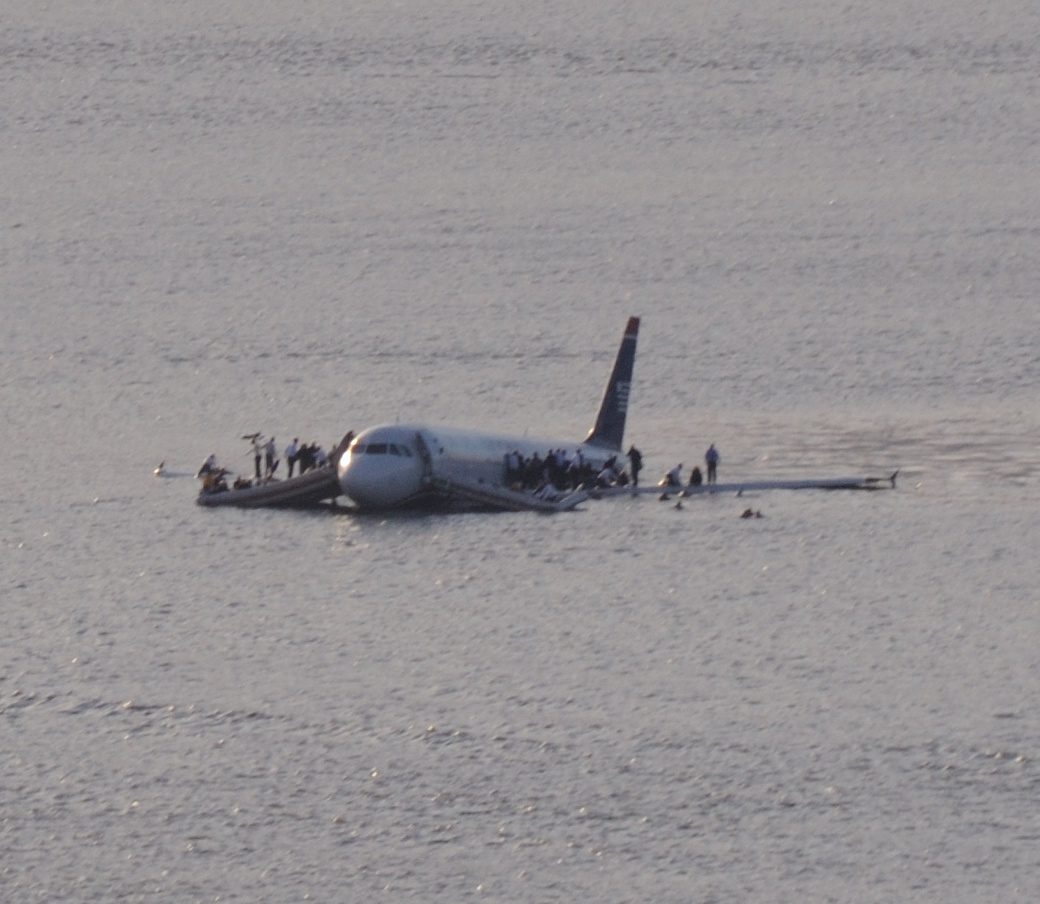
US Airways Flight 1549 remains the reference case: after losing thrust on both engines at about 2,800 ft above the ground on the climb out of LaGuardia, the crew ditched the A320 on the Hudson River, and all 155 on board survived. The engine drills that come before a ditching are covered in engine failure and engine fire.
Over-water operations requirements
Equipment for over-water operations is set by distance from land.
| Rules | Life jackets | Life rafts and survival equipment |
|---|---|---|
| EASA, commercial aeroplanes | More than 50 NM from shore, or where take-off or approach is over water and a ditching is likely; stowed within easy reach of each seat | Beyond 120 min at cruising speed or 400 NM, whichever is less, if the aeroplane can continue with the critical engine inoperative; otherwise beyond 30 min or 100 NM, whichever is less. Rafts for all on board, life-saving equipment and two survival ELTs |
| EASA Part-NCO, light aeroplanes | Single-engine landplane beyond gliding distance from land, and on take-off or approach over water where a ditching is likely | Beyond 30 min at normal cruising speed or 50 NM, whichever is less, from land suitable for an emergency landing: the pilot-in-command assesses the ditching risk and decides on rafts, signalling and life-saving equipment |
| FAA Part 91 | For hire beyond power-off gliding distance: approved flotation for each occupant and a pyrotechnic signalling device; large and turbine multi-engine aeroplanes beyond 50 NM from shore | Large and turbine multi-engine aeroplanes beyond 30 min or 100 NM from shore |
In addition, EASA does not allow commercial aeroplanes with more than 30 passenger seats to fly more than 120 minutes at cruising speed or 400 NM, whichever is less, from land unless they meet the ditching airworthiness requirements. The Part-NCO risk assessment weighs sea state, sea and air temperature, distance from land and the availability of search and rescue.
Life jackets, life rafts and survival equipment
Life jackets are the first layer of protection and must be reachable from the seat. Life rafts keep survivors out of water that may kill by cold long before rescue arrives, and carry overwater survival equipment: signalling devices, first aid and means of sustaining life. Survival equipment for flights over remote land follows the same idea, matched to the terrain and climate: water, shelter and clothing, first aid and signalling.
Being found quickly is the other half of survival. A 406 MHz ELT, or on the smallest aeroplanes under Part-NCO a personal locator beacon, alerts search and rescue through the Cospas-Sarsat satellites (see emergency beacons and search and rescue signals). Red rockets or flares fired at short intervals signal distress to searchers. The survival equipment, life jackets and dinghies carried are declared in Item 19 of the ICAO flight plan so that the rescue coordination centre knows what the survivors have.
Frequently asked questions
What is the difference between a forced landing and a precautionary landing?
A forced landing is made because the aircraft cannot continue flying, typically after an engine failure, so the pilot must land within gliding range wherever a suitable surface exists. A precautionary landing is chosen while the aircraft can still fly, because continuing is unwise: weather closing in, low fuel, a rough engine, a sick passenger or being lost. It is flown with power, so the field can be inspected first.
What is the impossible turn?
The impossible turn is an attempt to turn back to the runway after an engine failure shortly after take-off. It needs a steep turn at low speed, which raises the stalling speed and the sink rate, and much more height than pilots expect, because the aircraft must turn well over 180 degrees to line up. Below a height briefed before take-off, the safe choice is to land ahead or within about 30 degrees either side.
How do you ditch an aircraft?
Land along the swell, on its crest or back and never into its face, unless the wind is strong enough to make an into-wind landing the better compromise. Keep the gear up, fly the aircraft onto the water at the lowest safe speed in a tail-low attitude rather than stalling onto it, unlatch the doors and brace. Put life jackets on before touchdown, but inflate them only when outside the aircraft.
When are life jackets required on a flight over water?
Under EASA rules for commercial aeroplanes, a life jacket for each person is required more than 50 NM from the shore, or where the take-off or approach path lies over water and a ditching is a realistic possibility. For a single-engine landplane under Part-NCO the trigger is flying over water beyond gliding distance from land. The jackets must be stowed within easy reach of each seat.
What percentage of ditchings are survivable?
Figures quoted in exam material, from UK and US data, show that about 88 per cent of ditchings end with few if any injuries to the occupants. When people die in a ditching it is mainly by drowning afterwards, which is why life jackets, rafts, exposure protection and a quick alert to search and rescue matter as much as the touchdown itself.
Test yourself on Forced Landing and Ditching
The v1prep banks cover this topic in Operational Procedures (070), with a worked explanation for every answer. EASA ATPL, PPL, IR and CPL, the FAA written tests and A320/B737 type ratings.
Start practising →Sources and further reading
- FAA Airplane Flying Handbook (FAA-H-8083-3C), Emergency Procedures
- FAA Aeronautical Information Manual, Chapter 6, Section 3, Distress and Urgency Procedures (6-3-3, Ditching Procedures)
- EASA Easy Access Rules for Air Operations (Regulation (EU) No 965/2012), CAT.IDE.A and NCO.IDE.A flight over water and survival equipment
- 14 CFR 91.509, Survival equipment for overwater operations
- 14 CFR 91.205, Powered civil aircraft with standard category U.S. airworthiness certificates, instrument and equipment requirements
- ICAO Annex 6, Operation of Aircraft, Part I, International Commercial Air Transport, Aeroplanes
- NTSB AAR-10/03, Loss of Thrust in Both Engines After Encountering a Flock of Birds and Subsequent Ditching on the Hudson River, US Airways Flight 1549
Library articles are written for study and exam preparation. They do not replace your aircraft's approved documentation, your operator's procedures or the regulations themselves.