British Midland Flight 92 (Kegworth)
- Date
- Phase of flight
- Approach
- Location
- M1 motorway embankment near Kegworth, Leicestershire, on the approach to East Midlands Airport, United Kingdom
- Aircraft
- Boeing 737-400
- Registration
- G-OBME
- Operator
- British Midland Airways
- Flight
- British Midland 92 (BD092)
- Occupants
- 126
- Fatalities
- 4739 passengers died at the scene and 8 later in hospital; all 8 crew members survived; 74 occupants were seriously injured
- Investigating body
- Air Accidents Investigation Branch (United Kingdom)
- Final report
- AAIB Aircraft Accident Report 4/90 (EW/C1095)
- Report date
- Report title
- Report on the accident to Boeing 737-400 G-OBME near Kegworth, Leicestershire on 8 January 1989
On 8 January 1989 a fan blade failed in the left engine of a British Midland Boeing 737-400 climbing from Heathrow towards Belfast. The crew shut down the healthy right engine by mistake; on the approach to East Midlands the damaged engine lost power and the aircraft struck the M1 embankment near Kegworth. 47 passengers died.
On 8 January 1989, British Midland flight BD092, a Boeing 737-400 registered G-OBME, was climbing out of London Heathrow for Belfast when an outer panel of one fan blade broke away in its left (No 1) engine. The crew believed the trouble lay in the right engine and shut it down. The damaged left engine kept running until the final approach, then lost power 2.4 NM short of runway 27 at East Midlands Airport, where the crew were diverting. At 20:24:43 UTC the aircraft struck the ground just east of the M1 motorway and came to rest on the motorway's western embankment near Kegworth, Leicestershire.
Of the 8 crew and 118 passengers, 39 passengers died at the scene and 8 more later in hospital. All the crew survived; 74 of the survivors were seriously injured.
The AAIB report is a detailed study of how a crew can form a wrong diagnosis under stress, receive what looks like confirmation, and then stop questioning it. It also examined engine instrument design, communication between cabin and flight deck, and occupant protection.
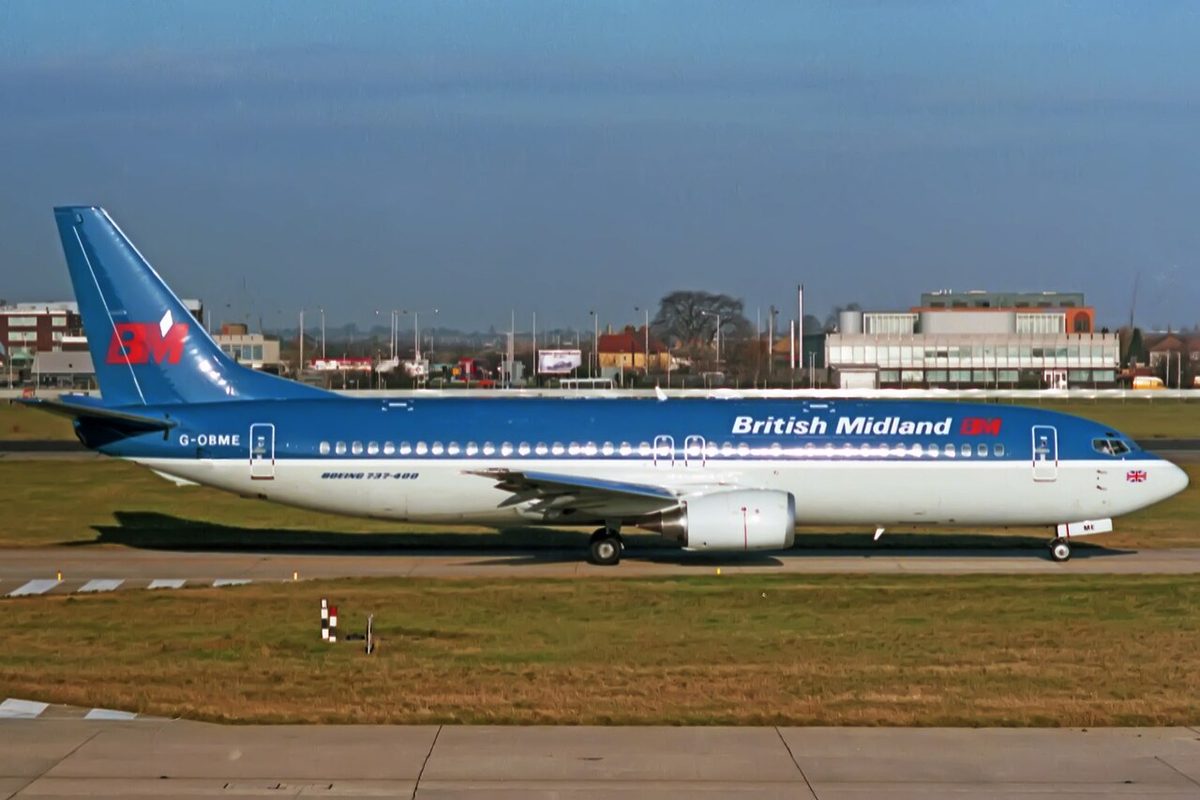
The flight
G-OBME was a new aircraft, with 521 airframe hours; its certificate of airworthiness had been issued on 3 November 1988. It was powered by two CFM56-3C turbofans, rated at 23,500 lb thrust for takeoff. The 737-400 had a new engine instrument system (EIS) that replaced mechanical pointers with light-emitting diode (LED) displays: N1, EGT, N2 and fuel flow on the primary display, and oil pressure, oil temperature, vibration and hydraulic pressure on the smaller secondary display.
The commander had 13,176 hours and had been a captain with the company for 14 years, but only 763 hours on the 737 and 23 hours on the Series 400. The first officer had 3,290 hours, 192 on the 737 and 53 on the Series 400; he had flown jet transports for only 6 months. The aircraft took off from Heathrow at 19:52 with the first officer flying. All times in the report are UTC.
The accident
At 20:05:05, climbing through FL283 about 20 NM south-south-east of East Midlands Airport, the crew felt moderate to severe vibration and smelt burning. There was no fire warning. The flight data recorder showed the No 1 engine's N1 fluctuating between 99 % and 74 % and its EGT rising from 780 °C to 900 °C, with low and fluctuating fuel flow, over about 22 seconds of compressor stalls. The No 2 engine was steady and normal throughout.
| Time (UTC) | Event |
|---|---|
| 20:05:05 | Fan blade failure in No 1 engine at FL283: vibration, shuddering, smell of fire |
| Onset + 19 s | Asked which engine, the first officer says "IT'S THE LE... IT'S THE RIGHT ONE"; commander: "THROTTLE IT BACK"; autothrottle disengaged, No 2 throttled back |
| Onset + 43 s | Commander orders No 2 shut down, then delays: "SEEMS TO BE RUNNING ALRIGHT NOW" |
| Onset + 2 min 7 s | No 2 start lever closed and APU started, about 5 NM south of East Midlands |
| 20:12:28 | Commander begins to review the symptoms; interrupted by ATC |
| 20:17:33 | Approach checklist completed, 15 NM from touchdown, 6,500 ft amsl |
| 20:20:03 | Power increased on No 1 engine at 3,000 ft; its vibration returns to maximum |
| 20:23:49 | Abrupt power loss on No 1 engine, 2.4 NM out at 900 ft agl; relight of No 2 called |
| About 36 s before impact | No 1 engine fire warning; GPWS glideslope warning 7 s later |
| 20:24:33 | "PREPARE FOR CRASH LANDING"; stick shaker 2 s later below 125 kt |
| 20:24:43 | Impact |
Within 1 to 2 seconds of the No 2 throttle being closed, the aircraft rolled level again, the shuddering stopped, and the No 1 engine settled at an N1 3 % below its previous value and an EGT 50 °C higher. Its vibration indicator, however, stayed at maximum. When the No 2 engine was finally shut down, the smell of smoke cleared from the flight deck, which the commander later said convinced him he had acted correctly.
In the cabin, many passengers and the three cabin attendants in the rear saw fire or sparks from the left engine. The commander told the passengers over the public address that the right engine had been shut down; many who had seen the fire were puzzled, but none raised it with the cabin crew, and the three aft cabin attendants said they had not heard the reference to the right engine.
The descent was flown by hand with a high workload: ATC headings, calls to the company, weather, checklists, and two minutes spent by the first officer trying without success to reprogram the flight management system for East Midlands. The commander's attempt to review the symptoms at 20:12 was cut short by ATC and never resumed.
On final approach the No 1 engine lost power. The commander raised the nose to stretch the glide while the first officer tried to restart the No 2 engine, but flight conditions were outside the windmill start envelope, there was probably too little bleed air, and no power was obtained. The aircraft first struck a field in a 13° nose-up attitude at 113 kt, passed through trees and made its second, major impact on the northbound carriageway and western embankment of the M1. It came to rest about 900 m from the runway threshold. The fuselage broke into three main sections.
The investigation
The engine failure
Fan blade No 17 of the No 1 engine had failed in fatigue and its outer panel had detached. The imbalance made the fan and compressor blades rub their abradable seals, which put smoke and a smell of burning into the air conditioning. The released outer panel probably lodged in the acoustic lining of the intake; when power was raised on the approach it was shaken free and ingested, causing extensive secondary fan damage, compressor stalls and a fire outside the fan case, where the prolonged vibration had loosened fuel and oil unions.
The initial conclusion was that the failure was isolated. Then in June 1989 two more CFM56-3C-1 fan blades failed on UK 737-400s climbing at high altitude: a Dan-Air aircraft, G-BNNL, on 9 June, and another British Midland aircraft, G-OBMG, on 11 June. Both crews identified the failed engine correctly, with the help of the vibration indicators. The AAIB found that the -3C-1, rated at higher climb thrust than the earlier -3B-2, had a fan vibration mode excited at high corrected fan speed at altitude, a condition the certification test-bed running had not reproduced. On 12 June 1989 the UK CAA withdrew the type approval of UK-registered 737-400s; an FAA airworthiness directive then required replacement of the fan blades and discs that had run at -3C-1 ratings and restricted engines to -3B-2 ratings.
Why the wrong engine
The EIS was serviceable and would have shown the No 1 engine's large parameter swings. The AAIB found that both pilots acted before they had any positive evidence of which engine was at fault, contrary to their training and the Operations Manual, which required them to evaluate all indications before acting. The first officer could not recall what he had seen on the instruments; he half-formed the word "left" before saying "right", perhaps glancing during a 6-second lull between surges. The commander, handling the aircraft after disengaging the autopilot, later explained his choice by the air conditioning: he thought the smoke came from the cabin, whose air came mostly from the right engine. That reasoning suited aircraft he had flown before, but on the 737-400 some cabin air comes from the left engine. The AAIB thought it more likely that he provisionally accepted the first officer's assessment, believing the first officer had seen positive indications.
The decisive moment was a coincidence. The evidence indicated that disengaging the autothrottle, just before the No 2 throttle was closed and at a moment when it was demanding slightly less thrust, let the damaged No 1 engine recover from its stalls. The noise and shuddering ceased as the crew closed the wrong throttle. The AAIB wrote that it "would have required an exceptional crew to question the association between their action and its apparently obvious, and highly desirable, consequence."
Note: The AAIB judged that throttling back an engine when the instruments give no clear answer is reasonable: power is reduced on each engine in turn to find the one causing the vibration. What followed was the problem: the No 2 engine was shut down with no further analysis, and the No 1 vibration indication went unnoticed.
The instruments
The airborne vibration monitor (AVM) showed maximum vibration, 5 units, on the No 1 engine within about 2 seconds of the failure, and kept showing it for about 3 minutes. Neither pilot noticed. The commander rarely scanned vibration gauges, believing them unreliable, a view many pilots of earlier jets shared, and neither pilot's training had drawn attention to the newer, more reliable AVM. On the EIS the vibration pointer was a small LED segment, easily lost beside the adjacent oil quantity digits. A Boeing bulletin of March 1988 had introduced a high vibration drill: retard the thrust lever to keep the AVM below 4.0 units, with the note that engine shutdown is not required.
The AAIB found the LED displays less conspicuous than mechanical pointers and noted that the EIS appeared to have been introduced without a thorough evaluation with line pilots. With no EIS-equipped simulator available, a pilot was likely to see abnormal EIS indications first in flight, with a failing engine.
Communication between cabin and flight deck
The AAIB considered it "extremely unfortunate" that the fire evident to many passengers never reached the flight deck. Passengers assume the pilots know; cabin crew avoid interrupting a busy flight deck, and airline training did not then prepare them to pass on what they had seen. The report stated that had some initiative been taken by the cabin crew who saw the left engine's distress, the accident could have been prevented.
Survival
The second impact produced a peak deceleration of about 22 to 28 g, mainly longitudinal, beyond the certification standards for the airframe and furnishings but within human tolerance. Deaths were concentrated where the cabin floor collapsed, forward and just aft of the wing; in the overwing and tail sections the floor and seats stayed largely intact. All but one of the 30 overhead bins fell. A computer simulation for the report gave a much lower head injury value for a braced occupant than an unbraced one.
Probable cause and contributing factors
The AAIB does not use the term "probable cause". Its conclusion was:
The cause of the accident was that the operating crew shut down the No 2 engine after a fan blade had fractured in the No 1 engine. This engine subsequently suffered a major thrust loss due to secondary fan damage after power had been increased during the final approach to land.
It listed five factors that contributed to the incorrect response of the flight crew:
- The combination of heavy engine vibration, noise, shuddering and a smell of fire was outside their training and experience.
- They reacted to the initial engine problem prematurely and in a way that was contrary to their training.
- They did not assimilate the indications on the engine instrument display before they throttled back the No 2 engine.
- As the No 2 engine was throttled back, the noise and shuddering from the surging No 1 engine ceased, persuading them that they had correctly identified the defective engine.
- They were not informed of the flames from the No 1 engine seen by many on board, including three cabin attendants in the aft cabin.
The findings added that the decision to land at East Midlands without delay was correct, but created a workload that precluded an effective review, and that no simulator training had been given, or required, on recognising engine failure on the EIS or on decision making for failures outside standard procedures.
Safety recommendations and what changed
The AAIB made 31 recommendations between January 1989 and March 1990. Among them:
- advise pilots that high engine vibration may bring smoke or a smell of burning into the cabin and flight deck through the air conditioning, from blade tips rubbing their seals, and add a procedure for that combination to the 737 Flight Manual;
- train pilots in the value of engine vibration indicators for identifying an engine with a rotating assembly failure, and fit an attention-getting feature when a vibration indicator reaches maximum;
- evaluate new instrument displays with line pilots under normal and abnormal conditions, and give pilots new to electronic displays simulator familiarisation first;
- simulator practice in reprogramming the FMS for unplanned diversions, and ATC guidance on offering a discrete frequency in an emergency;
- joint exercises for pilots and cabin crew, and a review of pilot training that includes the potential of simulator training in flight deck decision making;
- instrumented flight tests of engines for damaging vibration at all altitudes and powers;
- stronger seats, cabin floors and overhead bins, research into upper torso restraint and aft-facing seats, and child seats for infants.
Lessons for pilots
Do not rush the diagnosis. Few engine malfunctions require action within seconds. Fly the aircraft, then read every engine parameter on both engines before touching a thrust lever, and confirm the identification between both pilots. The Boeing training cited in the report told pilots to avoid precipitate action; the order to throttle back came some 19 seconds after the onset.
Exam tip: In human factors, the tendency to seize on a first explanation and then accept only the evidence that supports it is confirmation bias. Kegworth is a widely cited example: the stopping of the shuddering was taken as proof, and later cues were missed. See cognitive biases in decision making.
Know your instruments, especially the ones you rarely look at. A vibration indicator at full scale was the clearest cue to which engine had failed, and both later crews used it. Knowing what normal and abnormal readings look like on your type's display, and how systems such as air conditioning are actually supplied, protects against reasoning from another aircraft. See engine indications.
Note: Smoke or fumes do not by themselves identify an engine. On many aircraft both engines can supply the cabin and flight deck.
Review, and keep reviewing. After an engine shutdown, a structured review of what happened, what was done and what is still unexplained is part of engine failure management. Reducing workload, by using the autopilot, asking ATC for a quiet frequency or delaying non-essential calls, makes room for it.
Use the whole crew. Cabin crew and passengers could see what the pilots could not. Modern crew resource management training includes cabin crew and teaches both sides that a short, factual report of what is seen from the cabin, such as fire or damage on a particular side, can be decisive.
Exam tip: After an engine failure, identify the failed engine by more than one cue (engine instruments, yaw and rudder required, vibration, crew and cabin reports), confirm it with the other pilot, and verify the correct thrust lever and fuel control before shutting an engine down.
The AAIB concluded that "the cause of the accident was that the operating crew shut down the No 2 engine after a fan blade had fractured in the No 1 engine. This engine subsequently suffered a major thrust loss due to secondary fan damage after power had been increased during the final approach to land." It listed five factors that contributed to the crew's incorrect response, including a premature reaction and not assimilating the engine instrument indications.
Train this on v1prep
The theory behind this accident and the questions that test it, each with a worked explanation.
Question banks
- B737 Engines126 questions with worked explanations
- ATPL Human Factors494 questions with worked explanations
- Interview Case Studies & Scenarios12 questions with worked explanations
In the Library
- Engine Failure and Engine FireCovers engine failure after V1 and after take-off, the engine fire and severe damage drills, single-engine approach and landing, and loss of thrust on all engines, including in-flight relight.
- Engine Indications and Condition MonitoringThe primary gas turbine engine indications (N1, N2, EPR, fuel flow and EGT) and their limits, plus vibration monitoring, trend monitoring and borescope inspection.
- Cognitive Biases in Decision-MakingExplains the cognitive biases that distort pilot judgement, with emphasis on plan continuation bias, get-there-itis, VFR into IMC and other operational pitfalls.
- Crew Resource Management (CRM)Covers the aims and skills of CRM, crew coordination and cross-monitoring, group decision-making pitfalls, debriefing, and single-pilot resource management.
Frequently asked questions
What caused the Kegworth air disaster?
The AAIB found that the crew shut down the No 2 (right) engine after a fan blade had fractured in the No 1 (left) engine. The damaged left engine kept running at reduced power, but on the final approach, after power was increased, it suffered a major loss of thrust from secondary fan damage. The aircraft could not reach the runway and struck the M1 motorway embankment near Kegworth.
Why did the Kegworth pilots shut down the wrong engine?
The AAIB found they reacted too quickly, before assimilating the engine instruments. The combination of heavy vibration, noise, shuddering and a smell of fire was outside their training and experience. When they throttled back the right engine, the left engine stopped surging, most probably because the autothrottle had just been disengaged, so the noise and shuddering ceased, which convinced them they had chosen correctly. They were not told of the flames seen from the left engine by passengers and three cabin crew.
Why did the fan blade fail on the Kegworth Boeing 737?
Fan blade No 17 of the left CFM56-3C engine failed by fatigue. The AAIB found that the blade had been exposed to vibratory stress above its design level, from a fan vibration mode excited at high corrected fan speed at altitude, which flight tests later found during climbs at -3C-1 rated power. Engine certification testing had not detected it. Two more blades failed the same way in June 1989.
How many people died in the Kegworth crash?
The Boeing 737-400 carried 8 crew and 118 passengers, including one infant. 39 passengers died at the scene and 8 more died later in hospital, 47 in all. All the crew survived. Of the other 79 occupants, 74 were seriously injured. There was no major fire, largely because the landing gear legs and the engines separated without rupturing the wing fuel tanks.
What changed after the Kegworth air disaster?
The AAIB made 31 safety recommendations. They covered training pilots to use engine vibration indicators, an alerting feature for maximum vibration, evaluation of new instrument displays with line pilots, simulator training in decision making and in electronic engine displays, joint flight crew and cabin crew training, flight tests of engines for damaging vibration, and stronger seats, floors, overhead bins and child restraints.
Sources and further reading
Crash Investigations pages summarise official investigation reports for study and exam preparation. The investigating body's report is the authoritative account and prevails wherever it differs from this page. Under ICAO Annex 13, an investigation exists to prevent accidents, not to apportion blame or liability.