Fly-by-Wire and Flight Envelope Protection
Fly-by-wire is a flight control system in which the pilot's inputs are converted into electrical signals and processed by computers that command the control surface actuators, replacing mechanical linkages. Most fly-by-wire airliners also use those computers to keep the aircraft inside its safe flight envelope.
Fly-by-wire replaces the cables, pulleys and push rods between the flight deck and the control surfaces with wires and computers. Sensors measure the pilot's inputs, flight control computers turn them into commands, and hydraulic or electric actuators move the surfaces. Because a computer sits between pilot and surface, it can shape the aircraft's response, trim automatically, co-ordinate turns and keep the aircraft inside its safe flight envelope.
Every Airbus airliner since the A320 flies this way, as do the Boeing 777 and 787 and most modern combat aircraft. For pilots the subject explains why an Airbus side-stick commands a flight path rather than an elevator angle, why the aircraft handles differently after certain failures, and why the protections that make it so hard to stall in normal operation can vanish when sensor data become unreliable.
Fly-by-wire principles
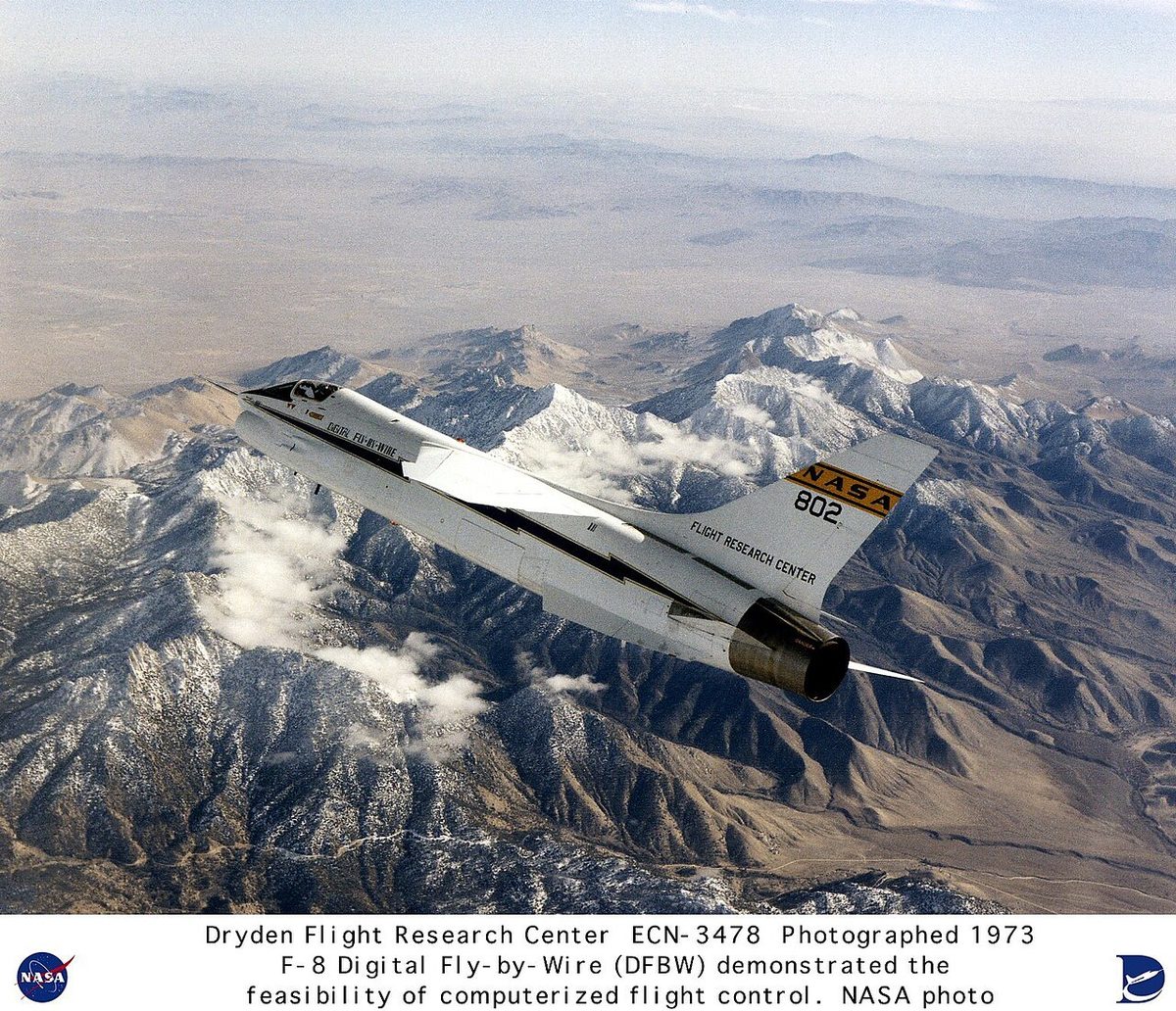
In a conventional powered control system the control column still moves a mechanical linkage that opens a valve on each actuator. In a fly-by-wire (FBW) system that linkage is replaced by electrical signalling. Concorde, which first flew on 2 March 1969, used analogue electrical signalling for its main flight controls, retaining a mechanical backup. Digital fly-by-wire began on 25 May 1972, when NASA pilot Gary Krier flew an F-8 Crusader controlled by a computer taken from the Apollo programme. It had no mechanical backup, only an analogue emergency system that was never needed. Airbus brought full digital fly-by-wire to airline service with the A320, first delivered in 1988, together with side-sticks and flight envelope protection. The 777 was Boeing's first fly-by-wire airliner.
The computers do not simply relay stick position. They apply a control law, a set of equations that links the pilot's input to the aircraft's response. In Airbus normal law, fore and aft stick demands a load factor and sideways stick demands a roll rate, up to 15° per second at full deflection on the A320. With the stick released the aircraft holds its flight path and bank angle and trims itself.
The benefits include lower weight, automatic trim and turn co-ordination, damping of unwanted motion, and on combat aircraft the freedom to design an airframe with relaxed or even negative stability. The penalty is that a computer failure can be sudden and total, where a mechanical system usually degrades gradually. Fly-by-wire software is therefore developed to the most demanding assurance level, level A of DO-178 (EUROCAE ED-12), and the architecture is built around redundancy.
Pilot inceptors: side-stick and yoke
An inceptor is any control through which the pilot commands the aircraft: stick, column and wheel, rudder pedals or thrust levers. Fly-by-wire frees the designer to choose its form.
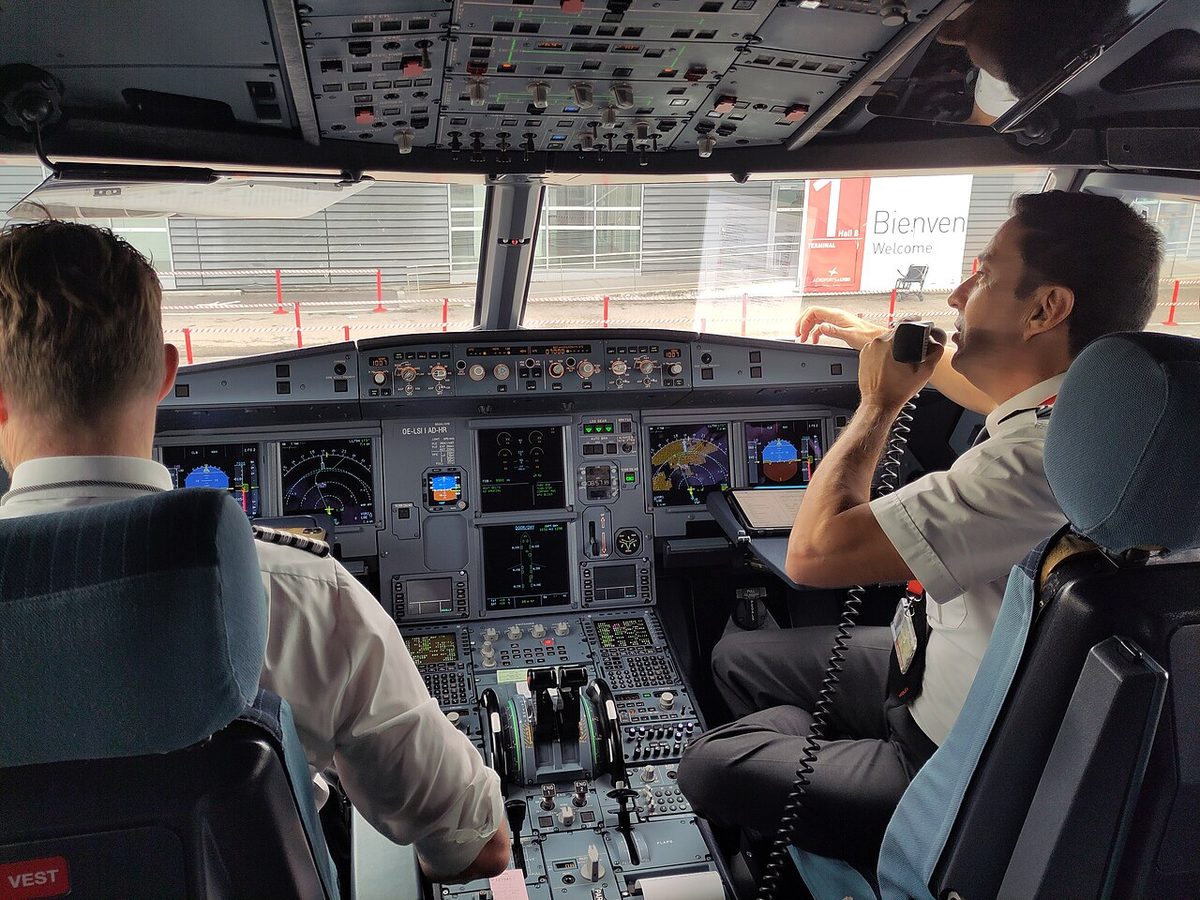
Airbus fits a side-stick on each pilot's outboard console. The sticks are spring-loaded to neutral, give no feedback from the control surfaces, stay locked at neutral while the autopilot is engaged and are not mechanically coupled, so neither pilot can feel the other's input. If both pilots move their sticks, the computers add the inputs algebraically. Green lights flash on the glareshield and a "DUAL INPUT" voice message sounds.
Priority logic resolves the conflict. Pressing and holding the takeover push-button on a side-stick deactivates the other stick. The last pilot to press gets priority, a "PRIORITY LEFT" or "PRIORITY RIGHT" message sounds and a red arrow lights in front of the pilot who has lost authority. Holding the button for 40 seconds latches the priority until either pilot presses a button again.
Boeing kept a conventional column and wheel with artificial feel on the 777 and 787. On the 777 the controls are back-driven, so both pilots see and feel what the autopilot and the protections are doing. This is a design choice, not a technical necessity.
Command and monitor channels
Airbus builds each flight control computer with command and monitor channels. The command (COM) channel computes the surface orders and sends them to the actuators. The monitor (MON) channel receives the same inputs, performs its own computation and compares the results. If they disagree beyond a tolerance, the computer disconnects itself and another computer takes over. Each computer is therefore fail-passive: it either works correctly or stops. The system as a whole keeps working because several computers can do each job.
The A320 has seven flight control computers: two ELACs (elevator aileron computers) for normal pitch and roll control, three SECs (spoiler elevator computers) for the spoilers and standby pitch control, and two FACs (flight augmentation computers) for yaw damping, turn co-ordination, rudder trim and travel limiting, and the characteristic speeds shown on the speed scale. Two flight control data concentrators pass their data to the displays and maintenance system.
The Boeing 777 uses three primary flight computers, each with three computing lanes. In each computer one lane is in command and the other two monitor it, and the outputs of the three computers are voted by median selection before reaching the actuator control electronics.
Redundancy and dissimilar computers
Duplicating identical computers protects against random hardware failures, but not against a design error, which would affect every copy at the same moment. Dissimilar redundancy answers this by building the same function in different ways. On the A320 the ELACs and SECs come from different suppliers and use different microprocessors, and the COM and MON channels of each type run separately developed software, giving four different software packages. On the 777 the three lanes of each flight computer use three different processors, an Intel 80486, a Motorola 68040 and an AMD 29050, running the same Ada source code compiled by three different compilers.
Segregation adds further independence: computers are powered from different electrical buses, actuators from different hydraulic systems, and wiring is routed apart. The A320 keeps a final layer as well. In mechanical backup the pilot controls pitch with the trim wheels, which are mechanically linked to the hydraulically powered trimmable horizontal stabiliser, and controls the aircraft laterally with the rudder pedals. It exists to cover rare cases such as a temporary total loss of electrical power or of the fly-by-wire computers.
Common-mode failures
A common-mode failure is a single cause that disables several redundant channels at once, defeating redundancy. Candidates include a software error, a shared power supply, lightning, a maintenance error repeated on every unit, or corrupted data from a sensor that all channels rely on.
Air data is the classic weak point, because every computer uses the same angle of attack, airspeed and inertial information. On 7 October 2008 Qantas flight 72, an A330-303 cruising at 37,000 ft off Western Australia, was pitched nose-down twice without command. One of the three air data inertial reference units began producing intermittent spikes on all its parameters. The ATSB found that the flight control primary computers' algorithm for processing angle of attack data could not cope with multiple spikes 1.2 seconds apart, and the computers commanded nose-down elevator. The first pitch-down reached about 8.4° nose-down and 650 ft of height loss. At least 110 of the 303 passengers and nine of the 12 crew were injured. The lesson is that the logic which manages redundancy is itself a critical design item.
Airbus control laws
Airbus defines a normal law and a hierarchy of reconfiguration laws that the computers adopt as sensors, computers or hydraulic systems are lost.
| Law | Pitch | Roll | Protections |
|---|---|---|---|
| Normal | Load-factor demand, auto-trim | Roll-rate demand, turn co-ordination | All protections |
| Alternate | Load-factor demand, auto-trim | Direct | Load factor limitation; low and high speed stability; stall warning |
| Direct | Stick to elevator, manual trim | Direct | None; stall and overspeed warnings only |
| Mechanical backup | Stabiliser by trim wheel | Rudder pedals | None |
In alternate law the high angle of attack protection is replaced by a gentle nose-down stability demand that starts about 5 to 10 kt above the stall warning speed and that the pilot can override. Alternate law without reduced protection loses even the low and high speed stability. Pitch attitude and bank angle protection and alpha floor are lost, and the pitch law becomes direct when the landing gear is selected down. In direct law stick deflection maps straight to surface deflection, auto-trim is lost and the flight deck displays "USE MAN PITCH TRIM". An abnormal attitude law also exists to recover the aircraft if it reaches extreme attitudes, for example more than 125° of bank.

Flight envelope protection
Flight envelope protection is the set of functions in the control laws that keeps the aircraft within limits whatever the pilot does. Airbus designs its protections to let the pilot use full stick instinctively in an emergency, such as a terrain escape or windshear, without overstressing or stalling the aircraft. The A320 normal law provides the following:
| Protection | A320 normal law |
|---|---|
| Load factor | +2.5 g to −1 g clean; +2 g to 0 g with slats or flaps extended |
| Pitch attitude | 30° nose-up, reducing to 25° at low speed (25° and 20° in CONF FULL); 15° nose-down |
| High angle of attack | Between alpha prot and alpha max the stick commands angle of attack; alpha max is not exceeded even with full aft stick |
| High speed | Nose-up demand above VMO/MMO; nose-down authority fades to zero at about VMO + 16 kt or MMO + 0.04 |
| Bank angle | 67° maximum, 45° in high angle of attack protection, 40° in high speed protection; beyond 33° the aircraft rolls back to 33° when the stick is released |
High angle of attack protection has priority over all other protections, while high speed protection guards against the overspeed and Mach effects described in high-speed flight. Alpha floor, an autothrust function, sets take-off and go-around thrust when the angle of attack passes a threshold between alpha prot and alpha max; it is available from lift-off to 100 ft radio height on approach. The rudder is not protected: the protections are not designed to prevent structural damage from inappropriate rudder inputs.
Exam tip: A320 load factor limits are +2.5 g/−1 g clean and +2 g/0 g in other configurations, and the load factor protection survives into alternate law. Pitch attitude and bank angle protection do not.
Hard and soft protection
The two main airliner manufacturers take different positions, usually described as hard versus soft envelope protection. Airbus uses hard protection. In normal law the limits cannot be overridden, so the pilot can pull fully back in an escape manoeuvre and obtain the aircraft's maximum performance without stalling it.
Boeing uses soft protection on the 777, and in the same way on the 787. Approaching a limit, the protections increase the force the pilot must apply, for example on the control wheel beyond a set bank angle, but a pilot who pushes or pulls hard enough can override them. In pitch, Boeing's CU law blends pitch rate and load factor (C) with a speed term (U) that returns the aircraft towards a trim reference speed. The pilot therefore trims much as in a conventional aeroplane and feels speed stability.
Both philosophies depend on valid sensor data. On Air France 447, on 1 June 2009, ice crystals blocked the pitot probes of an A330 at cruise altitude, leaving the crew with unreliable airspeed. The autopilot disconnected and the flight controls reverted to alternate law, removing the high angle of attack protection. Sustained nose-up inputs stalled the aircraft, and auto-trim moved the stabiliser from 3° to 13° nose-up within about a minute, where it stayed. When measured airspeed fell below 60 kt the angle of attack data were rejected as invalid and the stall warning stopped. All 228 occupants died. The lessons for fly-by-wire crews are to know the active law, to treat protections as a safety net that can be lost, and to fly the stall recovery like any other aeroplane once they are gone. The aircraft manufacturer's procedures take precedence; see stall and upset prevention and recovery.
Note: 14 CFR Part 25 and CS-25 were written for conventional controls. The FAA certifies envelope protection through published special conditions on each type, covering for example load factor limiting and high incidence protection, and EASA applies its own special conditions through the type certification process. Their technical intent is closely aligned.
Frequently asked questions
What is fly-by-wire?
Fly-by-wire is a flight control system in which the cockpit controls send electrical signals to flight control computers instead of moving the control surfaces through cables and rods. The computers apply a control law and command hydraulic or electric actuators. Because a computer sits between pilot and surface, it can trim automatically, co-ordinate turns, damp unwanted motion and keep the aircraft within its safe flight envelope.
Can an Airbus be stalled in normal law?
In normal law the high angle of attack protection limits the angle of attack to alpha max even with the side-stick held fully back, so the aircraft cannot be stalled, provided the angle of attack and air data are valid. After some failures the aircraft reverts to alternate or direct law. The protection is then lost, only a stall warning and some stability functions remain, and the aircraft can be stalled like a conventional aeroplane.
What happens when both pilots move the side-sticks at the same time?
The Airbus side-sticks are not mechanically linked, so the flight control computers add the two inputs algebraically. Green lights flash in front of both pilots and a DUAL INPUT voice message sounds. To take control, a pilot presses and holds the takeover push-button on the side-stick: the last pilot to press gets priority, and a red arrow lights in front of the pilot who has lost authority.
What is the difference between Airbus and Boeing fly-by-wire?
Airbus uses side-sticks and hard envelope protection: in normal law the computers will not let the pilot exceed the limits on load factor, pitch attitude, bank and angle of attack, and they resist overspeed, whatever the input. Boeing's 777 and 787 keep conventional control columns and use soft protection: control forces increase as a limit is approached, but a pilot who applies enough force can override the protection.
What is alpha floor on the A320?
Alpha floor is an autothrust protection linked to the high angle of attack protection. When the angle of attack reaches a threshold between alpha prot and alpha max, the autothrust commands take-off and go-around thrust whatever the thrust lever position. It is available from lift-off down to 100 ft radio height on approach and is lost in alternate and direct law. Once speed recovers, the crew must cancel the locked thrust.
Test yourself on Fly-by-Wire and Flight Envelope Protection
The v1prep banks cover this topic in Aircraft General Knowledge (021), with a worked explanation for every answer. EASA ATPL, PPL, IR and CPL, the FAA written tests and A320/B737 type ratings.
Start practising →Sources and further reading
- Airbus, Safety innovation
- Airbus, Safety innovation
- Traverse, P. et al., Airbus Fly-by-Wire, A Total Approach to Dependability (ICAS 2006)
- Yeh, Y. C., Triple-triple redundant 777 primary flight computer (IEEE, 1996)
- NASA Fact Sheet, F-8 Digital Fly-By-Wire
- ATSB AO-2008-070, In-flight upset, Airbus A330-303, VH-QPA, west of Learmonth, 7 October 2008
- BEA, Final Report on the accident on 1 June 2009 to the Airbus A330-203, flight AF 447
- FAA Special Conditions, Airbus A350-900, Flight Envelope Protection, High-Incidence Protection and Alpha-Floor Systems
Library articles are written for study and exam preparation. They do not replace your aircraft's approved documentation, your operator's procedures or the regulations themselves.