British Airways Flight 38
- Date
- Phase of flight
- Approach
- Location
- London Heathrow Airport, United Kingdom
- Aircraft
- Boeing 777-236ER
- Registration
- G-YMMM
- Operator
- British Airways
- Flight
- British Airways 38
- Occupants
- 152
- Fatalities
- 0One passenger seriously injured; 34 passengers and 12 cabin crew suffered minor injuries
- Investigating body
- Air Accidents Investigation Branch (United Kingdom)
- Report date
- Report title
- Report on the accident to Boeing 777-236ER, G-YMMM, at London Heathrow Airport on 17 January 2008
On 17 January 2008 British Airways flight 38, a Boeing 777-236ER, lost thrust on both engines at about 720 ft on approach to Heathrow and landed 330 m short of runway 27L. The AAIB found that ice released from within the fuel system had restricted fuel flow at each engine's fuel oil heat exchanger.
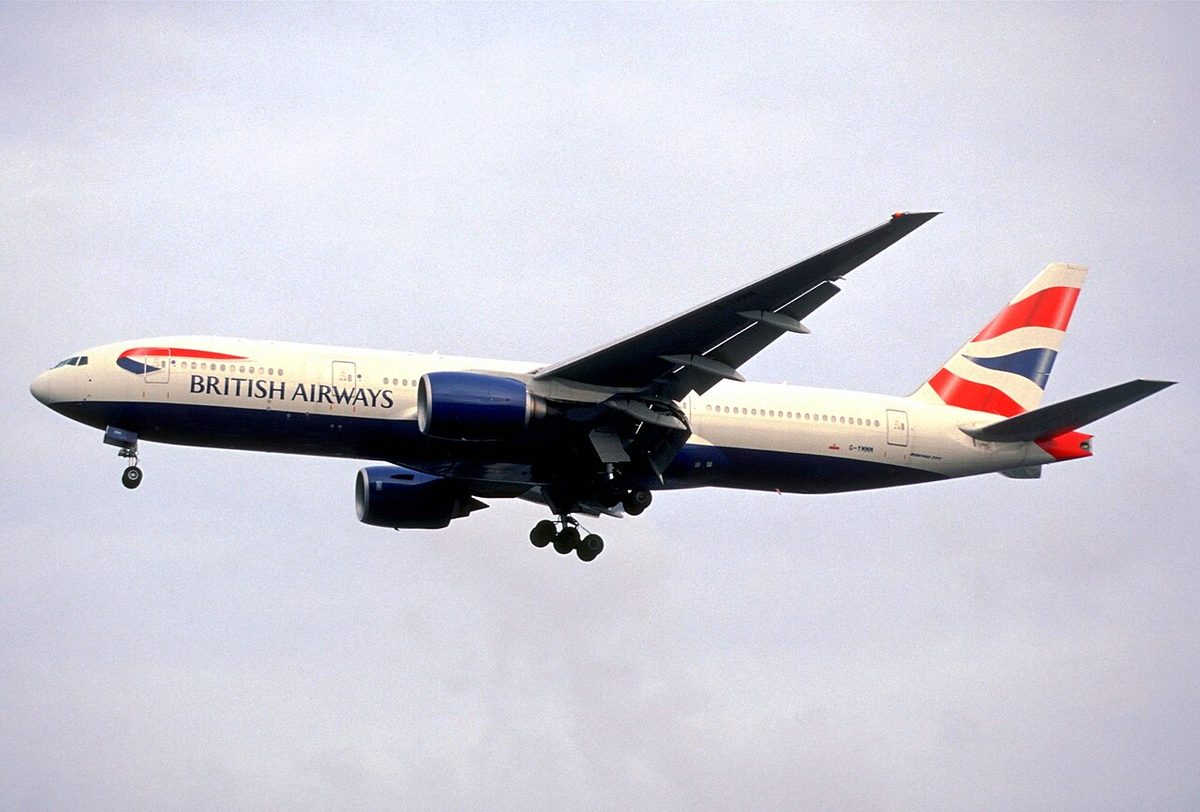
On 17 January 2008 a British Airways Boeing 777-236ER, registration G-YMMM, was on final approach to runway 27L at London Heathrow after a flight from Beijing when both engines stopped responding to demands for more thrust. At about 720 ft the right engine's power fell back, and seven seconds later the left engine's did the same. The aircraft lost speed, descended below the glidepath and struck the grass 330 m short of the runway, inside the airfield boundary. All 152 people on board survived.
The investigation by the UK Air Accidents Investigation Branch (AAIB), whose final report was published in February 2010, included extensive fuel system tests and a search of data from 175,000 flights. It found no pre-existing defect in the aircraft or engines. Instead, ice that had formed from water naturally present in the fuel had built up inside the fuel feed pipes during the flight, then broke loose on approach and blocked the fuel oil heat exchanger (FOHE) of the right engine and, most likely, of the left. The AAIB's report identifies the aircraft by its registration and gives its call sign, 'Speedbird 38'; the flight is widely known as British Airways flight 38.
The accident revealed a failure mode that certification had not considered, and it shows how a crew can protect lives in the last seconds of an approach that can no longer reach the runway. Times below are UTC.
The flight
G-YMMM, serial number 30314, was powered by two Rolls-Royce Trent 800 engines. The flight crew consisted of a commander and two co-pilots, the extra co-pilot allowing in-flight rest. The commander, aged 43, had 12,700 hours, 8,450 of them on type; the operating senior co-pilot, aged 41, had 9,000 hours, 7,000 on type. The AAIB found the crew adequately rested.
The flight plan predicted "extreme cold" at a waypoint on the border between China and Mongolia, and the crew agreed on a fuel load of 79,000 kg, of which 71,401 kg was loaded at Beijing. The left main tank fuel was at -2 °C at take-off, which was at 02:09. The initial cruise was FL348. Two step climbs, to FL380 and FL400, were flown in vertical speed (VS) mode for passenger comfort, which kept fuel flows lower than a VNAV climb would. The crew monitored the fuel temperature, which reached a minimum of -34 °C, while the total air temperature reached -45 °C. The low fuel temperature warning never appeared. The AAIB found that these temperatures were unusual but within the aircraft's operating envelope.
The flight was uneventful to London. The aircraft held at Lambourne for about five minutes, descending from FL110 to FL90, and was vectored for the ILS to runway 27L. At 1,000 ft above aerodrome level it was fully configured with gear down and flap 30, autopilot and autothrottle engaged. The Heathrow weather was mild: wind 200° at 10 kt, visibility over 10 km, scattered cloud at 800 ft and a temperature of 10 °C.
The accident
At about 800 ft the co-pilot took control as briefed, intending to disconnect the autopilot at 600 ft and land manually. The autothrottles commanded more thrust and the engines at first responded. Then the thrust of both engines fell back, above flight idle but far below the commanded level, and stayed there.
| Time before touchdown | Height | Event |
|---|---|---|
| 57 s | about 720 ft | Right engine rolls back to 1.03 EPR |
| about 50 s | Left engine rolls back to 1.02 EPR, seven seconds later | |
| 48 s | Co-pilot notices the thrust levers have "split" | |
| 34 s | 430 ft | Commander calls the approach stable; co-pilot replies "just" |
| about 27 s | Co-pilot notices the airspeed falling below the 135 kt approach speed | |
| 240 ft | Commander reduces flap from 30 to 25 | |
| about 10 s | 200 ft | Speed about 108 kt; stick shaker; co-pilot pushes forward, autopilot disconnects |
| 3 s | Commander transmits MAYDAY | |
| 0 | Impact at 12:42:09, 330 m short of runway 27L |
The engines did not shut down: fuel flows settled at 6,000 pph on the right and 5,000 pph on the left, above flight idle, while each engine's electronic control opened its fuel metering valve fully without effect. Pushing the thrust levers fully forward achieved nothing. Because the co-pilot had been distracted by the thrust problem, the autopilot was still engaged and raised the nose to hold the glideslope, bleeding off speed until the "airspeed low" caution at 115 kt. To reduce drag, the commander retracted the flaps one stage; he also moved what he believed to be an engine starter/ignition switch. When the stick shaker operated, the co-pilot promptly pushed the control column forward, which disconnected the autopilot, but the aircraft was by then only about 150 ft above the ground.
The aircraft struck the soft ground about 110 m inside the perimeter fence with a vertical load of 2.9 g and a descent rate of about 1,400 ft/min, and slid 372 m. The nose gear collapsed, the left main gear collapsed and the right main gear separated, and the aircraft came to rest on the paved undershoot of runway 27L.
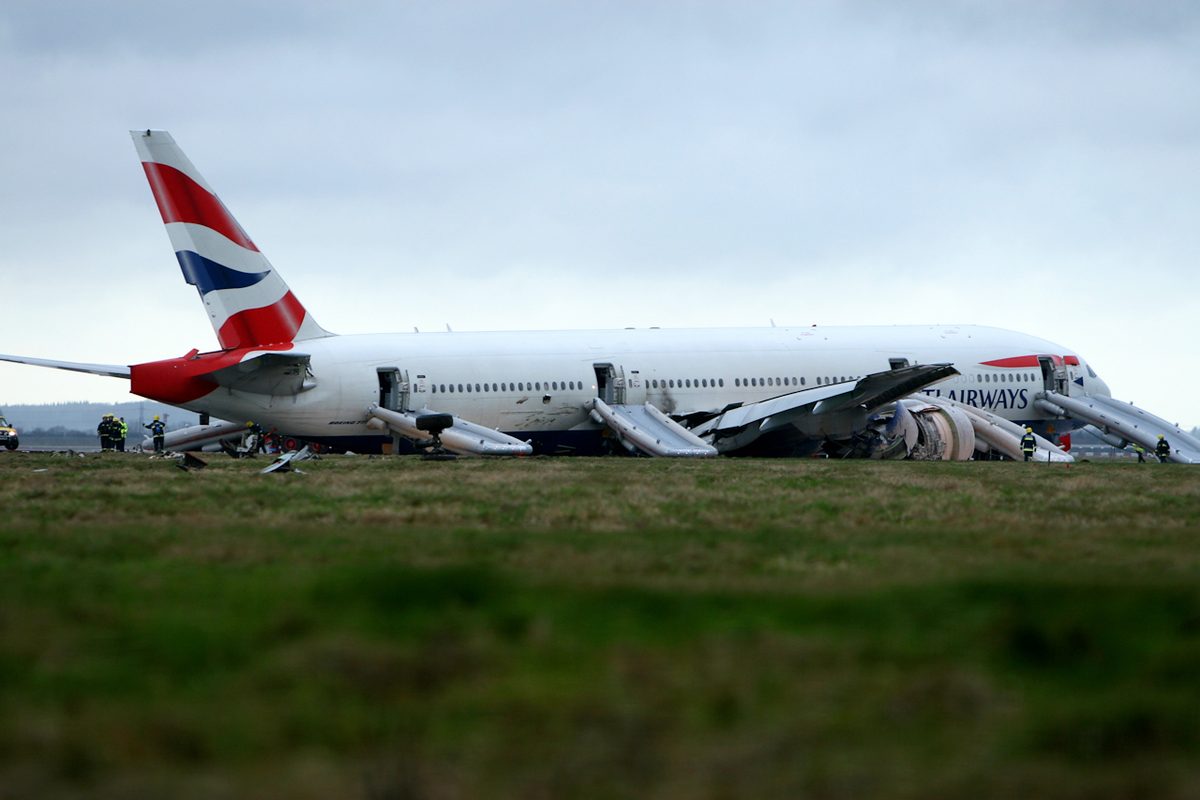
There was no time to warn the cabin or call "brace brace". The commander's first evacuation call went out on the tower frequency; when told, he repeated it on the PA. All escape slides deployed, the cabin crew ran an efficient evacuation, and the first fire vehicle reached the aircraft within two minutes. One passenger suffered a broken leg when parts of the right main gear penetrated the fuselage. There was no fire, but 6,750 kg of fuel leaked from the engines. The spar valves had stayed open because the gear separation damaged their wiring and, on the right side, because the fire handle was pulled before the fuel control switch was set to cutoff, which isolated the switch's signal to close the valve.
The investigation
Ruling things out
The fuel was Jet A-1 to specification, with 35 to 40 ppm of water, similar to other aircraft on similar routes. It never cooled to a temperature at which it would wax; the sampled fuel's freezing point was -57 °C. Fuel sumping, the water scavenge system and electromagnetic interference were all ruled out. Fresh cavitation on both high pressure fuel pumps showed that fuel had recently been restricted upstream of them, but no physical blockage remained when investigators examined the aircraft.
How ice formed and moved
Water is always present in jet fuel: dissolved, entrained as tiny droplets, or as free water. As fuel cools, dissolved water comes out of solution. Fuel system tests showed that ice can form on the inside of fuel pipes, and that ice crystals are most likely to stick in a sticky range between about -5 °C and -20 °C, most of all at -12 °C. Below about -35 °C ice did not appear to stick.
On G-YMMM, ice probably began to accumulate while warmer centre tank fuel flowed through feed pipes running through the cold main tanks. Accumulation continued, more slowly, once the main tanks fed the engines. Low fuel flows over many hours, including the VS-mode step climbs, gave the ice time to build up. On approach, the final engine accelerations, perhaps with turbulence, pitch changes and a warmer strut, released it as soft ice.
The fuel oil heat exchanger
The FOHE warms the fuel with hot engine oil, both to cool the oil and to protect downstream components from ice. It contains over 1,000 small tubes whose ends protruded about 4 mm into the fuel inlet chamber. Tests showed that soft ice in high concentration could restrict the FOHE when the fuel was colder than -10 °C and the flow was above flight idle. Reducing the flow to idle always cleared the restriction. No other component could be shown to collect enough ice to cause the restrictions seen on the accident flight.
On the right engine, a drop in oil pressure recorded at the start of the final acceleration matched a restricted FOHE. The left engine's data stopped too soon to confirm the same, but the AAIB judged a different mechanism within seven seconds very unlikely. The fuel temperature at the moment of rollback was -22 °C.
In November 2008 another Boeing 777-200ER, N862DA, also powered by Trent 800 engines, suffered a rollback of its right engine at FL390 on a flight from Shanghai to Atlanta. The engine recovered when the thrust lever was retarded to idle during descent, and the fuel temperature at the rollback was again -22 °C. The NTSB's preliminary conclusion was that its FOHE had become restricted by ice.
The data mining found that G-YMMM's flight was unique among 175,000 flights in combining a low cruise fuel flow, a high fuel flow during the approach and a low fuel temperature.
The crew's actions
The AAIB found that the crew faced an unprecedented double-engine rollback at low height, for which no specific training existed. Manufacturer analysis showed that retracting the flap at about 240 ft moved the touchdown about 50 m towards the runway; with flap 30 the aircraft would have landed just before the ILS antenna, still inside the airfield. The AAIB noted that the crew "kept the aircraft flying and under control so that, at impact, it was wings level and at a moderate pitch attitude."
Probable cause and contributing factors
The AAIB found that the reduction in thrust was due to restricted fuel flow to both engines: at the FOHE on the right engine, and most likely at the FOHE on the left. It listed four probable causal factors:
- "Accreted ice from within the fuel system released, causing a restriction to the engine fuel flow at the face of the FOHE, on both of the engines."
- Ice had formed within the fuel system from water that occurred naturally in the fuel, while the aircraft operated with low fuel flows over a long period and the localised fuel temperatures were in the "sticky range".
- The FOHE, although compliant with the applicable certification requirements, was susceptible to restriction when presented with soft ice in a high concentration, with a fuel temperature below -10 °C and a fuel flow above flight idle.
- Certification requirements did not take account of this phenomenon, as the risk was unrecognised at the time.
Safety recommendations and what changed
The AAIB made eighteen safety recommendations, several of them before the final report.
Fuel and fire drills (February 2008). Recommendation 2008-009 asked Boeing to tell all 777 operators to set the fuel control switch to cutoff before pulling the fire handle, in both the fire and evacuation drills. Boeing issued this advice on 15 February 2008; a service bulletin, SB 777-28-0025, allows the switch to close the spar valve even after the fire handle has been pulled.
Interim operating procedures (September 2008). Following recommendation 2008-047, Boeing amended the 777 flight manual for Trent 800-powered aircraft, mandated by the FAA and EASA:
- recirculation of fuel during refuelling when the fuel temperature is below 0 °C;
- when the fuel temperature is below -10 °C, maximum climb thrust for at least 10 seconds, first within 3 hours and later 2 hours before top of descent;
- a non-normal procedure if an engine fails to respond to thrust demands: thrust lever to idle for 30 seconds, then advance to maximum.
A redesigned heat exchanger (2009). Rolls-Royce modified the FOHE so that its tubes sit flush with the inlet face, without inlet crimps. Tests showed it could tolerate soft ice down to at least -44 °C. EASA AD 2009-0142 required it on Trent 800 engines by 1 January 2011 at the latest, and a similar change was mandated for the Trent 500 and Trent 700.
Research and certification. The AAIB asked the FAA and EASA to consider the findings for other airframe and engine combinations, to review certification so that fuel systems tolerate the build-up and sudden release of ice, to study wider use of anti-icing additives, and to research ice formation and release in fuel. Other recommendations asked for recording of fuel metering valve position on flight data recorders, less data buffering in the quick access recorder, a modified main gear drag brace to prevent fuel tank rupture, landing gear certification that considers side loads and different ground surfaces, and better retention of ceiling lights, cabin fittings and seat-back video monitors.
Lessons for pilots
A thrust lever split can be the first sign. Slight splits are common, and the AAIB noted that realigning them is a normal response. Here it was the first indication of a rollback. Any mismatch between commanded and achieved thrust, fuel flow or EPR on approach deserves an immediate check of the engine indications.
With no thrust, the glidepath is not the priority. The engaged autopilot tried to hold the glideslope and pitched the aircraft up, trading speed for height until the stick shaker. With thrust gone, the choice is between speed and distance, and a stall close to the ground is the worst outcome. The co-pilot's immediate response to the stick shaker kept the aircraft under control. See stall.
Exam tip: Reducing flap reduces drag and lift and raises the stall speed. On G-YMMM, the change from flap 30 to flap 25 had minimal effect on the stall speed and extended the glide by about 50 m. With more height it would have helped more.
Fuel temperature is more than a freezing-point check. The EICAS low fuel temperature alert warns of fuel approaching its freezing point: it triggers 3 °C above the freezing point set, at -44 °C for Jet A-1 and -37 °C for Jet A. The ice that stopped G-YMMM's engines formed at much warmer temperatures, from the water always present in fuel. Knowing how water behaves in fuel, and why some aircraft use a fuel system icing inhibitor, is exam material. See fuel additives and contamination and gas turbine engine fuel systems.
Note: Jet A-1 has a maximum freezing point of -47 °C and Jet A of -40 °C. A fuel system icing inhibitor, at 0.10 to 0.15 % by volume, can prevent water ice forming down to -40 °C, but is not commonly used in large transport aircraft.
Sequence the shutdown in the evacuation drill. Setting the fuel control switch to cutoff before pulling the fire handle matters. The operator's checklist split these actions between the two pilots with nothing to ensure their order; on G-YMMM the fire handles were pulled first, which removed the switch's ability to close the right spar valve, and fuel leaked until the valves were closed by hand. Check that the PA is selected before announcing an evacuation. See emergency evacuation.
Evacuation discipline saves time. The cabin crew had no warning, yet they kept passengers seated until the evacuation command and then emptied the aircraft quickly. Some passengers still took bags, and one even climbed back up a slide to retrieve belongings, a reminder of why the evacuation briefing matters.
The AAIB found that the reduction in thrust was due to restricted fuel flow to both engines. Its probable causal factors were that "accreted ice from within the fuel system released, causing a restriction to the engine fuel flow at the face of the FOHE, on both of the engines"; that the ice had formed from water naturally present in the fuel during a long period of low fuel flow with fuel temperatures in the "sticky range"; that the FOHE was susceptible to such a restriction; and that certification requirements did not take account of this previously unrecognised risk.
Train this on v1prep
The theory behind this accident and the questions that test it, each with a worked explanation.
Question banks
- ATPL Powerplant190 questions with worked explanations
- ATPL Aircraft Systems818 questions with worked explanations
- ATPL Principles of Flight488 questions with worked explanations
In the Library
- Fuel Additives and ContaminationFuel additives such as icing inhibitors, anti-static and lubricity agents, and how water and microbial contamination are prevented, detected and drained.
- Gas Turbine Engine Fuel SystemHow fuel travels from the aircraft tanks through the engine's LP and HP pumps, heaters, filters and shut-off valves to the fuel manifold.
- StallWhat happens at the critical angle of attack, how stall speed changes with weight, load factor and power, stall warning and wing drop, and how to recover.
- Emergency EvacuationWhen to evacuate, the brace command and position, door arming and disarming, escape slides, exit row seating restrictions, how an evacuation is conducted and the break-in markings used by rescue crews.
Frequently asked questions
What caused the British Airways 38 crash at Heathrow?
The AAIB found that both engines of the Boeing 777 lost thrust because their fuel flow was restricted. Ice had built up inside the fuel system during a long, cold flight at low fuel flows. On final approach it was released and collected on the face of each engine's fuel oil heat exchanger, blocking the flow. The heat exchanger met certification requirements, but those requirements did not recognise this risk.
Was anyone killed on British Airways flight 38?
No. All 152 occupants, 16 crew and 136 passengers, survived. One passenger suffered a broken leg when parts of the right main landing gear penetrated the fuselage during the ground slide, and 34 passengers and 12 cabin crew had minor injuries, mainly to the back and neck. There was no fire, although fuel leaked from the engines until the spar valves were closed manually.
What is the fuel icing 'sticky range'?
The AAIB's tests found that ice crystals formed from water in jet fuel are most likely to stick to their surroundings between about -5 °C and -20 °C, and are stickiest at about -12 °C. At fuel temperatures of -35 °C or below, ice did not appear to stick to the inside of the fuel pipes. Ice that accumulates in the sticky range can later be released as soft ice when fuel flow increases.
Why did the British Airways 38 captain retract the flaps?
When no extra thrust was available, the commander reduced the flap from 30 to 25 at about 240 ft to reduce drag, with minimal effect on stall speed. The AAIB found that this moved the touchdown point about 50 m towards the runway and allowed the aircraft to clear the ILS antenna array. With flap 30 it would still have touched down within the airfield boundary.
What changed after the British Airways 38 accident?
Boeing introduced interim flight manual procedures for Trent 800-powered 777s, mandated by the FAA and EASA, including an application of maximum climb thrust for at least 10 seconds before top of descent when the fuel is very cold. Rolls-Royce then redesigned the fuel oil heat exchanger so that its tubes sit flush with the inlet face; EASA mandated the modification. The AAIB made eighteen safety recommendations, including research into fuel icing and a review of certification requirements.
Sources and further reading
- AAIB, Aircraft Accident Report 1/2010, Boeing 777-236ER, G-YMMM, London Heathrow Airport, 17 January 2008
- GOV.UK, AAIB report 1/2010 on Boeing 777-236ER G-YMMM (report page and later correction)
- FAA, copy of AAIB Aircraft Accident Report 1/2010
- EASA Airworthiness Directive 2009-0142, Rolls-Royce Trent 800 fuel oil heat exchanger modification
Crash Investigations pages summarise official investigation reports for study and exam preparation. The investigating body's report is the authoritative account and prevails wherever it differs from this page. Under ICAO Annex 13, an investigation exists to prevent accidents, not to apportion blame or liability.