A320 APU: The Complete Pilot's Guide
LAST UPDATED: 24 MAY 2026
The Honeywell 131-9A APU is one of the most-asked systems in A320 type rating orals — partly because it's relatively simple, partly because the start envelope and electrical implications matter operationally. This guide covers the architecture, the start logic, the bleed and electrical envelopes, the ECAM ECB messages, and the EMER ELEC behaviour you'll be tested on.
What the APU does
The APU provides electrical power and bleed air when engines aren't running, and serves as a backup source in flight. Three operational uses:
- Ground autonomy — runs the aircraft on stand without GPU/ASU
- Engine start — supplies bleed air to start either main engine
- In-flight backup — backs up electrical and air conditioning if a main system fails
Architecture
The A320 APU is the Honeywell 131-9A — a single-shaft gas turbine with an integral load compressor for bleed air and a generator on the gearbox. Three key components:
- Power section — gas turbine that drives everything
- Load compressor — provides bleed air to the pneumatic manifold
- Generator — 115V AC at 400 Hz, ~90 kVA
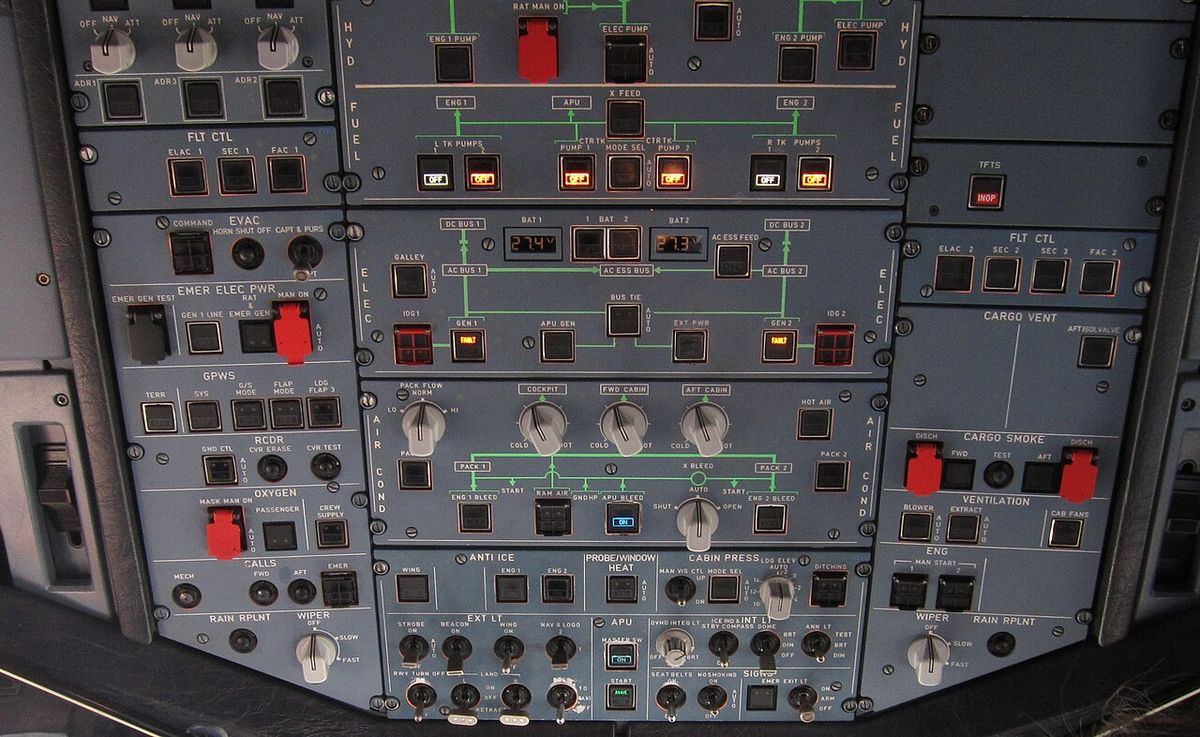
The Electronic Control Box (ECB) is the APU's FADEC equivalent — full authority digital controller managing start/stop, monitoring, automatic shutdowns, and ECAM data. Pilots interact via the APU MASTER SW and APU START pushbutton on the overhead panel.
Fuel supply
The APU is fed from the left wing tank via a dedicated fuel feed line. Same fuel as the main engines (Jet A-1). Fuel is normally pressurised by the wing tank pumps; if no main pump is providing pressure, the APU fuel pump auto-starts to pressurise the supply line.
Fuel consumption: approximately 130 kg/hr at typical loads. Higher with bleed in use, lower with electrical-only.
Start sequence and envelope
Sequence
- MASTER SW ON — air intake flap opens, fuel isolation valve opens, ECB powers up and self-tests, ECAM APU page appears
- START pb ON — when intake flap fully open, starter engages, ignition starts 1.5 seconds later
- N rises — starter de-energised at 60% N, ignition cuts off at 60% N
- AVAIL light at 95% N (or 99.5%) — APU ready to provide electrical and bleed
Start envelope
- Battery-only start — up to FL250
- Normal AC power start — up to FL410 on later variants (some types limit to FL250)
- APU max running altitude — FL410 (~41,000 ft) on current variants
- EMER ELEC in-flight start — inhibited for 45 seconds after entering EMER ELEC
Bleed air supply
The APU bleed system is fully automatic — once the APU BLEED pushbutton is selected ON and the APU is available (N ≥ 95%), the APU bleed valve opens automatically. The X-bleed valve in AUTO opens to distribute bleed to both sides.
Altitude limits for APU bleed
- Two packs running — up to FL200
- One pack running — up to FL225
- Engine start with APU bleed — up to FL200
- Wing anti-ice from APU bleed — NEVER permitted at any altitude (insufficient pressure)
Speed governing
APU normally runs at 100% N. When supplying air conditioning within the FCOM-stated ambient temperature band, speed reduces to 99% N for efficiency. ECAM N indication turns amber at ≥ 102% and red at ≥ 107%.
Electrical supply
The APU generator produces 115V AC at 400 Hz, ~90 kVA — same specification as the IDGs. It can power both AC BUS 1 and AC BUS 2 simultaneously via the bus tie contactors, fully replacing both engine generators if needed.
Operational uses:
- Ground autonomy — no GPU needed
- In-flight electrical backup — replaces a failed IDG generator
- EMER ELEC support — even though APU starting is inhibited briefly, once running it provides AC power
Fire protection
APU fire protection differs by phase:
On ground
- APU shuts down automatically
- Fire extinguisher discharges automatically
- Horn sounds in nose gear bay (audible to ground crew)
- APU fire warning in cockpit
In flight
- APU fire warning to crew
- APU shutdown is automatic OR via APU FIRE handle
- Fire extinguisher discharge is manual — crew pushes the APU FIRE pushbutton
The asymmetry: on ground, automatic discharge protects an unattended aircraft. In flight, manual discharge preserves crew judgement (the crew might want to delay discharge or coordinate with cabin).
EMER ELEC behaviour
In EMER ELEC configuration:
- APU MASTER SW ON automatically closes battery contactors for up to 3 minutes (allowing battery-powered start attempt)
- APU start is inhibited for 45 seconds after entering EMER ELEC
- Once running, APU GEN provides AC power (replacing the lost IDGs)
The 45-second inhibit prevents a confused start sequence during the cascade of electrical events when EMER ELEC is triggered.
10 interview questions you'll get
- What aircraft makes the A320 APU? — Honeywell 131-9A
- What does the APU provide? — Electrical power (115V/400Hz) and bleed air
- What's the max altitude for APU start with batteries only? — FL250
- What's the max altitude for APU bleed with two packs? — FL200
- Can APU bleed be used for wing anti-ice? — No, never (insufficient pressure)
- What fuel does the APU use? — Same Jet A-1 as engines, fed from left wing tank
- What does the ECB do? — Electronic Control Box; full authority digital controller, manages start/shutdown/monitoring
- Difference between APU fire on ground and in flight? — Ground: auto shutdown + auto extinguisher discharge. In flight: warning to crew, manual discharge.
- How long does the cooling run last after MASTER SW OFF? — 60 seconds, if APU bleed was in use; otherwise immediate shutdown
- Is the APU available in EMER ELEC? — Yes, but start is inhibited for 45 seconds after entering EMER ELEC
Drill APU systems in v1prep
v1prep's APU bank covers 118 questions on every ECB threshold, ECAM message, and operational implication.
Practice the full bank →