Thrust Levers, Idle Modes and Engine Handling
Thrust levers set the thrust a jet engine is asked for; on FADEC aircraft their angle is only a demand to the engine control. Engine handling covers how the control chooses between ground, flight and approach idle, why the engine takes seconds to spool up, and how it is warmed up and cooled down.
The thrust lever is the pilot's only direct control over a jet engine's power, but on a modern airliner it no longer acts on the fuel directly. Its position is read electrically and passed to the engine control, which decides how much fuel to deliver and how fast. Between the lever and the thrust lie the idle schedules the control chooses, the time the engine needs to accelerate and the limits it protects (see FADEC and engine fuel control).
Handling the engine well means knowing what the control will do and when it needs help. Idle is not one setting but several, chosen for fuel economy, bleed pressure or quick acceleration. A high-bypass engine takes seconds to spool up. A running engine can lose thrust without being told to, and it needs time to warm up after start and to cool down before shutdown.
Thrust lever and lever angle
The position of the lever is measured as the thrust lever angle (TLA); on turboprops and in older texts the same quantity is the power lever angle (PLA). On a FADEC aircraft the TLA is the crew's statement of intent, and the FADEC computes the fuel flow that delivers the corresponding thrust within the limits. The Embraer E190-E2 shows the idea in numbers: its levers travel through 81.5°, with MAX at 82°, TO/GA, which is also the maximum continuous position, at 75°, IDLE at 22°, MIN REV at 12° and MAX REV at 0.5°.
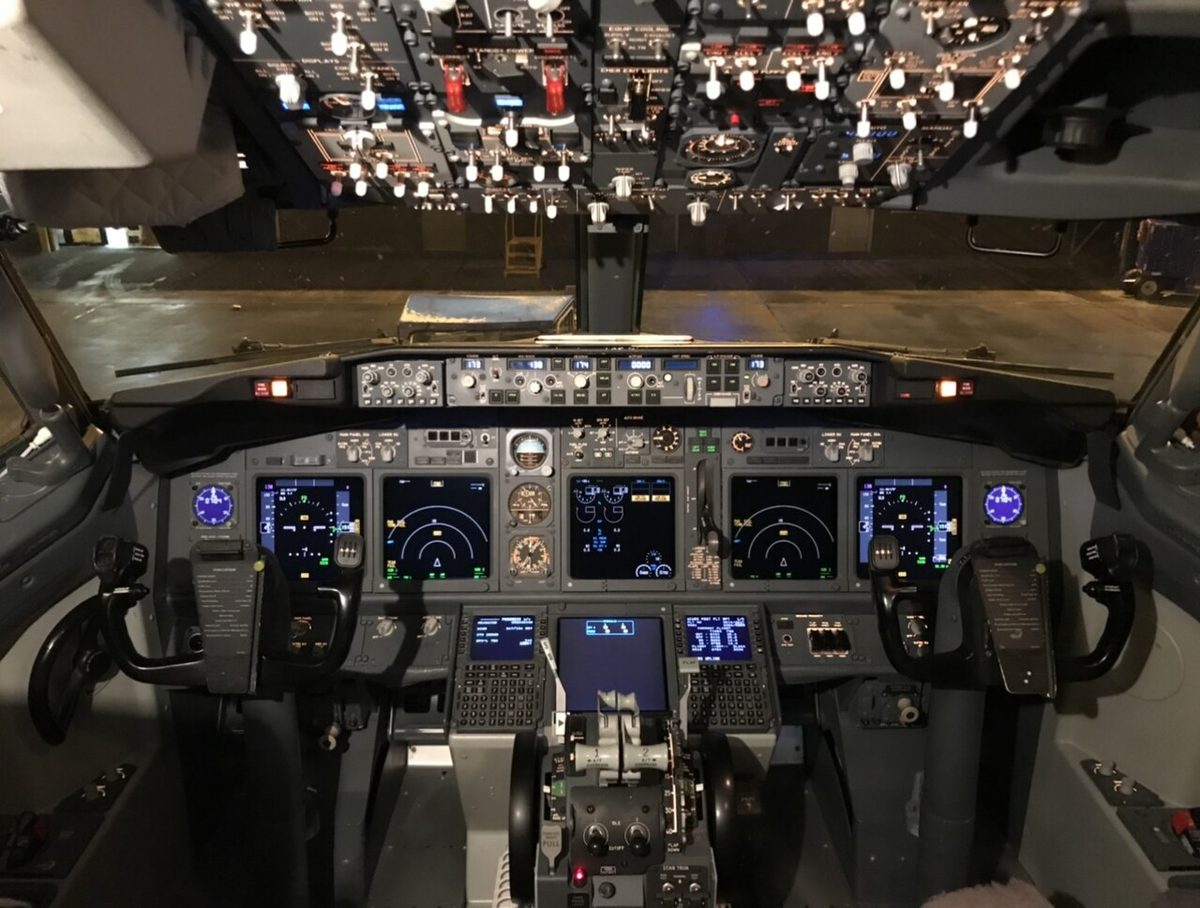
The two main airliner philosophies differ in how the levers behave:
| Airbus A320 | Boeing 737 NG | |
|---|---|---|
| Lever movement under autothrust | Levers do not move | Autothrottle servos drive the levers |
| Positions | Detents TO/GA, FLX/MCT, CL, IDLE; REV IDLE behind, maximum reverse beyond | Continuous travel; full rated take-off thrust reached before the forward stop, maximum rated thrust at the stop |
| Lever between two positions | FADEC applies the rating of the higher detent | EEC sets the N1 for the lever angle, limited to the maximum rated thrust |
| Reverse | Latching lever on the front of each thrust lever | Separate reverse levers, usable only with the forward lever at idle |
On the A320 only the FLX/MCT and TO/GA detents are approved for take-off, and the autothrust is active with the levers between just above idle and the CL detent. On the 737, raising a reverse lever locks the forward lever, and a forward lever cannot be advanced while its reverse lever is deployed. The autothrust side is covered in autothrottle.
Ground, flight and approach idle
Idle is the lowest thrust the control allows with the lever at its idle stop, and the control chooses between several values. Ground idle is the lowest, keeping taxi thrust, fuel burn and brake wear down. Flight idle is higher: in the air the engine must keep enough compressor pressure for the bleed air systems and enough speed to accelerate in reasonable time. Approach idle is higher still, because on approach a go-around may need full thrust at any moment.
The Boeing 737 NG's EEC selects ground minimum idle, flight minimum idle and approach idle automatically; the air/ground system tells it which of the first two applies. Approach idle is selected in flight when:
- cowl thermal anti-ice is on for either engine, at any altitude; or
- the aircraft is below 19,000 ft MSL with a main landing gear down and locked, or with the flaps in the approach configuration (flaps 15 or more).
It is held until after touchdown, when ground minimum idle takes over. If a fault denies the EEC its flap or gear signals, approach idle begins below 19,000 ft MSL. At the same speed and altitude, N1 and N2 are higher at approach idle than at minimum flight idle, which shortens the engine's acceleration time for a go-around.
Modulated and minimum idle
The A320 uses different words for similar ideas. Modulated idle is regulated according to the bleed system's demand and is selected in flight with the flaps retracted and on the ground when reverse is not selected. Approach idle is regulated according to altitude, regardless of bleed demand, and is selected in flight when the flaps are extended, to allow rapid acceleration to go-around thrust. Reverse idle, selected on the ground with the levers at REV IDLE, is slightly higher than forward idle.
The minimum idle is not fixed. The A320's FADEC raises idle N1 automatically when bleed demand is high, for example with wing anti-ice or high air conditioning flow, or when the engine oil runs warmer than normal. Opening an engine anti-ice valve raises the idle of that engine, and if the packs cannot cool the cabin because bleed pressure is too low, the air conditioning controller asks the engine interface units to raise minimum idle. At low power the HP bleed valve opens so that bleed pressure is maintained.
Icing brings special cases. On the Embraer E190-E2 flight idle and approach idle are raised in icing conditions, but final approach idle, below 1,200 ft AGL in the landing configuration, is not, and the autothrottle does not account for the minimum N1 anti-ice needs; the pilot must watch the cyan minimum N1 mark. On the ground, long periods at idle in icing conditions let ice build on the fan, and E-Jet procedures call for ice-shedding run-ups: on the E190-E2, 60 % N1 for 10 seconds when the OAT is 3 °C or below with visible moisture and the engines have been at ground idle for 30 minutes or more.
Spool-up time and acceleration
A high-bypass turbofan has a heavy fan and a core that must be accelerated before the fan can speed up, and the fuel control will only add fuel as fast as the compressor can take it without surging. At low speed thrust also changes little with rpm: about 25 % N1 gives only about 5 % of take-off thrust. The result is spool-up time, the several seconds an engine needs to go from idle to go-around thrust.
Aeroplane certification allows for it. The landing climb requirement, CS 25.119 and 14 CFR 25.119, is a gradient of 3.2 % with all engines at the thrust available 8 seconds after the levers are moved from minimum flight idle to the go-around position (see approach speeds and go-around climb requirements).
The operational consequences are familiar. Crews keep the thrust above idle on final approach, reducing to idle only in the flare, and stabilised approach criteria require the thrust to be stabilised at the target speed (see stabilised approach). Reduced take-off thrust is not recommended when windshear is expected, partly because the engines would have further to accelerate when full thrust is needed. For take-off, thrust is first set to an intermediate value and allowed to stabilise before take-off thrust is set, about 40 % N1 on the 737 and 50 % on the A320 (see take-off procedures and rejected take-off). At San Francisco in 2013 the thrust levers of Asiana 214's Boeing 777 stayed at idle, with the engines at about 24 % N1, on a low and slow approach. When they were advanced at 86 ft the engines reached 90 % N1 in about 6 to 7 seconds, within their specification, but too late (see autothrottle).
Engine rollback
An engine rollback is an uncommanded fall in engine speed and thrust with the thrust lever unmoved and the engine still running. It differs from a flameout, in which combustion stops; a rollback can be partial, and it can recover.
Two causes are well documented. High-altitude ice crystals near deep convection partly melt on warm compressor surfaces, build up and shed, and have been linked to surge, rollback and flameout events (see airframe icing). Ice in the fuel system caused the accident to British Airways 38, a Boeing 777-236ER with Rolls-Royce Trent 800 engines, on 17 January 2008. At about 720 ft on final approach to Heathrow the right engine rolled back, and the left followed seven seconds later; the aircraft landed short of the runway. The AAIB found that ice had built up inside the fuel system during a long, cold flight at low fuel flows, was released by the final accelerations, and restricted the fuel flow at the face of each engine's fuel-oil heat exchanger. The engines kept running above flight idle, and pushing the thrust levers fully forward achieved nothing. In tests, reducing the fuel flow to idle always cleared the restriction, and in a similar event later that year another 777's engine recovered when its thrust lever was retarded to idle.
A rollback shows as N1 or EPR, N2, fuel flow and EGT falling, or failing to follow the demand, while the thrust lever stays forward. On BA38 the first sign the crew noticed was a split between the thrust levers, then a loss of airspeed; Boeing afterwards gave Trent 800-powered 777s a procedure for an engine that fails to respond: thrust lever to idle for 30 seconds, then advance to maximum. If the engine falls below idle the control treats it as a flameout: the 737 NG shows ENG FAIL below sustainable idle, about 50 % N2, and fires both igniters automatically (see gas turbine ignition, flameout and relight).
N1 keep-out zones
Rotating parts have natural frequencies. In some bands of fan speed a vibration mode of the fan blades would be excited, and running there continuously could fatigue them. A keep-out zone is such a band, in which the engine must not be operated steadily. For some A320 engine variants, the Airbus flight crew training manual describes a keep-out zone of approximately 60 to 74 % N1, which protects against fan flutter: the EEC prevents the engine stabilising in that range, and during take-off the crew may notice that thrust responds non-linearly to lever movement.
The danger is real. The fan blade that failed at Kegworth in 1989 had been exposed, the AAIB found, to vibratory stress from a fan vibration mode excited at high corrected fan speed at altitude, which the certification test-bed running had not reproduced.
Engine warm-up
A cold engine needs time before high power. Its casings, discs and blades heat at different rates, and the oil is cold and thick. Airbus asks the crew to run the A320's engines at or near idle for at least 2 minutes before advancing the levers to high power, to avoid thermal shock; taxi time at idle counts. Boeing's 737 NG requirement is to see an increase in engine oil temperature before take-off, with a recommended warm-up of at least 2 minutes at taxi thrust. Engine starting itself is covered in gas turbine engine starting.
Cooldown and heat soak-back
After high-thrust operation the hot section and casings are much hotter than at idle. If the engine is shut down at once, the cooling airflow and oil flow stop while the metal is still hot, and heat soaks back into the surrounding parts, raising under-cowl temperatures. A cooldown period at or near idle lets the engine stabilise thermally first.
| Type | Cooldown before shutdown |
|---|---|
| Boeing 737 NG | At least 3 min at or near idle; taxi thrust counts; may start when thrust is reduced to idle for landing if idle or no reverse is used; routinely shorter cooldowns can cause engine degradation |
| Airbus A320 | 3 min at or near idle after high-thrust operation; idle reverse and taxi thrust are not high thrust |
| Embraer E190-E2 | 3 min after nosewheel touchdown, 5 min recommended |
| Embraer E190 (E1) | 2 min at or near idle |
Heat also affects the next start. As a shut-down engine cools, its rotor can bow slightly, and the E190-E2 begins every normal start by motoring the engine at about 8 to 11 % N2 to counter this rotor bow before fuel and ignition are introduced, which lengthens its start cycle.
Frequently asked questions
What is the difference between flight idle and ground idle?
Ground idle is the lowest idle setting, used on the ground so that the engines give as little thrust as possible while taxiing. Flight idle is higher. It keeps enough compressor pressure for the bleed air systems and enough rotational speed for the engine to accelerate reasonably quickly. On the Boeing 737 NG the EEC selects ground minimum idle or flight minimum idle automatically from the air/ground signal.
Why is approach idle higher than flight idle?
A high-bypass engine accelerates slowly from a low idle. Approach idle holds N1 and N2 higher, so that go-around thrust is reached sooner. On the 737 NG it is selected in flight with engine anti-ice on, or below 19,000 ft MSL with a main gear down and locked or flaps at 15 or more, and it lasts until after touchdown. On the A320 it is selected in flight when the flaps are extended.
How long does a jet engine take to spool up?
Several seconds from idle to go-around thrust, because the fan and core must accelerate and the fuel control adds fuel only as fast as the compressor can accept it. Certification allows for this: the all-engines landing climb gradient of 3.2 % under CS 25.119 and 14 CFR 25.119 is based on the thrust available 8 seconds after the levers are moved from minimum flight idle. That is why crews keep thrust above idle on final approach.
What is an engine rollback?
A rollback is an uncommanded loss of engine speed and thrust while the engine keeps running and the thrust lever is not moved. It differs from a flameout, in which combustion stops. Known causes include ice crystals accreting inside the engine near deep convection and ice in the fuel system: in 2008 both engines of British Airways 38, a Boeing 777, rolled back on final approach to Heathrow because ice restricted their fuel flow.
Why must jet engines cool down before shutdown?
After high power the hot section, bearings and casings are far hotter than they are at idle. Running at or near idle for a few minutes lets them stabilise thermally before the cooling air and oil flow stop. Boeing gives at least three minutes on the 737 NG, to reduce under-cowl soak-back temperatures, and warns that routinely shorter cooldowns can degrade the engine; Airbus also gives three minutes after high-thrust operation.
What is a keep-out zone on a jet engine?
A keep-out zone is a band of fan speed in which the engine must not run steadily, because a vibration mode of the fan or another rotating part would be excited. For some A320 engine variants, the Airbus flight crew training manual describes one of approximately 60 to 74 % N1, protecting against fan flutter; the EEC prevents the engine stabilising in it, so the crew may notice a non-linear thrust response when setting take-off thrust.
Test yourself on Thrust Levers, Idle Modes and Engine Handling
The v1prep banks cover this topic in Aircraft General Knowledge (021), with a worked explanation for every answer. EASA ATPL, PPL, IR and CPL, the FAA written tests and A320/B737 type ratings.
Start practising →Sources and further reading
- EASA Easy Access Rules for Large Aeroplanes (CS-25), CS 25.119 landing climb
- 14 CFR 25.119, Landing climb, all-engines-operating
- AAIB Aircraft Accident Report 1/2010, Boeing 777-236ER G-YMMM, London Heathrow, 17 January 2008
- Boeing AERO Q1 2010, Avoiding Convective Weather Linked to Ice-Crystal Icing Engine Events
- FAA Airplane Flying Handbook (FAA-H-8083-3C), Transition to Jet-Powered Airplanes
- EASA, Explanatory Note to ED Decision 2018/001/R, Part-FCL theoretical knowledge learning objectives (021 Powerplant)
Library articles are written for study and exam preparation. They do not replace your aircraft's approved documentation, your operator's procedures or the regulations themselves.