Asiana Airlines Flight 214
- Date
- Phase of flight
- Approach
- Location
- San Francisco International Airport, California, United States
- Aircraft
- Boeing 777-200ER
- Registration
- HL7742
- Operator
- Asiana Airlines
- Flight
- Asiana Airlines 214
- Occupants
- 307
- Fatalities
- 33 passengers; 49 occupants seriously injured
- Investigating body
- National Transportation Safety Board (United States)
- Final report
- NTSB/AAR-14/01
- Report date
- Report title
- Descent Below Visual Glidepath and Impact With Seawall, Asiana Airlines Flight 214, Boeing 777-200ER, HL7742, San Francisco, California, July 6, 2013
Asiana Airlines flight 214, a Boeing 777-200ER, struck the seawall short of runway 28L at San Francisco on 6 July 2013 during a visual approach; 3 of the 307 occupants died. The NTSB found that the crew mismanaged the descent, the pilot flying unintentionally deactivated automatic airspeed control, and the crew did not monitor airspeed and went around too late.
On 6 July 2013, at about 11:28 local time (PDT), Asiana Airlines flight 214, a Boeing 777-200ER registered HL7742, struck the seawall short of runway 28L at San Francisco International Airport at the end of a visual approach in good weather. Three of the 291 passengers died. Forty passengers, 8 of the 12 flight attendants and 1 of the 4 flight crew members were seriously injured. The aeroplane was destroyed by the impact and a post-crash fire.
The flight from Incheon, Seoul, was flown by a captain in training on the 777, supervised by an instructor on his first flight in that role. Both were experienced pilots. The approach started high, the crew's attempts to correct it led to an autothrottle mode in which the airspeed was no longer controlled, and none of the three pilots on the flight deck noticed the speed decaying until the aeroplane was about 200 ft above the ground.
The NTSB report is a clear study of automation mode confusion, monitoring and the unstabilised approach. The Korean investigation authority appended comments that differ from part of its analysis.
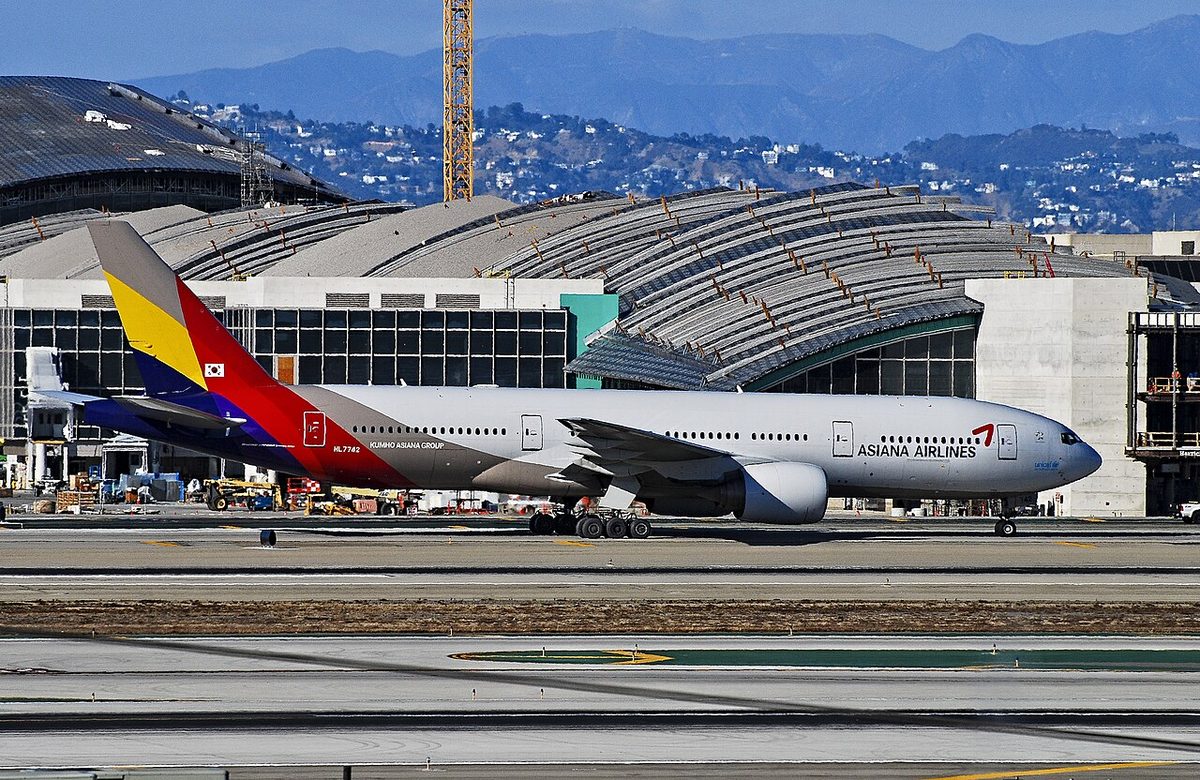
The flight
Flight 214 was an operating experience flight: the trainee captain in the left seat was pilot flying (PF), and the instructor pilot (IP) in the right seat was pilot in command and pilot monitoring (PM). A relief first officer sat in the jump seat as an observer for the approach and landing. The estimated time en route was 10 hours 24 minutes.
| Pilot | Age | Total hours | Hours on the 777 |
|---|---|---|---|
| Trainee captain (PF) | 45 | 9,684 | 33 flight hours |
| Instructor pilot (PM) | 49 | 12,307 | 3,208 |
| Relief first officer (observer) | 40 | 4,557 | 715 |
The PF, an Asiana cadet from 1994, had been a captain on the 737 and the A320 before starting 777 training in March 2013. He had completed 8 of the 20 flight legs of operating experience required, all with ILS approaches.
The ATIS reported visual approaches in progress to runways 28L and 28R, whose ILS glideslopes were out of service. In his briefing the PF planned to follow the localiser for lateral guidance and to use the autopilot vertical speed mode for the descent. The reference speed, VREF, was 132 kt, and the target approach speed 137 kt.
At 11:21:49 the approach controller cleared the flight for a visual approach to runway 28L. The aeroplane was descending through about 6,300 ft at about 211 kt, clean, with the autothrottle (A/T) in HOLD and the autopilot flight director system (AFDS) in flight level change speed (FLCH SPD) mode. At 11:23:17, about 14.1 NM from the runway, the controller asked the flight to maintain 180 kt to 5 miles from the airport.
The accident
After accepting the speed restriction, the crew mismanaged the descent. The PF used vertical speed mode at 1,000 and then 1,500 ft/min. At 11:24:53 the PM remarked that the aeroplane seemed "a little high". The aeroplane crossed the final approach fix, DUYET, about 450 ft above its 1,800 ft minimum altitude, and was about 400 ft above the 3° glidepath at 5 NM.
At 11:26:25.7, with the aeroplane below the selected altitude of 3,000 ft (the missed approach altitude, set about 40 seconds earlier), the pitch mode changed to FLCH SPD. The autopilot began to climb towards 3,000 ft and the autothrottle, in THR mode, began to advance the thrust levers. Three seconds later the PF disconnected the autopilot and pulled the thrust levers back. At 11:26:33 they reached idle and the autothrottle changed to HOLD, in which it does not move the thrust levers or control speed. None of the three pilots later recalled seeing this change on the flight mode annunciator.
At 11:26:43 the PF's flight director was switched off, but the PM's remained on. Had both been off, the autothrottle would have changed to speed mode and held the selected 137 kt.
| Time (PDT) | Height (radio altitude) | Airspeed | Event |
|---|---|---|---|
| 11:26:54.9 | 1,000 ft | 151 kt | Descent about 1,500 ft/min; PAPI four white |
| 11:26:58.6 | 917 ft | 147 kt | Observer: "sink rate sir" |
| 11:27:14.8 | 500 ft | 137 kt | Thrust levers at idle; descent about 1,200 ft/min; PAPI three white, one red |
| 11:27:19.8 | 404 ft | 134 kt | PM: "on glide path sir"; PAPI two white, two red |
| 11:27:23.3 | 344 ft | 130.5 kt | Airspeed below VREF |
| 11:27:31.0 | 219 ft | 122 kt | PAPI four red |
| 11:27:33.6 | 180 ft | 118 kt | PM: "it's low" |
| 11:27:39.3 | 124 ft | 114 kt | Low airspeed caution (quadruple chime) |
| 11:27:43.2 | 86 ft | 109 kt | Thrust levers advanced |
| 11:27:46.4 | 46 ft | 104 kt | Stick shaker |
| 11:27:47.8 | 29 ft | 104 kt | PM: "go around" |
| 11:27:50.3 | 5 ft | 106 kt | Impact with the seawall |
At 500 ft the aeroplane was slightly above the glidepath, and the airspeed had just reached 137 kt. But the thrust levers were at idle with the engines at about 24 % N1, and the descent rate was about 1,200 ft/min against the roughly 700 ft/min needed to stay on the glidepath. The crew continued. The PF raised the nose to stop the aeroplane going below the glidepath, and without thrust the speed kept falling. From about 200 ft one or more of the pilots were aware that the aeroplane was low and slow, but the thrust levers were not advanced until 86 ft, and the go-around was called at 29 ft.
When the thrust levers were advanced, the engines reached 90 % N1 in about 6 to 7 seconds, within their specification, but there was no time left. The lowest recorded airspeed was about 103 kt. The main landing gear and aft fuselage struck the seawall, and the tail broke off at the aft pressure bulkhead. The aeroplane slid along the runway, partly lifted, spun about 330° and came to rest about 2,400 ft from the first impact.
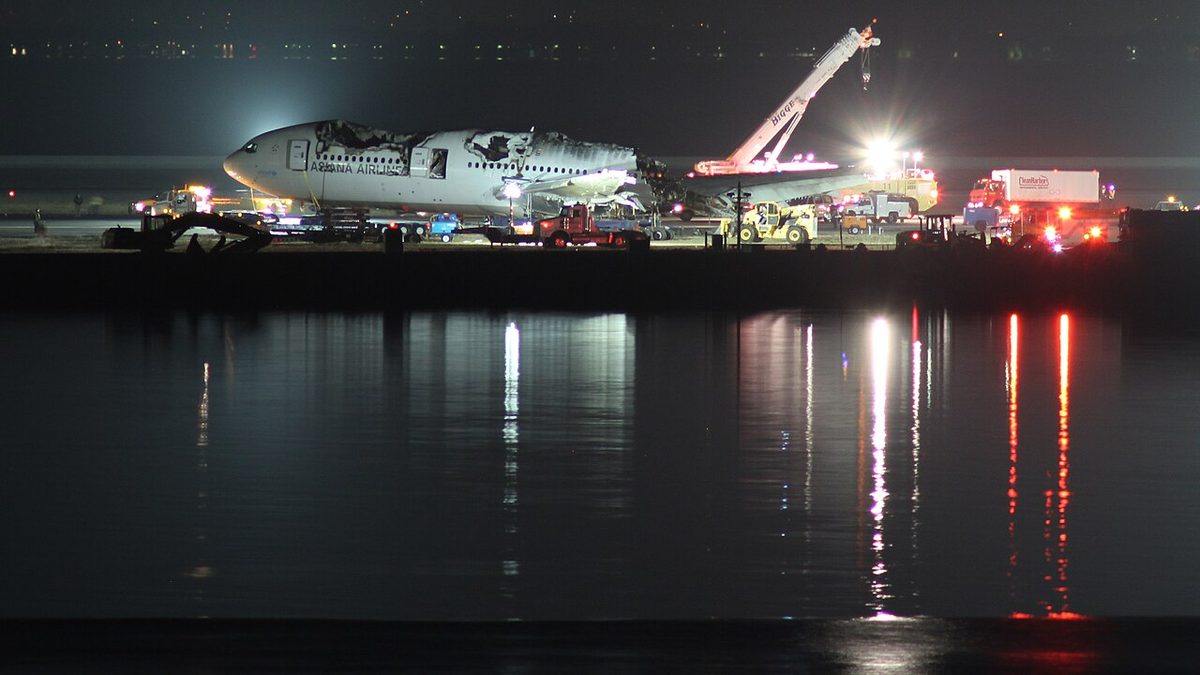
A fire began in the separated right engine, next to the fuselage. The flight attendants began the evacuation when they saw fire outside door 2R, after a delay of about 90 seconds that the NTSB attributed partly to the PM's command not to evacuate immediately and partly to disorientation and confusion. Two slide/rafts inflated inside the cabin, injuring and temporarily trapping two flight attendants. About 98 % of the passengers evacuated by themselves, and firefighters entered the burning cabin to rescue five passengers who could not.
The investigation
The NTSB found no pre-impact failure of the structure, engines or systems, and no problem with air traffic control or crew qualification. The investigation centred on why three pilots did not notice that the thrust had stayed at idle and the airspeed was decaying.
The autothrottle mode
On the 777 the autothrottle can support stall protection through an automatic engagement function, often called "A/T wakeup". It works only when the autothrottle is armed but not active in any mode, and it is not available in FLCH SPD or TO/GA pitch modes. Once the PF had pulled the thrust levers to idle in FLCH SPD, the autothrottle sat in HOLD and would not wake up, however slow the aeroplane became.
The PF's statements showed that he did not accurately understand when the autothrottle would go to and stay in HOLD after a manual override of the thrust levers, and interviews showed that other Asiana pilots, including some instructors, had similarly inaccurate mental models. The NTSB found that the design logic was complex and not intuitive, and that the 777 Flight Crew Operating Manual described the exceptions in two separate notes with dissimilar wording. During 787 certification, the FAA and EASA had already raised concerns about the same logic. The NTSB calculated that a wakeup-type function would have added thrust about 20 seconds before impact, when the speed fell to 124 kt (VREF minus 8 kt), and "may have prevented the accident."
The low airspeed alert
The 777's low airspeed alert is a caution, not a warning. It sounded 11 seconds before impact, and the PM advanced the thrust levers about 4 seconds later, the response time Boeing expected. The alert had been designed to warn of low airspeed in cruise, for stall avoidance. At 124 ft and 114 kt, there was no longer enough height or speed to trade while the engines accelerated. The NTSB recommended a context-dependent low energy alert that takes account of airspeed, altitude and engine response time.
The go-around
Asiana's procedures required approaches to be stabilised by 500 ft above airport elevation in visual conditions, with a sink rate no greater than 1,000 ft/min and thrust appropriate to the configuration. At 500 ft the approach met neither of these two criteria, and the PM made no 500 ft callout. Simulations showed that a go-around started 11 to 12 seconds before impact would have succeeded; the actual one began about 7 seconds before, at about 90 ft. The NTSB noted that industry data show about 97 % of unstable approaches are continued to landing.
Crew factors
The NTSB found that the crew's monitoring of airspeed was insufficient because of expectancy, workload, fatigue and reliance on the automation. The pilots believed the autothrottle was controlling speed. The crew did not consistently follow Asiana's procedures for mode control panel selections and callouts, which is likely why the PF did not call out FLCH when he selected it; the PM, whose attention was likely on the flaps, did not notice the mode change.
The accident flight was the PM's first as an instructor pilot, and his instructor training had not included supervising a trainee in operational service. The NTSB found that such experience would likely have better prepared him to intervene promptly. It also found that Asiana's automation policy emphasised full use of automation and did not encourage manual flying, and that more manual practice would likely have helped the PF use pitch trim, notice the decaying speed and add power.
The accident occurred when the three pilots would normally have been asleep, during their circadian low, after a flight across 8 time zones. The NTSB concluded that the crew was fatigued and that this likely degraded their performance.
Survival
Two of the three passengers who died were ejected through the ruptured tail; they were not wearing their seat belts and would likely have survived if they had been. Four flight attendants in the aft galley were ejected while still restrained. The impact loads far exceeded certification limits. The NTSB also examined the airport fire and rescue response.
Probable cause and contributing factors
The NTSB determined that the probable cause was "the flight crew's mismanagement of the airplane's descent during the visual approach, the pilot flying's unintended deactivation of automatic airspeed control, the flight crew's inadequate monitoring of airspeed, and the flight crew's delayed execution of a go-around after they became aware that the airplane was below acceptable glidepath and airspeed tolerances."
Contributing to the accident were:
- the complexities of the autothrottle and autopilot flight director systems that were inadequately described in Boeing's documentation and Asiana's pilot training, which increased the likelihood of mode error;
- the flight crew's nonstandard communication and coordination regarding the use of the autothrottle and autopilot flight director systems;
- the PF's inadequate training on the planning and execution of visual approaches;
- the PM/instructor pilot's inadequate supervision of the PF;
- flight crew fatigue, which likely degraded their performance.
Korea's Aviation and Railway Accident Investigation Board (ARAIB), representing the State of the Operator, appended comments to the report. It considered that the report dealt only superficially with the deficiency of the 777 low-speed alert and speed protection, and proposed adding as a contributing factor the "inadequacy of the B777's low airspeed alert and inconsistencies in the airspeed protection function." It proposed that ICAO require large commercial aircraft manufacturers to fit a more direct low-speed alert and to provide adequate speed protection in all modes.
Safety recommendations and what changed
The NTSB issued 27 recommendations, A-14-37 to A-14-63, to the FAA, Asiana Airlines, Boeing, the Aircraft Rescue and Firefighting Working Group and the City and County of San Francisco. Among them:
- Boeing and the FAA: better 777 training on autothrottle modes and automatic activation (A-14-37, -38); a stall protection demonstration showing when the autothrottle does not protect speed (A-14-39, -40); a certification design review of how the 777 controls airspeed (A-14-42); a manual statement that with the autopilot and both flight directors off the autothrottle goes to SPD (A-14-56); and context-dependent low energy alerting (A-14-43, -57).
- Training: an expert panel on how best to train crews in automated flight path management (A-14-41).
- Asiana: reinforced callouts for mode control panel inputs (A-14-52); supervised line training for new instructors (A-14-53); guidance to switch off both flight directors if they are not being followed on a visual approach (A-14-54); and more manual flight in training and line operations (A-14-55).
- Survival and rescue: research on lateral impact forces and spinal injuries, slide/raft certification loads, and airport firefighting tactics, staffing, training and communications (A-14-44 to -51, -58 to -63).
Lessons for pilots
Know what the automation will and will not do. Pulling the thrust levers to idle in FLCH SPD left the 777 autothrottle in HOLD, controlling nothing and unable to wake up. If you override an automatic function, confirm on the flight mode annunciator what mode you have left it in. See autothrottle and flight deck automation.
Exam tip: A flight mode annunciator shows the active modes of the autothrottle and autopilot. Mode changes must be called out and checked by both pilots; an uncalled mode change is a classic threat in threat and error management.
Monitor the basics: speed, path, thrust. The thrust levers stayed at idle from 11:26:33 to 11:27:43 while the speed decayed, on a clear day, with three pilots on the flight deck. A stable picture outside is not proof of a stable aeroplane.
Plan the descent early. After accepting 180 kt to 5 NM, the crew arrived high. Energy problems on a visual approach are cheapest to fix far out, with drag, speed and path planned together.
Use your stabilised approach gate as a decision, not a formality. At 500 ft the approach was not stabilised. The gate exists so that the go-around is decided while the aeroplane still has the energy to fly one. See stabilised approach and go-around and missed approach.
Warning: Jet engines take several seconds to spool up from idle. On this flight 90 % N1 took 6 to 7 seconds, and a go-around started 7 seconds before impact was too late.
Instructors must intervene early. An instructor who is also pilot in command must monitor the trainee closely and be ready to take over. Clear roles and standard callouts are the basics of crew resource management.
Note: Flight directors that are not being followed are a distraction on a visual approach. On the 777, with the autopilot off, switching both off also puts the autothrottle in speed mode.
The NTSB determined that the probable cause was the flight crew's mismanagement of the aeroplane's descent during the visual approach, the pilot flying's unintended deactivation of automatic airspeed control, the crew's inadequate monitoring of airspeed, and their delayed execution of a go-around after they became aware that the aeroplane was below acceptable glidepath and airspeed tolerances. Contributing factors included autoflight complexity that was inadequately described in Boeing's documentation and Asiana's training, nonstandard crew communication, inadequate visual approach training and supervision, and fatigue.
Train this on v1prep
The theory behind this accident and the questions that test it, each with a worked explanation.
Question banks
- ATPL Operational Procedures482 questions with worked explanations
- ATPL Human Factors494 questions with worked explanations
- ATPL Instruments597 questions with worked explanations
In the Library
- Stabilised ApproachCovers the criteria that define a stabilised approach, the stabilisation gates, approach energy management and the hazards of unstable, steep or below-path approaches.
- Go-Around and Missed ApproachExplains when and how to fly a go-around, the associated callouts and policies, and variants including low approaches, low passes and engine-out missed approaches.
- AutothrottleThe autothrottle or autothrust system, its speed and thrust modes, TOGA thrust and the TO/GA switches, and the go-around mode with reduced go-around thrust.
- Flight Deck AutomationThe human factors of automated flight decks: choosing and managing levels of automation, complacency and dependency, mode confusion and automation surprise, and keeping manual flying skills.
Frequently asked questions
What caused the Asiana 214 crash?
The NTSB determined that the probable cause was the crew's mismanagement of the descent during the visual approach, the pilot flying's unintended deactivation of automatic airspeed control, inadequate monitoring of airspeed, and a go-around started too late. Contributing factors were the complexity of the 777 autothrottle and autopilot flight director systems, inadequately described in Boeing's documentation and Asiana's training, nonstandard crew communication, inadequate training in visual approaches, inadequate supervision by the instructor pilot, and fatigue.
Why did the autothrottle not maintain speed on Asiana 214?
The pilot flying selected flight level change mode below the selected altitude, so the autopilot began a climb and the autothrottle advanced thrust. He disconnected the autopilot and pulled the thrust levers to idle, and the autothrottle changed to HOLD, a mode in which it does not control airspeed. In HOLD, the automatic engagement feature that would otherwise have added thrust at low speed was not available.
Was the glideslope out of service for Asiana 214?
Yes. The ILS glideslopes for runways 28L and 28R at San Francisco were out of service, and visual approaches were in progress. The NTSB found that the lack of a glideslope should not have prevented the pilots from completing a visual approach successfully. The precision approach path indicator lights were available and showed the aeroplane first well above, then below, the glidepath.
When should the Asiana 214 crew have gone around?
At 500 ft above airport elevation, the point by which Asiana required a stabilised approach in visual conditions, the thrust levers were at idle and the descent rate was about 1,200 ft per minute. The NTSB found that the crew should then have gone around. They became aware of the low airspeed and low path at about 200 ft but did not start a go-around until below 100 ft, when the aeroplane no longer had the performance to climb away.
Did Korea agree with the NTSB's findings on Asiana 214?
Korea's Aviation and Railway Accident Investigation Board appended comments to the report. It considered that the deficiency of the 777 low-speed alert and the inconsistencies in its airspeed protection should have been treated in more depth and added as a contributing factor. It proposed that ICAO require a more direct low-speed alert and speed protection in all autoflight modes.
Sources and further reading
- NTSB, Aircraft Accident Report AAR-14/01, Descent Below Visual Glidepath and Impact With Seawall, Asiana Airlines Flight 214
- NTSB investigation page DCA13MA120, Asiana Airlines flight 214
- Flight Safety Foundation, ALAR Briefing Note 7.1, Stabilized Approach
- Flight Safety Foundation, Go-Around Decision-Making and Execution Project, Final Report
Crash Investigations pages summarise official investigation reports for study and exam preparation. The investigating body's report is the authoritative account and prevails wherever it differs from this page. Under ICAO Annex 13, an investigation exists to prevent accidents, not to apportion blame or liability.