Stabilised Approach
A stabilised approach is one flown on the correct lateral and vertical path, in the landing configuration, at the target speed and with steady thrust and sink rate from a defined gate height down to the flare, so that only small corrections are needed to land in the touchdown zone.
A stabilised approach is one in which the aeroplane is on the correct path, in its landing configuration, at its target speed and with steady thrust and sink rate well before touchdown. From a defined height down to the flare, the crew then only has to make small corrections. An approach that settles early leaves both pilots free to monitor; one still being fixed close to the ground hides its errors behind the workload.
Unstable approaches lie behind many approach-and-landing accidents: overruns, hard landings, tail strikes, landings short and controlled flight into terrain. The defence is a set of criteria, a height by which they must be met, and a go-around whenever they are not.
- What is a stabilised approach
- Stabilised approach criteria
- Stabilisation gates (1,000 / 500 ft)
- Energy management on approach
- Intercepting the glideslope from above
- Deviation callouts and go-around triggers
- Duck-under and visual segment risks
- Steep approach procedures
- Unstable approaches in accidents
- Frequently asked questions
What is a stabilised approach
EASA's Air Operations Regulation (EU) No 965/2012 defines a stabilised approach as one flown in a controlled and appropriate manner in terms of configuration, energy and control of the flight path. It runs from a predetermined point or altitude down to 50 ft above the threshold, or to the point where the flare begins if that is higher.
The criteria in use today come from the Flight Safety Foundation's approach-and-landing accident reduction (ALAR) work of the late 1990s. Its Briefing Note 7.1 turned the concept into a checklist, and most airlines' criteria are a version of it.
Stabilised approach criteria
The Flight Safety Foundation's stabilised approach criteria require all of the following:
- The aircraft is on the correct flight path, and only small changes in heading and pitch are needed to stay on it.
- Indicated airspeed is not more than VREF + 20 kt and not less than VREF.
- The aircraft is in the correct landing configuration.
- The sink rate is no greater than 1,000 ft/min. An approach that needs more, such as a steep approach, calls for a special briefing.
- Thrust is appropriate for the configuration and not below the minimum for approach given in the aircraft operating manual.
- All briefings and checklists have been completed.
- On an ILS, the aircraft is within one dot of the glideslope and localiser.
- On a circling approach, the wings are level on final by 300 ft above airport elevation.
Any other planned deviation from these elements also needs a special briefing. FAA documents spell the term stabilized approach criteria, and US operators build their standard operating procedures on the same list.
The Airbus A320 procedure asks for the same things in its own words: the correct lateral and vertical path, the landing configuration, thrust stabilised (usually above idle) at the target speed, and no excessive deviation of any flight parameter. Many operators set tighter speed tolerances than the FSF band.
EASA and the FAA handle the subject differently:
| EASA | FAA | |
|---|---|---|
| Legal status | Rule: CAT.OP.MPA.115 requires every approach to be flown as a stabilised approach unless the authority approves otherwise for a particular approach to a particular runway | Guidance: AC 120-71B asks operators to publish stabilized approach criteria and a go-around policy in their SOPs |
| Non-precision approaches | Continuous descent final approach (CDFA) mandatory unless another technique is approved for a particular runway | CDFA recommended through AC 120-108 |
| Gate reference | AMC1 CAT.OP.MPA.115: stabilised by 1,000 ft above runway threshold elevation on a straight-in approach flown without visual reference | Operators' SOPs, typically the FSF gates above airport elevation |
On a CDFA with a higher speed required by ATC or the operator's procedures, EASA's AMC accepts later speed stabilisation, but no later than 500 ft above threshold elevation.
Stabilisation gates (1,000 / 500 ft)
The stabilised approach gate (US: stabilized approach gate) is the height at which every criterion must be met. The FSF gates are 1,000 ft above airport elevation in instrument meteorological conditions (IMC) and 500 ft in visual meteorological conditions (VMC). The gate is a decision point, not a target: arriving with the flaps still travelling does not count.
The rule works both ways: an approach not stabilised at the gate, or one that becomes unstabilised below it, requires an immediate go-around.
Airbus calls the gate the stabilisation height: 1,000 ft above aerodrome level in IMC, 500 ft in VMC, or another height set by the operator. In IMC, a later stabilisation of speed and thrust may be acceptable under the operator's policy if the aircraft is decelerating towards the target speed, but it must be achieved by 500 ft. If a criterion is not met, the crew goes around unless only small corrections are needed to restore it.
Exam tip: the FSF and Airbus gates are measured above aerodrome elevation; EASA's AMC uses runway threshold elevation.
Energy management on approach
Energy management means controlling the aircraft's total energy, its height and its speed together, so that it arrives at the gate on the path, configured and at target speed. A clean jet cannot descend steeply and slow down at the same time without drag, so every mile of track and every knot of excess speed has to be planned for.
The geometry is simple. A 3° path descends about 318 ft per nautical mile, which is where the rule of thumb of 3 NM per 1,000 ft comes from, and the crew must add distance to decelerate. The rate of descent on a 3° path is roughly five times the ground speed: about 740 ft/min at 140 kt, but about 850 ft/min at 160 kt. A tailwind on final therefore pushes the sink rate towards the 1,000 ft/min limit.
A high-energy state usually follows a late descent, a shortened route or a "slam-dunk" clearance. The remedies are an early speed reduction, speedbrakes within their limits, early landing gear extension, extra track miles, and an early "unable" to ATC. A low-energy state, with idle thrust and speed decaying below target, is more dangerous because it ends near the stall and short of the runway.
On the A320, the standard technique for ILS and GLS approaches, and for approaches flown with FLS, SLS or FINAL APP guidance, is the decelerated approach. The aircraft slows and configures on the final descent to reach the approach speed by the stabilisation height, which works only if the deceleration stays on schedule.
Intercepting the glideslope from above
The normal ILS intercept is from below, in level flight. Glideslope interception from above is sometimes unavoidable after a short vector or late descent, and it brings two problems besides the automation set-up:
- False lobes. False glide paths lie only above the true one, the first at about twice the nominal angle, so a capture from above must be checked against the chart's altitudes at DME or waypoint positions.
- Energy. Descending faster than the path while slowing needs drag, usually early landing gear and flaps as speed allows.
The A320 procedure is typical. With the localiser established and approach mode armed, the pilot sets the FCU altitude above the aircraft's altitude to prevent an unwanted altitude capture, and selects V/S 1,500 ft/min initially. A vertical speed above 2,000 ft/min drives the speed towards VFE. On reaching VFE the autopilot holds that speed and reduces the vertical speed. If the aircraft will not be stabilised by the gate, the answer is a go-around or more track miles, not a steeper dive. The manufacturer's procedure takes precedence over this outline.
Deviation callouts and go-around triggers
The pilot monitoring makes an excessive deviation callout when a parameter passes a limit. The pilot flying acknowledges, corrects and judges whether the approach will be stable again in time; if not, the crew goes around. The A320 callout limits on final are:
| Parameter | PM calls when |
|---|---|
| Speed | Below target − 5 kt or above target + 10 kt |
| Pitch attitude | Below −2.5° or above +10° |
| Bank angle | More than 7° |
| Descent rate | More than 1,000 ft/min |
| Localiser or glideslope | More than ½ dot |
The operations manual sets the values for each type. Warnings add further triggers. On the A320, a "SINK RATE" or "GLIDESLOPE" caution above the gate calls for a flight path correction, and below it for a go-around to be considered. A windshear warning, loss of the required visual reference or an obstructed runway are go-around triggers too (see GPWS and TAWS).
The weak point is compliance. A study commissioned by the Flight Safety Foundation found that only about 3% of unstable approaches end in a go-around, so 95 to 97% continue to land. The Foundation identifies the failure to go around as the leading risk factor in approach-and-landing accidents and a primary cause of runway excursions. Pilots who pressed on reported pressure to land and discomfort with challenging. Operators therefore state a no-fault go-around policy: either pilot may call "go around" and the pilot flying complies, a core part of crew resource management.
Duck-under and visual segment risks
The FAA uses duck-under for descending below the decision altitude or minimum descent altitude without the required visual references, often to take a look. The same word describes a second habit: once the runway is in sight, pushing below the glidepath to touch down nearer the threshold on a short or wet runway.
Below minima, obstacle protection assumes the aircraft stays on or near the published path. A deliberate dip below the path cuts threshold crossing height and raises the sink rate just before the flare, which leads to hard landings and landings short of the runway. Visual illusions add to the risk. A black-hole approach at night or an up-sloping runway makes the aircraft feel high and invites a descent below the path (see spatial disorientation and visual illusions). The defence is to keep the ILS, the PAPI or the vertical guidance centred all the way to the flare and to aim for the touchdown zone.
On non-precision approaches the old "dive and drive" technique invited the same behaviour; a CDFA flown to a derived decision altitude removes the level segment at the minimum descent altitude.

Steep approach procedures
A steep approach uses a glide path noticeably steeper than the usual 3°, usually because of obstacles or noise constraints around the airport. London City's 5.5° ILS is the best-known example. Under EASA's CAT.POL.A.245, steep approach operations with a glideslope of 4.5° or more and a screen height of less than 60 ft, but not less than 35 ft, require prior approval from the competent authority. The aircraft needs certified steep approach data and the crew specific training.
A steep path breaks the normal criteria by design. A 5.5° glideslope descends about 585 ft per nautical mile, so at 120 kt ground speed the sink rate is close to 1,200 ft/min. That exceeds the FSF limit, hence the special briefing. The steep approach procedure for the type specifies the configuration, speed, descent rate limits, flare technique and wind limits. Types certified for steep approaches may also change the automatic callouts and alerting while the steep approach function is active. The manufacturer's procedure always takes precedence.
Unstable approaches in accidents
The FAA's AC 91-79B names unstabilized approaches as a leading cause of excessive speed and height over the threshold, long touchdowns and overruns (see runway excursions). High sink rates near the ground also cause hard and bounced landings.
Southwest Airlines 1455, Burbank, 2000. A Boeing 737-300 flew a final approach at about 7°, against 3° to 4° for most aircraft landing on that runway. It touched down at about 182 kt, overran the runway and struck a blast fence and the airport perimeter wall. Two passengers were seriously injured. Both pilots later recalled GPWS alerts, "SINK RATE" and, for the first officer, "PULL UP", but neither acted on them. The NTSB's probable cause was the crew's excessive airspeed and flightpath angle and its failure to abort the approach when the stabilized approach criteria were not met. ATC's positioning of the aircraft, which left no safe option but a go-around, contributed.
Asiana Airlines 214, San Francisco, 2013. A Boeing 777-200ER flew a visual approach to runway 28L while the ILS glideslope was out of service. When the pilot flying moved the thrust levers to idle during the descent, the autothrottle entered HOLD mode and stopped controlling speed, unnoticed by the three pilots. The aircraft sank below the path as speed decayed, the go-around came too late, and the tail struck the seawall. Three people died. The NTSB cited the crew's mismanagement of the descent, the unintended deactivation of automatic speed control, inadequate monitoring of airspeed, and the delayed go-around after the crew knew the aircraft was below glidepath and speed tolerances.
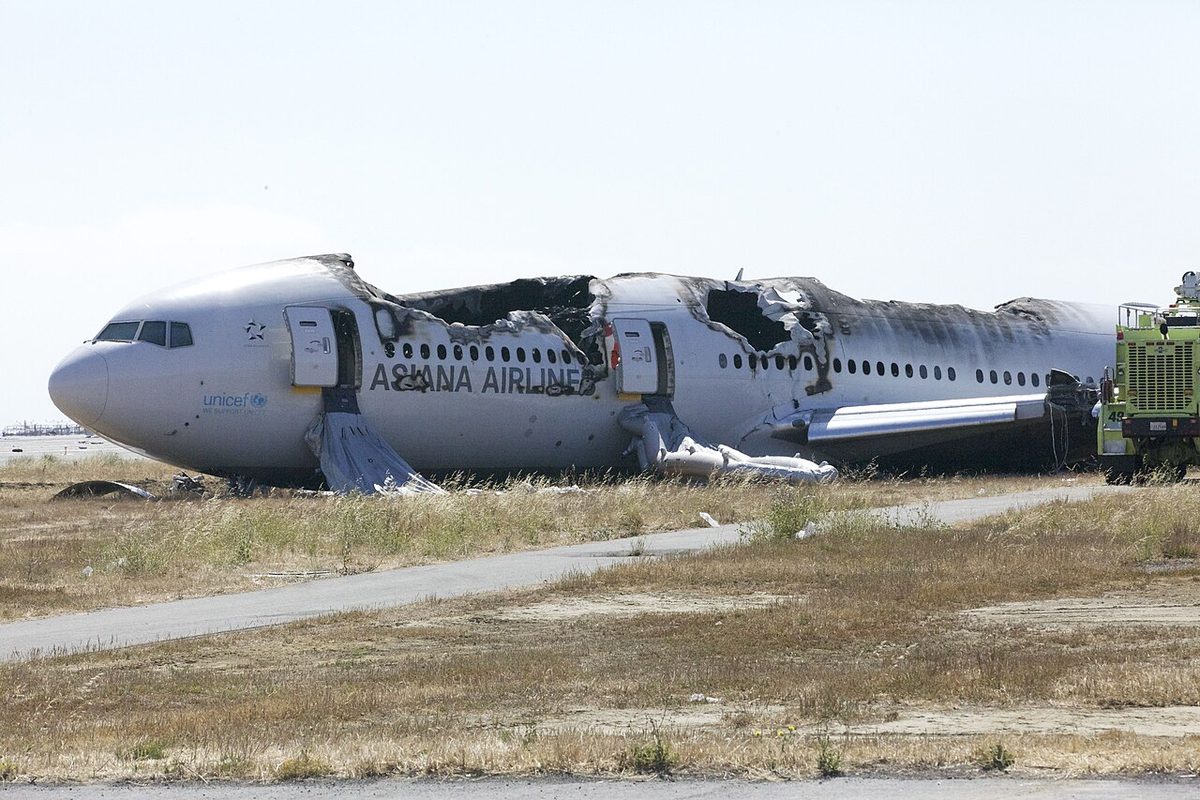
The two accidents sit at opposite ends of the energy scale, one high and fast, the other low and slow. In both, the crew continued below the gate with the criteria plainly not met, when a go-around was still available.
Frequently asked questions
What are the stabilised approach criteria?
In the Flight Safety Foundation version, the aircraft is on the correct flight path with only small heading and pitch changes needed, at a speed between VREF and VREF + 20 kt, in the landing configuration, descending at no more than 1,000 ft/min, with thrust appropriate and above the approach minimum, and with all briefings and checklists complete. On an ILS it must be within one dot of the localiser and glideslope.
At what height must an approach be stabilised?
The Flight Safety Foundation gates are 1,000 ft above airport elevation in instrument conditions and 500 ft in visual conditions, and most operators use them. EASA's acceptable means of compliance expects stabilisation by 1,000 ft above runway threshold elevation on a straight-in approach flown without visual reference. Operators may publish other heights, and the gate in the operations manual is the one that applies.
What should a pilot do if the approach is not stabilised at the gate?
Go around. An approach that is not stabilised at the gate, or becomes unstable below it, requires an immediate go-around under the Flight Safety Foundation criteria and in airline procedures. Either pilot may call it and the pilot flying executes it without debate. Some procedures, such as Airbus's, allow the approach to continue only if the crew judges that small corrections will restore every criterion.
Why do so many pilots continue unstable approaches?
A study for the Flight Safety Foundation found that only about 3% of unstable approaches end in a go-around, so 95 to 97% continue to land. Crews who pressed on reported more pressure to land, less confidence that the other pilot would support a go-around, discomfort with challenging, and inhibition caused by the cockpit authority structure. No-fault go-around policies and monitoring training target those factors.
What is a steep approach?
An approach flown on a glide path noticeably steeper than the usual 3°. Under EASA rules, steep approach operations with a glideslope of 4.5° or more and a screen height of less than 60 ft, but not less than 35 ft, need prior approval from the authority. London City's 5.5° ILS is the best-known example. Aircraft need certified procedures and crews need specific training.
Test yourself on Stabilised Approach
The v1prep banks cover this topic in Operational Procedures (070), with a worked explanation for every answer. EASA ATPL, PPL, IR and CPL, the FAA written tests and A320/B737 type ratings.
Start practising →Sources and further reading
- Flight Safety Foundation, ALAR Briefing Note 7.1, Stabilized Approach
- Flight Safety Foundation, Go-Around Decision-Making and Execution Project, Final Report
- EASA, AMC and GM to Part-CAT (AMC1 CAT.OP.MPA.115, Approach flight technique)
- UK CAA Regulatory Library, CAT.POL.A.245 Approval of steep approach operations
- FAA AC 91-79B, Aircraft Landing Performance and Runway Excursion Mitigation
- NTSB AAB-02/04, Southwest Airlines Flight 1455, Boeing 737-300, Burbank, California
- NTSB AAR-14/01, Asiana Airlines Flight 214, Boeing 777-200ER, San Francisco, California
Library articles are written for study and exam preparation. They do not replace your aircraft's approved documentation, your operator's procedures or the regulations themselves.