Gas Turbine Ignition, Flameout and Relight
The ignition system of a gas turbine uses high-energy igniter plugs to light the fuel during a start and to relight it after a flameout, the unintended extinction of combustion. Continuous or automatic ignition guards against flameout, and a flamed-out engine can usually be relit in flight inside its relight envelope.
Once a gas turbine is running, its flame sustains itself: fuel sprays continuously into a burning primary zone, and no further spark is needed. The ignition system is therefore used only to light the engine during a start, to protect the flame when conditions threaten it, and to relight the engine if the flame goes out. That last event, the unintended extinction of combustion, is a flameout, or flame-out.
A flameout is not the same as an engine failure. The engine is usually undamaged; it has simply lost its flame, and it runs down to windmilling speed. If the cause has passed and the aeroplane is inside the engine's relight envelope, it can normally be relit. This article covers the ignition hardware, the use of continuous and automatic ignition, the causes of flameout and the in-flight relight. The engine failure drills that surround it, including the dual engine failure, are covered in engine failure and engine fire.
High-energy ignition units and igniters
A gas turbine's engine ignition system has to light a fuel spray in a fast-moving airflow, sometimes in the thin, cold air of high altitude after a flameout. It uses a far stronger spark than a piston engine. A high-energy ignition unit (HEIU), also called an ignition exciter, supplies the sparks to an igniter plug in the combustion chamber. The ATPL texts give an output of about 12 joules. Some engines have both outputs: a high-energy one for starting and for relighting at altitude, where air density and fuel vaporisation are poorest, and a low-energy one for continuous ignition. Each unit sparks about 60 to 100 times a minute, so someone listening at the jet pipe with the ignition selected hears the unsynchronised beat of two units firing independently.
Airliner engines have two igniters or ignition channels, with supplies chosen to keep ignition available after electrical failures:
- On the A320, igniter A is powered from the AC ESS bus, transferring to the static inverter bus when the static inverter is operating, and igniter B from the AC normal bus.
- On the Boeing 737, the left igniter is powered from the associated AC transfer bus and the right from the AC standby bus.
- The E190-E2 uses one dual-channel exciter supplied from the DC essential buses.
Only one igniter is needed for a normal ground start, so the two share the work. The A320 FADEC alternates igniter and FADEC channel over successive automatic ground starts, so that both igniters wear evenly, while 737 crews select IGN L or IGN R and alternate on subsequent starts; the selection applies to both engines. On the A320, both igniters are used for a manual start, an in-flight start and continuous ignition. After a normal start the igniters are switched off automatically, in the ATPL texts' description by a speed switch once the engine is past self-sustaining speed (see gas turbine engine starting).
Continuous and automatic ignition
Continuous ignition keeps the igniters firing while the engine runs, so that if the flame is blown out it is relit at once. It is selected when the flame is at risk:
- take-off and landing on runways with standing water or other contamination;
- heavy rain or hail, falling or expected after take-off;
- severe turbulence;
- engine anti-ice operation;
- operation near volcanic ash;
- an emergency descent, on both the A320 and the 737.
On the Boeing 737 NG, ignition is a limitation for take-off, landing, operation in heavy rain and anti-ice operation. The ENGINE START switch has four positions: GRD for ground starts; OFF, from which the automatic relight logic can still fire both igniters; CONT, which fires the selected igniters while the engine runs with the start lever at IDLE, and both igniters in flight if N2 falls below idle; and FLT, which fires both igniters. On the A320, continuous ignition is selected with the ENG MODE selector at IGN/START, and a green IGNITION memo shows when it is active.
Automatic ignition is continuous ignition switched on by the aircraft. On the A320 it comes on whenever engine anti-ice is selected ON and after a flameout in flight. The ATPL texts also describe systems in which the stall warning system selects continuous ignition, because a stall can disturb the airflow into the engines.
Exam tip: High-energy ignition is used for starting and for relighting at altitude. Continuous, often low-energy, ignition is used for take-off from contaminated runways and flight through heavy precipitation or severe turbulence.
Causes of flameout
The flame needs fuel and air in the right proportions, and a flameout follows when either fails.
- Fuel: exhaustion, starvation through mismanagement, contaminated fuel, or air collecting in a suction feed line in the climb, which the 737 manual warns can cause thrust deterioration or flameout at high altitude (see gas turbine engine fuel system).
- The combustion stability loop: a flame burns only between a rich and a weak limit of air-fuel ratio, and the band narrows as the air mass flow through the chamber rises. At high altitude and high airspeed the margin is smallest, and too sudden a change in fuel flow can take the mixture outside it (see combustion chambers and turbines).
- Compressor stall or surge, which disrupts the airflow into the combustion chamber (see gas turbine intakes and compressors).
- Ingestion: heavy rain and hail, ice shed into the engine from an intake left without anti-ice, birds, and volcanic ash, whose glassy particles melt in the hot section, re-solidify on the turbine and can make the engine surge and flame out (see volcanic ash).
- Severe turbulence, which disturbs the intake airflow and is one reason for continuous ignition and the correct turbulence penetration speed and thrust setting.
Some causes act on every engine at once. On 15 January 2009 an A320, US Airways Flight 1549, lost thrust on both engines after flying into a flock of Canada geese at about 2,800 ft above the ground and ditched on the Hudson River (see bird strike and foreign object damage). In 1982 British Airways Flight 9, a Boeing 747, temporarily lost all its engines in volcanic ash over Java, and the crew restarted them.
A flameout shows first as a rapid, uncommanded fall in N2, which is also how the 737's engine control detects one. On the E190-E2, an amber FAIL on N1 with red oil pressure and no fire warning or loud noise points to a flameout, handled with the ENG FAIL procedure.
Water ingestion
Engines are designed to swallow rain, but not unlimited quantities of it. In the strong updraughts of a thunderstorm, raindrops can be held aloft until the water concentration exceeds the limits for which some turbine engines are designed, and flameout or engine damage can follow. It is one more reason why thunderstorms are avoided rather than penetrated (see thunderstorms).
Water also enters on the runway, as spray thrown up by the wheels from standing water; the nose-wheel tyres of many aircraft carry chines that deflect it away from the engine intakes. Continuous ignition is therefore selected for take-off and landing on runways with standing water and whenever heavy rain is falling or expected, so that the engine relights itself if the flame is quenched.
Windmilling engines
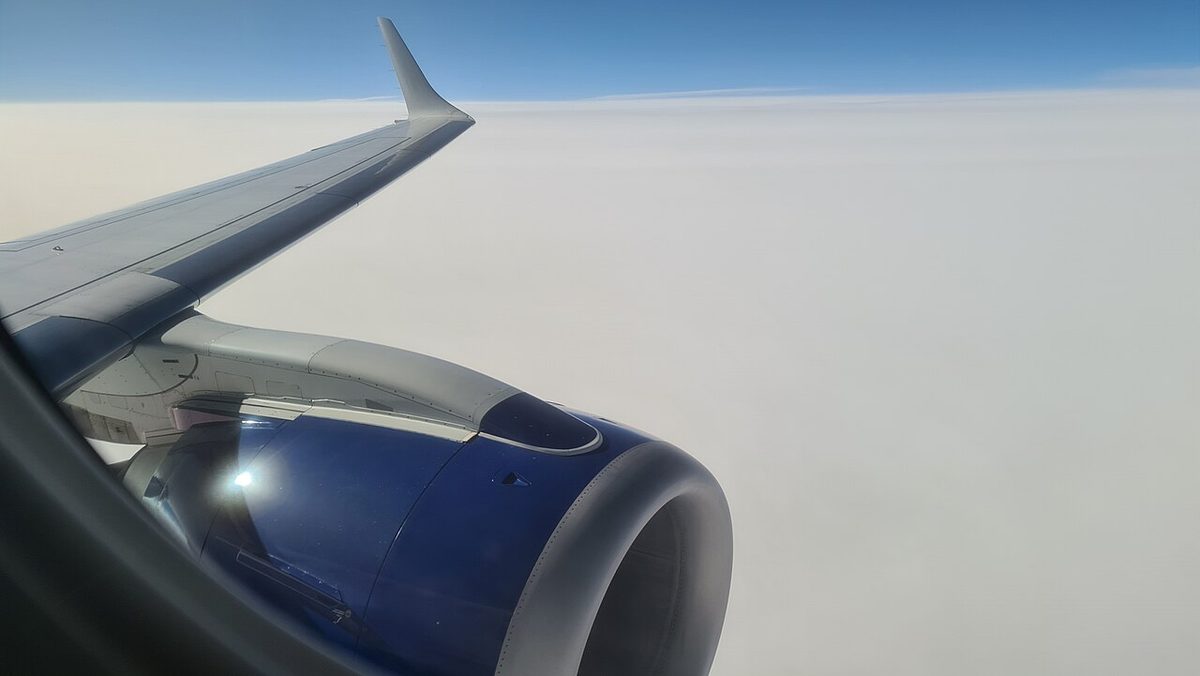
An engine that has flamed out keeps turning in the airflow, like a propeller driven by the wind. This windmilling keeps air moving through the compressor, and at high enough airspeed it turns the HP spool fast enough for combustion. A windmilling start then needs only fuel and ignition, the HP fuel valve opened and the igniters selected, without the starter.
Windmilling has side effects. A windmilling engine produces drag, not thrust, and its oil may not return to the tank. On the 737, an oil quantity indication as low as zero is normal when windmilling N2 is below about 8%, and at low N2 during an in-flight start the scavenge pump may not return enough oil, giving a low quantity indication.
In-flight relight and the relight envelope
An in-flight relight, or airstart, is possible only within the in-flight relight envelope, a chart of altitude against airspeed in the flight manual. The envelope has two parts. At higher airspeeds a windmilling relight is possible. At lower airspeeds the windmilling speed is too low and the starter must assist, with air from the APU or, through the crossbleed, from another running engine. The Boeing 737 lists exactly these two methods, windmill and crossbleed, and shows a magenta X-BLD indication above the N2 dial when crossbleed air is recommended. The APU cannot help at every altitude: on the A320, APU bleed for engine starting is limited to 20,000 ft.
After a flameout at high altitude and high airspeed, the combustion stability loop is at its narrowest. The standard technique is therefore to descend and reduce speed to bring the engine inside the envelope before attempting a relight.
The relight itself is a start without the ground protections. The A320 FADEC and the 737 EEC abort automatically only on ground starts, and on the E190 E1 the crew must abort an in-flight start themselves if there is no light-off within 30 seconds. On the A320, both igniters fire as soon as the ENG MASTER is set ON in flight, and the HP fuel valve opens above 15% N2. On the 737, when only the EGT redline is shown during an in-flight start, it is the in-flight start limit.
If thrust is lost on both engines, the Boeing 737 recall items select the ENGINE START switches to FLT and the start levers to CUTOFF, then return the start levers to IDLE detent once the EGT is decreasing, repeating the cycle as needed; on the NG, an engine reaching 950 °C EGT has its start lever cycled to CUTOFF and back to IDLE detent.
Warning: An engine shut down for fire or showing signs of severe damage is not relit. A relight is attempted after a flameout whose cause has passed: once clear of volcanic ash or heavy precipitation, or once the fuel supply has been restored.
Automatic relight systems
Modern engine controls do not wait for the crew. Automatic relight, or auto-relight, detects a flameout and fires the igniters at once, without waiting for a crew action.
- On the Boeing 737, whenever the EEC detects a flameout, from an uncommanded rapid decrease in N2 or N2 below idle, both igniters are activated, even with the ENGINE START switch at OFF.
- On the A320, continuous ignition comes on automatically after a flameout in flight.
- On the E190-E2, the FADEC selects continuous ignition when it detects a flameout.
Automatic relight has limits. It reacts only after the flame has gone out and relights the engine only if the cause, a slug of water or a disturbed airflow, has passed. That is why continuous ignition is still selected in advance when heavy rain or severe turbulence is expected. If the engine does not recover, the crew handle it as an engine failure, and any later relight attempt is made deliberately, inside the envelope.
Frequently asked questions
What is the difference between continuous and automatic ignition?
Continuous ignition keeps the igniters firing while the engine runs, so that the flame is relit at once if it goes out. Crews select it in conditions that threaten the flame, such as heavy rain, severe turbulence, contaminated runways and engine anti-ice use. Automatic ignition is switched on by the aircraft itself: on the A320 when engine anti-ice is selected or a flameout is detected in flight, and on the Boeing 737 when the engine control senses a rapid, uncommanded fall in N2.
What causes a jet engine flameout?
A flameout happens when the fuel or the air can no longer sustain the flame. Fuel causes include exhaustion, starvation and air in a suction feed line at altitude. Air causes include operation outside the combustion stability loop at high altitude and speed, compressor stall or surge, and ingestion of heavy rain, hail, ice, birds or volcanic ash. Many flameouts leave the engine undamaged, so it can be relit once the cause has passed.
What is a windmilling relight?
When an engine flames out in flight, the airflow keeps its rotors turning, or windmilling. At high enough airspeed the windmilling compressor delivers enough air for combustion, so the engine can be relit with only fuel and ignition, without the starter. At lower airspeeds the windmilling speed is too low, and the starter must assist, using bleed air from the APU or, through the crossbleed, from another engine.
What is the relight envelope?
It is the range of altitude and airspeed, published in the flight manual, in which an in-flight relight is expected to succeed. Its limits exist because at high altitude and high airspeed the combustion stability loop is at its narrowest and a relight is difficult. Part of the envelope allows windmilling relights, and a lower-speed part needs starter assistance. After a flameout at high altitude the crew descend and adjust speed to bring the engine inside the envelope.
How much energy does a jet engine igniter deliver?
The ATPL texts give a high-energy ignition unit an output of about 12 joules, because it must light a fuel spray in a fast airflow, including at high altitude after a flameout. Some engines also have a low-energy output for continuous ignition. Each unit sparks at about 60 to 100 times a minute.
Test yourself on Gas Turbine Ignition, Flameout and Relight
The v1prep banks cover this topic in Aircraft General Knowledge (021), with a worked explanation for every answer. EASA ATPL, PPL, IR and CPL, the FAA written tests and A320/B737 type ratings.
Start practising →Sources and further reading
- FAA Aviation Maintenance Technician Handbook, Powerplant (FAA-H-8083-32B)
- EASA, Explanatory Note to ED Decision 2018/001/R, Part-FCL theoretical knowledge learning objectives (021 Powerplant)
- EASA Easy Access Rules for Engines (CS-E)
- 14 CFR Part 33, Airworthiness Standards, Aircraft Engines
- NTSB AAR-10/03, Loss of Thrust in Both Engines After Encountering a Flock of Birds and Subsequent Ditching on the Hudson River, US Airways Flight 1549
- SKYbrary, Volcanic Ash
Library articles are written for study and exam preparation. They do not replace your aircraft's approved documentation, your operator's procedures or the regulations themselves.