Top 50 A320 Interview Questions (FCOM-Sourced Answers)
LAST UPDATED: 24 MAY 2026
Published Apr 2026~18 min readFCOM & FCTM sourcedConversational style
These are the questions you'll actually hear in airline interviews and type-rating orals — not because we asked theoretical pilots what might come up, but because they're pulled from the same 16,000+ question bank that pilots have been using to prep with v1prep. Every answer is sourced from the Airbus FCOM, FCTM, or relevant ICAO/EASA documentation.
Tone here is conversational. The textbook gives you the fact. We tell you what the interviewer actually wants to hear — the why behind the what, the operational consequences, and the quick "if/then" rule that proves you understand the system.
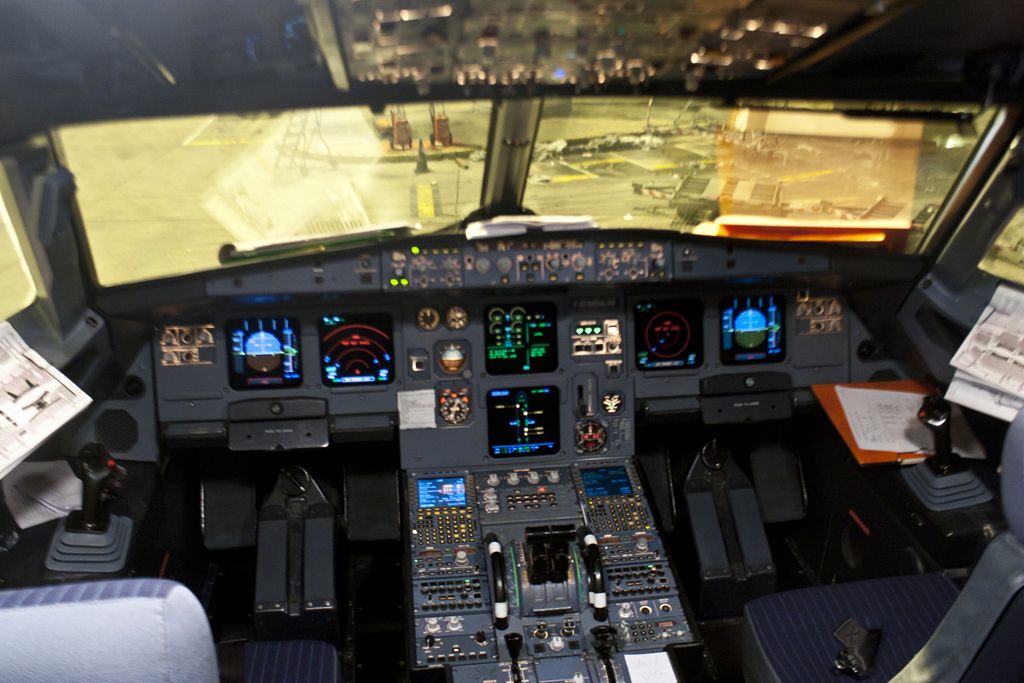
The flight deck of an Air France Airbus A320: six display screens, the pedestal with the thrust levers, and a sidestick on each side console instead of a control column.Photo: Louis from Paris, France · CC BY-SA 2.0 · Wikimedia Commons
How many hydraulic systems does the A320 have, and how are they driven?
Three independent systems: Green, Yellow, and Blue, each operating at 3,000 PSI. Green is driven by an engine-1 driven pump (EDP), Yellow by an engine-2 driven EDP, and Blue by an electric pump (plus the RAT in extremis). What your interviewer wants to hear: three is for redundancy, and the asymmetric sourcing means losing one engine doesn't disable a second hydraulic system.
Question 2
What does the PTU do and when does it activate?
The Power Transfer Unit (PTU) mechanically transfers power between Green and Yellow systems without mixing fluids. It's a back-to-back hydraulic motor + pump. It activates automatically when the differential pressure between Green and Yellow exceeds ~500 PSI. Classic example: on the ground with the engines stopped, the yellow electric pump runs and the PTU pressurises Green from Yellow; that is the "barking" you hear. It is inhibited during the first engine start and during cargo door operation, and automatically tested during the second engine start.
The A320 PTU in 40 seconds: what it transfers, when it runs by itself, when it is inhibited, and what its FAULT light means. Silent.v1prep animation, built from the FCOM-sourced A320 bank. For study only; always follow your FCOM.
Question 3
Which hydraulic system powers the landing gear?
Green system, normal extension and retraction. If Green fails, gravity extension is available — manual handle on the centre pedestal, gear free-falls and locks down with airflow. Brakes follow a different logic: Green for normal braking, Yellow for alternate braking, and the brake accumulator (Yellow-charged) gives you ~7 brake applications even with both systems lost. Knowing the brake source priority is a common follow-up.
Question 4
What is the RAT and when does it deploy?
Ram Air Turbine — a wind-driven propeller that drops out of the right wing-to-fuselage fairing. It powers the Blue hydraulic system and (via Blue) drives the emergency generator. Auto-deploys when both AC buses are lost in flight (effectively a dual-engine failure) AND speed is above 100 kt. It can also be manually deployed from the overhead RAT MAN ON pushbutton. Most pilots never see it deploy — but every pilot should know exactly when it would.
Question 5
If you lose the Green system, what's the operational impact?
You lose: normal landing gear extension/retraction, normal nose wheel steering, normal braking, half the spoilers, half the elevators, the inner ailerons. You keep: Yellow brakes (alternate), gravity gear extension, all flight controls (degraded but flyable). The QRH "HYD G SYS LO PR" procedure walks you through it. The interviewer's follow-up: "and how does that affect your landing distance?" — significantly, because of degraded braking and no thrust reverser on engine 1.
Practice 124 hydraulic system questions with FCOM explanations.
IDGs, AC/DC architecture, the moment the RAT drops
Question 6
Describe the A320 electrical architecture in one minute.
Two engine-driven IDGs produce 115V AC at 400 Hz, each feeding its respective AC bus (AC BUS 1 and AC BUS 2). The APU generator (also 115V/400Hz) can replace either IDG. External ground power plugs into the same architecture. DC is via TRUs (Transformer Rectifier Units) — TR1 from AC1, TR2 from AC2, ESS TR for the essential bus. Two main batteries (BAT 1 and BAT 2) provide DC backup. The Static Inverter generates emergency AC from DC battery power when all else fails.
Question 7
What is EMER ELEC configuration and how does it activate?
Emergency Electrical Configuration — the state where both AC buses have been lost in flight. The RAT auto-deploys, drives the Blue hydraulic system, which drives the EMER GEN. The EMER GEN powers AC ESS bus only. The Static Inverter converts DC battery power into AC ESS until RAT speed is high enough. Significant items lost: most lighting, second pack, F/O instruments, autopilot 2. You're flying on essentials only.
Question 8
What's the difference between the AC ESS bus and the AC BUS 1?
AC ESS is a special priority bus that's normally fed from AC BUS 1 but can be re-routed from AC BUS 2 via the AC ESS FEED switch. It feeds the captain's primary instruments, FAC1, ELAC1, and other "must-have" equipment. In EMER ELEC, only AC ESS gets power (from EMER GEN or Static Inverter). The point: even with one AC bus lost, the captain still flies normally because AC ESS is preserved.
Question 9
How long do the batteries last in EMER ELEC?
Approximately 30 minutes minimum with the RAT inoperative or below 100 kt. With RAT operating normally, the batteries are kept charged and the duration is effectively unlimited (until you land). The 30-minute figure assumes worst-case battery-only operation — that's why the QRH "EMER ELEC CONFIG" procedure prioritises landing within 30 min. If you're transoceanic, this is sobering.
Question 10
What does "IDG fault" tell you and what's the action?
An IDG fault means the Integrated Drive Generator is malfunctioning — typically high oil temperature or low oil pressure. The associated GEN fault light comes on, ECAM caution. Action: ECAM displays "ELEC IDG 1 (2)" — the procedure offers to disconnect the IDG (orange guarded button on the overhead). Once disconnected, you cannot reconnect in flight — the disconnection is permanent for the rest of the flight, requiring maintenance ground reset. The bus is then powered by the APU GEN or via bus tie from the other IDG.
Drill electrical procedures with 230 ATA 24 questions from real FCOM situations.
Where does engine bleed air normally come from, and why?
Normally from the intermediate-pressure (IP) stage of the HP compressor — minimises fuel penalty. At low engine power (descent, idle), IP pressure is too low, so the system switches automatically to HP bleed, regulated to ~36 PSI. The delta — IP at high power, HP at low power — is the canonical question. The bleed valve itself regulates downstream delivery to ~45 PSI at the precooler inlet.
Question 12
What does the X-bleed valve do?
The crossbleed valve connects the left and right pneumatic manifolds. Three positions: AUTO (default), OPEN (manual), SHUT. In AUTO, it opens automatically when the APU is supplying bleed air (so APU bleed reaches both packs) and closes if a leak is detected. Closes during engine start to prevent reverse flow. The interviewer might ask: "what fails first if both engines lose bleed?" Answer: you can't start the second engine if APU bleed is also unavailable, because there's no source.
Question 13
What's the maximum altitude for APU bleed?
FL200 with two packs running, FL225 with one pack, and engine start with APU bleed up to FL200. Above these limits, APU pressure is insufficient. APU electrical generation continues to FL410, but bleed is the harder constraint. Wing anti-ice from APU bleed is never permitted at any altitude — pressure too low.
Question 14
If you get a "WING A. ICE OPEN ON GND" warning, what does it mean?
On the ground, when WING ANTI-ICE is selected ON, the valves open for a 30-second test cycle, then close automatically. If they remain open more than 35 seconds, this warning fires (Single Chime + Master Caution). The reason it matters: hot bleed air without cooling airflow can damage the slat leading edges. Action: select wing anti-ice OFF and check ECAM.
Question 15
What's the precooler outlet temperature limit, and what triggers an overheat?
Three time-temperature thresholds, all triggering ENG BLEED FAULT: 290°C for >5 sec, 270°C for >15 sec, or 257°C for >55 sec. The lower long-duration threshold is what catches a slow overheat that the high-temp/short-time threshold would miss. Phase inhibits 3, 4, 5, 7, 8 (no nuisance warnings during takeoff/landing/climb/descent).
Master 91 pneumatic system questions covering every BMC threshold and ECAM message.
CFM56-5B vs IAE V2500, FADEC architecture, thrust ratings
Question 16
What does FADEC stand for and what are its two main functions?
Full Authority Digital Engine Control. Two functions: (1) fuel metering — computes precise fuel flow based on thrust lever position, optimised for all flight phases; (2) engine management — controls VBVs, VSVs, ignition, start sequence, EGT limiting, surge protection, reverser logic. Each engine has its own dual-channel FADEC (channels A and B) — only one channel is active at a time, the other monitors. Auto-switch on active channel fault.
Question 17
What's the difference between the CFM56-5B and the IAE V2500 from the cockpit?
Cockpit-wise, the main difference is the primary thrust parameter: CFM uses N1 percentage, IAE uses EPR. The ECAM ENGINE page layout adapts accordingly. EGT limits look different (CFM ~950°C, IAE ~635°C) but that's because the EGT probes are at different turbine stages — not because the engines run cooler. SOPs and checklists are otherwise identical.
Question 18
What is FLEX takeoff and what are its limits?
Reduced thrust takeoff using an assumed temperature higher than actual OAT. The FADEC computes thrust as if it were that hotter day, producing less thrust — saves engine wear, reduces noise. Limits: FLEX temp must be ≥ OAT + 5°C, ≤ ISA + 53°C, and the aircraft must still meet all CS-25 requirements at actual conditions. Prohibited on contaminated runways. Entered in MCDU PERF TAKEOFF.
Question 19
If a thrust lever is between two detents, which limit does the FADEC apply?
The higher detent. Per FCOM 1.70 p. 11, if the thrust lever is between two detents, the FADEC selects the rating limit corresponding to the higher position. Common gotcha — many pilots intuit "the lower one for safety," which is wrong. Knowing the right answer here flags you as someone who actually read the FCOM rather than relying on lore.
Question 20
What happens if you lose both FADEC channels on one engine?
Loss of both channels means loss of engine control. The engine reverts to its last commanded state (the FADEC failsafes to held position). Practically: thrust freezes at the last commanded value. ECAM caution. Action: shut down the engine using the engine master switch. The dual-channel FADEC was specifically designed so this scenario is extremely unlikely — but pilots are expected to know what to do.
What are the three flight control laws on the A320?
Normal Law (full envelope protection — load factor, pitch attitude, AoA, bank angle, high speed); Alternate Law (load factor protection retained, but high AoA replaced by low-speed stability; bank angle and pitch attitude protections lost); Direct Law (stick-to-surface, no protections, lands like a conventional aircraft). "And mechanical backup?" the interviewer often follows — pitch via THS trim wheel, yaw via rudder pedals, NO roll control.
Question 22
What triggers a transition from Normal to Alternate Law?
Loss of redundancy: dual ADR failure, dual IR failure, triple ADIRU disagreement, dual ELAC failure, or loss of all engines. The flight controls page on ECAM shows the active law. The transition is annunciated by "USE MAN PITCH TRIM" (in Alternate without protections, you may need to manually trim — though Alternate WITH protections still auto-trims). Practically: the side-stick still moves the surfaces, but the protections that prevent the airplane from departing controlled flight are gone.
Question 23
What is alpha floor and when does it activate?
Alpha floor is an autothrust protection that automatically applies TOGA thrust when angle of attack exceeds a threshold (~9-15° depending on flap config). Active in Normal Law only, between liftoff and 100 ft RA on go-around. Independent of A/THR engagement state. Recovery: pilot pitches down, alpha falls below threshold, A/THR returns to normal. The "TOGA LK" annunciation persists until the pilot manually deselects (push instinctive disconnect).
Question 24
What's the maximum bank angle protection in Normal Law?
67° in roll with full sidestick deflection. Above 33° bank, releasing the sidestick causes the aircraft to auto-roll back to 33°. Maximum positive load factor is +2.5g clean (+2.0g with flaps). Pitch attitude limited to +30° nose up, -15° nose down. These protections give you a "you can't break the airplane" envelope — the entire FBW philosophy in one sentence.
Question 25
What's the difference between Direct Law and Mechanical Backup?
Direct Law still uses the FBW computers — the side-stick electrically commands surface deflection proportionally, just without protections or stabilities. Mechanical Backup bypasses the FBW computers entirely: pitch via the THS trim wheel (mechanical cables), yaw via direct rudder pedal-to-rudder cables. NO roll control in mechanical backup. It's a "land ASAP" condition — the FCOM literally says so.
All flight law transitions, protections, and reconfiguration logic — practice in v1prep.
Electrical power (115V AC, 400 Hz) and bleed air, plus optional starting power. On the ground, the APU makes the aircraft self-sufficient (no GPU/ASU needed). In flight, it backs up the electrical system and air conditioning, and can be used to start the engines after a shutdown. The APU is a single-shaft gas turbine with an integral load compressor, drawing fuel from the left wing tank.
Question 27
Up to what altitude can the APU be started?
FL250 (25,000 ft) battery-only start; up to FL410 with normal AC electrical power available on later variants. The starter is a DC electric motor — requires battery or DC bus power. Above FL250 on battery alone, the air is too thin for reliable light-off. APU running ceiling: FL410 (~41,000 ft) on current variants — that's running, not starting.
Question 28
What happens if you get an APU fire on the ground vs in flight?
On the ground: APU shuts down automatically AND the fire extinguisher discharges automatically — even with no crew in the cockpit. A horn sounds in the nose gear bay (audible to ground crew). In flight: the warning is presented to the crew, but discharge is manual via the APU FIRE handle. The asymmetric logic protects an unattended aircraft on the ground while preserving crew judgement in flight.
Question 29
What's the APU EGT max and how is it calculated?
Calculated by the ECB (Electronic Control Box) and transmitted to the ECAM. EGT max varies with N during start and with ambient temperature when running. Typical limits: ~1090°C transient during start, ~675°C continuous running. The amber threshold appears at EGT max minus 33°C, giving the crew margin before red-line. Auto-shutdown if exceeded.
Question 30
If APU bleed is in use, what happens when you select MASTER SW OFF?
The APU runs for 60 more seconds, cooling itself before shutting down. This prevents thermal coking in the fuel nozzles. If APU bleed wasn't being used, the cooling run is skipped (it shuts down promptly). The cooling run is fully automatic — the crew doesn't have to wait, just confirm AVAIL light extinguishes.
112 APU questions from real FCOM thresholds and ECAM messages.
Three tanks: left wing (inner + outer cell), right wing (inner + outer cell), and centre tank in the wing-fuselage centre section. Total capacity ~24,200 litres. The wings are divided into inner and outer cells with surge tanks at the wing tips. Centre tank is consumed first, then wing tanks. The outer wing cells transfer to the inner cells by gravity when the inner level drops to ~750 kg.
Question 32
In what order are the fuel tanks consumed?
Centre tank first, then wings simultaneously. The centre tank pumps run at higher pressure than the wing pumps, so when both are running, fuel flows from the centre tank to the engines first. Centre pumps auto-stop when the centre tank is empty; wing pumps then take over. Outer wing cells transfer to inner cells by gravity. The aim is to keep wings heavy as long as possible for structural reasons (less wing bending moment).
Question 33
What does the X-feed valve do, and when is it used?
The cross-feed valve (a single valve, manually controlled) connects the left and right engine feed lines. In normal ops, each engine feeds from its own side. The X-feed is used only to correct fuel imbalance between wings: open the valve, and the higher-pressure side feeds both engines, draining preferentially from the heavier side. Close it once balance is restored. Critical: never operate engines with X-feed open during takeoff or landing — single-source failure becomes a both-engines failure.
Question 34
What's the fuel imbalance limit?
Per FCOM, no more than 1500 kg difference between wings under normal conditions; check the QRH for specific limits during failures. An imbalance triggers an ECAM "FUEL L+R WING TK LO LVL" or similar caution. The X-feed valve is opened to correct it. Operationally, pilots check fuel quantities at every level-off and during cruise to catch a slow imbalance early.
Question 35
What's the minimum fuel quantity for takeoff?
Operator-specific — based on company OM-A and the regulatory minimum. Typical breakdown: trip fuel + contingency (5% or 5 min holding) + alternate fuel + final reserve (30 min holding at 1500 ft AAL) + extra fuel + taxi fuel. The crew computes this on the operational flight plan. Interviewer's follow-up: "and what's the absolute minimum landing fuel?" Answer: final reserve — landing with less is a fuel emergency.
Practice fuel system management in v1prep's ATA 28 bank.
Slats 3, 4, and 5 on each wing (the outboard slats, where ice accretion most affects stall performance), plus the engine inlet cowls. Note what's NOT anti-iced: the horizontal stabiliser, vertical stabiliser, and inboard slats 1-2. The reason: certified ice accretion on those surfaces doesn't degrade controllability significantly.
Question 37
What heats the wing anti-ice — and where does the air come from?
Hot bleed air from the engines. One wing anti-ice valve per wing — independent — controlled by the BMC. APU bleed cannot supply wing anti-ice (insufficient pressure). If a leak is detected during operation, only the affected side's valve closes — the unaffected side keeps protecting that wing. Critical for asymmetric leak handling.
Question 38
When does ICE DETECTED appear on ECAM?
Four conditions, all required: ≥ 1500 ft AGL, TAT < 10°C, ice detected by at least one of two ice detector probes, AND ENG A. ICE pushbutton at OFF. The intent: alert the crew when icing is sensed but engine anti-ice hasn't been turned on. If ENG A. ICE is already ON, the message is suppressed — no need to nag the crew about a problem they're already managing.
Question 39
What's the difference between ICE DETECTED and SEVERE ICE DETECTED?
Same gating conditions (1500 ft, TAT, detector). The difference: ICE DETECTED = normal icing, ENG A. ICE pb OFF (prompt to turn on engine anti-ice). SEVERE ICE DETECTED = heavy icing, WING A. ICE pb OFF (prompt to turn on wing anti-ice). The two warnings prompt the crew to activate the appropriate level of anti-ice for the icing severity encountered.
Question 40
In EMER ELEC, which probe heats stay powered?
Captain's probes only. The Captain PHC (Probe Heat Computer) is supplied from AC ESS bus, which survives EMER ELEC. F/O PHC and Standby PHC are on DC2 and DC1 respectively — both lost in EMER ELEC. Captain's primary instrumentation stays heated and reliable. The F/O is reading the same captain-side data via cross-feed at that point — flying as a crew off one set of probes.
62 ice and rain protection questions covering every threshold and ECAM trigger.
~8,000 ft at FL390 (cruise). The Cabin Pressure Controller (CPC) schedules cabin altitude as a function of aircraft altitude, keeping cabin altitude below 8,000 ft at all normal cruise altitudes. The schedule is automatic — pilots don't manually set the cabin altitude. If you see cabin altitude exceeding 8,000 ft in cruise, something's wrong — usually a packs failure or pressurisation system fault.
Question 42
What's the maximum differential pressure?
9.0 PSI normal, with safety relief valves opening at 8.6 PSI. Above this, the structural certification of the fuselage is exceeded. The CPC actively prevents this by opening the outflow valve as needed. Negative pressure differential limit is much smaller (~1 PSI) — if cabin pressure ever exceeds outside pressure (descending into a high-altitude airport too fast), the safety valves vent inward.
Question 43
When do passenger oxygen masks deploy automatically?
When cabin altitude exceeds 14,000 ft (+0, -500 ft). The asymmetric tolerance means masks may deploy as low as 13,500 ft cabin altitude, but never above 14,000 ft. The pre-recorded PA also activates automatically. HI ALT LANDING mode raises this threshold to 16,000 ft for high-elevation airports (La Paz, Cusco, Quito) where normal pressurisation would otherwise force the cabin above 14,000 ft on approach.
Question 44
How long does the passenger oxygen last after deployment?
About 15 minutes per chemical generator. Each generator feeds a group of 2, 3, or 4 masks (depending on row configuration). The chemical reaction is exothermic — passengers may notice a burning smell, smoke, and rising cabin temperature. This is normal, not an aircraft fire. The crew briefs this awareness because the symptoms are easily misdiagnosed.
Question 45
What does REGUL LO PR indicate on the DOOR/OXY page?
Low pressure on the low-pressure circuit downstream of the cylinder regulator — approximately 50 PSI. This is distinct from the high-pressure cylinder amber threshold at 400 PSI. REGUL LO PR points to a regulator or distribution-system problem, not a depleted cylinder. The cylinder may be full but the masks won't deliver flow reliably. Action: check oxygen quantity vs. minimum and consider the QRH procedure.
Pressurisation, oxygen, emergency descent — practice the full procedure flow in v1prep.
V-speeds, takeoff performance, SOPs that catch candidates out
Question 46
Define V1, VR, V2, and Vref.
V1 — decision speed; below this, you abort, above this, you go. VR — rotation speed; pilot pulls back to begin pitch-up. V2 — takeoff safety speed; minimum safe climb speed with one engine inoperative, ≥ 1.13 × VS1G per CS-25.107. Vref — landing reference speed; 1.23 × VS1 in landing configuration. VLS (the magenta speed) ≈ 1.23 × VS1, displayed during approach as the lowest selectable speed.
Question 47
What's the OEI second segment climb gradient minimum?
2.4% net for twin-engine aircraft per CS-25, gear up, flaps in takeoff config, V2, TOGA on the live engine. The 2nd segment is from gear retraction to the acceleration altitude (~1,500 ft AAL). Net flight path = gross minus 0.8% margin. This is the limiting segment for hot/high departures — RTOW (Regulatory Takeoff Weight) is often constrained by 2nd segment performance.
Question 48
What's the difference between gross and net flight path?
Gross flight path is the actual measured average performance of the aircraft type. Net flight path is gross minus a regulatory gradient decrement (0.8% for twin-engine OEI). The decrement provides safety margin for variability in performance. Obstacle clearance must be calculated against the NET flight path — clearing obstacles by 35 ft on net, not gross.
Question 49
When do you NOT use FLEX takeoff?
Contaminated runway (wet, snow, slush, ice) — full thrust may be needed. Some operators prohibit FLEX with anti-ice ON below certain temperatures. Also: if conditions are at or near the limits of the performance envelope (you need every kg of available thrust). MEL items can also restrict FLEX. "And what if you forget to enter FLEX TEMP and select FLX/MCT detent?" — the engines produce TOGA thrust by default, no warning. Always verify FLEX TEMP before takeoff.
Question 50
What's the reverse thrust deployment logic?
Three conditions, all required: (1) both main gears compressed (LGCIU signals), (2) at least one FADEC channel operating with TLA reverse signal, (3) at least one SEC reverse signal. Before doors are fully deployed, FADEC commands reverse idle thrust. AUTO RESTOW is inhibited in flight and on the ground above 70% N1 — preventing accidental restow during reverse application. Critical safety design: in-flight reversal is mechanically and electrically prevented, after the Lauda Air accident drove industry-wide redesign.
That's 50. There are 16,000+ more.
Every question above is pulled from the v1prep bank — the same one Airbus type-rating candidates use to drill systems, SOPs, and ATPL theory. Sign up free. No credit card. Sourced explanations from the actual FCOM, FCTM, and ICAO/EASA documentation.