ITA Airways Pilot Interview Prep: Process, Sim, Questions (2026 Guide)
LAST UPDATED: 30 AUGUST 2026
ITA Airways is an Italian airline flying an all-Airbus fleet — A220s, A320neo-family narrowbodies, and A330neo and A350 widebodies — from Rome Fiumicino and Milan Linate. Its only published pilot entry route is an ab-initio Multi Pilot Licence cadet programme, roughly 280 pilots over four years, announced in July 2026. This guide sticks to what ITA itself publishes, says plainly where a figure is not published, and gives you ten technical questions with full answers on the aeroplanes it actually flies.
As at 25 August 2026 ITA Airways had no open pilot application of any kind — the MPL cadet posting was offline with no reopening date published, and no direct-entry route was advertised — so check our airline pilot jobs page for the current position.
About ITA Airways
ITA Airways publishes two bases: Rome Fiumicino (FCO), the main hub, and Milan Linate (LIN). It publishes these two as bases and nothing more: it does not publish crew or pilot basing arrangements for either, and it has never named the location of the training centre used for the MPL course. Treat any article that tells you where you would be based, or where you would train, as guessing.
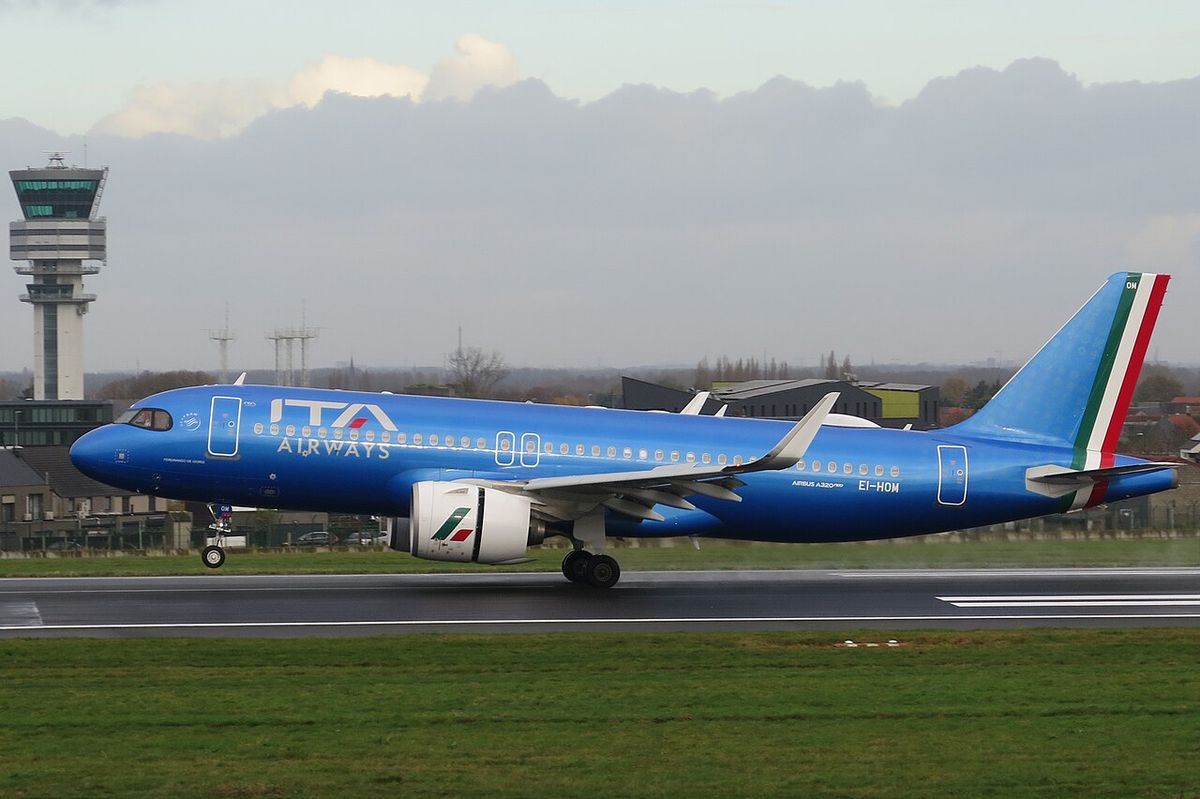
The fleet ITA lists is all-Airbus and current-generation: A220-100 and A220-300, A320neo and A321neo, and long-haul A330-900neo and A350-900. Notice what is missing. The A319 has gone — reported retired, absent from ITA's own fleet page. Third-party trackers still show legacy A320ceo airframes, but ITA does not list the ceo, so prepare the neo.
Two narrowbody families is the fact that should change how you prepare. An A220 is not a small A320. It is a Bombardier-designed fly-by-wire aeroplane flown on a sidestick like the A320, but with its own systems, its own flight-control logic, Pratt & Whitney PW1500G geared turbofans rather than the neo's LEAP-1A or PW1100G, and its own type rating. Two families means two training streams and two sets of procedures — so treat them as two different aeroplanes when you prepare. ITA has not published how cadets are allocated to a fleet, or what its selection looks like.
Lufthansa is reported to hold a minority shareholding in ITA, but ITA's own published recruitment material says nothing about it. Whatever the shareholding, it is not a shared cockpit: ITA publishes nothing about pilot mobility to other Lufthansa Group carriers and nothing about shared selection standards. Do not assert a career path the airline has never described.
Entry requirements
Most guides go wrong here because they copy figures from aggregator sites. ITA publishes entry requirements for exactly one pilot route: the Multi Pilot Licence (MPL) cadet programme announced on 16 July 2026. There is no direct-entry First Officer, type-rated First Officer or Captain route — and so no published hours minimum, type-rating requirement or medical class for experienced pilots.
| Requirement | What ITA Airways publishes |
|---|---|
| Licence | None on entry. Aimed at candidates with no previous flying experience, or limited experience. |
| Total hours | No minimum — zero experience is explicitly accepted. Direct entry: not published. |
| Hours on type | Not published. |
| Type rating | Provided inside the 21-month course. Who pays is not stated. |
| Medical | Not published. ITA names a DLR certification — an aptitude certificate, not a medical. EASA Class 1 is a general prerequisite for commercial training, but ITA does not list it. |
| Language | Excellent Italian, spoken and written, and excellent English. No ICAO level published, no test named. |
| Right to work | Not published by ITA — no nationality, residency or visa condition appears in its material. The Italian-language requirement is the only published de facto constraint. |
| Age | Minimum 17 at selection. No maximum is published. |
| Education | Italian upper-secondary leaving diploma, or equivalent. |
Read the language line twice: it is the hard filter. Excellent written and spoken Italian is a published eligibility condition, not something you promise to fix later. If your Italian is conversational, this route is not open to you.
The published scale is roughly 280 pilots over four years in 21-month courses, the first starting October 2026, and ITA states it is currently the only company certified in Italy to run MPL courses. One caveat: as at 25 August 2026 the vacancy page carrying the full criteria was offline, so it may have held further conditions that can no longer be read. Everything above comes from ITA's 16 July 2026 press release.
The selection process
ITA publishes the shape of its MPL selection and almost none of the detail. Selection runs in-house, and ITA does not publish the stages, their order or the pass criteria. The table keeps that line visible.
| Step | Source |
|---|---|
| Application through ITA's own career portal, where the MPL posting appeared | Published by ITA |
| DLR aptitude certification, required to take part in the selection | Published by ITA |
| Eligibility check: age 17, secondary diploma, excellent Italian and English | Published by ITA |
| Selection run in-house — stages, order and pass marks not stated | Published by ITA |
| A 21-month course: theory, live flying, simulators, company procedures | Published by ITA |
| Three phases of 8 months theory, 7 flying, 6 simulator, ending in an A220 or A320 type rating | Third parties, unverified |
| A partnership with a named flight academy for the flying phase | Third parties, unverified |
| A course cost near EUR 135,000 payable by the cadet | Third parties, unverified |
| A guaranteed First Officer job on completion | Third parties, unverified |
| ATPL requirements, hours minima and assessment formats | Aggregator sites only — untraceable to ITA |
That last row deserves its own warning. Several aggregators publish ITA "hiring requirements" with licence types, hours figures and interview formats. None of it comes from ITA, and some were advertising an ITA cadet application on 25 August 2026, while ITA's own posting was offline. ITA names only two official channels: the Work with Us page on its site and the Job Offers section of its LinkedIn page. Anyone else, especially anyone charging a fee, is not official.
The simulator assessment
Start with what is not there. ITA publishes no simulator assessment profile — no device, no duration, no exercise list. The only assessment instrument it names is the DLR aptitude certification, a ground battery rather than a jet sim. Any article promising "a 90-minute A320 sim with a raw-data ILS and an engine failure" has invented it; the simulators ITA describes sit inside the course, not in front of it.
What is worth knowing is what a line captain watches in any sim check.
- Scan. Raw-data straight-and-level without wandering, and a scan that still works when the flight director is taken away.
- Manual handling. Pitch, power, trim, in that order, anticipating rather than chasing. Over-controlling under observation is the oldest failure mode there is.
- Standard calls. Right moment, right words, unprompted — silence reads as saturation.
- CRM. Can you fly and communicate at once? Brief out loud, state intentions, use the other pilot — silent perfection is a failed CRM assessment.
- Recovery from an unstable approach. Stabilised-approach gates expect the aeroplane configured, on speed, on profile and at a stable descent rate by 1,000 ft IMC or 500 ft VMC. If it is not, the assessed answer is a go-around — flown promptly, called clearly, not salvaged.
Technical questions with answers
An MPL cadet is not expected to arrive knowing jet systems. But the moment you reach a technical conversation — in the course, at a line check, or with any operator on this fleet — these are the sorts of questions any operator on this fleet asks about these aeroplanes. ITA publishes nothing about its own technical question content, so treat this as generic fleet preparation, not an ITA question bank. The first eight are A320-family, with figures from the A320 FCOM and FCTM and from EASA CS-25; the last two are A220, which is a separate study stream with its own manuals. Confirm everything against your own variant. More in our top 50 A320 interview questions.
Walk me through the A320 hydraulic systems, and what the PTU does.
Three independent systems — Green, Yellow and Blue — each at 3,000 psi. Green is driven by an engine-driven pump on engine 1; Yellow by one on engine 2 plus an electric pump and a hand pump for the cargo door; Blue by an electric pump, with the RAT as its emergency source. The PTU is where candidates slip: it is a bidirectional motor-pump that transfers power between Green and Yellow, never fluid, running automatically above roughly 500 psi differential. See our hydraulic system guide.
What are the A320 flight control laws, and what moves you between them?
Normal law gives load factor demand in pitch and roll rate demand in roll, with auto-trim and protections for angle of attack, high speed, pitch attitude, bank angle and load factor. Lose enough redundancy — typically multiple ADR, IR or flight control computer failures — and you drop to alternate law, which keeps load factor demand but trades most protections for low- and high-speed stability. Direct law — entered from alternate law when the landing gear is selected down, or after further failures — maps sidestick directly to surface deflection, with no protections and no auto-trim, so the aeroplane must be trimmed manually. Note that alternate law already gives direct stick-to-surface control in roll. Beneath it all sits mechanical backup: pitch trim wheel and rudder. See our flight control laws guide.
What is a FLEX takeoff, and when may you not use one?
FLEX is the assumed temperature method: you tell the FADEC the air is hotter than it is, and it sets a lower N1 that still meets every certification requirement at the actual conditions. Two rules define it — the assumed temperature must be at or above actual OAT, and the reduction is capped at 25% of full takeoff thrust. The FCTM prohibits reduced thrust on a contaminated runway and with certain items inoperative. TOGA stays available by pushing the levers fully forward. See our FLEX guide and performance guide.
Engine failure at V1 in an A321neo — the first 400 feet.
Past V1 you are going flying. Keep straight with rudder, rotate at VR at a slower rate than normal — of the order of 2 to 2.5 degrees per second — towards the pitch that satisfies SRS, and fly the SRS target, which with an engine failed is V2, or the speed at the moment of failure if that was already between V2 and V2+15. Gear up on a positive rate. Below 400 ft AGL the FCTM has you do nothing but fly the aeroplane and hold the track — no ECAM, no non-essential calls. At 400 ft, flight path under control, start ECAM. At acceleration altitude, level off, accelerate and clean up. See our engine failure at V1 guide.
What does ECAM do for you, and where does it stop helping?
ECAM detects the failure, prioritises warnings and cautions, displays corrective actions line by line, calls up the system page, then gives a STATUS page with inoperative systems and the landing consequences. The limits matter more in an interview. ECAM does not cover the memory items you action from recall; it cannot reason about failure combinations nobody wrote it for; and it never tells you where to land. The FCTM order holds: fly, navigate, communicate, then manage. Our ECAM guide works through it.
Both engine generators fail in the cruise. What have you got left?
With both engine generators and the APU generator lost, the aircraft enters the emergency electrical configuration. The RAT extends automatically and pressurises the Blue hydraulic system, which drives the emergency generator; the batteries carry essential loads through the transition and the static inverter supplies AC essential. You keep the captain's primary instruments, the standby instruments, one radio, essential lighting and enough control authority to fly an approach. As speed decays on finals, RAT output falls away. See our electrical system guide.
Where does bleed air come from, and what does the APU contribute?
Air is tapped from the intermediate-pressure and high-pressure stages of each compressor, the HP valve opening only when IP pressure is insufficient at low thrust, then regulated through the pressure regulating valve and precooler. Users are the packs and pressurisation, anti-ice, engine start, hydraulic reservoir and water tank. The alternatives are a ground cart and the APU load compressor. The APU gives bleed and electrical power but no thrust and no hydraulics, and its altitude limits vary by variant. See our pneumatic guide and APU guide.
Define V1, VR and V2, and tell me how VMCG constrains them.
V1 is the maximum speed at which the first stopping action must be taken, and the minimum speed from which the takeoff can be continued on the remaining engine. VR is rotation speed; V2 the takeoff safety speed achieved by 35 ft. CS-25 ties them together: V1 may not be below VMCG, the ground minimum control speed at which you hold the centreline on rudder alone after an engine failure. VR must be at least 1.05 VMCA, V2 at least 1.10 VMCA and 1.13 VSR. Our V-speeds guide has the rest.
What is a geared turbofan, and why does the A220's PW1500G have one?
A conventional turbofan bolts the fan straight onto the low-pressure shaft, so fan and low-pressure turbine are stuck with the same speed. That is a compromise: a big fan wants to turn slowly to keep its tip speed down, while the low-pressure turbine driving it is more efficient turning fast. The PW1500G puts a reduction gearbox between them, so the fan turns considerably slower than the shaft. You get a larger, slower fan and a high bypass ratio for the same core — better fuel burn and markedly less noise — at the cost of a gearbox that has to be lubricated and cooled, which is why oil temperature and quantity indications matter to the crew. For contrast, the A320neo family is offered with the direct-drive LEAP-1A or the geared PW1100G, and ITA does not publish which of the two it operates, so do not assert an engine choice you have not seen confirmed.
The A220 is also fly-by-wire with a sidestick. Where does the similarity end?
Almost immediately, and that is the point of the question. The A220 came out of the Bombardier CSeries programme, so behind a familiar-looking sidestick sits a different aeroplane: its own flight control computers, its own control-law names and reversion logic, its own electrical, hydraulic and pneumatic architecture, its own display philosophy and its own memory items. It carries a separate type rating from the A320 — in practice a separate fleet, a separate recurrent cycle and a separate set of numbers.
So the trap is arriving with A320 figures and applying them. System pressures, pump and generator counts, bleed sources, speeds and limitations are all aircraft-specific, and the professional answer to anything you have not read in the A220's own manuals is that you would confirm it there rather than guess. What does transfer is the airmanship: memory items from recall before any checklist, fly, navigate, communicate, then manage, standard calls made unprompted, and stabilised-approach discipline. If ITA's cadet programme can end on either narrowbody — and ITA has not published which — assume you will study whichever you are given from its own books, not from the other one's.
HR and motivation questions
ITA publishes no interview format, so treat any account of an ITA panel as speculation. The substance is specific: a 21-month ab-initio course, in Italian and English, for someone with no flying experience, aimed at qualifying you to fly as a co-pilot on a multi-crew commercial aircraft — ITA describes the outcome as a pool of trained pilots, not a guaranteed First Officer offer, and has not published which type the course ends on.
Why ITA Airways?
Answer about the operation, not the brand. Two bases, two narrowbody families, ITA's statement that it is currently the only company certified in Italy to run MPL courses, and in-house selection and training — all checkable, and all of it shapes the training you would actually do. Do not claim a Lufthansa Group career path ITA has never published.
Why an MPL rather than a modular ATPL?
An MPL is built around one operator's procedures from the start, trading the portability of a standalone CPL/IR for depth in the environment you will work in. Show that you understood that trade and chose it anyway.
Competency questions
- A time an instructor corrected you. They want self-awareness and changed behaviour, not a story where you were secretly right.
- A decision made without full information. Show process: what you knew, what you assumed, how you reduced the unknown.
- A failure. A real one, with a result. If it ends at "and then I explained myself", it is not finished.
- Working with someone difficult. The CRM question in plain clothes — concrete behaviour, not personality theory.
- Twenty-one months of full-time training. ITA has not published where the course runs, so plan for the possibility of relocating, and answer practically: finances, family, study routine, a failed progress check.
Situation, task, action, result; ninety seconds; one real example each. And be ready to do any of it in Italian: ITA has not published its interview language, but excellent spoken and written Italian is a published eligibility condition, so assume it can be tested.
Eight ways candidates get this wrong
- Applying as a direct-entry First Officer. ITA published no such route, and as at 25 August 2026 no ITA pilot vacancy of any kind was open, so there was nothing to apply to — watch the two official channels and prepare the MPL route.
- Quoting hours minima from an aggregator site. None of those figures trace back to ITA — work only from ITA's own material.
- Treating Italian as something to pick up later. It is a published eligibility condition, so fix the language before the application, not after.
- Assuming the EUR 135,000 cost is settled. ITA has published nothing on who pays or what is bonded — ask in writing before building a plan on a newspaper figure.
- Assuming a job at the end. ITA's announcement talks about building a pool of trained pilots, not a guaranteed offer — get the terms in writing before you commit.
- Preparing for an A319 or a classic A320. Neither is on ITA's published fleet — prepare the neo and the A220.
- Believing anyone who says applications open soon. ITA has published no reopening date and no second-intake criteria — plan for a long wait, not a rumour.
- Turning up to the aptitude battery cold. DLR certification is a condition of entry, not a formality — find out what it involves and give yourself months, not days, to prepare for it, because ITA publishes only that the certificate is required, not what the battery contains.
Practice the technical bank
v1prep covers 9,600+ A320 and ATPL questions.
Practice the full bank →