Stall
A stall is the sudden loss of lift and rise in drag that occur when a wing exceeds its critical angle of attack and the airflow separates from its upper surface. It is caused by angle of attack, not airspeed, so it can happen at any speed and in any attitude.
A stall is what happens when a wing is asked for more lift than its airflow can deliver. Beyond a certain angle of attack the air can no longer follow the curved upper surface, it separates, lift stops increasing and then falls, and drag rises sharply. Because the trigger is an angle, not a speed, an aeroplane can stall at high speed in a steep turn, nose-down in a dive, or at low speed in a climb.
Stalls matter because many loss of control accidents begin with an unrecognised or mishandled stall. The subject runs from the PPL syllabus, where students recover from stalls in a light aeroplane, to the airline simulator, where crews practise the manufacturer's stall recovery procedure in a swept-wing jet.
The critical angle of attack
The angle of attack is the angle between the wing chord line and the relative airflow. As it increases, lift rises almost in proportion, but the air flowing over the upper surface has to recover from an ever deeper low-pressure peak near the leading edge to the pressure at the trailing edge. That rising pressure, the adverse pressure gradient, slows the boundary layer. Near the trailing edge the slowest air stops following the surface, and the separation point moves forward as the angle increases.
The lift coefficient reaches its maximum, CLmax, at the critical angle of attack. Beyond it, separation spreads over most of the upper surface, lift falls away and drag increases steeply. This is the stall. For a given wing in a given configuration the critical angle is fixed; exam texts quote about 16° for a typical aerofoil section. Weight, bank angle, load factor and density altitude do not change it. Flaps, slats, ice, frost and damage do, and above roughly M 0.4 compressibility lowers it.
Exam tip: "An aeroplane can stall at any airspeed and in any attitude" is always the correct answer. Only exceeding the critical angle of attack causes a stall, and only reducing the angle of attack recovers from it.
Stall warning, buffet and stall identification
As separated flow develops on the wing, its turbulent wake shakes the airframe and tail. Felt before the stall this is pre-stall buffet, a natural warning. The heavier buffeting that continues at and beyond the stall is stall buffet. Other natural cues are soft, less effective controls, a high nose attitude and a falling airspeed.
Because natural buffet is not always strong enough, most aeroplanes add an artificial warning. Light aircraft use a vane or reed near the leading edge that senses the stagnation point moving aft as angle of attack increases and sounds a horn. Transport aircraft use angle of attack vanes feeding computers that drive a stick shaker and aural warnings. Under CS 25.207 and 14 CFR 25.207, which are harmonised, stall warning must begin at least 5 kt or 5 % CAS, whichever is greater, above the speed at which the stall is identified, with speed reduced at up to 1 kt per second.
Stall identification is the point at which the aeroplane is considered stalled. CS 25.201 and 14 CFR 25.201 accept any one of three behaviours: a nose-down pitch that cannot readily be arrested; buffeting strong enough to be an effective deterrent to further speed reduction; or the pitch control reaching its aft stop with no further increase in pitch attitude. Where the natural stall is unacceptable, a stick pusher identifies the stall artificially by pushing the column forward.
Large aeroplanes certified since Amendment 25-108 of Part 25, and under CS-25, use the reference stall speed VSR, a 1 g stall speed, in place of the older minimum speed seen during a stall entry. Operating speeds are set as multiples of it: V2 at least 1.13 VSR and VREF at least 1.23 VSR0, replacing the older 1.2 VS and 1.3 VS0. With a stick pusher fitted, VSR may not be less than 2 kt or 2 %, whichever is greater, above the speed at which the pusher operates.
Note: Terminology differs. EASA's UPRT material calls the region between stall warning and the stall "approach-to-stall", flight beyond the critical angle the "post-stall regime", and either one a "stall event". FAA material, including AC 120-109A and the Airman Certification Standards, speaks of an "impending stall" and a "full stall".
Stalling speed, weight and load factor
In level flight lift equals weight, so the stall speed is the speed at which the wing, at CLmax, just supports the weight: VS = √(2W ÷ (ρ × S × CLmax)). As indicated or equivalent airspeed, VS is the same at any altitude until compressibility intervenes, although the true airspeed at the stall rises with altitude.
Stall speed varies with the square root of weight. A 20 % lighter aeroplane stalls at about 10 % lower speed. A forward centre of gravity raises it, because the tail must carry a larger download that the wing must also support.
Anything that makes the wing carry more than the weight raises the stall speed in the same way. The stalling speed in a turn is VS × √n, where n, the load factor, is 1 ÷ cos(bank angle) in a level, co-ordinated turn.
| Bank angle (level turn) | Load factor | Stall speed increase |
|---|---|---|
| 30° | 1.15 g | about 7 % |
| 45° | 1.41 g | about 19 % |
| 60° | 2.0 g | about 41 % |
| 75° | 3.86 g | about 97 % |
An aeroplane that stalls at 150 kt in level flight therefore stalls at about 212 kt in a level 60° turn. The same √n relationship sets the design manoeuvring speed VA: below it, the wing stalls before the limit load factor can be reached.

Accelerated and power-on stalls
An accelerated stall is a stall at more than 1 g, and therefore above the published stall speed. It follows an abrupt pull, a steep turn with back pressure, or a pull-out from a dive. It tends to be sharper than a 1 g stall and, if the aeroplane is out of balance, can lead straight into a spin. The recovery is the same: release back pressure until the wing is flying again.
A power-on stall occurs with high power set, typically after take-off or in a go-around with the nose high and speed decaying. Power lowers the stall speed: on a propeller aeroplane the slipstream energises the wing behind it, and on any aeroplane the upward component of thrust supports some of the weight. The penalty is that the break can be abrupt. Torque, slipstream and P-factor make a wing drop more likely in a single-engine aeroplane, and underwing jet engines produce a nose-up pitching moment.
Training covers both cases as the power-on and power-off stall exercises: the power-off stall reproduces the approach and landing with the throttle closed, the power-on stall the take-off and departure at climb or full power.
Tip stall, wing drop and deep stall
A tip stall is a stall that begins at the wing tip rather than the root. Strong taper, high aspect ratio and sweepback all promote it. On a swept wing the boundary layer drifts outboard and thickens towards the tip, so the tip reaches its critical angle first. Losing lift at the tips, which lie behind the root, moves the centre of pressure forward and pitches the nose up, increasing the angle of attack further. Tip stall also robs the ailerons of effectiveness.
A wing drop is a sudden roll caused by one wing stalling before the other, through sideslip, asymmetric flap or ice, rigging, or propeller effects. A wing drop at the stall must not be countered with aileron while the wing is still stalled. The down-going aileron raises the angle of attack of the dropping wing and can deepen its stall or start a spin. The correct response is to reduce the angle of attack first, use rudder to stop any yaw towards the low wing, and level the wings with co-ordinated aileron and rudder once the wing is flying, always within the aircraft manufacturer's procedure. For large aeroplanes, CS 25.203 and 14 CFR 25.203 require that roll and yaw can be produced and corrected with aileron and rudder, used in the normal sense, up to the stall. In a wings-level stall the roll between the stall and recovery may not exceed about 20°, and in a turning stall about 60° in the direction of the turn or 30° against it.
A swept wing combined with a T-tail can produce a deep stall, in which the wake of the stalled wing blankets the tailplane and elevator, leaving too little nose-down authority to recover. On 22 October 1963 the prototype BAC One-Eleven G-ASHG entered a stable stall during stall tests and struck the ground near Chicklade, Wiltshire, in an almost level attitude, killing all seven crew. A stick shaker and stick pusher system was fitted to production aircraft as a result.
Stall strips and stall progression
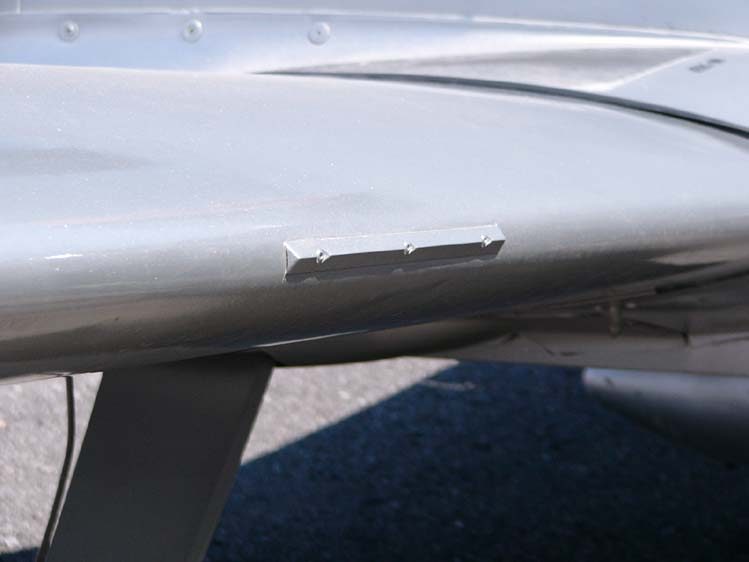
Designers aim for a stall that starts at the root and spreads outboard: the inboard wake shakes the tail as a warning, the nose tends to drop, and the outboard sections keep the ailerons working. A rectangular wing stalls this way naturally. Tapered and swept wings need help:
- Washout. Twisting the wing so the tip has a lower angle of incidence than the root makes the root reach the critical angle first.
- Stall strips. A small triangular strip on the inboard leading edge trips the flow at high angle of attack, making that section stall early.
- Slats and slots. Often fitted to the outer wing, they re-energise the boundary layer and delay tip separation.
- Fences, vortilons and vortex generators. These limit spanwise flow or mix energy into the boundary layer on swept wings.
Contamination and the stall
Ice, frost and snow change the wing's shape and roughen its surface, so the boundary layer loses energy and separates earlier. The critical angle of attack falls, CLmax falls and the stall speed rises. FAA AC 20-117 notes that contamination with the thickness and roughness of medium or coarse sandpaper on the leading edge and upper surface can cut lift by as much as 30 % and increase drag by 40 %. This is why no ice, frost or snow may remain on critical surfaces at take-off.
An icing-induced wing stall is particularly dangerous because the stall warning, set for the clean wing, may not operate before the wing stalls; some types lower the warning threshold when ice protection is selected. Roll control problems, from growing oscillation to a sharp wing drop, and an unexpected rate of descent may be the first signs. The response, subject to the manufacturer's procedure, is to reduce the angle of attack, use the ice protection and leave the icing conditions. See airframe icing.
Warning: A tailplane can stall on ice before the wing, often just after flap is extended, with a sudden nose-down pitch. Its recovery is the opposite of a wing stall: pull back, return the flaps to the previous setting and reduce power if it was just increased. Follow the aircraft manufacturer's procedure.
Recovery and secondary stall
Every stall recovery rests on one action: reduce the angle of attack. For transport aeroplanes, FAA AC 120-109A sets out a stall recovery template that manufacturers' procedures follow in substance:
- Autopilot and autothrottle: disconnect, while holding the attitude.
- Nose-down pitch control: apply until the stall warning and other indications stop, with nose-down trim as needed.
- Bank: wings level.
- Thrust: as needed. A stall can occur at any thrust setting, and underwing engines pitch the nose up.
- Speedbrakes or spoilers: retract.
- Return to the desired flight path.
The aircraft manufacturer's procedure always takes precedence over this generic sequence, and some types publish a separate procedure for a stall warning at lift-off. Fly-by-wire aeroplanes in normal law are protected against the stall, but in a degraded control law the conventional technique applies. At high altitude little excess thrust is available, so the nose may have to go below the horizon to regain speed.
A secondary stall is a second stall during the recovery. It follows when the pilot pulls out before the wing is unstalled, or pulls too hard before speed has built up. The remedy is a decisive, sustained reduction in angle of attack and a smooth return to level flight, accepting the height loss.
Two 2009 accidents shaped current training. On 12 February 2009 Colgan Air flight 3407, a Bombardier Q400, crashed on approach to Buffalo, killing 50 people. The NTSB found that the captain responded to the stick shaker by pulling back and overrode the stick pusher. On Air France 447 predominantly nose-up inputs held an A330 in a stall from cruise altitude to the sea. Both reinforced the rule of reducing angle of attack first that underpins upset prevention and recovery training.
Frequently asked questions
At what angle of attack does a wing stall?
Every wing stalls at its critical angle of attack, the angle at which the lift coefficient reaches its maximum. For a typical aerofoil section exam texts quote about 16 degrees. The angle is fixed for a given wing shape and configuration: it does not change with weight, bank angle or density altitude. It is changed by flaps and slats, by ice, frost or damage, and at high Mach numbers by compressibility.
Why does stall speed increase in a turn?
In a level turn the wing must produce more lift than the weight, because part of the lift is tilted sideways to turn the aeroplane. The load factor is 1 divided by the cosine of the bank angle, and stall speed rises with the square root of the load factor. At 60 degrees of bank the load factor is 2 g and the stall speed is about 41 per cent higher than in straight and level flight.
What is the difference between a stick shaker and a stick pusher?
A stick shaker is a warning. It vibrates the control column shortly before the stall so that the pilot recognises the approach to the stall and reduces the angle of attack. A stick pusher is a stall identification and prevention device. It applies a strong nose-down force to the column at a set angle of attack, and it is fitted to types, often with T-tails, whose natural stall behaviour is unacceptable.
What is a secondary stall?
A secondary stall is a second stall during recovery from the first. It happens when the pilot starts pulling out before the wing has been properly unstalled, or pulls so hard that the critical angle of attack is exceeded again before speed has built up. The cure, as in the flight manual procedure, is to reduce the angle of attack decisively, let speed increase, and return to level flight smoothly while accepting some height loss.
Why can ice cause a stall without any stall warning?
Stall warning systems measure angle of attack and are set for the clean wing. Ice, frost or snow roughens the leading edge and upper surface, so the flow separates at a lower angle of attack than the clean wing would. The wing can therefore stall before the warning threshold is reached. Roll oscillation, a sudden wing drop or an unexpected rate of descent may be the first signs of an icing-induced stall.
Test yourself on Stall
The v1prep banks cover this topic in Principles of Flight (081), with a worked explanation for every answer. EASA ATPL, PPL, IR and CPL, the FAA written tests and A320/B737 type ratings.
Start practising →Sources and further reading
- FAA Airplane Flying Handbook (FAA-H-8083-3C), Chapter 5, Maintaining Aircraft Control
- FAA Pilot's Handbook of Aeronautical Knowledge (FAA-H-8083-25), Chapter 5, Aerodynamics of Flight
- FAA AC 120-109A, Stall Prevention and Recovery Training
- 14 CFR Part 25, Subpart B, Stalls (25.201, 25.203, 25.207)
- EASA Easy Access Rules for Large Aeroplanes (CS-25)
- FAA AC 20-117, Hazards Following Ground Deicing and Ground Operations in Conditions Conducive to Aircraft Icing
- NTSB AAR-10/01, Loss of Control on Approach, Colgan Air Flight 3407
Library articles are written for study and exam preparation. They do not replace your aircraft's approved documentation, your operator's procedures or the regulations themselves.