Air Florida Flight 90
- Date
- Phase of flight
- Takeoff
- Location
- 14th Street Bridge and the Potomac River, near Washington National Airport, Washington, D.C., United States
- Aircraft
- Boeing 737-222
- Registration
- N62AF
- Operator
- Air Florida
- Flight
- Air Florida 90
- Occupants
- 79
- Fatalities
- 7874 of the 79 on board (70 passengers, including 3 infants, and 4 crew members) and 4 people in vehicles on the bridge
- Investigating body
- National Transportation Safety Board (United States)
- Final report
- NTSB/AAR-82/08
- Report date
- Report title
- Air Florida, Inc., Boeing 737-222, N62AF, Collision with 14th Street Bridge, near Washington National Airport, Washington, D.C., January 13, 1982
Air Florida flight 90, a Boeing 737, took off in moderate to heavy snow from Washington National Airport on 13 January 1982 with snow or ice on its wings and iced engine probes that made its EPR gauges over-read. It could not sustain flight, descended in stall buffet and struck the 14th Street Bridge; 78 people died.
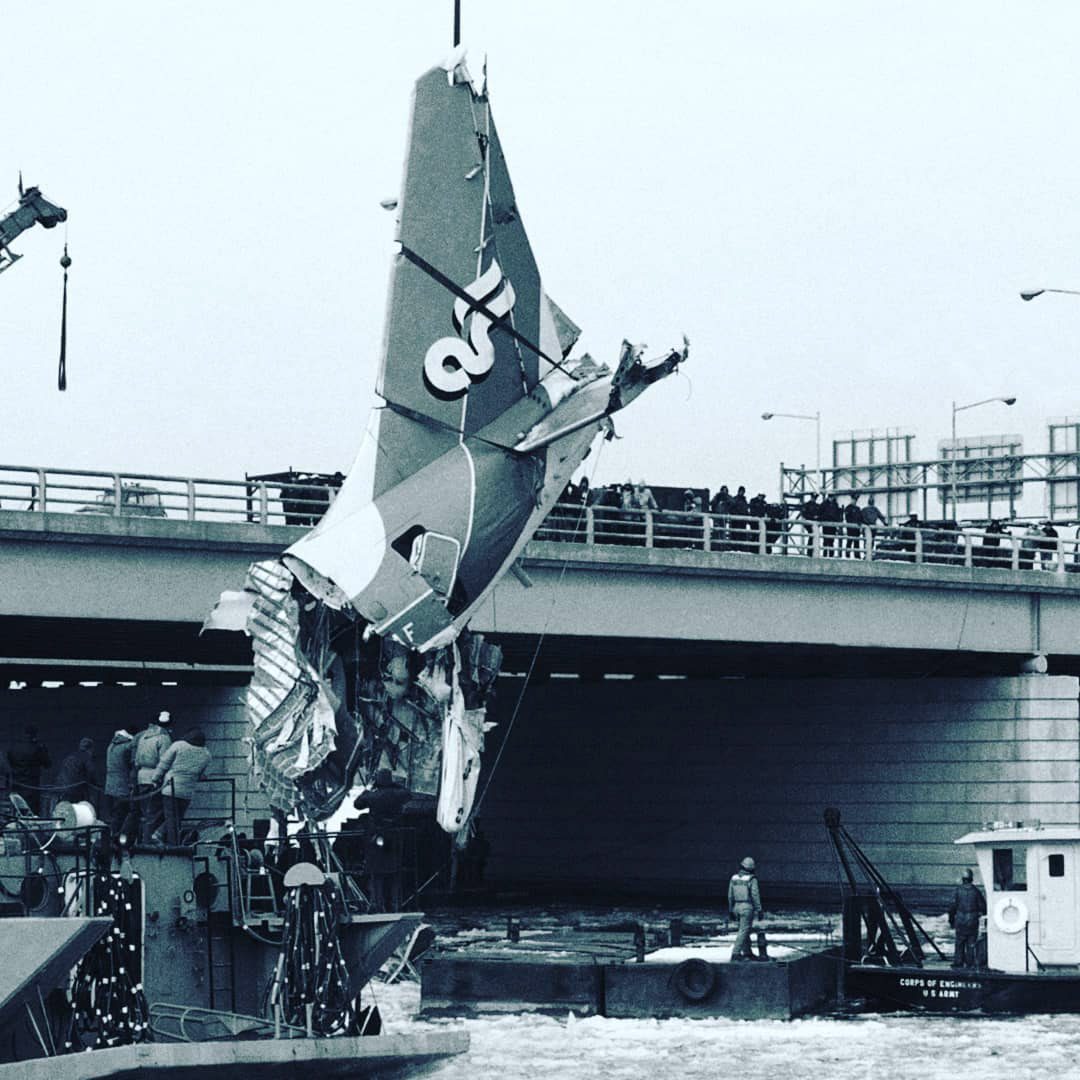
On 13 January 1982, at 16:01 local time (EST), Air Florida flight 90, a Boeing 737-222 registered N62AF, struck the northbound span of the 14th Street Bridge in Washington, D.C., less than a minute after taking off from runway 36 at Washington National Airport, and fell into the ice-covered Potomac River. It came to rest 0.75 NM from the departure end of the runway. Of the 74 passengers, including 3 infants, and 5 crew members, 4 passengers and 1 flight attendant survived. Four people in vehicles on the bridge were also killed.
The flight to Fort Lauderdale, via Tampa, had been delayed about 1 hour 45 minutes by moderate to heavy snowfall that closed the airport for snow removal. The aircraft was de-iced at the gate, then waited nearly 50 minutes in continuing snow before it was cleared for takeoff.
Two hazards combined: engine pressure probes blocked by ice, which made the thrust gauges over-read, and snow or ice on the wings, which degraded lift and raised drag. The NTSB concluded that neither alone would probably have caused the crash.
The flight
The aircraft arrived at gate 12 from Miami at 13:29. The temperature was 24°F (about −4 °C), with moderate to heavy snow; at the time of the accident visibility varied between 1/4 and 5/8 mile.
American Airlines staff de-iced the aircraft under a service agreement. The left side was sprayed with a single heated mix of about 30 to 40 % glycol, with no separate anti-icing overspray; the right side was washed with hot water and then oversprayed with a weaker mix. A non-standard nozzle on the de-icing truck meant the solution delivered contained about 18 % de-icing fluid rather than the 30 % selected. No engine plugs or pitot-static covers were fitted, contrary to Air Florida's manual. De-icing finished at 15:10.
The tug could not move the aircraft on the slippery, sloping ramp, so the crew tried to help with reverse thrust for an estimated 30 to 90 seconds, against the tug operator's advice and contrary to flight manual guidance. The pushback eventually succeeded at 15:35. At 15:38, running the after-start checklist, the captain answered "off" to the item "anti-ice". The engine anti-ice was never switched on.
In the queue, the crew discussed the snow on the wings at length. The captain deliberately positioned the aircraft close behind a New York Air DC-9, apparently hoping its exhaust would clear the snow. At about 15:49 the first officer noticed a difference between the left and right engine indications, which later settled down; the NTSB believed he was seeing an erratic EPR reading as ice formed on the engine inlet probe. He also remarked that one wing had "about a quarter to half an inch" of snow on it. There is no evidence that either pilot left the cockpit to look at the wings.
The captain was an experienced pilot with about 8,300 hours, about 1,100 of them as a 737 captain; the first officer, a former fighter pilot, had about 3,353 hours, 992 of them on the 737. The first officer was pilot flying. They had flown together for only 17.5 hours, and the NTSB found only eight takeoffs or landings in precipitation with freezing or near-freezing temperatures in the captain's record as a 737 captain, and two in the first officer's record at Air Florida.
The accident
At 15:58:55 flight 90 was cleared to taxi into position and hold and, 29 seconds later, cleared for takeoff, with a landing aircraft 2.5 miles out and an instruction not to delay. The crew began advancing the thrust levers during the turn onto the runway. The takeoff bugs were set at 138 kt (V1), 140 kt (VR) and 144 kt (V2), with a target of 2.04 EPR.
| Time (EST) | Event |
|---|---|
| 15:59:45 | Captain: "Your throttles"; engines spool up |
| 15:59:58 to 16:00:02 | First officer: "that don't seem right, does it?" |
| 16:00:05 to 16:00:10 | First officer: "that's not right"; captain: "Yes it is, there's eighty" |
| 16:00:21 to 16:00:23 | Captain calls "hundred and twenty"; first officer: "I don't know" |
| 16:00:31 | V1 call |
| 16:00:37 | V2 call; stick shaker begins about 2 seconds later and continues to impact |
| 16:00:45 to 16:00:55 | Captain: "Forward, forward", "We only want five hundred", "just barely climb" |
| 16:01:00 | First officer: "we're going down"; captain: "I know it" |
| 16:01:01 | Impact with the bridge |
The takeoff took about 45 seconds and about 5,400 ft of the 6,869 ft runway, against about 30 seconds and 3,500 ft for a normal 737 at that weight. The aircraft lifted off at 140 to 145 kt and briefly climbed, helped by ground effect, but the stick shaker was active from just after liftoff. Airspeed fell towards 130 kt and the aircraft sank in stall buffet; witnesses described a nose-high attitude of 30 to 40 degrees before it hit the bridge. Thrust was added at some point, but too late.
The aircraft struck six occupied cars and a boom truck, tore away 41 ft of bridge wall and 97 ft of railing, and broke up in the river. Six occupants escaped from the wreckage into water at 34°F. A US Park Police helicopter rescued four passengers and one flight attendant between 16:22 and 16:35, one of them with the help of a bystander who swam out. The airport's airboat could not reach them in time.
The investigation
Deficient thrust: the iced Pt2 probe
The first clue came from the cockpit voice recorder. Spectrum analysis of the engine fan noise showed the engines turning at about 80 to 84 % N1 during the takeoff, far less than the target setting would have given. Tests at Boeing with a 737-200 whose left engine Pt2 probe was taped over matched it: with the blocked probe indicating 2.04 EPR, the engine was actually producing the thrust of 1.70 EPR, about 10,750 lb instead of 14,500 lb per engine.
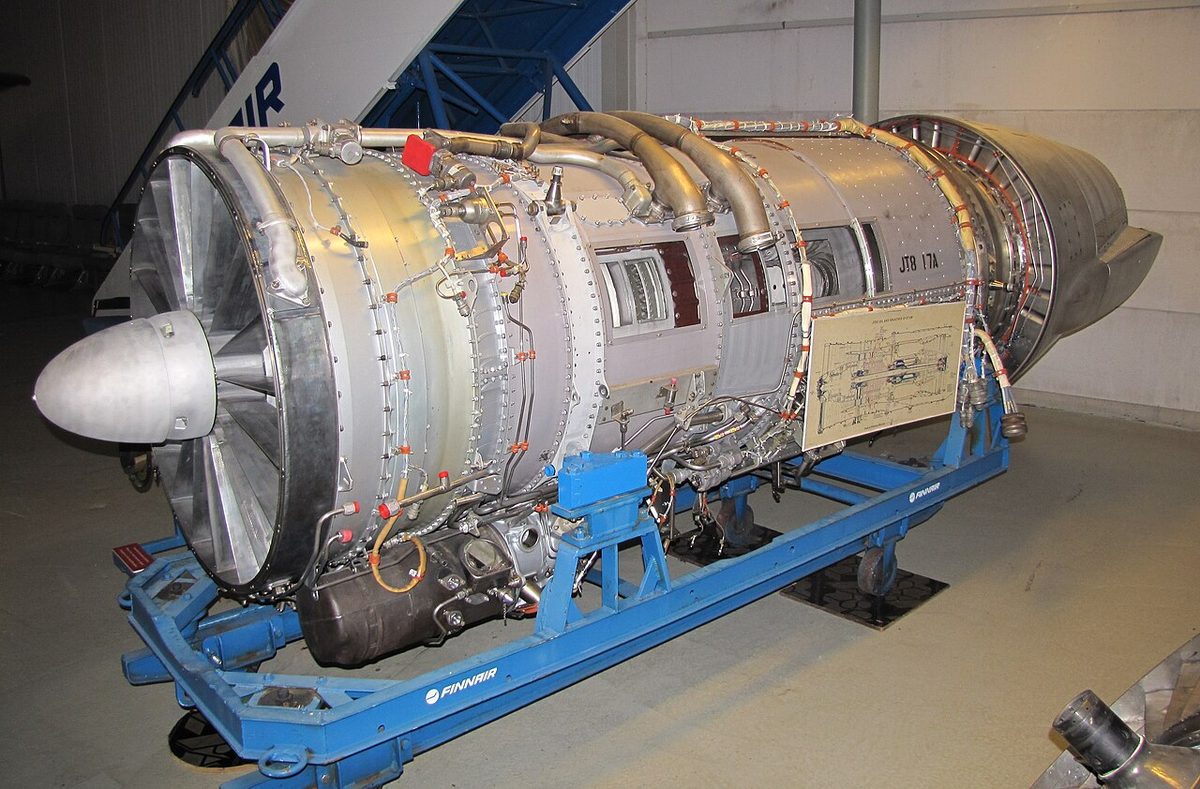
EPR, the primary thrust-setting instrument on the JT8D, is the ratio of turbine discharge pressure to compressor inlet total pressure (Pt2), which is sensed by a probe in the engine nose cone. If ice blocks the probe's opening and the engine anti-ice is off, the sense line is vented to the inside of the nose cone, which is at the lower inlet static pressure. A lower Pt2 means a higher ratio: the gauge over-reads, and a crew setting the target EPR sets too little thrust. With anti-ice on, the effect is reversed: warm air raises the nose cone pressure and the gauge under-reads, so the crew cannot reach the target EPR, which usually leads to a rejected takeoff. After the crash, four of the six motor-driven engine anti-ice valves were found closed, consistent with the CVR and the engine speed evidence.
The other engine instruments told the truth. At the real thrust, N1, N2, EGT and fuel flow were all well below normal takeoff values; in the Boeing tests the needles differed by about 30° for N1 and 42° for fuel flow. The first officer saw that "something was not right"; the NTSB called him astute and found no evidence that the captain compared the EPR with the other gauges.
Degraded wing: snow and ice on the aerofoil
At 1.70 EPR a clean 737 should still have climbed at more than 1,000 ft/min at 145 kt. Its failure to do so pointed to the wings. Contamination makes the airflow separate earlier, so both the maximum lift coefficient and the angle of attack at which it occurs fall, and drag rises (see airframe icing). The 737's stick shaker is driven by a fuselage-mounted angle of attack vane, set for the clean wing. At the accident weight it would normally have activated at about 133 kt, with buffet at about 130 kt and the stall at about 121 kt. Flight 90's stick shaker activated at about 145 kt; in about 24 seconds of flight its airspeed varied between 145 and 131 kt, with buffet for much of that time. The Board took this as positive evidence that snow or ice was degrading the wing.
Contamination on a swept wing also changes trim. If the outer wing, which lies further aft, loses more lift than the root, the centre of lift moves forward and the aircraft pitches up. The NTSB knew of 22 reports since 1970 of 737s pitching up or rolling off just after takeoff in icing conditions, and Boeing had issued three Operations Manual Bulletins on it, the last warning that heavy frost or rime ice on the leading edge raised stall speeds by 8 to 10 kt at takeoff flap settings. The Board concluded that the contamination produced a nose-up moment at rotation that was not, or could not be, countered at once.
Why it could not climb
Below the minimum drag speed, about 155 KIAS for a clean 737 at that weight and higher for a contaminated one, slowing down increases drag. The aircraft was flying at a high angle of attack, below that speed, with too little thrust. Ground effect, which fades at about one wingspan (about 100 ft for the 737), hid the problem for a few seconds. As it faded, drag exceeded thrust and the aircraft could only descend or stall. Simulations showed that full thrust (2.23 EPR) applied as soon as the stick shaker activated, with correct pitch control, would probably have allowed the aircraft to accelerate and climb away. After 15 seconds or more in the stall, recovery was usually not possible.
Other findings
The local controller had cleared flight 90 to take off ahead of Eastern 1451, a Boeing 727 that touched down before flight 90 lifted off, with separation of less than 4,000 ft, in breach of the 2-mile criterion; the Board did not find sufficient evidence that this was causal. It also criticised the de-icing, the lack of flow control and gate-hold procedures, and the airport's water rescue capability.
Probable cause and contributing factors
The National Transportation Safety Board determines that the probable cause of this accident was the flightcrew's failure to use engine anti-ice during ground operation and takeoff, their decision to take off with snow/ice on the airfoil surfaces of the aircraft, and the captain's failure to reject the takeoff during the early stage when his attention was called to anomalous engine instrument readings.
The contributing factors were the prolonged ground delay between de-icing and takeoff clearance in continuing precipitation, the known inherent pitch-up characteristics of the 737 with even small amounts of snow or ice on the leading edge, and the crew's limited experience of jet transport winter operations.
Among the findings: the aircraft "could not sustain flight because of the combined effects of airframe snow or ice contamination which degraded lift and increased drag and the lower than normal thrust"; either condition alone should not have prevented continued flight. The first officer voiced his concern four times during the takeoff, but the captain took no action to reject it; in its analysis the Board found the first officer's comments "not assertive".
Safety recommendations and what changed
On 28 January 1982, two weeks after the accident, the NTSB issued recommendations A-82-6 to -15, six of them marked urgent. They asked the FAA to warn operators of engine inlet probe icing and require crews to cross-check all engine instruments when setting takeoff power, to stress that de-icing fluid does not protect against re-icing in continuing precipitation, to document probe blockage effects in flight manuals, and to give aircraft more ground separation in freezing weather. The FAA issued a bulletin on engine inlet icing in March 1982, but rejected a proposal to require a wing inspection when more than 20 minutes had passed since de-icing, preferring the "clean aircraft" rule without time limits.
With the final report the Board added recommendations A-82-79 to -89, including:
- adding "anti-ice" to the 737's taxi and takeoff checklist and reviewing all checklists for items affected by changes during long ground delays;
- training on how leading edge contamination changes the relationship between airspeed and angle of attack, and what that does to stall warning;
- an airworthiness directive for the 737 requiring either a ground-operable wing thermal anti-ice system or larger stall speed margins at liftoff;
- stricter ATC separation and gate-hold practices, and better water rescue capability at airports with flight paths over water.
Two days after the accident the UK Civil Aviation Authority required extra takeoff speed margins for 737s taking off with flaps 1 or 2 in visible moisture below 5 °C, and in June 1982 Boeing issued an engineering change to allow wing anti-ice to be used on the ground. The Board also recalled its 1979 recommendation on flight deck resource management training; Air Florida gave no such training, and none was required.
Lessons for pilots
A clean wing is not negotiable. The first officer expected the wingtips to "shuck all that other stuff" as speed built. The NTSB feared that some pilots believe a little contamination can be tolerated, and called takeoffs with snow adhering to the aircraft "a too frequent occurrence". Even thin, rough contamination lowers the critical angle of attack and CLmax. De-icing fluid removes contamination; it does not guarantee protection for any length of time in falling snow. If there is doubt after a long wait, look, and go back for de-icing (see ground de-icing and anti-icing).
Exam tip: Frost, ice or snow on the wing reduces the stalling angle of attack and CLmax, increases stall speed and drag, and can defeat an angle of attack stall warning set for the clean wing: the stall may come before, or very close to, the warning.
Understand what your thrust gauge measures. An EPR indication depends on two pressure measurements; a blocked inlet probe corrupts it without any failure flag. Engine anti-ice protects the probe as well as the intake. When setting takeoff power, cross-check the primary parameter against N1, N2, EGT and fuel flow, and know roughly what they should read. Two engines giving the same wrong reading look convincing.
Exam tip: With the Pt2 probe iced and engine anti-ice off, the EPR gauge over-reads and actual thrust is lower than indicated. With anti-ice on and the probe still blocked, it under-reads. N1, N2, EGT and fuel flow are the cross-check.
Reject early when something is not right. V1 assumes normal acceleration. If acceleration is low, the distance to reach V1 grows and the distance left to stop shrinks, and on a slippery runway the margin shrinks further. The NTSB wrote that an observation that something is not right is sufficient reason to reject a takeoff without further analysis, and that on a slippery runway the decision must come as early as possible.
Stall warning after liftoff: attitude and thrust together. The crew worked on pitch but, believing thrust was already at the limit, added power too late. The NTSB said that training should stress the use of thrust beyond normal limits if the alternative is losing the aircraft. See stall for the recovery technique.
Note: Ground effect can let an aircraft with too little thrust or a contaminated wing lift off and climb briefly. The margin disappears as height reaches about a wingspan.
Speak up, and listen. The first officer saw the problem and said so four times, in tentative words; the captain did not act on it. These are the skills that crew resource management training addresses: a monitoring pilot's doubt, clearly stated, should be enough to stop a takeoff, and a captain should invite it.
The NTSB determined that the probable cause was "the flightcrew's failure to use engine anti-ice during ground operation and takeoff, their decision to take off with snow/ice on the airfoil surfaces of the aircraft, and the captain's failure to reject the takeoff during the early stage when his attention was called to anomalous engine instrument readings." The long ground delay after de-icing, the B-737's known pitch-up tendency with contaminated leading edges and the crew's limited winter jet experience contributed.
Train this on v1prep
The theory behind this accident and the questions that test it, each with a worked explanation.
Question banks
- ATPL Operational Procedures482 questions with worked explanations
- ATPL Principles of Flight488 questions with worked explanations
- ATPL Human Factors494 questions with worked explanations
In the Library
- Airframe IcingHow supercooled water and freezing precipitation form ice on aircraft, the types and intensities of icing, frost, SLD and ice-crystal icing, and the products that forecast it.
- Aircraft Ground De-icing and Anti-icingCovers the clean aircraft concept and ground icing contamination, de-icing and anti-icing fluids and procedures, holdover times, pre-take-off contamination checks and engine ice shedding on the ground.
- StallWhat happens at the critical angle of attack, how stall speed changes with weight, load factor and power, stall warning and wing drop, and how to recover.
- Crew Resource Management (CRM)Covers the aims and skills of CRM, crew coordination and cross-monitoring, group decision-making pitfalls, debriefing, and single-pilot resource management.
Frequently asked questions
What caused the Air Florida Flight 90 crash?
The NTSB found that the crew did not use engine anti-ice on the ground or for takeoff, decided to take off with snow or ice on the wings, and that the captain did not reject the takeoff early when the first officer pointed out abnormal engine readings. Contributing were the long delay after de-icing in continuing snow, the Boeing 737's known pitch-up tendency with contaminated leading edges, and the crew's limited experience of jet winter operations.
Why did the engines of Air Florida 90 produce less thrust than indicated?
Ice blocked the inlet pressure (Pt2) probes of both engines. With engine anti-ice off, a blocked probe senses a lower pressure than the true inlet pressure, so the EPR gauge over-reads. The crew set the target of 2.04 EPR, but tests and analysis of engine sound on the cockpit voice recorder showed the engines were actually producing the thrust of about 1.70 EPR, some 3,750 pounds less per engine.
Could the Air Florida 90 crew have rejected the takeoff?
Yes. The NTSB calculated that the aircraft reached 80 knots after about 1,250 feet and could have stopped from 80 knots in less than 2,000 feet even on a very slippery runway with a braking coefficient of 0.1. It could have stopped within the runway even if the rejection had begun at 120 knots. The first officer voiced his doubts about the engine readings several times during the roll.
Why did the stick shaker activate on Air Florida 90 at a normal airspeed?
The 737's stall warning is triggered by angle of attack. Snow or ice on the wing lowers the angle of attack at which the wing stalls and the lift it gives at a given speed, so the aircraft must fly at a higher angle of attack for the same speed. The stick shaker activated almost immediately after liftoff at about 145 knots, well above the roughly 133 knots at which it would have activated on a clean wing.
Could Air Florida 90 have been saved after takeoff?
The NTSB concluded the accident was not inevitable at liftoff. Engineering simulations showed that if full available thrust, equivalent to 2.23 EPR, had been added immediately when the stick shaker activated, together with correct pitch control, the aircraft could probably have accelerated to a safe margin above the stall. The crew corrected pitch but did not add thrust in time, probably reluctant to exceed the normal engine limits.
Sources and further reading
- NTSB, Aircraft Accident Report AAR-82/08, Air Florida, Inc., Boeing 737-222, N62AF, Collision with 14th Street Bridge, near Washington National Airport, January 13, 1982
- 14 CFR 121.629, Operation in icing conditions
- FAA AC 20-117, Hazards Following Ground Deicing and Ground Operations in Conditions Conducive to Aircraft Icing
Crash Investigations pages summarise official investigation reports for study and exam preparation. The investigating body's report is the authoritative account and prevails wherever it differs from this page. Under ICAO Annex 13, an investigation exists to prevent accidents, not to apportion blame or liability.