High Speed Flight
High-speed flight is flight at Mach numbers where the compressibility of air significantly changes the flow around an aircraft, producing supersonic regions, shock waves, wave drag and changes in lift, stability and control that do not occur at low speed.
High-speed flight is the branch of aerodynamics that deals with speeds at which air can no longer be treated as incompressible. For a jet transport this covers the whole of the cruise: at a typical cruise Mach number the air accelerating over the wing is already supersonic in places, shock waves stand on the upper surface, and drag, lift, stability and control all behave differently from the low-speed picture learned for a light aeroplane.
For pilots the subject explains why jet aircraft carry a maximum operating Mach number (MMO) as well as an airspeed limit (VMO), why high-speed buffet and Mach tuck exist, and why the usable speed range narrows at high altitude. It also explains the design features, such as sweepback, supercritical aerofoils and area ruling, that let airliners cruise efficiently just below the speed of sound.
Speed of sound and Mach number
The speed of sound is the speed at which small pressure disturbances travel through air. For a perfect gas it depends only on absolute temperature: a = √(γRT), which for air works out at roughly 39 × √T knots with T in kelvin. Pressure and density do not appear, because in the atmosphere they change in proportion to each other. In the ISA the speed of sound is about 661 kt at mean sea level (+15 °C, 288 K) and about 573 kt at and above the tropopause (−56.5 °C). What matters in flight is the local speed of sound (LSS), the value in the air the aircraft is actually flying through.
Mach number (M) is true airspeed divided by the local speed of sound. An aircraft flying at 480 kt TAS where the LSS is 600 kt is at M 0.80. Climbing at constant IAS raises the Mach number on two counts: TAS rises as density falls, and the LSS falls as temperature falls. For this reason jets climb on IAS and change to a Mach number at the crossover altitude, above which MMO rather than VMO is the limiting speed.
Exam tip: the local speed of sound depends on temperature alone. On a day warmer than ISA the LSS is higher, so the same Mach number gives a higher TAS and ground speed.
Compressibility
Compressibility is the ability of air to change density when its pressure changes. At low speed the pressure changes around an aircraft are small compared with ambient pressure, and air can be treated as incompressible. By about M 0.3 the density changes reach roughly 5 per cent, and from about M 0.4 they begin to alter the pressure distribution noticeably.
The physical reason is the time available for "warning". At low speed, pressure waves run far ahead of the wing and the approaching air begins to divide well upstream. As speed rises, the warning distance shrinks, the air meets the leading edge more abruptly and peak suctions grow. The lift-curve slope steepens, but the stalling angle and CLmax fall. As a result the 1 g stall speed, expressed as EAS, begins to rise with altitude at high cruise levels. Compressibility also explains why the airspeed indicator needs a compressibility correction between CAS and EAS: at high speed and altitude, CAS over-reads EAS.
Subsonic, transonic and supersonic flight
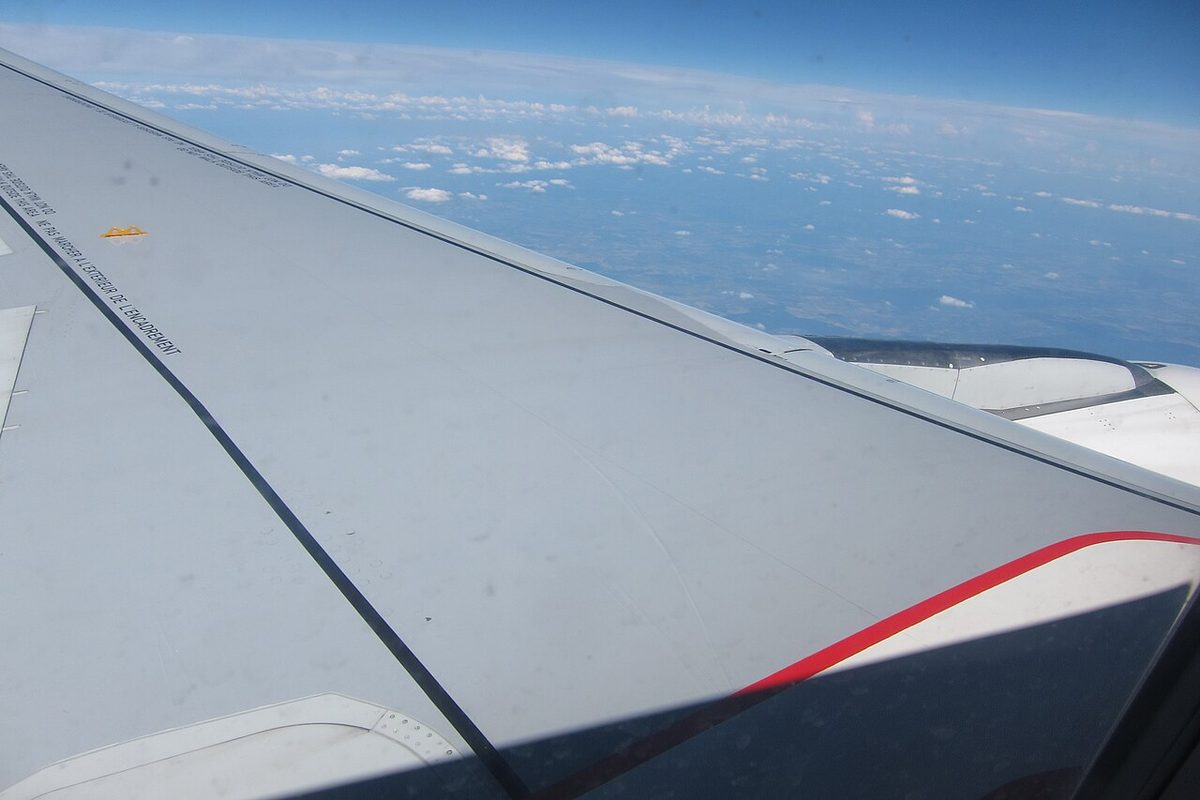
Because air accelerates over a lifting wing, the local Mach number there is higher than the free-stream value. The critical Mach number (Mcrit) is the free-stream Mach number at which the local flow somewhere on the aircraft, usually near the point of maximum thickness on the wing upper surface, first reaches M 1.0. Mcrit falls as thickness/chord ratio or angle of attack increases, so a heavy aircraft, high altitude or a turn all lower it. Sweepback raises it.
| Regime | FAA handbook range | Flow over the aircraft |
|---|---|---|
| Subsonic | below M 0.75 | Subsonic everywhere |
| Transonic | M 0.75 to 1.20 | Mixed subsonic and supersonic |
| Supersonic | M 1.20 to 5.0 | Supersonic almost everywhere |
| Hypersonic | above M 5.0 | Supersonic, with very strong shocks and heating |
Transonic flight is the mixed regime between Mcrit and the point where the whole flow becomes supersonic. Supersonic flight begins once the free stream and almost all local flow exceed M 1.0. The FAA handbook gives fixed boundaries. European ATPL texts usually define the regimes by the flow pattern, so the transonic band starts at Mcrit, which varies with aircraft and conditions. The principle is identical.
Shock wave formation
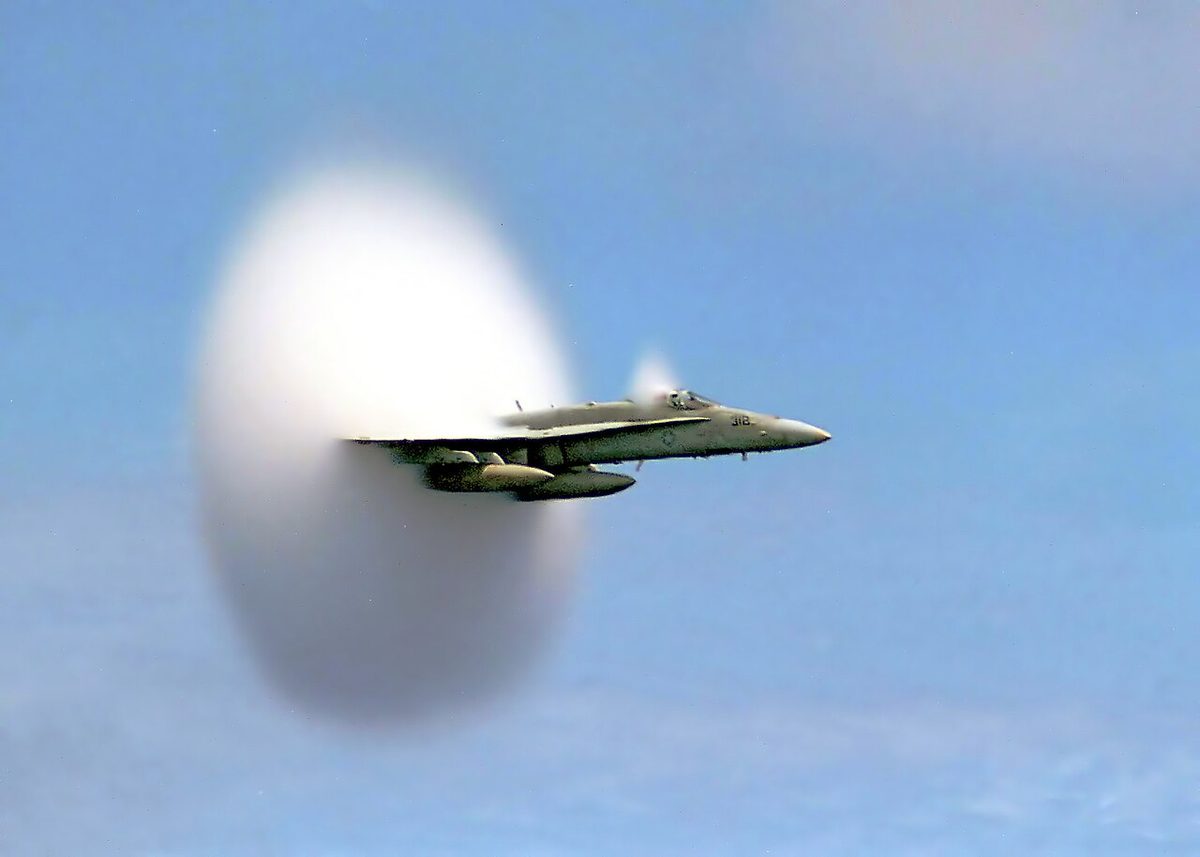
Just above Mcrit a small pocket of supersonic flow appears on the upper surface. Supersonic flow cannot slow down gradually to match the subsonic conditions downstream. It decelerates abruptly through a shock wave, a very thin region across which pressure, density and temperature rise almost instantly. The shock forms at the rear boundary of the supersonic region.
As Mach number increases, the supersonic pocket grows and the upper-surface shock strengthens and moves aft. A second shock appears later on the lower surface and moves aft more quickly, and both approach the trailing edge near M 1.0. The centre of pressure moves aft through the transonic range and settles near 50 per cent chord in supersonic flight. Once the free stream exceeds M 1.0, a bow wave forms ahead of the aircraft. At first it stands detached in front of a blunt nose or leading edge, and with increasing Mach number it moves closer and can attach to a sharp leading edge.
Normal and oblique shocks, expansion waves
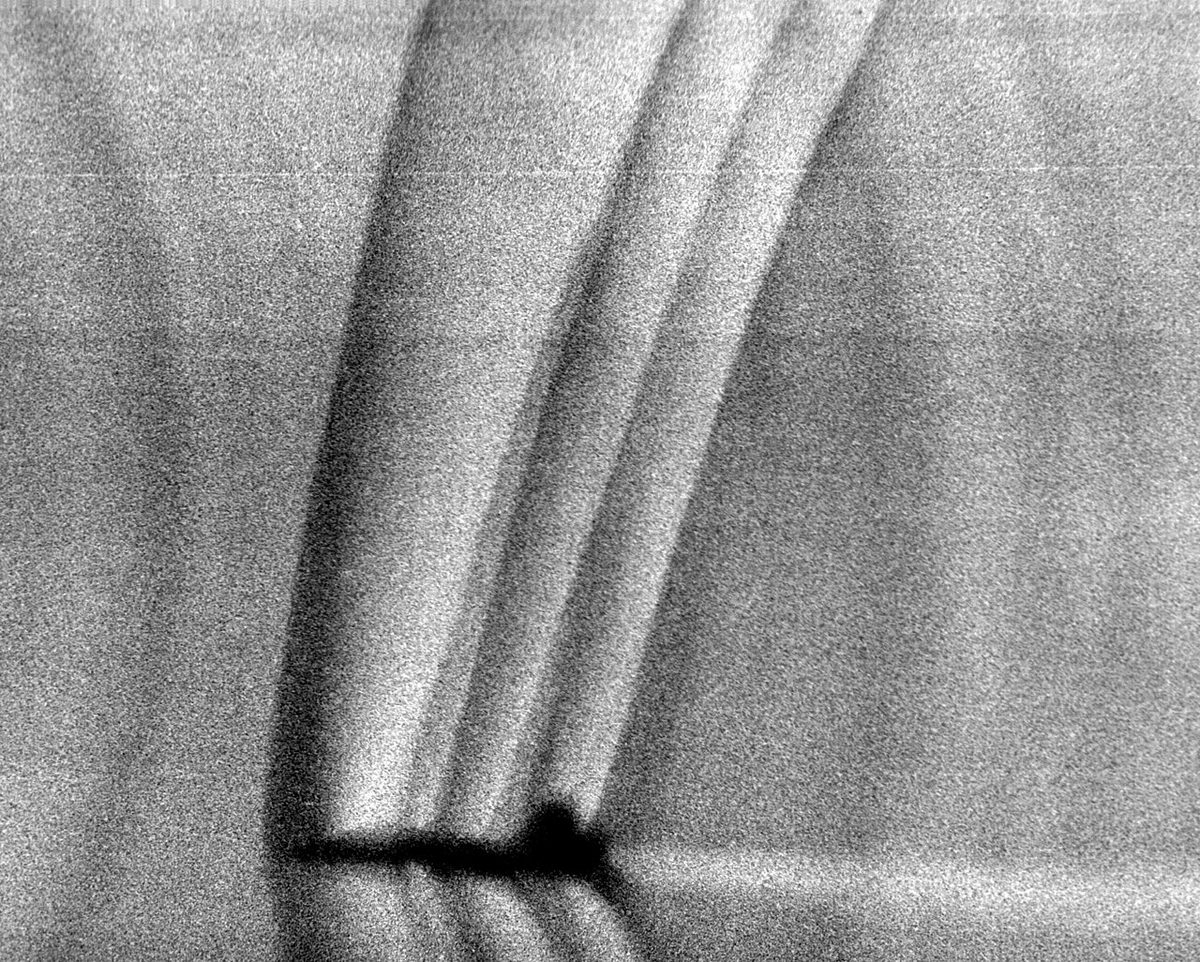
A normal shock wave stands at right angles to the local flow. The flow does not change direction, but it always leaves the shock subsonic: velocity falls, while static pressure, density and temperature rise. Some total pressure is lost for good, converted into heat, and that loss is drag.
An oblique shock wave is inclined to the flow and forms where supersonic flow is turned into itself, as at a wedge or sharp leading edge. The flow is deflected, only the velocity component normal to the shock is reduced below M 1.0, and the flow behind may stay supersonic. Oblique shocks are weaker and waste less energy. A bow wave is nearly normal on the axis and becomes oblique further out, weakening with distance.
A small disturbance moving supersonically cannot send signals ahead of itself. Its influence is confined to a Mach cone whose half-angle μ satisfies sin μ = 1/M, so at M 2.0 the half-angle is 30°. Air outside the cone receives no warning, which is why a sonic boom arrives suddenly.
Where supersonic flow turns away from itself, around a convex corner, it passes through an expansion wave, a fan of weak waves across which velocity increases and pressure, density and temperature fall. The process is smooth and loses no energy. A supersonic aerofoil combines both: oblique shocks at the leading edge, expansion over the surfaces and shocks again at the trailing edge, with lift shared roughly equally between upper and lower surfaces.
| Change across the wave | Normal shock | Oblique shock | Expansion wave |
|---|---|---|---|
| Velocity | Falls to subsonic | Falls, may stay supersonic | Rises |
| Pressure, density, temperature | Rise sharply | Rise less | Fall |
| Flow direction | Unchanged | Turned towards the wave | Turned away |
| Energy loss | Large | Smaller | None |
Shock stall and shock-induced separation
The pressure jump through a shock imposes a steep adverse pressure gradient on the boundary layer. Once the shock is strong enough, the boundary layer separates behind it. This shock-induced separation reduces lift at a given angle of attack, increases drag and produces high-speed (Mach) buffet as the separated wake shakes the wing and tail. A shock oscillating near a control hinge can cause control buzz, and controls behind a shock lose effectiveness. The loss of lift is called shock stall. Its cure is to reduce the Mach number, and where buffet is induced by manoeuvring, the load factor as well.
On a swept wing with a thicker root section, separation usually begins at the root. Lift is lost inboard and forward, so the centre of pressure moves outboard and aft, while the disturbed flow reduces downwash at the tailplane. Both effects pitch the nose down: this is Mach tuck, which makes the aircraft unstable with speed. Conventional jets fit a Mach trim system that adds nose-up trim as Mach increases. Fly-by-wire types provide the same compensation within their flight control laws.
Because Mcrit falls with angle of attack, the high-speed buffet boundary moves to lower Mach numbers as weight, altitude or load factor increase. The low-speed buffet boundary rises with altitude, and the two meet at the aerodynamic ceiling known as the coffin corner. Operators plan cruise levels that keep a margin to buffet onset, conventionally 1.3 g, which is equivalent to about 40° of bank in level flight.

Wave drag and drag divergence
Wave drag is the extra drag caused by shock waves. It has two parts: the energy lost through the shocks themselves, and the pressure drag of the boundary layer separated behind them. Just above Mcrit drag rises only gently. A few hundredths of a Mach higher it begins to climb steeply at the drag divergence Mach number (MDD). MDD is always above Mcrit, and manufacturers define it by a chosen criterion. Boeing, for example, uses a wave-drag increase of 0.002 in drag coefficient (20 drag counts), while Douglas used a drag-curve slope of 0.1 per unit Mach.
The drag coefficient peaks near M 1.0 and then decreases as shocks become oblique and attached, although total drag keeps rising with dynamic pressure. For a transport aircraft, flying beyond MDD buys little speed for a large increase in fuel flow, so high-speed cruise schedules sit close to, but not beyond, the drag rise.
Note: EASA and FAA certification rules are harmonised on overspeed warning. CS 25.1303(c)(1) and 14 CFR 25.1303(c)(1) both require an aural warning whenever speed exceeds VMO + 6 kt or MMO + 0.01. How to recover from an overspeed is covered under upset prevention and recovery.
Supercritical aerofoils and area rule
Four wing-design features delay the transonic drag rise, and the area rule then deals with the aircraft as a whole.
- Thin sections. A lower thickness/chord ratio raises Mcrit, at a cost in structural weight and fuel volume.
- Sweepback. The pressure distribution depends mainly on the velocity component normal to the leading edge, roughly V × cos Λ, so a swept wing raises Mcrit. It also flattens the lift-curve slope, which reduces gust response. The penalties are tip stall and pitch-up near the stall, a lower CLmax and more pronounced Mach tuck.
- Supercritical sections. A supercritical aerofoil (FAA texts use supercritical airfoil) has a large leading-edge radius, a relatively flat upper surface and strong camber near the trailing edge. It accepts a wide supersonic region on the upper surface but ends it with a weak shock further aft, which delays separation and wave drag. Richard Whitcomb developed the concept at NASA Langley, and a NASA F-8 flew with a supercritical wing from March 1971. The gain can be taken as speed, as a thicker and lighter wing with more fuel volume, or as less sweep and a higher aspect ratio. The drawbacks are a nose-down pitching moment from the aft loading, with some trim drag, and a lower low-speed CLmax that needs effective high-lift devices.
- Vortex generators. These small vanes mix high-energy air into the boundary layer so that it can withstand the adverse pressure gradient at the shock, which reduces separation and buffet.
The area rule, formulated by Whitcomb at NACA Langley in 1952, states that transonic wave drag depends on how the total cross-sectional area of the aircraft varies along its length. That variation should be smooth, without abrupt humps, so the fuselage is waisted where the wing joins it, giving the "Coke-bottle" shape. The Convair F-102 could not exceed M 1.0 in level flight until it was redesigned to the rule. On transport aircraft the same principle shapes the wing-body fairing and the placement of nacelles and fairings.
Exam tip: a supercritical aerofoil does not have a sharp nose. Expect a blunt leading edge, a flat upper surface, aft camber, a weaker shock further aft and reduced low-speed CLmax.
Frequently asked questions
What is the difference between critical Mach number and drag divergence Mach number?
The critical Mach number is the free-stream Mach number at which the airflow somewhere on the aircraft, usually over the wing upper surface, first reaches the local speed of sound. Nothing dramatic happens there. The drag divergence Mach number is slightly higher: it is the point at which shock waves have grown strong enough for drag to start rising steeply. MDD is therefore always above Mcrit, typically by a few hundredths of a Mach.
Why does Mach number increase when climbing at a constant indicated airspeed?
Two effects add together. As density falls with height, a constant indicated airspeed means a rising true airspeed. At the same time the temperature falls in the troposphere, and because the speed of sound depends only on absolute temperature, the local speed of sound falls too. Mach number is true airspeed divided by the local speed of sound, so it rises on both counts. That is why jets change from an IAS to a Mach limit in the climb.
What is Mach tuck?
Mach tuck is a nose-down pitching tendency that develops as a jet aircraft accelerates beyond its critical Mach number. Shock-induced separation, usually starting at the thicker wing root of a swept wing, moves the centre of pressure aft, and the reduced downwash at the tailplane lowers its download. Left uncorrected, the nose drops and speed increases further. Conventional jets use a Mach trim system to counter it; fly-by-wire aircraft compensate within the flight control laws.
What is a supercritical wing?
A supercritical wing uses aerofoil sections with a large leading-edge radius, a relatively flat upper surface and pronounced camber near the trailing edge. The design accepts a region of supersonic flow on the upper surface but ends it with a weaker shock further aft, so shock-induced separation and wave drag are delayed to a higher Mach number. The benefit can be taken as higher cruise speed, a thicker and lighter wing, or less sweep.
What is the coffin corner in high-speed flight?
The coffin corner is the altitude at which the low-speed buffet boundary, caused by approaching the stall, meets the high-speed buffet boundary, caused by shock-induced separation. As altitude increases the stall speed rises in Mach terms while the buffet-onset Mach number falls, so the band of usable speeds narrows until only one speed remains. Airliners are operated well below this point by keeping a margin to buffet onset, conventionally 1.3 g.
Test yourself on High Speed Flight
The v1prep banks cover this topic in Principles of Flight (081), with a worked explanation for every answer. EASA ATPL, PPL, IR and CPL, the FAA written tests and A320/B737 type ratings.
Start practising →Sources and further reading
- FAA Pilot's Handbook of Aeronautical Knowledge (FAA-H-8083-25), Chapter 5, Aerodynamics of Flight
- FAA Airplane Flying Handbook (FAA-H-8083-3C), Transition to Jet-Powered Airplanes
- 14 CFR 25.1303, Flight and navigation instruments (speed warning device)
- EASA Easy Access Rules for Large Aeroplanes (CS-25)
- NASA, Richard T. Whitcomb (area rule and supercritical wing)
- NASA, Where Are They Now, F-8 Supercritical Wing
- Scholz, D., Mach number, relative thickness, sweep and lift coefficient of the wing (HAW Hamburg)
Library articles are written for study and exam preparation. They do not replace your aircraft's approved documentation, your operator's procedures or the regulations themselves.