Spins and Spiral Dives
A spin is an aggravated stall in which the aeroplane autorotates, descending steeply while rolling and yawing with both wings stalled, one more deeply than the other. A spiral dive is a steep, tightening descending turn in which the wings are not stalled and the airspeed builds rapidly.
A spin is an aggravated stall in which the aeroplane autorotates: it descends along a steep corkscrew path, rolling and yawing continuously, with both wings stalled and one of them more deeply than the other. It is the most dangerous development of a stall, because an unintended spin close to the ground is rarely survivable and because the correct recovery runs against instinct.
A spiral dive can look similar from the cockpit, a steep descending turn with the ground rotating ahead, but it is a different condition. The wings are not stalled, the airspeed and load factor build quickly, and the recovery is different. Telling the two apart, and knowing why each develops, is required knowledge from the PPL to the ATPL and in FAA stall and spin awareness training.
Autorotation and spin entry
Two conditions must be present together for a spin to develop: the wing must be stalled and the aeroplane must be yawing. Keeping the wing below its critical angle of attack, or keeping the aeroplane in balance at the stall, prevents the spin.
The mechanism is autorotation. Below the stall, a wing that drops meets the air at a higher angle of attack and produces more lift, which resists the roll. Beyond the critical angle the effect reverses: a further increase in angle of attack reduces lift and increases drag. If the aeroplane yaws as it stalls, the down-going wing is pushed deeper into the stall, loses lift and gains drag, and keeps dropping, while the rising wing is less stalled and lifts more. The roll and the yaw now sustain each other and the rotation continues on its own until the angle of attack is reduced.
The yaw usually comes from the pilot. An accidental spin typically follows a stall in a manoeuvre flown with too much or too little rudder for the aileron being used, that is with crossed controls. Other sources are:
- Aileron used to lift a dropping wing near the stall. The down-going aileron raises that wing's angle of attack, deepens its stall and adds drag.
- Power effects. In a power-on stall a single-engine propeller aeroplane needs substantial rudder to counter the left-turning tendencies of torque, slipstream and P-factor, for a propeller turning clockwise seen from the cockpit.
- Asymmetric thrust. An engine failure on a twin produces a strong yaw at exactly the moment speed may be decaying.
The prevention follows directly. Near the stall, keep the ball centred. If a wing drops at the stall, reduce the angle of attack and use rudder to stop further yaw, keeping the ailerons neutral until the wing is flying again. The spins discussed here are erect spins, entered from a stall at positive angle of attack; inverted spins belong to aerobatics.
Incipient and developed spin
The FAA Airplane Flying Handbook divides a spin into four phases: entry, incipient, developed and recovery.
- Entry. The stall occurs with yaw present.
- Incipient spin. From the stall until the spin is fully developed, roughly the first two turns in a light aeroplane. Rotation rate, airspeed and attitude are still changing. Recovery is quickest here, which is why early recognition is the practical skill.
- Developed spin. Rotation rate, airspeed and vertical speed have stabilised, and the flight path is nearly vertical. Both wings remain stalled, the inside wing more deeply, and the aeroplane yaws towards it. The airspeed stays low and roughly steady.
- Recovery. The angle of attack is reduced below the critical angle and the rotation stops.
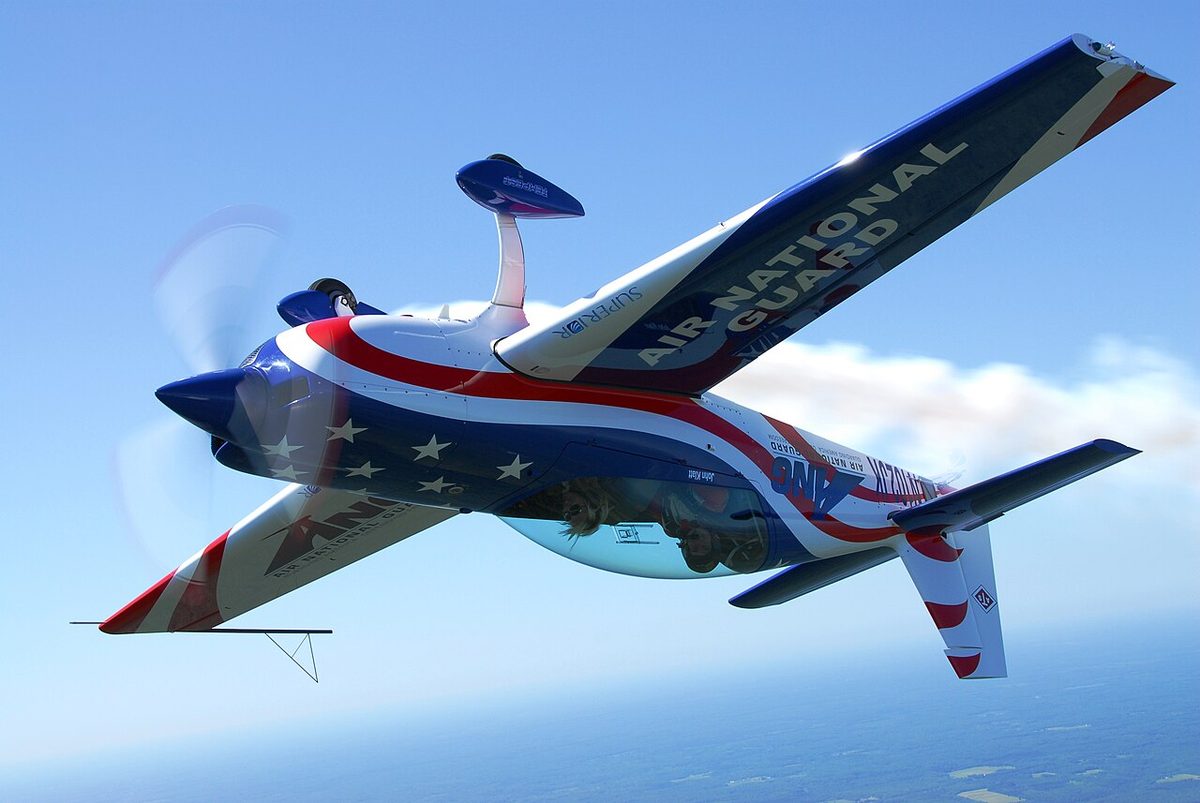
Certification limits which aeroplanes may be spun at all. Intentional spins are prohibited in the normal category. A utility category aeroplane may be approved for them, and a type certified in both categories must then be loaded inside the more restrictive utility envelope, which commonly limits mass, seats and CG range. Aerobatic category aeroplanes are generally cleared for spins. Transport aeroplanes are not certified for spinning, so for them stall prevention and stall recovery are the only defence.
Flat spins
In a normal erect spin the nose points steeply down. In a flat spin it sits much closer to the horizon. The main cause is a centre of gravity at or behind the aft limit: the nose-down pitching moment is reduced, the spin attitude flattens, and the elevator, working in disturbed air, has less authority to lower the nose. Recovery takes longer and may become impossible. Spin certification is done within the approved CG range, and on many light aeroplanes the aft limit is set by spin recovery, so an aft loading that feels acceptable in cruise can be lethal in a spin (see centre of gravity).
Control inputs can flatten a spin too. Power tends to flatten it, which is why the throttle is closed first. Training material also warns that into-spin aileron flattens the spin and delays recovery, while the FAA notes that aileron against the spin can aggravate it in some designs. Neutral aileron is the safe generic setting.
Warning: Never spin an aeroplane outside its approved category, mass and CG envelope. The spin characteristics beyond them were never demonstrated and may include a flat spin from which no recovery is possible.
Spin recovery
The recovery procedure in the aeroplane's flight manual or pilot's operating handbook always takes precedence. The generic sequence taught for light aeroplanes, and remembered by the FAA as PARE, is:
- Power to idle (throttle closed).
- Ailerons neutral.
- Rudder fully opposite to the direction of rotation, and held.
- Elevator: control column moved forward to reduce the angle of attack and unstall the wing.
- When the rotation stops, centralise the rudder so that a spin in the other direction does not start.
- Recover from the resulting dive smoothly, without exceeding VNE or the limit load factor and without a secondary stall.
The order matters. Power and aileron are removed first because they can flatten or aggravate the spin. Anti-spin rudder then stops the yaw that sustains autorotation, and the forward movement of the column unstalls both wings. The rotation does not stop at once, so the controls are held until it does.
Exam tip: Wording differs between sources. The FAA handbook says elevator "briskly forward", European training texts say the column is moved "progressively forward" until the rotation stops, and EASA question banks may say elevator "briskly to about neutral". All three reduce the angle of attack after anti-spin rudder has been applied.
After a prolonged spin the fluid in the semicircular canals keeps moving once the rotation has stopped, and the pilot may feel a spin in the opposite direction. Correcting that false sensation re-enters the original spin, the illusion known as the graveyard spin. The instruments, not the inner ear, decide when the rotation has stopped.
Spiral dive versus spin
A spiral dive is a steep, descending and tightening turn with the wings unstalled. It often grows out of spiral instability. Most light aeroplanes are designed to be slightly spirally unstable, with strong directional stability compared with their dihedral effect. After a small disturbance in roll the aeroplane sideslips towards the lower wing, the fin yaws it that way faster than the dihedral effect can level the wings, the outer wing speeds up and lifts more, and the bank steepens while the nose drops. The divergence is slow and easily corrected, provided the pilot notices it.
In cloud the pilot may not. In a steady turn the sensation of turning fades after roughly 15 to 20 seconds, so a descending turn feels like a wings-level descent. In a University of Illinois study popularised in FAA safety literature, pilots without instrument training who were placed in simulated instrument conditions all lost control, entering a spiral or another unusual attitude after an average of 178 seconds. Seeing the altimeter unwind, the disoriented pilot pulls back. With the wings steeply banked, the pull mostly tightens the turn: the load factor, the airspeed and the descent rate all increase. This is the graveyard spiral, and if the turn is stopped the pilot may feel a turn the other way and roll back into it.
The spiral dive recovery is:
- Reduce power.
- Roll the wings level with co-ordinated aileron and rudder, by reference to the attitude indicator.
- Only then ease out of the dive, respecting VNE and the load limits.
Pulling before the wings are level adds g without raising the nose, and a hard pull-out can overstress the airframe. Grey-out typically begins around 3 to 4 g in a relaxed pilot, so fading vision during the recovery means the pull is already severe.
| Spin | Spiral dive | |
|---|---|---|
| Wings | Stalled, beyond the critical angle of attack | Not stalled |
| Airspeed | Low and roughly steady | High and increasing towards VNE |
| Flight path | Steep, nearly vertical helix | Steep, tightening descending turn |
| Effect of pulling back | Keeps the wing stalled | Tightens the spiral, raises the load factor |
| Recovery | Power idle, ailerons neutral, opposite rudder, column forward | Power reduced, wings level, then ease out |
Note: The FAA commercial steep spiral is a different thing: a deliberate, controlled gliding turn around a ground point, flown at constant airspeed with the bank not exceeding 60°.
Stall-spin accidents
A stall-spin accident is one in which an unintended stall, usually with yaw, develops into a spin or incipient spin too low for recovery. The classic scenarios all combine low height, low speed and poor co-ordination:
- The base-to-final turn. A pilot who overshoots the extended centreline keeps the bank shallow, adds rudder into the turn and holds off bank with opposite aileron while pulling to keep the nose up. The turn becomes a skid. If the wing stalls, the slower inside wing, already at the higher angle of attack, stalls first and the aeroplane rolls under towards the spin. In a slipping turn the outside wing tends to stall first and rolls the aeroplane towards level, which is less violent (see turning flight).
- Turning back after an engine failure. A turn back to the runway combines a steep bank, a raised stall speed, a high sink rate and low height. FAA training material cites studies showing that most light aeroplanes need 800 to 1,000 ft above ground to do it. Below that, landing ahead or within about 30° either side of the runway heading is the survivable choice, and the minimum height for a turn-back belongs in the departure briefing.
- Departures and go-arounds. A nose-high attitude at high power and low speed demands considerable rudder, and an uncorrected yaw at the stall starts the spin.
- Low-level manoeuvring. Steep turns near the ground raise the stall speed by the square root of the load factor, about 25 % at 50° of bank, while leaving no height to recover.
The defence is to fly co-ordinated, keep a speed margin in turns, respond to the first stall warning by reducing the angle of attack, and treat any wing drop near the stall with rudder and forward stick rather than aileron. Upset prevention and recovery training builds on the same rules.
In the United States, spin training is required for the flight instructor certificate, and the commercial pilot Airman Certification Standards include spin awareness. Under 14 CFR 91.307, each occupant other than a crew member must wear an approved parachute when the aeroplane intentionally exceeds 60° of bank or 30° of pitch, but spins and other manoeuvres required for a certificate or rating are exempt when given by an authorised flight instructor.
Frequently asked questions
What causes an aeroplane to spin?
A spin needs two things at once: a stalled wing and yaw. If the aeroplane yaws as it stalls, the wing moving down meets the air at a higher angle of attack, stalls more deeply, loses lift and gains drag, so it keeps dropping while the other wing rises. The roll and yaw then feed each other in autorotation. Stalling in uncoordinated flight, for example in a skidding turn, is the usual cause.
How do you recover from a spin?
Follow the flight manual first. The generic light-aeroplane recovery, which the FAA remembers as PARE, is: power to idle, ailerons neutral, full rudder opposite to the rotation, then the control column forward to unstall the wing. Hold the controls until the rotation stops, centralise the rudder, and ease out of the resulting dive without exceeding the maximum speed or the limit load factor, and without a secondary stall.
What is the difference between a spin and a spiral dive?
In a spin the wings are stalled, so the airspeed stays low and roughly steady while the aeroplane rotates steeply downwards. In a spiral dive the wings are flying, the bank is steep and the airspeed, descent rate and load factor all build quickly. The recoveries differ: a spin needs opposite rudder and forward stick, while a spiral dive needs power off and wings level before any back pressure.
What is a flat spin and why is it dangerous?
A flat spin is a spin in which the nose sits much closer to the horizon than in a normal, steeply nose-down spin. It is most likely with the centre of gravity at or behind the aft limit, and power or into-spin aileron can also flatten a spin. The elevator works in disturbed air and has less authority to lower the nose, so recovery may take much longer or be impossible.
Why is the turn from base leg to final so dangerous?
A pilot who overshoots the final approach may be tempted to keep the bank shallow and push extra rudder into the turn while holding off bank with opposite aileron and pulling to hold the nose up. That is a skidding, cross-controlled turn at low speed. If the wing stalls, the inside wing stalls first and the aeroplane rolls towards a spin with no height left to recover.
Test yourself on Spins and Spiral Dives
The v1prep banks cover this topic in Principles of Flight (081), with a worked explanation for every answer. EASA ATPL, PPL, IR and CPL, the FAA written tests and A320/B737 type ratings.
Start practising →Sources and further reading
- FAA Airplane Flying Handbook (FAA-H-8083-3C), Chapter 5, Maintaining Aircraft Control
- FAA AC 61-67C, Stall and Spin Awareness Training
- FAA Pilot's Handbook of Aeronautical Knowledge (FAA-H-8083-25), Chapters 5 and 17
- 14 CFR 91.307, Parachutes and parachuting
- ICAO Doc 10011, Manual on Aeroplane Upset Prevention and Recovery Training
Library articles are written for study and exam preparation. They do not replace your aircraft's approved documentation, your operator's procedures or the regulations themselves.