Swept Wings
A swept wing is a wing angled backwards from a line at right angles to the fuselage, measured along its quarter-chord line. Sweepback delays compressibility effects and raises the critical Mach number, at the cost of a lower maximum lift coefficient, a tendency to stall at the tips and pitch up, and poorer low-speed handling.
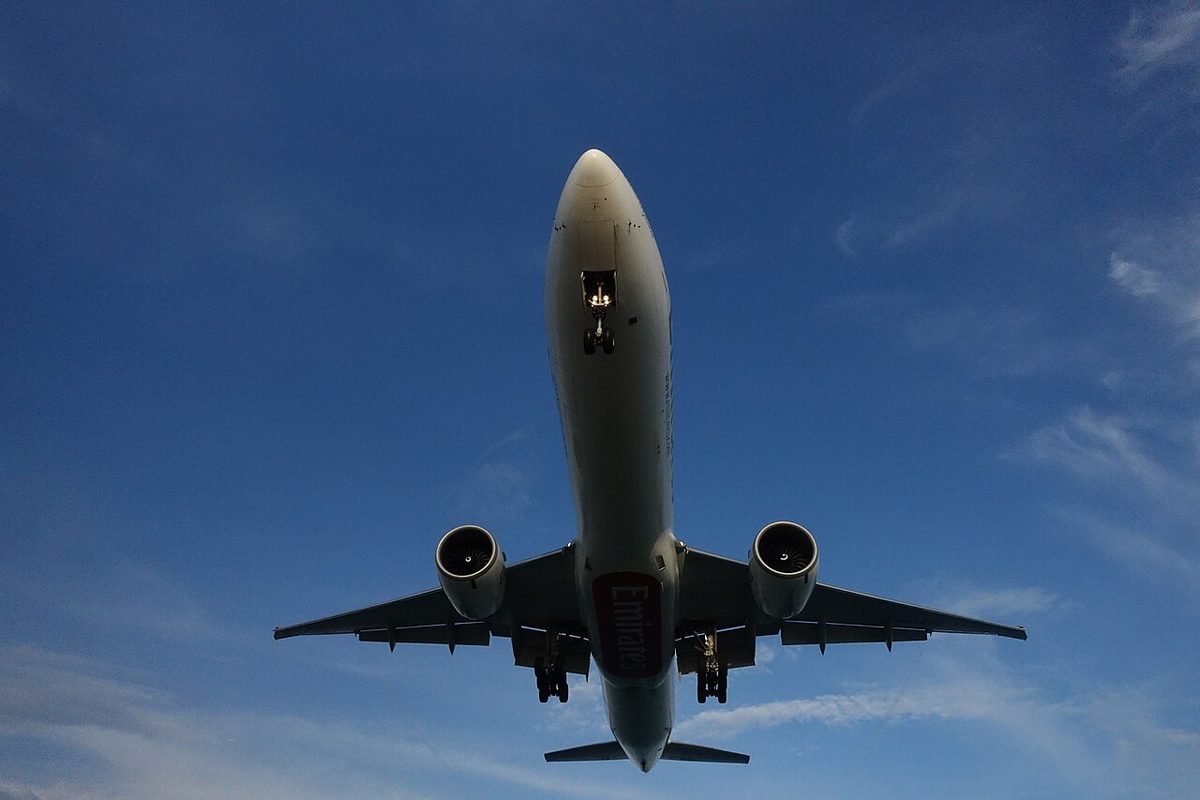
Almost every jet transport has swept wings: seen from above, each wing angles back from the fuselage towards the tip. Sweepback is a solution to a high-speed problem. It lets an aircraft cruise at a Mach number close to 0.8 without the shock waves, drag rise and buffet that a straight wing of the same thickness would suffer at that speed.
The price is paid at low speed. A swept wing produces less maximum lift, stalls at the tips first and tends to pitch up at the stall, and it has to carry fences, vortilons, saw-tooth leading edges and elaborate high-lift devices to fly safely at approach speeds. Understanding both sides explains much about how a jet is designed and flown, and why its stall is protected by a stick shaker and, on some types, a stick pusher.
Why wings are swept
As an aircraft approaches the speed of sound, the air accelerating over the wing reaches M 1.0 locally before the aircraft does. The free-stream Mach number at which this first happens is the critical Mach number (Mcrit). Beyond it a shock wave forms on the upper surface, and a little higher the drag rises steeply, the flow separates behind the shock and the aircraft buffets and tucks nose-down. These effects are described in high-speed flight.
Wing sweep delays them. The pressures over a swept wing depend mainly on the component of the airflow perpendicular to the leading edge, roughly V × cos Λ, where Λ is the sweep angle. The component along the span contributes little to the acceleration over the aerofoil. The wing therefore behaves like a straight wing flying more slowly: it is as if its thickness/chord ratio were smaller, and its critical Mach number is higher.
Sweep angle and critical Mach number
The sweep angle is conventionally measured between the line joining the 25 % chord points of the wing, the quarter-chord line, and a line perpendicular to the root chord. A wing swept back at 30° meeting a free stream of M 0.85 sees a velocity component perpendicular to its quarter-chord line of only about 0.87 of the free stream, the cosine of 30°, equivalent to about M 0.74. The Airbus A320's supercritical wing is swept at 25° and cruises at about M 0.78.
In practice sweep is combined with thin sections, which also raise Mcrit, and with supercritical sections to reach the required cruise Mach number. A supercritical aerofoil, with its blunt nose and relatively flat upper surface, delays shock formation and weakens the shocks, so the same cruise Mach number can be reached with less sweep, more fuel volume and a higher aspect ratio.
Sweep brings other effects, some welcome:
- Flatter lift curve. Sweep reduces the lift-curve slope. A vertical gust changes the angle of attack, and with a flatter lift curve the same change produces a smaller change in lift and load factor, so the ride in turbulence is smoother (see load factor and flight envelope).
- Directional stability. In a sideslip the wing facing into the airflow presents more span and less effective sweep, so it produces more lift and more drag, and the drag yaws the nose back into wind.
- Dihedral effect. The same wing lifts more and rises, a stabilising rolling moment proportional to the lift coefficient. At low speed it is so strong that swept-wing jets are prone to Dutch roll and carry yaw dampers (see lateral and directional stability).
Low-speed disadvantages of sweep
The same effect that raises Mcrit reduces the lift the wing can produce. The main penalties are:
- Lower CLmax. A swept wing reaches a lower maximum lift coefficient, so the stall speed is higher and take-off and landing distances longer. Jets need slats, Krueger flaps and multi-slotted flaps to recover it (see high-lift devices).
- Nose-high at low speed. With its flatter lift curve the wing needs a larger angle of attack for a given lift coefficient and stalls at a higher angle of attack than a straight wing. A swept-wing jet flies noticeably nose-high on the approach, which reduces tail clearance at touchdown and raises the risk of a tail strike.
- Weaker trailing-edge devices. Flaps and control surfaces hinged along a swept line are less effective than on a straight wing.
- Tip stall and pitch-up, described below.
- Less stability per unit of tail area, if the tail surfaces are swept too, because sweep flattens their lift curve as well.
Sweep also has a high-speed penalty: it makes Mach tuck more pronounced. Shock-induced separation on a swept wing usually begins at the thicker root, which moves the centre of pressure outboard and, because of the sweep, aft.
Tip stall and swept-wing pitch-up
On a swept wing the air flowing over the surface has a spanwise component, and the slow air of the boundary layer, having little energy, is carried outboard by it. The boundary layer therefore thickens towards the tips, and the outer wing, already highly loaded on a tapered planform, reaches its critical angle of attack first. The stall begins at the tips: a tip stall.
That produces swept-wing pitch-up. The tips of a swept-back wing lie behind the root, so when they stop lifting, the centre of pressure moves forward and inboard, ahead of where it was. At the same time the lift is concentrated on the inner wing, whose downwash strikes the tailplane and increases its download. Both effects raise the nose, which increases the angle of attack, which spreads the stall inboard: the pitch-up feeds on itself. Tip stall also robs the ailerons of effectiveness and makes a wing drop more likely.
On an aeroplane with a high tailplane the process can end in a deep stall, in which the tailplane sits in the wake of the stalled wing and the elevator can no longer lower the nose. The swept wing causes the pitch-up; the T-tail makes recovery impossible. ATPL texts cite the DC-9, MD-80, Boeing 727, Fokker F28 and Hawker Siddeley Trident as types with this combination, and types with deep-stall potential are fitted with a stick pusher (see tail configurations and stall).
For the pilot the defence is the one that applies to every stall: react to the first stall warning by reducing the angle of attack. The basic stall requirements for swept-wing aircraft are designed so that the ailerons remain usable up to the point at which the stall is recognised, with small, smooth rudder inputs co-ordinated with them; the rudder of a jet is powerful, and careless use near the stall can produce an excessive roll.
Wing fences and vortilons
Designers tackle tip stall at its cause, the outward drift of the boundary layer.
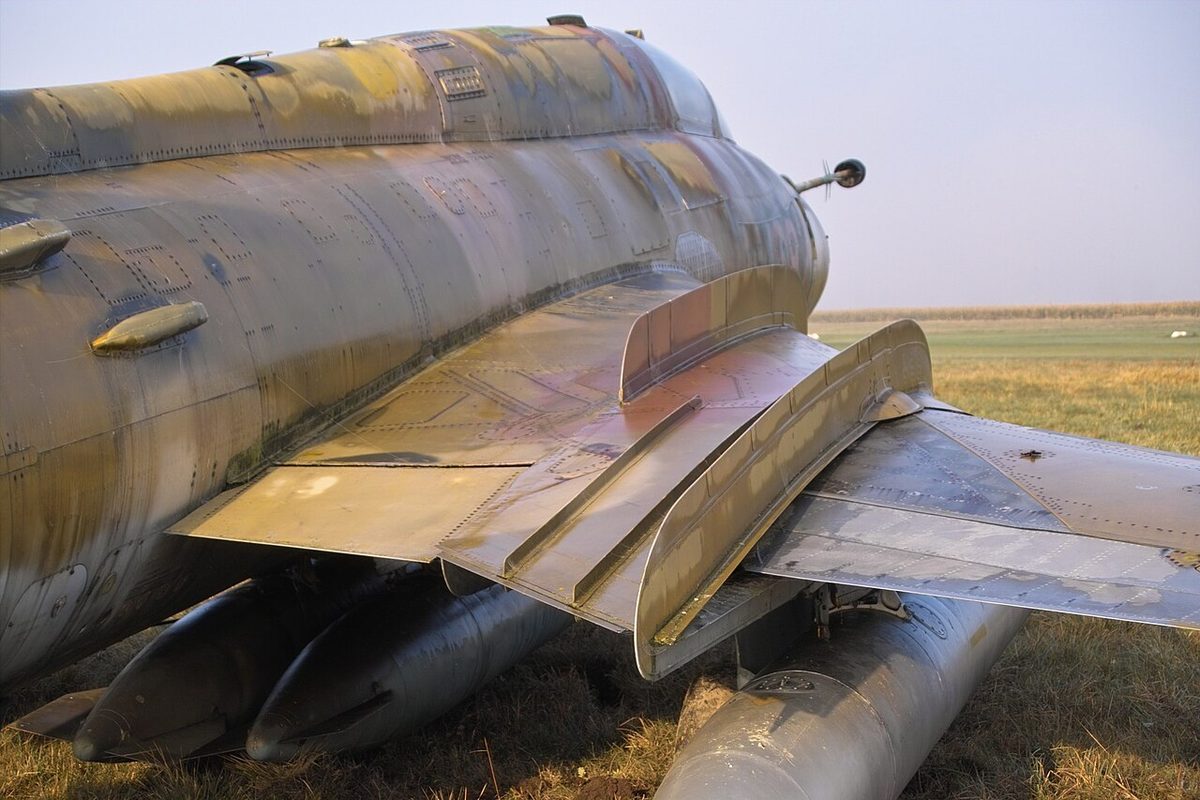
A wing fence is a thin plate standing up from the upper surface and running chordwise over part or all of the chord. It blocks the spanwise flow, so the boundary layer inboard of the fence cannot drift out to thicken the flow over the outer wing. The outer sections keep healthier flow and stall later.
A vortilon is a small fence-like plate fitted under the leading edge instead of on top of the wing. At high angles of attack the airflow wrapping around the leading edge makes it shed a strong vortex that passes back over the upper surface and acts like a fence, checking the outward flow. Engine pylons that extend forward of the leading edge produce a similar vortex.
A wingtip fence, such as the small device on the tips of earlier A320-family aircraft, is a different thing: it is fitted to reduce induced drag (see induced drag and wingtip vortices).
Saw-tooth leading edges
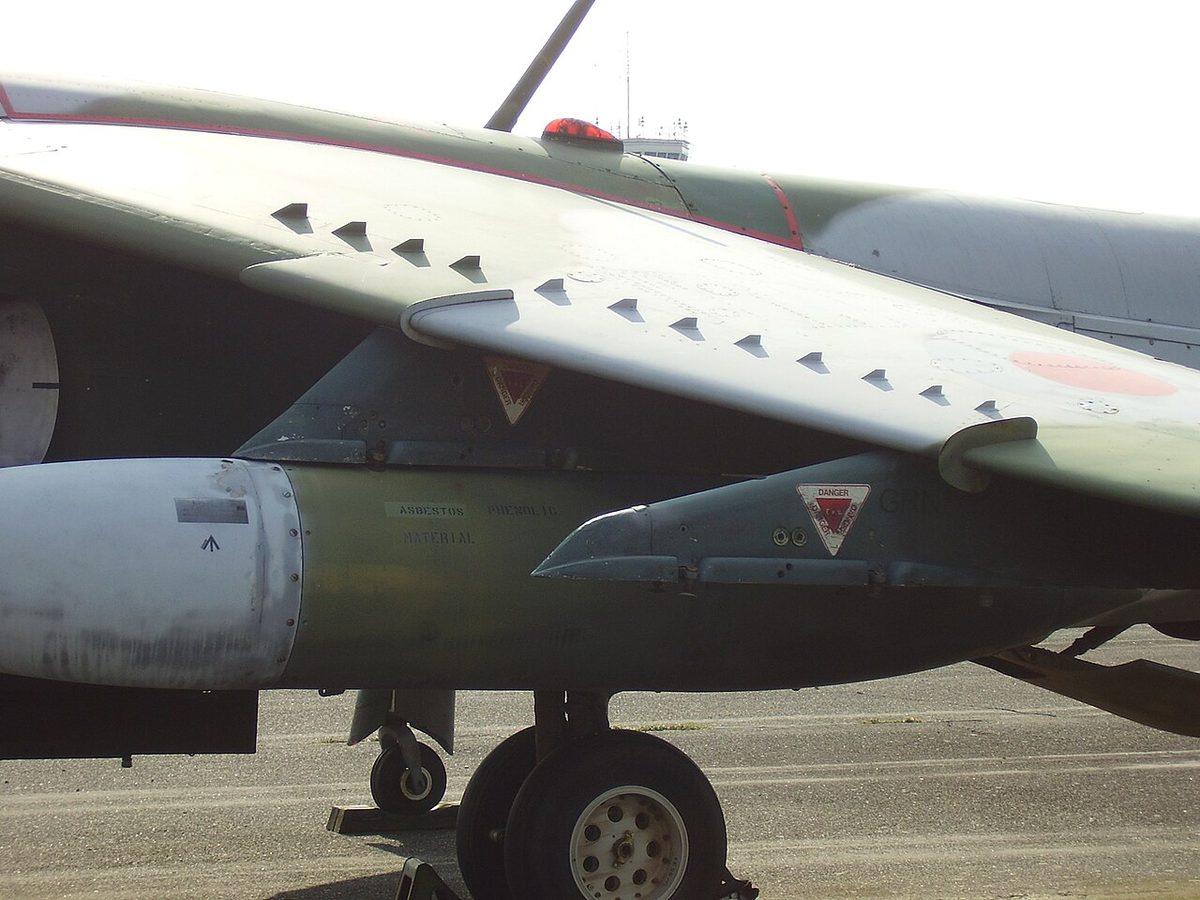
A saw-tooth leading edge is a sharp step in the leading edge where the outer part of the wing has an extended chord that projects forward of the inner part. The discontinuity sheds a strong vortex over the upper surface at high angle of attack, which minimises the spanwise flow of the boundary layer, much as a fence does.
These devices are usually combined with others that make the root stall before the tips:
- Washout, twisting the wing so that the tips meet the air at a lower angle of attack than the root (see wing planform and design).
- Leading-edge devices chosen by position: slats on the outer wing, which raise the stalling angle there, and Krueger flaps on the inner wing, as on the Boeing 737 NG.
- Vortex generators, small vanes that mix fast free-stream air into the boundary layer and delay separation, at low speed and behind shock waves at high speed.
Exam tip: increasing the sweep angle makes tip stall worse, never better. Fences, vortilons, saw-tooth leading edges, washout and outboard slats all work against it.
Frequently asked questions
Why do airliners have swept wings?
Sweep delays the effects of compressibility. The pressure distribution over a swept wing depends mainly on the component of velocity perpendicular to its leading edge, roughly the flight speed multiplied by the cosine of the sweep angle, so the wing behaves as if it were flying slower and thinner. Its critical Mach number rises, and the aircraft can cruise closer to the speed of sound before shock waves, wave drag and buffet appear.
What are the disadvantages of a swept wing?
A swept wing has a lower maximum lift coefficient, so it needs higher take-off and landing speeds and powerful high-lift devices. Its boundary layer drifts towards the tips, which tend to stall first and pitch the nose up. It flies nose-high on the approach, which raises the risk of a tail strike, and its trailing-edge flaps and controls are less effective. It also brings more Dutch roll tendency and more pronounced Mach tuck.
What is swept-wing pitch-up?
Near the stall the tips of a swept-back wing stall first. Because they lie behind the root, losing their lift moves the centre of pressure forward, and the lift concentrated inboard sends more downwash onto the tailplane. Both effects pitch the nose up, driving the angle of attack still higher. On an aeroplane with a T-tail this can lead to a deep stall, which is why such types carry a stick pusher.
What does a wing fence do?
A wing fence is a thin plate set chordwise on the upper surface of a swept wing, over part or all of the chord. It blocks the spanwise drift of the boundary layer towards the tip, so less slow, thickened air accumulates on the outer wing. The outer sections then stall later, which reduces the swept wing's tendency to tip stall and pitch up.
What is a vortilon?
A vortilon is a small fence-like plate fitted under the leading edge of a swept wing. At high angles of attack the airflow around the leading edge makes it shed a strong vortex that passes over the upper surface, where it acts like a wing fence, checking the outward flow of the boundary layer. Engine pylons that extend forward of the leading edge produce a similar effect.
Test yourself on Swept Wings
The v1prep banks cover this topic in Principles of Flight (081), with a worked explanation for every answer. EASA ATPL, PPL, IR and CPL, the FAA written tests and A320/B737 type ratings.
Start practising →Sources and further reading
- FAA Airplane Flying Handbook (FAA-H-8083-3C), Transition to Jet-Powered Airplanes
- FAA Pilot's Handbook of Aeronautical Knowledge (FAA-H-8083-25), Chapter 5, Aerodynamics of Flight
- EASA, Explanatory Note to ED Decision 2018/001/R, Part-FCL theoretical knowledge learning objectives
- EASA Easy Access Rules for Large Aeroplanes (CS-25)
- Scholz, D., Mach number, relative thickness, sweep and lift coefficient of the wing (HAW Hamburg)
Library articles are written for study and exam preparation. They do not replace your aircraft's approved documentation, your operator's procedures or the regulations themselves.