Newton's Laws and the Four Forces
The four forces of flight are lift, weight, thrust and drag. Newton's laws of motion govern how they act: when they balance and their moments cancel, the aeroplane flies in steady, unaccelerated flight, and any imbalance accelerates it or changes its flight path.
Four forces act on an aeroplane in flight: lift, weight, thrust and drag. Newton's three laws of motion say what they do. When the forces balance and their turning moments cancel, the aeroplane is in equilibrium and flies at constant speed along a straight path; when they do not, it accelerates, climbs, descends or turns. Every performance question, from climb gradient to glide range, starts from this balance.
The forces also act at different points. Lift acts through the centre of pressure, weight through the centre of gravity, and thrust and drag along lines that are rarely the same. Balanced forces can therefore still produce couples that pitch the nose up or down, which is why the position of the engines and the tailplane's load matter as much as the size of the forces.
Newton's laws applied to flight
A force is a push or a pull, that which causes or tends to cause a change in the motion of a body. Its unit is the newton (N).
Newton's first law, the law of inertia, states that a body remains at rest or in uniform motion in a straight line unless acted on by an external force. An aeroplane cruising at constant speed and height therefore has no resultant force on it. Its engines are working hard, but only to balance drag. To change speed or direction, a resultant force is needed.
Newton's second law states that the acceleration of a body is proportional to the applied force and inversely proportional to its mass: force = mass × acceleration. A force of 1 N gives a mass of 1 kg an acceleration of 1 m/s². Acceleration is any change of velocity, in direction as well as speed, so a turn at constant speed is an acceleration towards the centre of the turn. In a banked turn the horizontal component of lift provides it; the rudder only keeps the turn balanced (see turning flight). Stated more generally, force equals the rate of change of momentum.
Newton's third law states that every action has an equal and opposite reaction. It explains both lift and thrust:
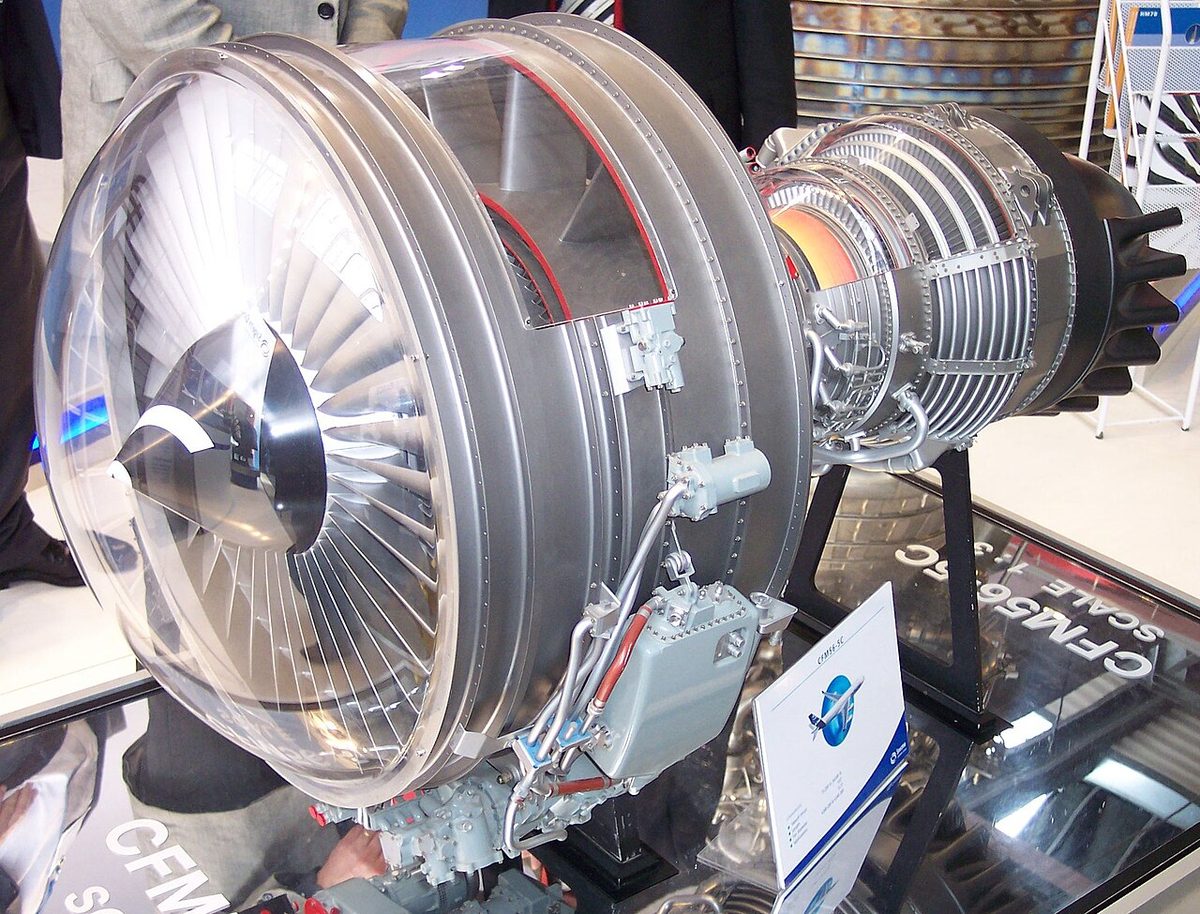
- Thrust. A propeller or jet engine accelerates a mass of air rearwards, and the air pushes the engine forwards with an equal force. For a jet the net thrust is the mass flow of air each second times the increase in its velocity, from the inlet to the nozzle, plus any pressure thrust from a choked nozzle. As the aeroplane speeds up, the inlet velocity rises and net thrust falls.
- Lift. The wing turns the air flowing past it downwards, giving it downward momentum every second. The air pushes back up on the wing with an equal force. The pressure difference across the wing described by Bernoulli's theorem is how that force is applied (see airflow and Bernoulli's principle). Newton and Bernoulli describe one lift from two sides; they are not two contributions to be added (see lift).
Mass, weight, inertia and momentum
Mass is the quantity of matter in a body, in kilograms. It does not change with location. Weight is the force of gravity acting on that mass: W = m × g, where g, the acceleration due to gravity, is 9.81 m/s². A 1 kg mass weighs 9.81 N, and a 60,000 kg aeroplane weighs 60,000 × 9.81 = 588,600 N, the lift its wing must produce in straight and level flight. EASA documents speak of mass (maximum take-off mass, for example), the FAA of weight, usually in pounds.
Inertia is the opposition a body offers to any change in its motion, whether starting, stopping or turning. It is a quality, measured by mass: the heavier the aeroplane, the more force and the more time or distance it needs to accelerate, stop or change direction.
Momentum is mass × velocity, in kg m/s, the quantity of motion of a body. At the same speed a heavier aeroplane has more momentum and keeps moving longer once the forces change.
Kinetic energy is the energy of a mass in motion: KE = ½mV², in joules. Because speed is squared, doubling the speed quadruples the energy, and the brakes must absorb all of it to stop the aeroplane. Touching down 10 per cent faster than the recommended speed gives 1.1² = 1.21 times the energy and, at the same rate of deceleration, about 21 per cent more ground roll.
The four forces of flight
| Force | Direction | Acts through | Produced by |
|---|---|---|---|
| Lift | At 90° to the relative airflow | Centre of pressure | Mainly the wing |
| Weight | Vertically downwards | Centre of gravity | Gravity acting on the mass |
| Thrust | Along the thrust line, roughly along the flight path | Thrust line | Propellers or jet engines |
| Drag | Parallel to the relative airflow, opposing the motion | – | All parts of the aeroplane moving through the air |
Lift is defined relative to the airflow, not to the horizon, so it is vertical only in straight and level flight. Lift and drag together make up the total reaction, the resultant of all the aerodynamic forces on the wing, split into a component perpendicular and a component parallel to the relative airflow. The ratio of lift to drag measures aerodynamic efficiency; for most modern aeroplanes it lies between about 10 and 20 to 1.
The four are closely linked. More weight needs more lift, more lift at a given speed means more drag, above all induced drag, and more drag needs more thrust.
Equilibrium in steady flight
A body is in equilibrium when the sum of all the forces acting on it and the sum of all their moments are both zero. That is the condition for steady, unaccelerated flight, in which an aeroplane holds a constant speed along a straight path. Equilibrium does not mean the aeroplane is at rest; by the first law it means nothing is changing.
- Straight and level: lift equals weight and thrust equals drag.
- Steady climb at a flight path angle γ: lift balances the component of weight perpendicular to the path, so L = W cos γ, slightly less than the weight. The component W sin γ acts backwards along the path with the drag, so T = D + W sin γ, and the climb angle is given by sin γ = (T − D) ÷ W. An aeroplane climbs on excess thrust, not on extra lift, so more weight or less thrust flattens the climb (see climb performance).
- Steady descent: again L = W cos γ, and now the weight component along the path adds to the thrust to balance drag: D = T + W sin γ.
- Glide: with no thrust, D = W sin γ, and the glide angle depends only on the lift/drag ratio. A heavier aeroplane flown at its best glide speed covers the same distance from the same height, but faster and with a higher rate of descent.
A level turn is not equilibrium: the aeroplane is accelerating towards the centre of the turn. The vertical component of lift balances the weight, and the horizontal component provides the turning force, so total lift must rise to W ÷ cos(bank angle), twice the weight at 60°.
An aeroplane is in trim when the moments about all three axes are zero and the pilot needs no continuous force on the controls to hold the attitude.
Exam tip: in any steady climb or descent, lift is less than weight (L = W cos γ). Thrust exceeds drag in a steady climb and is less than drag in a steady descent.
Lift/weight and thrust/drag couples
A moment is a force times the perpendicular distance from its line of action to the pivot, in newton metres; an aeroplane in flight pivots about its centre of gravity. A couple is a pair of equal, opposite and parallel forces that do not act along the same line. It produces no resultant force, only a turning moment equal to one force times the distance between them.
In level flight lift and weight are equal and opposite, so if they act along different lines they form the lift/weight couple. With the centre of pressure behind the centre of gravity, as in normal loading, the couple is nose-down. Thrust and drag are also equal and opposite in level flight. With the thrust line below the line of drag, as on many light aeroplanes, they form a nose-up thrust/drag couple.
Designers arrange the lift/weight and thrust/drag couples so that they oppose one another. The balance is never exact: the centre of pressure moves with angle of attack, drag changes with speed and thrust with the power set. The tailplane supplies the remaining moment. Normally it carries a small download on its long arm, so the wing must support the weight plus that download, which is why a forward centre of gravity slightly raises the stalling speed (see centre of gravity).
The arrangement is deliberately fail-safe. If the engine stops, the nose-up thrust/drag couple disappears, the nose-down lift/weight couple takes over and the aeroplane pitches down of its own accord, protecting its airspeed at the moment the pilot is busiest.
Thrust line and pitch coupling
The thrust line is the line along which the thrust of the engines acts. Its position relative to the centre of gravity decides how the aeroplane responds to power changes:
- Thrust line below the centre of gravity: an increase in thrust produces a nose-up pitching moment, a reduction a nose-down one.
- Thrust line above the centre of gravity: an increase in thrust produces a nose-down pitching moment.
Airliners with underslung engines, slung in pods beneath the wing, have their thrust line well below the centre of gravity, so thrust and pitch are strongly coupled. On an A320 take-off the pilot flying holds the sidestick half forward, or fully forward in some wind conditions, to counter the nose-up effect of take-off thrust until 80 kt, releasing it gradually to neutral by 100 kt.
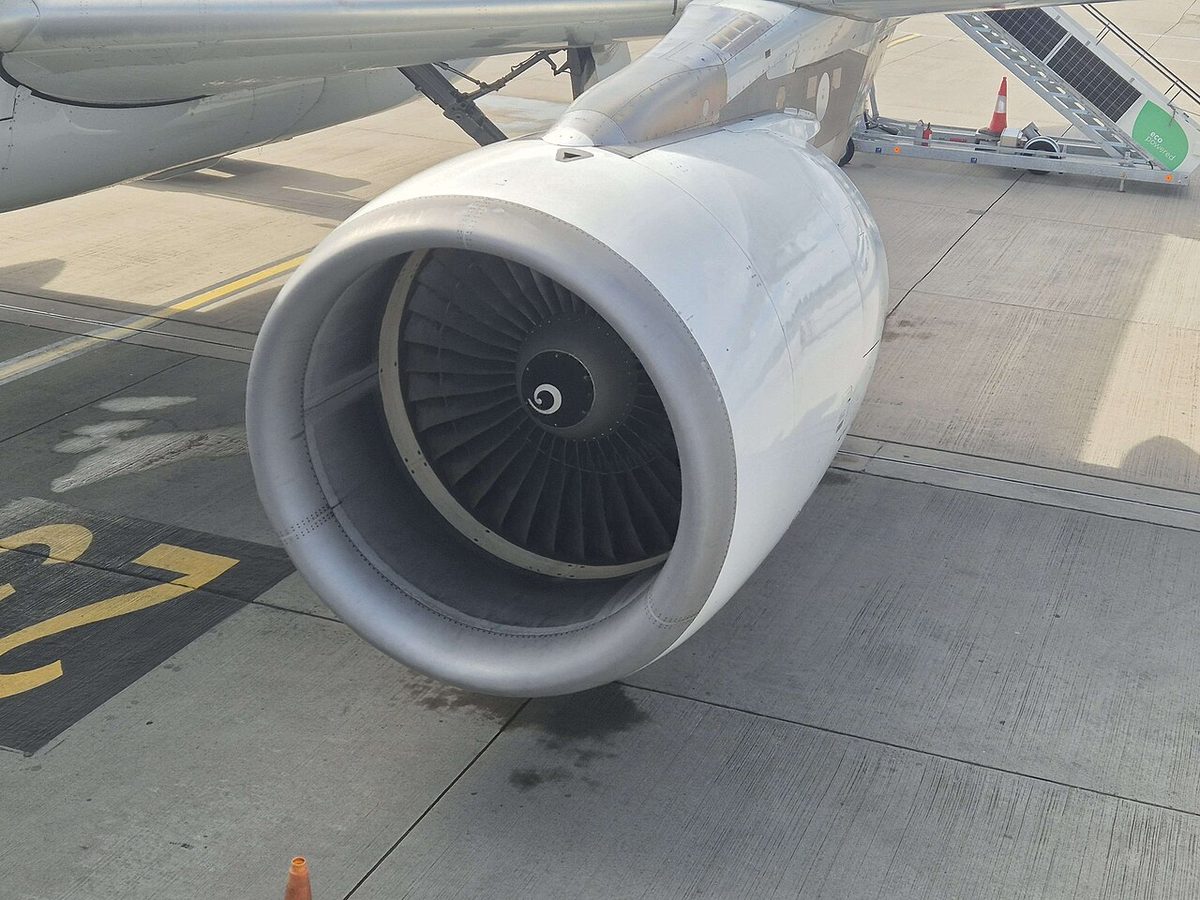
The coupling matters most near the stall. Applying maximum thrust to an underwing-engined jet while the wing is still stalled pitches the nose up and drives the angle of attack back up, so FAA AC 120-109A and manufacturers' stall recovery procedures put reducing the angle of attack first and thrust second, "as needed". In a nose-high upset on the Boeing 737, thrust is reduced to help the nose come down. Windshear and terrain escape manoeuvres, where the threat is the ground rather than the wing, still open with maximum thrust, but the pitch attitude is flown deliberately to a target, on the Boeing 737 an initial 15° for windshear and 20° for terrain, and raised further only as far as the pitch limit indicator, stick shaker or initial buffet while the ground remains a threat.
Warning: with engines below the centre of gravity, a large thrust increase at low speed and high angle of attack can pitch the aeroplane further towards the stall. Reduce the angle of attack first and add thrust smoothly, in accordance with the manufacturer's procedure.
Frequently asked questions
What are the four forces acting on an aeroplane in flight?
Lift, weight, thrust and drag. Lift acts at right angles to the relative airflow through the centre of pressure; weight acts vertically downwards through the centre of gravity; thrust acts along the thrust line, roughly along the flight path; drag acts parallel to the relative airflow, opposing the motion. They are linked: more weight needs more lift, more lift brings more drag, and more drag needs more thrust.
How do Newton's laws explain lift?
A wing turns the air passing it downwards, giving that air downward momentum every second. By Newton's second law that needs a downward force on the air, and by the third law the air pushes back on the wing with an equal upward force. The pressure difference over the wing, lower above and higher below, is how that force is exerted, so the Bernoulli and Newton explanations describe the same lift.
Is lift equal to weight in a climb?
No, it is slightly less. In a steady climb lift acts at right angles to the inclined flight path and balances only the component of weight perpendicular to it, W cos γ. The rest of the weight, W sin γ, acts backwards along the path with the drag, so thrust must exceed drag. An aeroplane climbs on excess thrust, not on extra lift, and the climb angle is given by sin γ = (T − D) ÷ W.
What is the difference between mass and weight?
Mass is the quantity of matter in a body, measured in kilograms, and it is the same anywhere. Weight is the force of gravity on that mass, measured in newtons, equal to mass times the acceleration due to gravity, 9.81 m/s². A 60,000 kg aeroplane weighs 588,600 N, and in level flight its wing must produce that much lift. EASA texts speak of mass, the FAA of weight.
Why do underwing engines pitch the nose up when thrust is increased?
Engines slung in pods below the wing have a thrust line well below the centre of gravity. Thrust acting below the centre of gravity forms a nose-up pitching moment, which grows as thrust is increased and shrinks as it is reduced. Crews counter it with forward stick or column on the take-off roll, and in a stall recovery reduce the angle of attack first and add thrust only as needed.
Test yourself on Newton's Laws and the Four Forces
The v1prep banks cover this topic in Principles of Flight (081), with a worked explanation for every answer. EASA ATPL, PPL, IR and CPL, the FAA written tests and A320/B737 type ratings.
Start practising →Sources and further reading
- FAA Pilot's Handbook of Aeronautical Knowledge (FAA-H-8083-25), Chapters 4 and 5, Principles and Aerodynamics of Flight
- FAA Airplane Flying Handbook (FAA-H-8083-3C), Chapter 5, Maintaining Aircraft Control
- Babinsky, H., How do wings work?, Physics Education 38(6), 2003
- FAA AC 120-109A, Stall Prevention and Recovery Training
- EASA, Explanatory Note to ED Decision 2018/001/R, Part-FCL theoretical knowledge learning objectives
Library articles are written for study and exam preparation. They do not replace your aircraft's approved documentation, your operator's procedures or the regulations themselves.