Centre of Gravity
The centre of gravity (CG) is the point through which the total weight of an aircraft acts. Its position, measured from a reference datum or as a percentage of the mean aerodynamic chord, must stay within forward and aft limits that protect stability and control.
The centre of gravity (CG), spelled center of gravity in FAA material, is the point through which the whole weight of an aircraft can be taken to act. It is the balance point. In flight it is also the point about which the aircraft pitches, rolls and yaws, so its position relative to the wing's lift and the tailplane decides how stable the aircraft is, how much elevator authority remains and how much drag the balancing tail load costs.
Mass limits protect the structure and the performance; CG limits protect stability and control. An aircraft can be under its maximum take-off mass and still be unsafe and illegal to fly because its CG is outside the envelope. The CG also moves as fuel burns, as people move and as flaps and landing gear travel, so it is checked for every loading condition that matters. EASA examines it in Mass and Balance (031); the FAA calls it weight and balance.
Reference datum and stations
All positions are measured from the reference datum, a point on the longitudinal axis or its extension chosen by the manufacturer. The FAA describes it as an imaginary vertical plane from which all horizontal distances are measured. It may sit at the nose, the firewall or a point ahead of the aircraft, so that every arm is positive. Every arm and CG limit in the flight manual refers to that datum, so figures from another type cannot be mixed in.
Structural positions use a separate grid numbered from the datum:
- A station number (Stn), or on large aircraft a body station (BS) or fuselage station, gives a fore-and-aft position in inches or metres from station zero. Where station zero is also the weight and balance datum, a station number is also an arm.
- A water line (WL) gives height above a horizontal reference plane.
- A buttock line gives distance left or right of the centreline, and a wing station measures outboard along the span.
Only the fore-and-aft coordinate enters the longitudinal CG calculation.
Note: the adjustable aeroplane datum found on some attitude indicators is unrelated. It is the knob-set miniature aircraft symbol, moved to allow for the cruise pitch attitude.
Arm, moment and the CG calculation
The arm, or balance arm in EASA texts, is the distance from the datum to the CG of an item: positive aft of the datum, negative forward of it. The moment is mass multiplied by arm, in kg m or lb-in, and measures the item's turning effect about the datum. Arm and moment lead to the one formula of the subject:
CG = total moment ÷ total mass
| Item | Mass (kg) | Arm (m) | Moment (kg m) |
|---|---|---|---|
| Basic empty mass | 720 | 2.30 | 1,656 |
| Front seat occupants | 140 | 2.20 | 308 |
| Rear passenger | 60 | 3.00 | 180 |
| Fuel | 80 | 2.95 | 236 |
| Total | 1,000 | 2.38 | 2,380 |
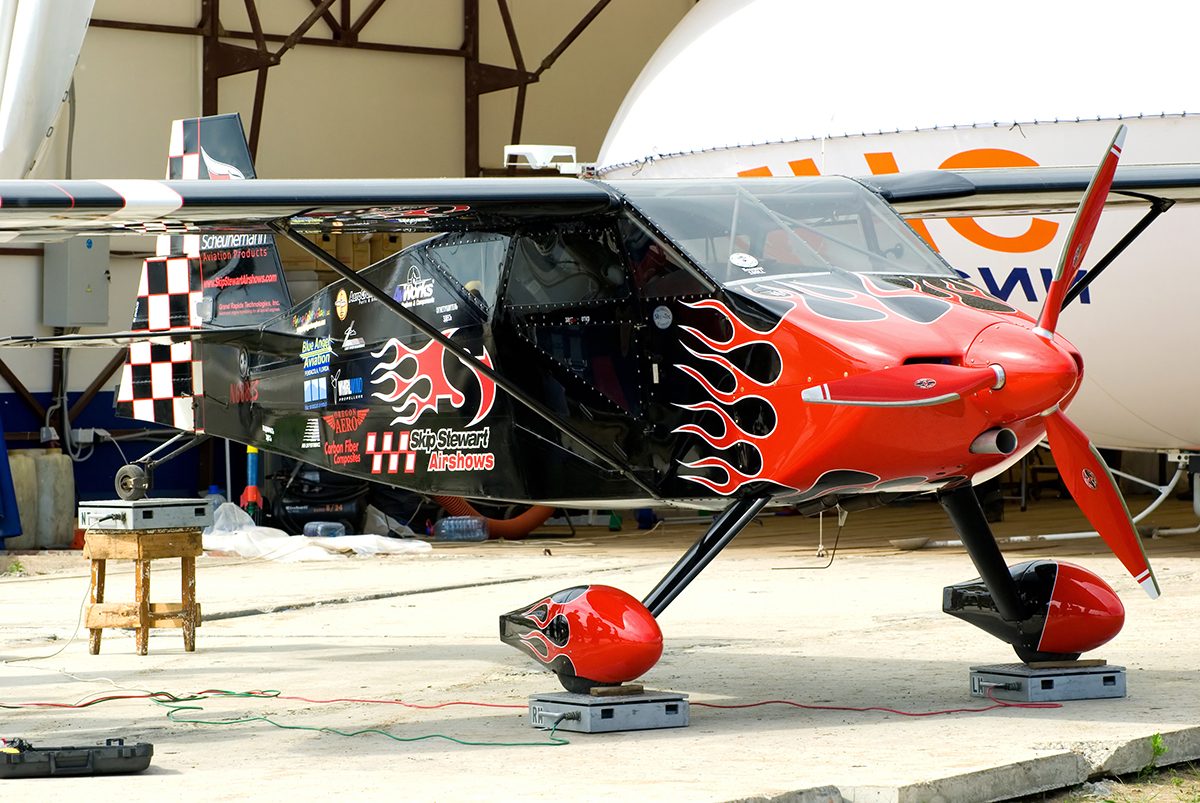
The CG is 2,380 ÷ 1,000 = 2.38 m aft of the datum. Weighing uses the same arithmetic: a nose wheel reading 500 lb at −20 in and two main wheels reading 2,000 lb each at +30 in give 4,500 lb and +110,000 lb-in, so the empty CG is at +24.4 in. Scale readings in newtons are divided by 9.81 to give kilograms.
To keep numbers short, moments are often divided by a constant. FAA loading tables use a moment index, typically the moment divided by 1,000; EASA load and trim sheets use a loading index, starting from the dry operating index (DOI), and read the CG from an envelope drawn in index units. When calculating by hand, multiply an index back by its constant before dividing by mass: a moment index of 274.5 at 3,050 lb is 274,500 lb-in, so the CG is at 90.0 in.
Mean aerodynamic chord and %MAC
The mean aerodynamic chord (MAC) is the chord of an imaginary rectangular wing with the same aerodynamic characteristics as the real, tapered or swept wing. The manufacturer publishes its length and the arm of its leading edge, the leading edge of MAC (LEMAC). The CG is then expressed as a percentage of that chord:
%MAC = (CG arm − LEMAC arm) ÷ MAC length × 100
With the CG 2.65 m aft of the datum, LEMAC at 2.20 m and a MAC of 1.50 m, the CG is at 0.45 ÷ 1.50 × 100 = 30% MAC. Working backwards, 21% of a 73 in MAC is 15.33 in, so with LEMAC at 26 in the CG is at 41.33 in.
Airliners state their limits in %MAC because it ties the CG to aerodynamic reference points on the wing, such as the aerodynamic centre near 25% of the chord and the aeroplane's neutral point (see lift). Light aircraft usually state limits in inches or metres aft of the datum.
Exam tip: dividing by the LEMAC arm instead of the MAC length is the classic wrong option; in the example above it gives 20.5%.
The CG envelope and limits
The centre of gravity (CG) envelope plots mass on the vertical axis against CG position, moment or %MAC. A loading is acceptable when its point lies inside the envelope or on its boundary. Mass, CG and the limits of each compartment are three separate tests: an aircraft can pass one and fail another. Types certified in both the normal and utility categories have a smaller utility envelope, which must be used for manoeuvres such as spins.
The two limits have different purposes:
- The forward CG limit guarantees a minimum of controllability. The elevator must still be able to rotate the aeroplane on take-off and raise the nose in the flare, at low speed and in ground effect, which is usually the deciding case. On many envelopes the forward limit moves aft at higher masses.
- The aft CG limit guarantees a minimum of static longitudinal stability. The neutral point is the CG position at which a disturbance produces no restoring pitching moment; the aft limit lies some distance ahead of it, and the distance from the CG to the neutral point is the static margin. Spin recovery can also set the aft limit.
The CG must stay inside the envelope in every phase of flight. As the tanks empty, it moves between the take-off point and the zero fuel point, provided fuel is used in the prescribed sequence. Airline loadsheets therefore give the zero fuel weight centre of gravity (ZFWCG) and the take-off centre of gravity (TOCG), both checked against the envelope. Airbus crews enter the zero fuel weight and ZFWCG in the flight management system and set the trimmable horizontal stabiliser for take-off from the loadsheet value. Boeing crews check the gross weight and cruise centre of gravity (CRZ CG) in the CDU against the dispatch papers. A stabiliser mis-set from a wrong CG has caused tail strikes and rotation problems.

Effects of forward and aft CG
On a conventional aeroplane the CG lies ahead of the wing's centre of pressure, producing a nose-down moment that the tailplane balances with a download. The wing must lift the weight plus that download. A forward CG increases the download and so the lift the wing must produce; an aft CG does the reverse.
| Effect | Forward CG | Aft CG |
|---|---|---|
| Longitudinal static stability | Greater | Less; neutral or negative behind the limit |
| Pitch control forces | Heavier | Lighter; stick force per g falls |
| Tail download and trim drag | Greater | Smaller |
| Stall speed | Higher | Lower |
| Cruise fuel burn and range | More fuel, less range | Less fuel, more range |
| Take-off | Higher VR and other take-off speeds; longer run | Easier rotation; shorter run |
| Landing flare | Elevator may run out of travel | Light, easily over-controlled |
| Spin recovery | Easier | Harder; the spin flattens |
| Light twin VMCA | Lower | Higher, as the rudder arm shortens |
The download acts like extra weight, so a forward CG raises the stall speed, and certification stall speeds are therefore set at the most forward CG (see stall). At altitude it narrows the buffet margins as a heavier aeroplane would (see high-speed flight). On the ground the aeroplane rotates about its main wheels, and a CG further ahead of them needs more elevator force, and so more airspeed, to lift the nose: VR and the other take-off speeds rise and the take-off run lengthens (see take-off speeds).
An aft CG reduces trim drag, which is why airlines load towards the aft limit and why the A330, A340 and MD-11 carry fuel in a tail trim tank in cruise. The price is stability. Near the aft limit the CG closes on the manoeuvre point, so the stick force per g falls and a small pull can produce a large load factor. Behind the limit the aeroplane may diverge in pitch, and a spin may become unrecoverable.
Warning: in 2003 Air Midwest flight 5481, a Beech 1900D, pitched up uncontrollably after take-off from Charlotte, North Carolina, and crashed. The NTSB found a mis-rigged elevator compounded by a CG well aft of the certified limit, and cited the FAA's average weight assumptions then in use as a contributing factor.
CG shift, mass change and ballast
When mass moves within the aircraft, the total mass is unchanged. The CG shift formula, called the weight shift formula in FAA texts, is:
mass moved × distance moved = total mass × CG shift
A 15 kg bag moved 2.00 m forward in a 1,000 kg aeroplane moves the CG 15 × 2.00 ÷ 1,000 = 0.03 m forward, from 2.35 m to 2.32 m. Rearranged, it gives the mass to move: at 2,400 lb with the CG 0.5 in behind the aft limit and compartments 30 in apart, 2,400 × 0.5 ÷ 30 = 40 lb must go forward.
When mass is added or removed, the total mass changes. The mass addition/removal formula is:
new CG = (old moment ± mass × its arm) ÷ (old mass ± mass)
or, as a shift, mass added × (its arm − old CG) ÷ new total mass. Adding 100 lb at 95.0 in to 2,200 lb at 42.0 in gives 101,900 ÷ 2,300 = 44.3 in. Fuel burn is a removal: 200 kg burned at 2.85 m from 1,800 kg at 2.40 m leaves 3,750 ÷ 1,600 = 2.34 m. Removing mass behind the CG moves the CG forward; adding it there moves the CG aft.
Ballast is mass carried only to correct the CG. At 2,100 lb with the CG at 38.5 in and the forward limit at 40.0 in, ballast at 115 in must satisfy ballast × (115 − 40.0) = 2,100 × 1.5, so 42 lb. Ballast must be secured and must respect the mass and compartment limits. When the CG is outside on the arm but not on the mass, redistributing load is usually the better cure.
Exam tip: the common errors are measuring from the datum instead of the CG, dividing by the old mass instead of the new, and getting the sign of the shift wrong.
Lateral CG
Longitudinal calculations assume the CG lies on the centreline. The lateral centre of gravity is kept there by symmetrical loading and fuel management, and transport aircraft publish fuel imbalance limits: on the Boeing 737, for example, a random imbalance between main tanks 1 and 2 must not exceed 453 kg, and crossfeed is used to correct it unless a fuel leak is suspected. Helicopters also calculate a lateral CG against lateral limits.
EASA and FAA rules
EASA rules sit in the mass and balance section of Part-CAT of Regulation (EU) No 965/2012 (CAT.POL.MAB), which replaced the EU-OPS 1 Subpart J that question banks still quote:
- Mass and CG are established by actual weighing before entry into service and re-established after modifications; EU-OPS required re-weighing of an individual aeroplane every four years. Fleets of one model and configuration may use an average dry operating mass and CG.
- Traffic load is found by actual weighing or by standard masses from tables for passengers and baggage, which include hand baggage; a child aged two to under twelve counts as 35 kg. Freight is weighed.
- Mass and balance documentation is prepared before each flight, names its preparer, is signed by the person supervising loading and is accepted by the commander. Last-minute changes are documented.
The FAA says weight rather than mass and covers the subject in the Pilot's Handbook of Aeronautical Knowledge and the Aircraft Weight and Balance Handbook (FAA-H-8083-1B). Each aircraft's empty weight and CG are recorded in its own weight and balance record, updated by the person who alters it. Standard weights are 6 lb per US gallon for avgas and 7.5 lb for oil. Part 121 carriers prepare a load manifest (14 CFR 121.665 and 121.693) under an approved programme; AC 120-27F allows approved average passenger and bag weights, from a survey or published government data, or actual weights, in place of the fixed standard weights of AC 120-27E.
Frequently asked questions
How do you calculate the centre of gravity of an aircraft?
List every item with its mass and its arm, the distance from the manufacturer's datum, positive aft and negative forward. Multiply each mass by its arm to get its moment, add up the masses and the moments, then divide the total moment by the total mass. The answer is the CG position as an arm from the datum. Never average the arms, because that ignores how much mass sits at each one.
How is CG expressed as a percentage of MAC?
Subtract the arm of the leading edge of the mean aerodynamic chord (LEMAC) from the CG arm, divide by the length of the MAC and multiply by 100. With the CG 2.65 m aft of the datum, LEMAC at 2.20 m and a MAC of 1.50 m, the CG is at 30% MAC. Airliners express their CG limits this way because it relates the CG directly to the wing's aerodynamics.
What happens if the CG is behind the aft limit?
Longitudinal static stability falls and may become neutral or negative, so the aeroplane diverges in pitch after a disturbance instead of returning. Stick forces become light, making it easy to overstress the structure. A spin tends to flatten and recovery may be impossible, and on a light twin the minimum control speed rises because the rudder's arm is shorter. Stall speed and trim drag fall slightly, which is no compensation.
Why does a forward CG increase the stall speed?
With the CG further ahead of the wing's lift, the nose-down moment is larger, so the tailplane must push down harder to balance it. The wing then has to support the weight plus that tail download, so it reaches its critical angle of attack at a higher speed. The stalling angle itself does not change; only the lift required, and so the speed, goes up. This is why certification stall speeds are set at the forward limit.
Why must the zero fuel CG be checked as well as the take-off CG?
As fuel is burned the CG travels between the take-off point and the zero fuel point, provided the tanks are used in the prescribed sequence. A take-off and a landing CG inside the envelope do not prove that the whole path is, so the zero fuel CG must be inside too. If it is not, a long flight or a diversion could carry the CG out of limits while airborne.
What is ballast in mass and balance?
Ballast is mass loaded only to bring the centre of gravity within limits, not to earn revenue. It is placed as far from the CG as practicable, on the side the CG must move towards, so that the least mass does the job. It must be secured, counted in the total mass and kept within the compartment limits. The amount is found by setting the new CG equal to the limit in the mass addition formula.
Test yourself on Centre of Gravity
The v1prep banks cover this topic in Mass and Balance (031), with a worked explanation for every answer. EASA ATPL, PPL, IR and CPL, the FAA written tests and A320/B737 type ratings.
Start practising →Sources and further reading
- FAA Pilot's Handbook of Aeronautical Knowledge (FAA-H-8083-25), Chapter 10, Weight and Balance
- FAA Aviation Handbooks and Manuals, Aircraft Weight and Balance Handbook (FAA-H-8083-1B)
- FAA AC 120-27F, Aircraft Weight and Balance Control
- EASA Easy Access Rules for Air Operations (Regulation (EU) No 965/2012), CAT.POL.MAB
- NTSB AAR-04/01, Loss of Pitch Control During Takeoff, Air Midwest Flight 5481
Library articles are written for study and exam preparation. They do not replace your aircraft's approved documentation, your operator's procedures or the regulations themselves.