Turning Flight
Turning flight is flight along a curved path, produced by banking the aeroplane so that the horizontal component of lift supplies the force towards the centre of the turn. At a given true airspeed the bank angle fixes the load factor, the rate of turn and the radius of turn.
An aeroplane turns by banking. Tilting the wings tilts the lift, and the sideways part of that lift pulls the aeroplane round a curved path. Everything else about the turn follows from that one fact: the extra lift needed, the rise in load factor and stall speed, the relationship between bank, speed, rate and radius, and the need to keep the turn in balance.
Turning is also where many loss of control accidents begin. A steep or badly co-ordinated turn at low speed and low height combines a raised stall speed with yaw, the two ingredients of a spin. Understanding the turn is therefore both basic handling and a safety subject.
Forces in a turn
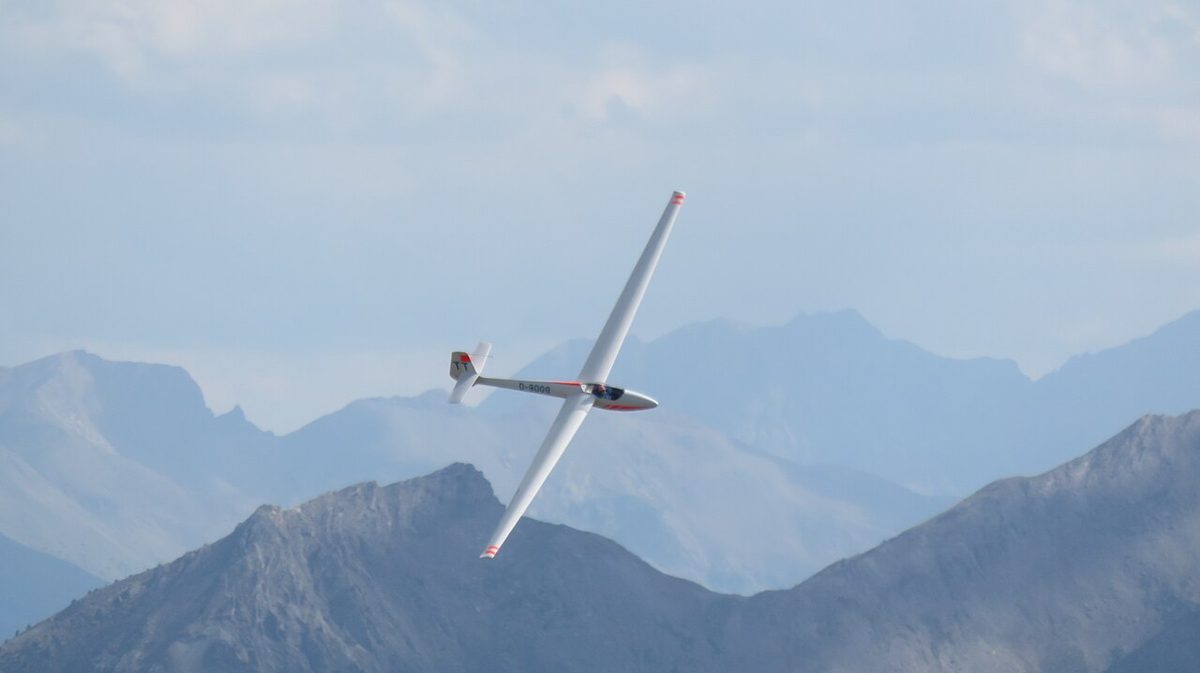
A body moving along a curve needs a force towards the centre of the curve, the centripetal force. In a turn the aeroplane supplies it by rolling: the lift, which acts perpendicular to the wings, is tilted by the bank angle. Its horizontal component of lift pulls the aeroplane round the turn, while its vertical component supports the weight.
In a level turn at bank angle φ:
- vertical component: L × cos φ = W
- horizontal component: L × sin φ = W × V² ÷ (g × r)
Because only part of the lift now acts upwards, the total lift must rise to keep the vertical part equal to the weight. The pilot provides it by increasing the angle of attack with back pressure. The weight itself does not change; the load factor does. The rudder does not turn the aeroplane: it keeps it in balance.
The extra lift costs drag. At a constant speed induced drag rises with the square of the load factor, so a level 60° turn produces four times the induced drag of wings-level flight. Without extra power the aeroplane slows down or descends.
Bank angle and load factor
Dividing the two equations shows that in a level, co-ordinated turn the load factor depends on the bank angle alone: n = 1 ÷ cos φ. It is the same for a glider and an airliner, and for a light or a heavy aeroplane.
| Bank angle | Load factor | Stall speed increase |
|---|---|---|
| 30° | 1.15 g | about 7 % |
| 45° | 1.41 g | about 19 % |
| 60° | 2.0 g | about 41 % |
| 75° | 3.86 g | about 97 % |
The stall speed rises with the square root of the load factor, VS × √n, so an aeroplane that stalls at 50 kt wings level stalls at about 71 kt in a level 60° turn. The increase is modest up to about 45° and rises steeply beyond 60°. See load factor and flight envelope and stall.
Rate and radius of turn
From the same equations, with V the true airspeed:
- turn radius: r = V² ÷ (g × tan φ)
- rate of turn: ω = g × tan φ ÷ V
In cockpit units these become r ≈ V² ÷ (11.3 × tan φ), in feet with V in knots, and a rate of about 1,092 × tan φ ÷ V degrees per second.
Three consequences follow. At a constant bank angle, doubling the true airspeed makes the radius four times larger and halves the rate. At a constant speed, a steeper bank reduces the radius and increases the rate. And neither depends on weight or type. The tightest turn therefore comes from a low speed combined with a steep bank, limited by the stall. Because the formulas use true airspeed, the same indicated speed and bank give a wider turn at high density altitude.
| Bank at 100 kt TAS | Radius | Rate | Time for 360° |
|---|---|---|---|
| 15° | about 3,300 ft | 2.9°/s | about 2 min |
| 30° | about 1,530 ft | 6.3°/s | about 57 s |
| 45° | about 885 ft | 10.9°/s | about 33 s |
| 60° | about 510 ft | 18.9°/s | about 19 s |
A rate one turn, called a standard rate turn by the FAA, is 3° per second: 180° in one minute and 360° in two. The bank it needs grows with true airspeed, since tan φ ≈ TAS ÷ 364: about 18° at 120 kt, 22° at 150 kt and 25° at about 170 kt. European texts use the rule of thumb TAS ÷ 10 + 7; FAA material uses TAS ÷ 10 plus half that figure. ICAO holding procedures assume 25° of bank or 3° per second, whichever needs less bank, so fast aircraft turn more slowly; the FAA AIM uses 3° per second, 30° of bank, or 25° with a flight director, again whichever needs the least bank (see holding patterns). The radius of a rate one turn is about TAS ÷ 190 in nautical miles, rounded in exam texts to TAS ÷ 200: about 1.9 NM at 360 kt.
Coordinated turns
A coordinated turn, often spelt co-ordinated in British texts, is one flown without sideslip: the relative airflow meets the aeroplane head-on and the slip ball is centred. Coordinated flight is the same condition at any time, and turn coordination is the use of aileron and rudder together to achieve it.
Rolling into a turn with aileron alone produces adverse yaw. The down-going aileron raises the lift and induced drag of the rising wing, which is held back, so the nose yaws away from the turn. Rudder applied with the aileron in the direction of roll cancels it; the details are in roll control, adverse yaw and spoilers. Once the bank is established the controls return to near neutral, with back pressure held to keep the nose up. Rolling out needs the same co-ordination in reverse. On the A320 in normal law the flight controls hold the flight path in a turn up to 33° of bank with no pitch correction from the pilot; beyond 33° both lateral and aft pressure are needed.
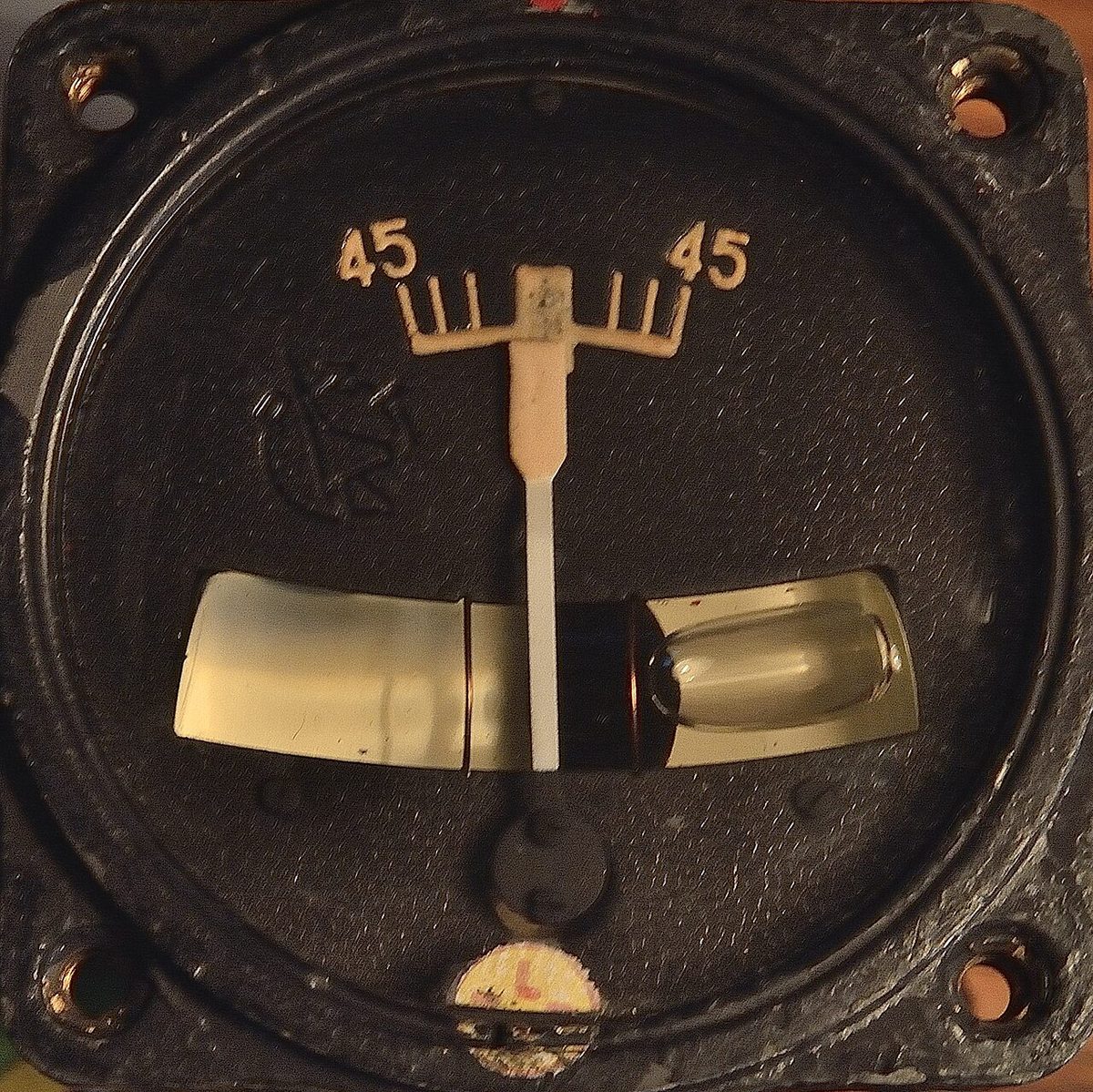
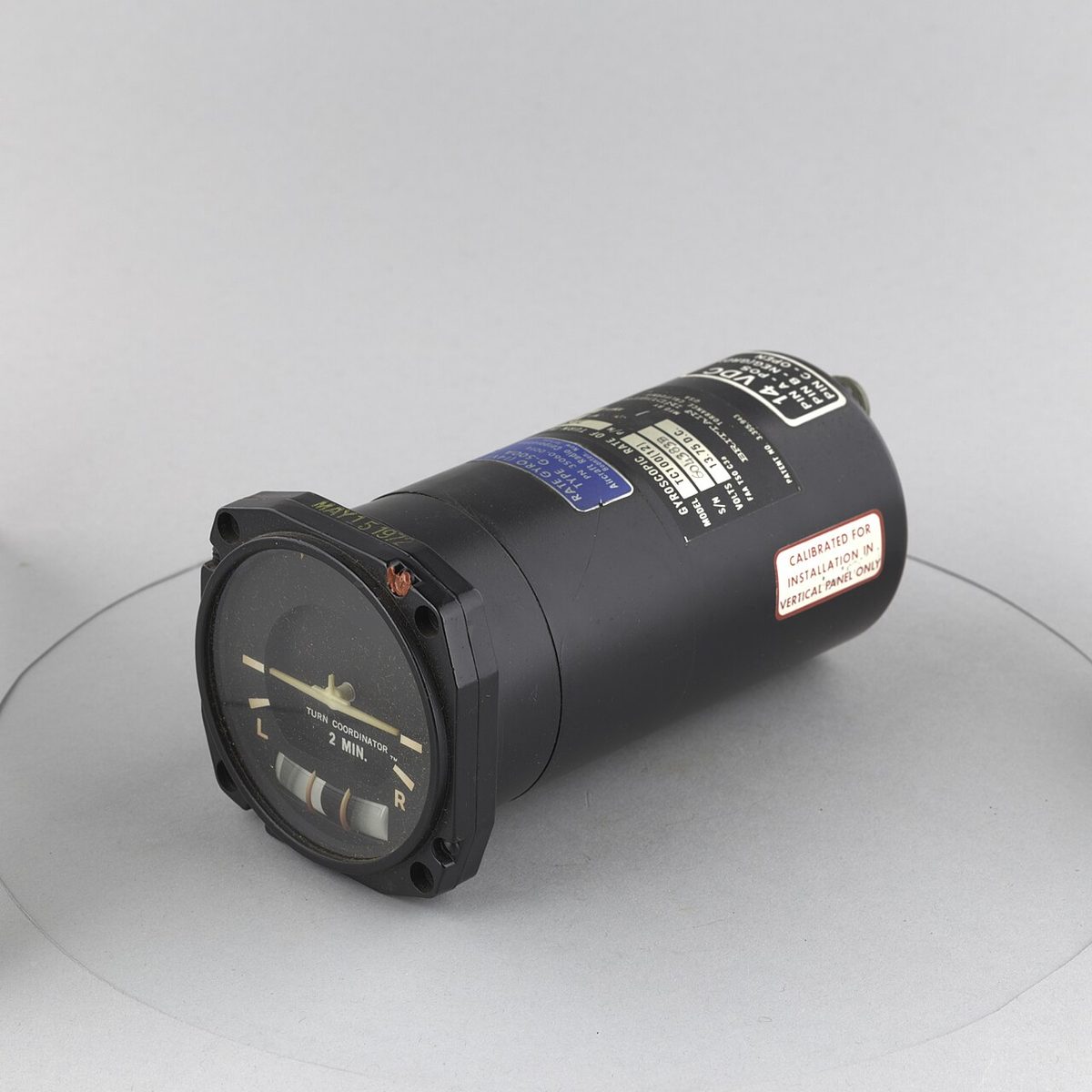
Two instruments show the turn. The needle of the turn and slip indicator or the aircraft symbol of the turn coordinator shows the direction and rate of turn, with a mark for rate one. The ball shows balance. The two indications are independent, and both must be right for a co-ordinated rate one turn.
Slips and skids
| Condition | What is wrong | Ball | Correction |
|---|---|---|---|
| Slip | Too much bank for the rate of turn | Inside the turn | Less bank or more inside rudder |
| Skid | Too little bank for the rate of turn | Outside the turn | More bank or less inside rudder |
In a slip the horizontal component of lift is too large for the rate of turn and the aeroplane slides towards the inside of the turn. In a skidding turn the rate of turn is too high for the bank, usually from too much rudder into the turn, and the aeroplane slides outwards. The correction in both cases is to "step on the ball": apply rudder on the side the ball has moved to, or adjust the bank.
The skid is the dangerous one. Near the stall, the slower inside wing of a skidding turn is at the higher angle of attack and stalls first, rolling the aeroplane further into the turn and towards a spin. In a slip the outside wing tends to stall first, rolling the aeroplane towards level, which is less violent. This is why the over-ruddered base-to-final turn is the classic stall-spin scenario (see spins and spiral dives).
Steep turns and overbanking tendency
A steep turn is flown at a large bank angle with back pressure and extra power to hold altitude and speed. The FAA commercial pilot steep turn is flown at 50° ±5° of bank, where the load factor is about 1.56 g and the stall speed about 25 % above its wings-level value.
In any turn the outside wing travels round a larger circle than the inside wing in the same time, so it flies faster and produces more lift. This is the overbanking tendency. In shallow turns the aeroplane's lateral stability outweighs it and the bank tends to decrease. In steep turns the overbanking tendency wins and the bank tends to increase, so the pilot holds a little aileron against the turn to keep it constant. If the bank is allowed to steepen, the nose drops and the turn can become a spiral dive.
A steep turn that is harmless at 3,000 ft becomes dangerous close to the ground. After an engine failure, a steep turn back towards the runway combines the raised stall speed with low speed, a high sink rate and a tailwind on the return leg.
Forward slips and crossed controls
Flying with crossed controls means holding aileron one way and rudder the other, which produces a deliberate sideslip. Used knowingly, it has two applications.
- A forward slip steepens the descent without increasing the airspeed. The pilot lowers one wing and applies opposite rudder, so the nose yaws away from the low wing while the flight path stays towards the landing area. The fuselage is presented side-on to the airflow and its drag increases the descent angle. It is useful when the aeroplane is too high on final, particularly without flaps.
- A sideslip, the wing-low crosswind technique, lowers the into-wind wing to stop drift and uses opposite rudder to keep the longitudinal axis aligned with the runway (see landing technique and crosswind operations).
In a slip the pitot tube and static ports meet the airflow at an angle, so the airspeed indicator may be in error, particularly with a single static port. Pilots rely on attitude and stall margin, and respect any flight manual limitation on slips with flaps extended.
Warning: The cross-controlled skid is the dangerous combination. Rudder into the turn with aileron holding off bank, plus back pressure at low speed, is the classic entry to an unintended spin.
Pivotal altitude
Pivotal altitude is the height above the ground at which, in a turn round a ground reference, the reference appears to stay fixed on a line from the pilot's eye along the wingtip, rather than moving forward or backward. It is the basis of the FAA commercial manoeuvre eights-on-pylons.
The pivotal altitude in feet above the ground is approximately the groundspeed in knots squared divided by 11.3, or the groundspeed in miles per hour squared divided by 15. At 90 kt it is about 717 ft; at 100 kt about 885 ft. The bank angle cancels out of the geometry, so pivotal altitude depends on groundspeed alone; in still air it equals the radius of a 45° turn.
Because groundspeed changes with the wind, the pivotal altitude rises on the downwind side of the turn and falls on the upwind side. If the pylon appears to move ahead of the wingtip reference, the aeroplane is above the pivotal altitude and must descend; if it moves behind, the aeroplane must climb. The pylon is held on the reference with altitude, not with rudder.
Frequently asked questions
What makes an aeroplane turn?
The horizontal component of lift. Banking tilts the lift vector, so part of it acts towards the centre of the turn and supplies the centripetal force that curves the flight path. The rudder does not turn the aeroplane; it keeps it in balance. Because only the vertical component now supports the weight, the pilot must increase the angle of attack with back pressure to hold altitude.
How do airspeed and bank angle affect the turn radius?
Turn radius equals the true airspeed squared divided by g times the tangent of the bank angle. At a constant bank angle, doubling the true airspeed makes the radius four times larger and halves the rate of turn. A steeper bank reduces the radius and increases the rate. Weight and aeroplane type make no difference, so the tightest turn comes from a low speed with a steep bank, within the stall margin.
What bank angle is needed for a rate one turn?
A rate one, or standard rate, turn is 3 degrees per second, 360 degrees in two minutes. The bank needed rises with true airspeed: about 18 degrees at 120 knots, 22 degrees at 150 knots and 25 degrees at about 170 knots. European texts use the rule of thumb TAS divided by 10 plus 7; FAA material uses TAS divided by 10 plus half that figure.
What is the difference between a slip and a skid?
In a slip the bank is too steep for the rate of turn and the aeroplane slides towards the inside of the turn; the ball moves to the inside. In a skid the rate of turn is too high for the bank, usually from too much inside rudder, and the ball moves to the outside. In both cases the pilot restores balance by stepping on the ball, adding rudder on the side the ball has moved to.
How do you calculate pivotal altitude?
Pivotal altitude in feet above the ground is approximately the groundspeed in knots squared divided by 11.3, or the groundspeed in miles per hour squared divided by 15. At 90 knots it is about 717 feet and at 100 knots about 885 feet. It depends on groundspeed only, not on bank angle, so it rises on the downwind side of an eights-on-pylons manoeuvre and falls on the upwind side.
Test yourself on Turning Flight
The v1prep banks cover this topic in Principles of Flight (081), with a worked explanation for every answer. EASA ATPL, PPL, IR and CPL, the FAA written tests and A320/B737 type ratings.
Start practising →Sources and further reading
- FAA Pilot's Handbook of Aeronautical Knowledge (FAA-H-8083-25), Chapter 5, Aerodynamics of Flight
- FAA Airplane Flying Handbook (FAA-H-8083-3C)
- FAA Instrument Flying Handbook (FAA-H-8083-15B)
- FAA Aeronautical Information Manual, Chapter 5 Section 3 (holding)
- FAA AC 61-67C, Stall and Spin Awareness Training
Library articles are written for study and exam preparation. They do not replace your aircraft's approved documentation, your operator's procedures or the regulations themselves.