Airflow and Bernoulli's Principle
Bernoulli's principle states that in the steady flow of an ideal fluid, static pressure plus dynamic pressure stays constant along a streamline, so where air speeds up its static pressure falls. With the principle of continuity it explains the venturi, the pitot tube and the pressure field around a wing.
Before a wing, a propeller or an airspeed indicator can be understood, the behaviour of moving air has to be. Two conservation laws do most of the work. The principle of continuity, conservation of mass, says that where a steady flow is squeezed into a smaller area it must speed up. Bernoulli's principle, conservation of energy, says that where the flow speeds up its static pressure falls. Together they explain the venturi, the pitot tube and the low pressure over the upper surface of a wing.
Both rest on simplifying assumptions, and both describe what happens along the flow rather than why the flow takes the shape it does. That shape is set by the body in the flow and, for a wing, by its angle of attack and sharp trailing edge. The laws of motion describe the same flow from the side of forces and momentum (see Newton's laws and the four forces); the two are consistent, not competing, accounts of one flow.
Air as a fluid
Air has mass, it is compressible, it has a low but real viscosity, and when it moves it carries kinetic energy. It flows from high pressure towards low pressure under the smallest pressure difference. To make the mathematics manageable, the basic theory treats it as an ideal fluid: one that is incompressible and has no viscosity. Real air is neither, but two facts make the model useful:
- Below about M 0.4 the density changes in the flow round an aeroplane are small enough to ignore, so the air behaves as if incompressible. Above that, compressibility has to be taken into account.
- Viscosity matters mainly in the thin boundary layer next to the surface, where it produces skin friction and decides where the flow separates (see boundary layer). Outside it the flow behaves very nearly as an ideal fluid.
The basic theory also works in two-dimensional airflow. It imagines a wing of infinite span with the same aerofoil section everywhere, so there is no spanwise pressure difference and no spanwise flow, and the section can be studied on its own. A real wing is three-dimensional: air spills round the tips, trailing vortices form and their downwash alters the flow over the wing (see induced drag and wingtip vortices).
Streamlines and streamtubes
A streamline is the path traced by a particle of air in a steady flow. Streamlines never cross, since a particle at any point can move in only one direction. Drawn on a diagram, their spacing shows the speed: where they crowd together the flow is fast, where they spread apart it is slow. Converging streamlines therefore show accelerating air with falling static pressure, and diverging streamlines decelerating air with rising static pressure.
A streamtube is an imaginary tube whose walls are made of streamlines. Because streamlines cannot cross, no air flows in or out through the walls; it can only flow along the tube. The idea allows a small part of a complicated flow, such as the air passing just above a wing, to be treated like flow in a pipe.
The principle of continuity
The principle of continuity is conservation of mass applied to a steady flow: air cannot be created or destroyed, nor can it pile up, so whatever mass enters one end of a streamtube each second must leave the other. The mass flow rate, in kg/s, is the same at every cross-section:
ρ × A × V = constant
where ρ is density, A the cross-sectional area and V the velocity. Below about M 0.4 density is practically constant and the equation reduces to A × V = constant: halve the area and the speed doubles. Above about M 0.4 density changes must be kept in the equation, which is one reason high-speed aerodynamics behaves differently (see high-speed flight). Continuity predicts how the speed of the flow changes around a body of known shape.
Bernoulli's principle
Bernoulli's theorem states that in the steady flow of an ideal fluid the sum of pressure energy and kinetic energy remains constant along a streamline. Written per unit volume:
p + ½ρV² = constant
where p is the static pressure and ½ρV² the dynamic pressure. The full theorem also contains a term for height, which is negligible over the dimensions of an aeroplane. Bernoulli's principle is the everyday statement of the same result: where air speeds up, its static pressure falls; where it slows down, its static pressure rises.
The same result follows from Newton's second law applied to a small parcel of air moving along a streamline. The parcel can only speed up if the pressure behind it is higher than the pressure ahead, so fast flow and low pressure go together. Air that starts in the same undisturbed stream carries the same total pressure on every streamline, which is why the flow above a wing can be compared with the flow below it.
Applied to a wing, continuity and Bernoulli together give the explanation used in EASA exam material. Over the upper surface of a lifting aerofoil the streamtubes narrow, the air accelerates and its static pressure falls; beneath, the flow slows slightly and its pressure rises. A pressure difference across a surface produces a force towards the lower pressure, and the upper-surface suction supplies most of it (see lift). The FAA's Pilot's Handbook of Aeronautical Knowledge explains lift with Bernoulli's principle and Newton's third law together. Both descriptions are needed and they agree: the pressure field is how the wing turns the air downwards and how the air's reaction reaches the wing.
Exam tip: continuity gives the change in speed, Bernoulli the change in pressure that follows. Any answer claiming that the air over the top must speed up to meet the air from underneath at the trailing edge is wrong: nothing requires the two to meet, and in reality the upper-surface air arrives first.
Static, dynamic and total pressure
Static pressure is the pressure of the air itself, the result of the weight of the atmosphere above. It acts with the same force per square metre on every surface of an aeroplane, whether moving or not. Its SI unit is the newton per square metre, or pascal; aviation uses the hectopascal (1 hPa = 100 Pa = 1 mb). ISA mean sea level pressure is 1013.25 hPa, or 29.92 inHg.
Dynamic pressure, written q or Q, is ½ρV², the kinetic energy of each cubic metre of moving air expressed as a pressure. It is common to every aerodynamic force, since lift and drag are each dynamic pressure times a coefficient times an area, and it sets the air loads on the airframe. Because velocity is squared, doubling the speed quadruples it. It cannot be measured on its own, because static pressure is always present as well.
Total pressure, also called stagnation pressure or pitot pressure, is static pressure plus dynamic pressure, the constant of Bernoulli's theorem.
| Air at ISA sea level density (1.225 kg/m³) | Value |
|---|---|
| Static pressure | 101,325 N/m² |
| Dynamic pressure at 52 m/s, about 100 kt | ½ × 1.225 × 52² = 1,656 N/m² (16.56 hPa) |
| Total pressure | 101,325 + 1,656 = 102,981 N/m² |
| Dynamic pressure at 104 m/s | 6,625 N/m², four times as much |
The pitot-static system puts this to work (see pitot-static system). A pitot tube faces upstream and brings the air entering it to rest, so it senses total pressure. Static ports sense static pressure. The airspeed indicator subtracts one from the other and displays the difference, dynamic pressure, as indicated airspeed. It is calibrated for ISA sea level density, so it shows true airspeed only when the density is 1.225 kg/m³. At high speed and altitude compressibility adds to the pressure in the pitot tube and the indicator over-reads, which the conversion from calibrated to equivalent airspeed corrects.
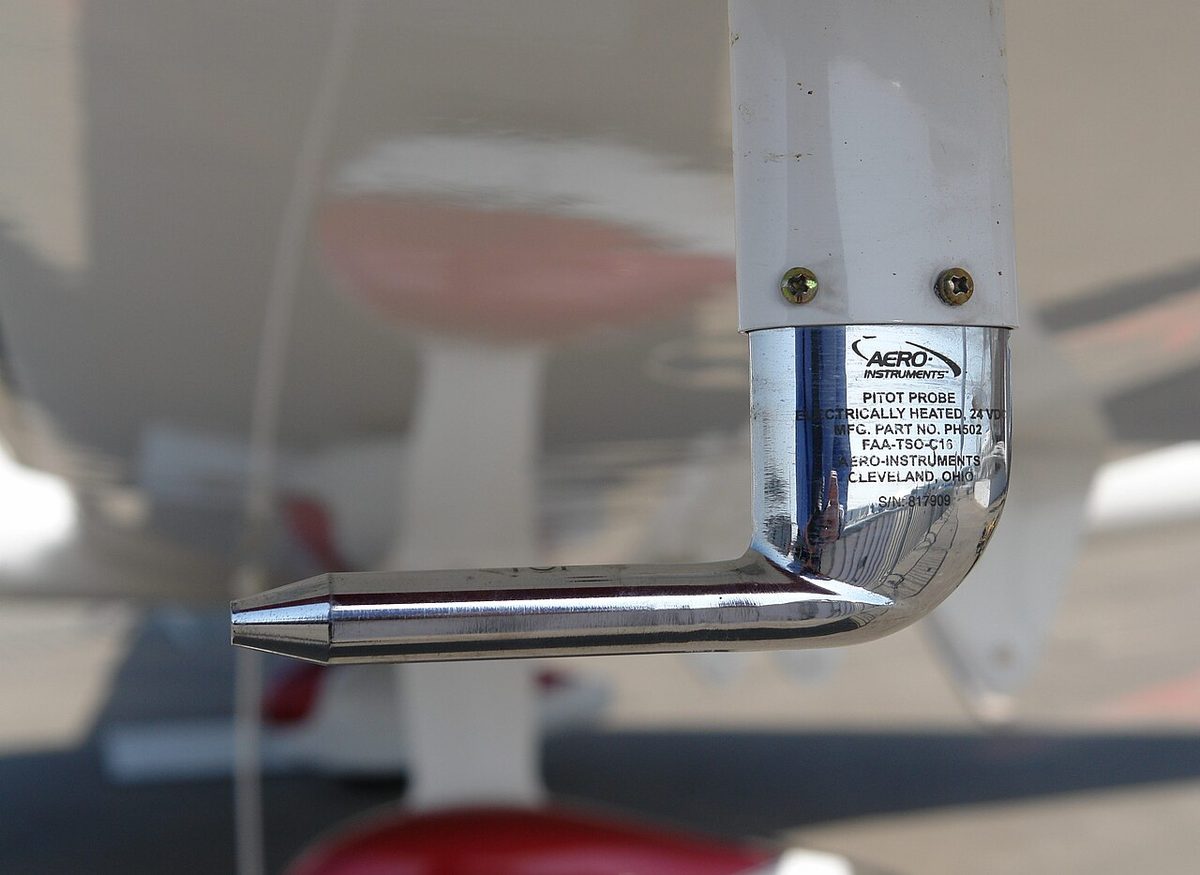
Holding a constant indicated airspeed holds dynamic pressure roughly constant. Many handling characteristics, including the stalling speed, control forces and structural loads, depend mainly on dynamic pressure, which is why pilots fly indicated rather than true airspeed.
The venturi
A venturi is a tube that narrows to a throat and then widens gradually again. By continuity the air is fastest at the throat, where the area is least, and by Bernoulli its static pressure there is lowest. Downstream of the throat the flow slows and its pressure rises again.
The carburettor of a piston engine uses the effect. The pressure drop at the throat draws fuel from the discharge nozzle into the airstream, and together with evaporating fuel it chills the air enough for ice to form there in humid air well above freezing (see carburettor icing).
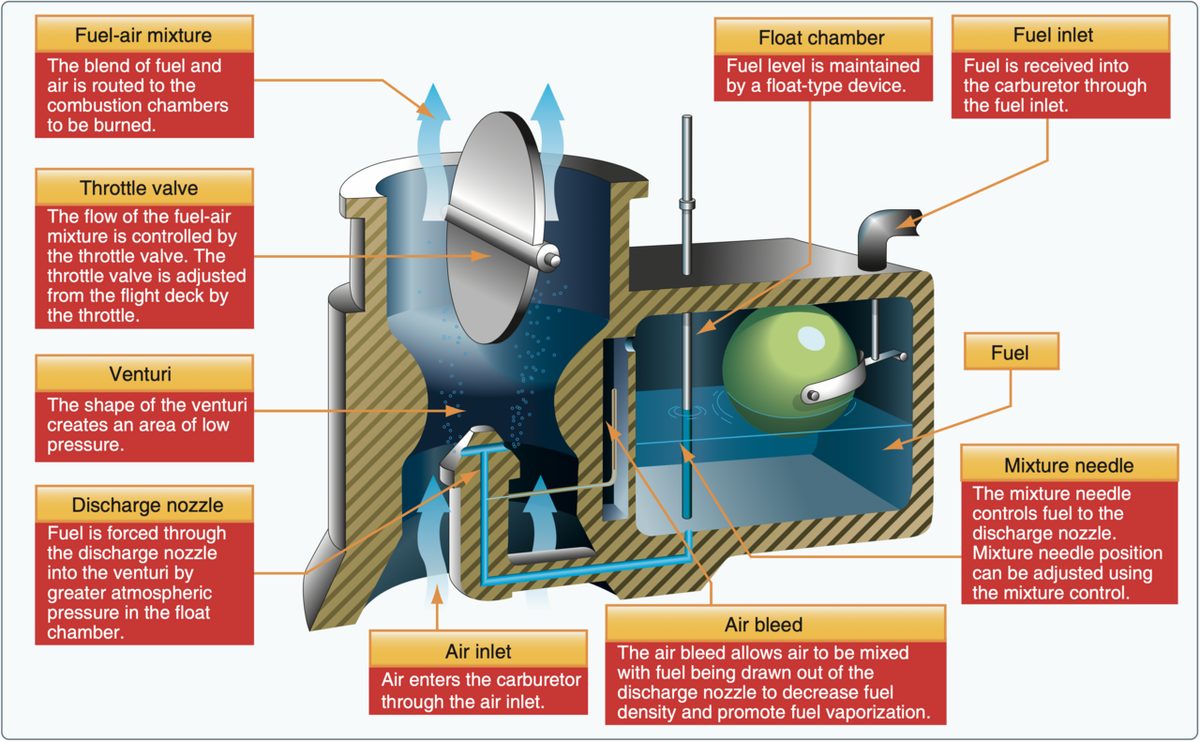
The flow over the upper surface of a wing resembles flow through a venturi, because the streamtubes above it narrow and then widen again. The comparison describes the pattern, not its cause: there is no wall above the wing. The narrowing is part of the pressure field the wing creates, which extends a long way above and below it.

Stagnation point
Where the flow meets a body it divides, part passing one side and part the other. At the dividing point, the stagnation point, the air comes to rest relative to the surface. Its dynamic pressure there is zero, so its static pressure is at its maximum, equal to total pressure. The open end of a pitot tube is a stagnation point by design.
On an aerofoil the stagnation point lies at or near the leading edge, and it moves as the angle of attack changes. At about −4° it lies on the upper surface; as the angle of attack increases it moves round the leading edge onto the lower surface. Stall warning vanes and reeds on light aircraft sense that movement, triggering the warning as the stagnation point moves aft beneath the leading edge (see stall).
Relative airflow
An aeroplane does not grip the air as a car grips the road, so it is often not pointing in the direction in which it is moving. What matters aerodynamically is the relative airflow, the flow of air produced by the aeroplane's motion through it. It is called the relative wind in FAA material and the free stream flow in theory, and it has three qualities:
- Direction: parallel and opposite to the flight path of the aeroplane's centre of gravity.
- Condition: it is air close to the aeroplane but not yet affected by it, with its pressure, temperature and velocity undisturbed.
- Magnitude: its speed is the true airspeed.
A steady wind moves the whole air mass, aeroplane included, so it changes the path over the ground but not the relative airflow. Close to the wing the flow is disturbed: ahead of it the air is drawn up towards the low pressure above, the upwash, and behind it the flow is turned down, the downwash. Flow disturbed in this way no longer has all three qualities and is called the effective airflow; the angle between it and the chord line is the effective angle of attack.
The relative airflow is the reference for the aerodynamic forces. Lift acts at 90° to it and drag parallel to it, and the angle of attack is measured between it and the chord line.
Air density and relative density
Density, ρ, is mass per unit volume, in kg/m³. For air it is proportional to pressure and inversely proportional to absolute temperature, and it falls as humidity rises. With height, the fall in pressure outweighs the fall in temperature, so density decreases steadily (see the atmosphere). Density is the property of air that matters most for lift: in thinner air less mass flows past the wing each second, so a higher true airspeed is needed for the same dynamic pressure.
Relative density, σ, is the actual density divided by ISA sea level density, 1.225 kg/m³. It is about 0.5 at 20,000 ft and about 0.25 at 40,000 ft in the ISA. It links true airspeed to equivalent airspeed: TAS = EAS ÷ √σ. At 40,000 ft, where √σ is about 0.5, true airspeed is about twice the equivalent airspeed for the same dynamic pressure. The FAA more often expresses air density as density altitude, the altitude in the standard atmosphere at which the density equals the actual density.
Frequently asked questions
What is Bernoulli's principle in simple terms?
In a steady flow of air, where the air speeds up its static pressure falls, and where it slows down its static pressure rises, because static pressure plus dynamic pressure stays constant along a streamline. The exact form, Bernoulli's theorem, is p + ½ρV² = constant. It holds for an ideal fluid, incompressible and without viscosity, which is a close model of real air outside the boundary layer below about Mach 0.4.
Does Bernoulli or Newton explain how a wing makes lift?
Both, because they describe the same flow. A wing turns the air passing it downwards. The pressure field that does the turning has faster flow and lower pressure above the wing, which Bernoulli's theorem describes; the downward momentum given to the air, and the equal upward reaction on the wing, are Newton's laws. They are not two separate sources of lift to be added together, and the equal transit time story is wrong.
What is the difference between static, dynamic and total pressure?
Static pressure is the pressure of the air itself, acting equally on every surface, sensed by static ports. Dynamic pressure, ½ρV², is the kinetic energy of each cubic metre of moving air and cannot be measured on its own. Total pressure is their sum, sensed where the air is brought to rest in a pitot tube or at a stagnation point. The airspeed indicator shows total minus static, the dynamic pressure.
Why does air speed up in a venturi?
By the principle of continuity, the mass of air passing each section of a steady flow every second is the same. Where a venturi narrows, the same mass must pass through a smaller area, so at low speed, with density almost constant, the velocity rises in proportion. By Bernoulli's theorem the faster air at the throat has the lowest static pressure, and after the throat the flow slows and its pressure rises again.
What is relative airflow or relative wind?
Relative airflow, called relative wind by the FAA, is the flow of air produced by the aeroplane moving through it. It is parallel and opposite to the flight path, is taken in air not yet disturbed by the aeroplane, and its speed is the true airspeed. Angle of attack is measured from it, and lift and drag are defined perpendicular and parallel to it, whatever the aeroplane's attitude.
Test yourself on Airflow and Bernoulli's Principle
The v1prep banks cover this topic in Principles of Flight (081), with a worked explanation for every answer. EASA ATPL, PPL, IR and CPL, the FAA written tests and A320/B737 type ratings.
Start practising →Sources and further reading
- FAA Pilot's Handbook of Aeronautical Knowledge (FAA-H-8083-25), Chapters 4 and 5, Principles and Aerodynamics of Flight
- Babinsky, H., How do wings work?, Physics Education 38(6), 2003
- NASA Glenn Research Center, The Lift Equation
- NASA Glenn Research Center, Incorrect Lift Theory (equal transit)
- EASA, Explanatory Note to ED Decision 2018/001/R, Part-FCL theoretical knowledge learning objectives
- U.S. Standard Atmosphere, 1976 (NOAA, NASA and US Air Force), NASA Technical Reports Server
Library articles are written for study and exam preparation. They do not replace your aircraft's approved documentation, your operator's procedures or the regulations themselves.