Flight Deck, Cabin and Emergency Lighting
Aircraft interior lighting covers the flight deck lighting that lets the crew read instruments and controls by day and night, the cabin lighting and signs, and the emergency lighting system: exit signs, lights and floor markings with their own power supply that guide the occupants to the exits when normal power fails.
The lights inside an aircraft fall into three groups. Flight deck lighting lets the crew read every instrument, label and document in any conditions, from low sun to a dark night, without spoiling their night vision. Cabin lighting, with the passenger signs, serves comfort and routine safety messages. The emergency lighting system is different in kind: it has its own power supply and, when armed, comes on by itself if normal power fails, so that passengers and crew can find the exits in darkness and smoke.
Emergency lighting is a certification requirement. For large aeroplanes CS 25.812 and 14 CFR 25.812, both titled Emergency lighting, govern it, and CS 25.811 governs the marking of emergency exits. Flight deck lighting is a human factors subject as much as an electrical one, because the eye's adaptation to darkness, glare from lightning and the colours used on charts and checklists all depend on it.
Flight deck lighting
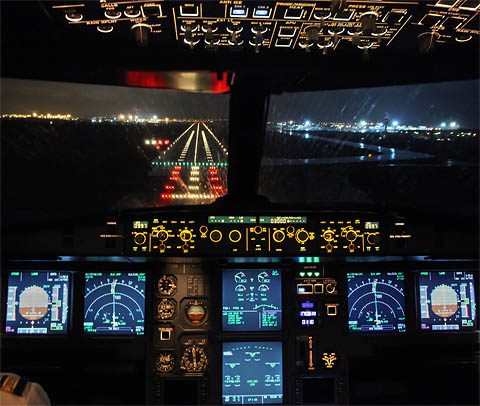
Flight deck lighting must let the pilots read their instruments without dazzling them at night. Brightness is therefore adjustable for almost every source. Glass displays add their own control: an EFIS remote light sensor, a photodiode that responds to the light in the flight deck, adjusts display brightness automatically, and a manual brightness control remains available.
The eye sets the rules at night. The rods, which give vision in low light, take about 30 minutes to reach full sensitivity, and a few seconds of bright light, from a torch, a strobe or a lightning flash, undoes that adaptation. Red light preserves the rods' adaptation but has a serious drawback: anything printed in red, such as airspace boundaries, obstacles and warnings on charts, almost vanishes under it, and red text on a white checklist can become invisible. The FAA's handbook therefore recommends white flight deck lighting dimmed as low as the pilot can still read, and many pilots prefer very dim white light as a compromise (see the eye and vision).
Thunderstorms reverse the rule. When lightning is possible the cockpit lights are turned fully up, so that a nearby flash does not leave the crew temporarily blinded; the FAA's advice for an unavoidable thunderstorm penetration likewise includes turning up the cockpit lights. Higher brightness also reduces fatigue and drowsiness on long night flights, and older pilots need more light than younger ones.
Integral and flood lighting
Integral lighting is built into an instrument or panel and lights its own legends, scales and pointers from within. Flood lighting comes from separate lamps that bathe a panel or work surface from outside. Most flight decks use both. On the A320:
- all instruments and panels except the display units have integral lighting, including the standby compass, and the crew can adjust its brightness;
- the OVHD INTEG LT knob controls the overhead panel's integral lighting, the INTEG LT MAIN PNL & PED knob that of the main instrument panel and pedestal, and knobs on the glareshield its own integral lighting and the brightness of the flight control unit displays;
- lights under the glareshield flood the centre instrument panel, and a flood light in the middle of the overhead panel lights the pedestal, with FLOOD LT MAIN PNL and FLOOD LT PED knobs on the pedestal;
- spot and flood lights light the work surfaces and side consoles, and each pilot has a reading light, a lighted map holder and a CONSOLE/FLOOR switch for the side console, briefcase and floor lighting.
The Boeing 737 uses a similar arrangement, with a MAIN PANEL control for the captain's panel and instrument lighting, the centre instrument panel and the autopilot mode control panel displays, and a BACKGROUND control for the incandescent lighting of the captain's, first officer's and centre panels.
Dome lights light the whole flight deck. The A320 has two dimmable dome lights that give shadow-free lighting, controlled together by a DOME switch with BRT, DIM and OFF positions; when only the batteries are supplying power, only the right-hand dome light is available. The 737's DOME control has DIM, OFF and BRIGHT positions, and its aft dome light contains a separate bulb, fed by the emergency lighting system, for flight deck evacuation.
The lighting most needed after an electrical failure is kept alive. On the 737, standby power is automatically supplied to the standby compass light, the dome lights, the instrument flood lights and selected system and warning lights when normal power is lost. Annunciator lights have a common brightness control: the A320's ANN LT switch sets all of them to the same level, with a DIM position for night and a TEST position that lights them all (see flight deck layout and master warnings).
Cabin lighting and signs
Cabin lighting is managed by the cabin crew, but the passenger signs are controlled from the flight deck. On the A320 the SEAT BELTS switch lights the FASTEN SEAT BELT and RETURN TO YOUR SEAT signs, and a second switch controls NO SMOKING, EXIT or NO PORTABLE ELEC DEVICE signs, depending on the aircraft. At AUTO the signs come on when the landing gear or the flaps and slats are extended. If the cabin altitude rises above 11,300 ft (±350 ft), the cabin lights, depending on the cabin system programming, and all cabin signs except NO PORTABLE ELEC DEVICE come on whatever the switch positions. Depending on the cabin system programming, a low tone chime sounds each time a sign comes on or goes off; on the 737, whose FASTEN BELTS signs at AUTO also follow the flaps and gear, a low tone sounds over the public address system.
Interior lighting is also a refuelling precaution. When an aircraft is refuelled with passengers embarking, on board or disembarking, the precautions under EU Air OPS include no smoking signs on and enough interior lighting to identify the emergency exits.
Emergency lighting system
The emergency lighting system guides everyone on board to the exits when normal lighting has failed, typically after a crash or a total loss of electrical power. On the A320 it consists of:
- the proximity emergency escape path marking system, with escape path markers and exit markers;
- overhead emergency lights;
- EXIT signs;
- lavatory auxiliary lights, which are always on;
- overwing escape route lighting and escape slide lighting.
Emergency lights must work when the aircraft's generators and main buses have gone, so they are fed by their own batteries or power units. On the A320, where the escape paths or exit markers are electrical, internal batteries supply them for at least 12 minutes. The Embraer E190-E2 has six emergency light power units that feed the interior emergency lights for 10 minutes. The A320's escape slide lights and overwing escape route lights are supplied by internal batteries and come on automatically when the slide is armed and the door or emergency exit is opened. ATPL texts also list emergency exit lights among the critical loads that can be fed from a hot battery bus, connected directly to the battery even with the battery switch off.
The system is armed from the flight deck:
| Airbus A320 | Boeing 737 | |
|---|---|---|
| Switch | EMER EXIT LT: ON, ARM, OFF | EMER EXIT LIGHTS, guarded to ARMED |
| Automatic operation when armed | EXIT signs and exit markers on loss of normal power or the DC SHED ESS bus; overhead emergency lights also on loss of AC BUS 1 | All emergency lights on failure of DC bus No. 1 or when AC power is turned off |
| Switch not armed | Amber EMER EXIT LT OFF light | Amber NOT ARMED light |
| Cabin override | LIGHT EMER pushbutton on the purser panel | Guarded switch on the aft attendant panel, which bypasses the flight deck |
At OFF the 737's system will not come on if electrical power fails, which is why the switch is guarded at ARMED; it is set to OFF when the aircraft is secured, and the A320's securing procedure likewise sets EMER EXIT LT to OFF. A cabin crew member can always light the emergency lighting from the cabin, whatever the flight deck switch position.
Warning: an emergency lighting switch left at OFF in flight disables the automatic function. Both types show an amber light on the flight deck when the switch is not armed.
Exit lights and exit signs
Exit signs mark each emergency exit and the way to it. On the A320 the EXIT signs come on with the rest of the system, and the exit markers of the floor proximity system show where the path reaches an exit. The 737 adds self-illuminating exit locator signs at the forward, middle and aft ends of the cabin. The traditional sign is a red EXIT legend. Among the findings that apply when an aircraft has the relevant design changes, the A320 family's type certificate data sheet lists equivalent safety findings that accept symbolic exit signs as an alternative to red EXIT signs, and a photoluminescent EXIT sign on movable class dividers.
Outside the cabin, escape route lights illuminate the overwing escape path and the slides, so that evacuees can see the escape route at night. On the A320 these lights come on only when an armed door or exit is opened.
Floor path marking
Smoke rises, and in a cabin fire it can hide the ceiling lights and signs. The floor proximity emergency escape path marking system (FPEEPMS) puts the guidance at floor level, where it remains visible beneath the smoke. Strips along the aisle lead to the exits, and markers show where an exit lies.
Two technologies are used. Electrical systems use lights along the floor fed by batteries, as on A320s fitted with electrical escape paths. Photoluminescent floor path marking uses strips that absorb light and glow afterwards, with no wiring or batteries. They must be charged: on the 737 the cabin ceiling and sidewall lights must be at full intensity and the strips must not be covered, and on the E190-E2 30 minutes of exposure lets the strips glow for 7 hours. A cabin left dark before departure, or strips hidden under bags, can therefore leave the path faint just when it is needed.
The emergency lighting and floor path marking support the commands of the cabin crew during an emergency evacuation, and the exits they lead to are described in doors, emergency exits and escape slides.
Exam tip: the emergency lighting system is armed in flight, works on its own batteries and comes on automatically when normal power fails; it can always be switched on from the cabin. Floor path marking is at floor level because smoke hides the ceiling, and photoluminescent strips must be charged by the cabin lights. At night, keep flight deck lighting dim, and turn it fully up when lightning is about.
Frequently asked questions
How long do aircraft emergency lights last?
Each type quotes its own figure. On the Airbus A320 the internal batteries of the electrical escape path and exit markers supply them for at least 12 minutes, and on the Embraer E190-E2 six emergency light power units feed the interior emergency lights for 10 minutes. Photoluminescent floor strips need no batteries: on the E190-E2, 30 minutes of exposure to the cabin lights lets them glow for 7 hours.
What is floor proximity emergency escape path marking?
It is a system of lights or photoluminescent strips along the cabin floor, with markers at the exits, that guides occupants to the exits when smoke obscures the ceiling lights or the cabin is dark. Electrically powered versions have their own batteries; photoluminescent strips glow after being charged by the cabin lighting. On the A320 it is one part of the emergency lighting system, together with overhead emergency lights and EXIT signs.
When do the emergency lights come on automatically?
When the cockpit switch is armed and normal power fails. On the Boeing 737, with the EMER EXIT LIGHTS switch at ARMED, all emergency lights come on if DC bus 1 loses power or AC power is turned off. On the A320, with the EMER EXIT LT switch at ARM, the EXIT signs and exit markers come on if normal power or the DC SHED ESS bus is lost, and the overhead emergency lights also come on after a failure of AC BUS 1.
Why do pilots use dim white rather than red cockpit lighting at night?
Red light preserves the rods' dark adaptation, but anything printed in red, such as airspace boundaries and obstacles on charts, almost disappears under it, and it makes close objects harder to focus on. The FAA therefore recommends white flight deck lighting dimmed as low as the pilot can still read. Whatever the colour, any bright light destroys dark adaptation in seconds, and full adaptation takes about 30 minutes.
What is the difference between integral lighting and flood lighting?
Integral lighting is built into an instrument or panel and lights its own markings, legends and pointers from within. Flood lighting comes from separate lamps that bathe a whole panel or work surface, such as the lights under the glareshield that light the A320's centre instrument panel. Both are dimmable and are normally used together.
Test yourself on Flight Deck, Cabin and Emergency Lighting
The v1prep banks cover this topic in Aircraft General Knowledge (021), with a worked explanation for every answer. EASA ATPL, PPL, IR and CPL, the FAA written tests and A320/B737 type ratings.
Start practising →Sources and further reading
- EASA Easy Access Rules for Large Aeroplanes (CS-25), CS 25.811 Emergency exit marking and CS 25.812 Emergency lighting
- 14 CFR 25.812, Emergency lighting
- EASA Easy Access Rules for Air Operations (Regulation (EU) No 965/2012)
- FAA Pilot's Handbook of Aeronautical Knowledge (FAA-H-8083-25), Chapter 17, Aeromedical Factors
- FAA Aviation Maintenance Technician Handbook, Airframe (FAA-H-8083-31B), Aircraft Electrical System
- FAA Aeronautical Information Manual, Chapter 7, Section 1 (Thunderstorms, Thunderstorm Flying)
- EASA Type-Certificate Data Sheet EASA.A.064, Airbus A318, A319, A320, A321 (equivalent safety findings on exit signs)
Library articles are written for study and exam preparation. They do not replace your aircraft's approved documentation, your operator's procedures or the regulations themselves.