Aircraft Exterior Lighting
Aircraft exterior lights are the lights fitted to the outside of an aircraft. Navigation and anti-collision lights make it visible and show its position and direction to others; landing, taxi, runway turn-off and wing lights let the crew see the runway, the taxiway and the airframe itself.
Aircraft exterior lights serve two purposes. Some exist so that the aircraft is seen: the navigation lights show other pilots which way it is heading, and the red beacons and white strobes, the anti-collision lights, draw the eye to it by day and night. The others exist so that the crew can see: landing, taxi and runway turn-off lights light the surface ahead, and wing lights let the crew inspect the airframe for ice in the dark.
Because the lights are also signals, their use is governed by rules and by standard operating procedures. The rules of the air, ICAO Annex 2 and in Europe SERA, say when navigation and anti-collision lights must be shown, the FAA's 14 CFR 91.205 and 91.209 set the equivalent requirements in the United States, and certification specifications such as CS-25 lay down where each light goes and how bright it must be. Airline procedures then add a common language: a beacon that comes on says that engines are about to start, strobes that come on say that an aircraft is entering a runway.
Exterior lighting overview
A modern airliner such as the Airbus A320 or the Boeing 737 carries the following lights:
| Light | Colour and type | Typical location | Main purpose |
|---|---|---|---|
| Navigation (position) | Steady red, green, white | Wingtips and tail | Show position and direction of travel |
| Anti-collision beacon | Flashing red | Top and bottom of fuselage | Conspicuity; engines running |
| Strobes | Flashing white | Wingtips and tail cone | Conspicuity in flight and on the runway |
| Landing | Steady white, high intensity | Fuselage or wings, retractable or fixed | Light the runway; conspicuity |
| Taxi and take-off | Steady white | Nose gear leg | Light the path ahead on the ground |
| Runway turn-off | Steady white | Nose gear leg or wing roots | Light the area beside the aircraft in turns |
| Wing (ice inspection) | Steady white | Fuselage sides, aimed outboard | Check wings and intakes for ice |
| Logo | Steady white | Horizontal stabiliser, aimed at the fin | Light the operator's logo |
CS-25 has a paragraph for each group: CS 25.1383 for landing lights, CS 25.1385 to 25.1397 for the position light system and its angles, intensities and colours, CS 25.1401 for the anti-collision light system and CS 25.1403 for wing icing detection lights.

Under SERA, all aircraft in flight at night display anti-collision lights and navigation lights, and aircraft fitted with anti-collision lights display them by day as well, in flight and on the aerodrome movement area. At night an aircraft moving on the movement area also shows its navigation lights. A pilot may switch off, or reduce the intensity of, flashing lights fitted to meet these requirements if they affect the crew's performance of their duties or would dazzle an outside observer; the steady navigation lights stay on. In the United States, 14 CFR 91.209 requires position lights from sunset to sunrise and lets the pilot in command turn the anti-collision lights off when that is in the interest of safety, for example in cloud. For night VFR, 91.205(c) requires approved position lights, an approved aviation red or white anti-collision light system and, for an aircraft operated for hire, an electric landing light.
Navigation lights
The navigation lights, which the FAA calls position lights, follow the convention of ships' lights:
- red on the left (port) wingtip, showing from dead ahead through 110° to the left;
- green on the right (starboard) wingtip, showing from dead ahead through 110° to the right;
- white at the tail, covering the remaining 140° astern, 70° either side of the centreline.
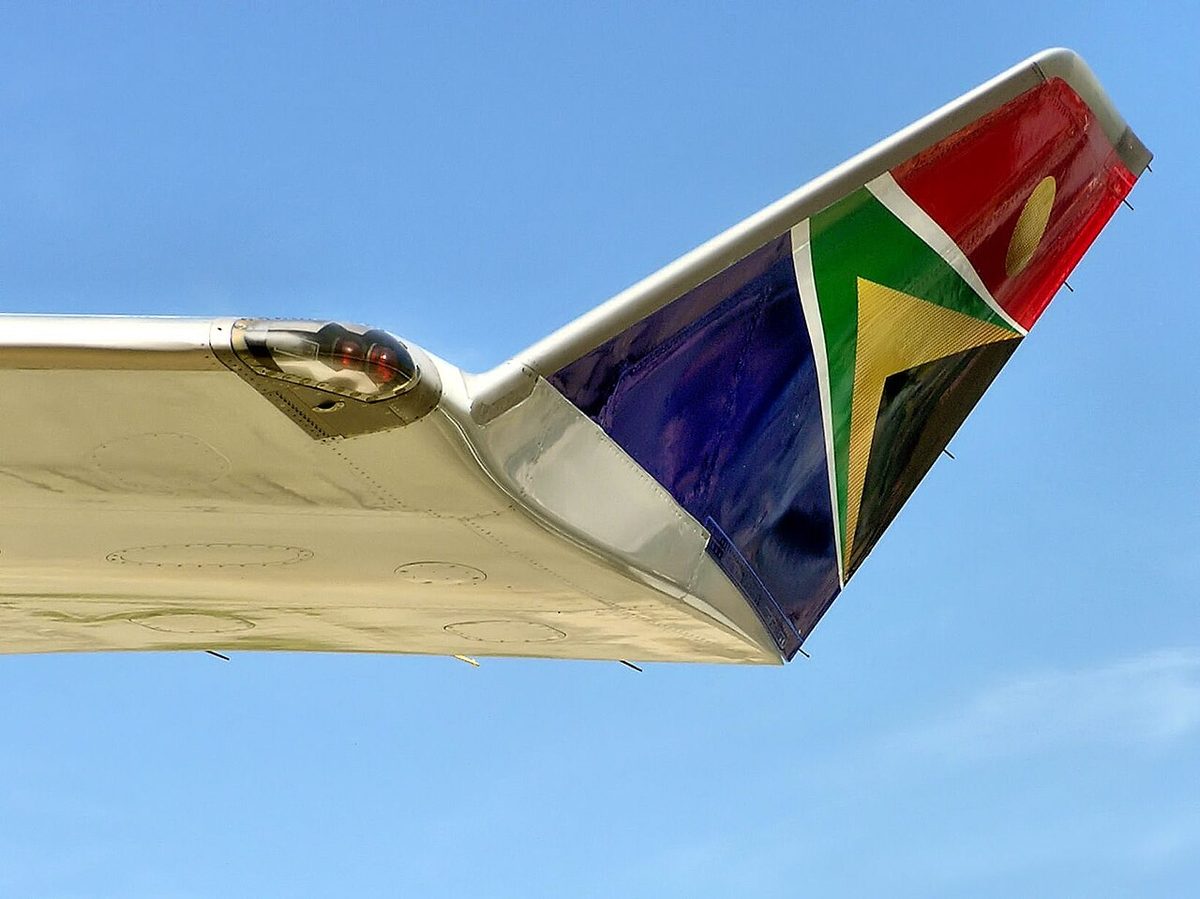
Together they let another pilot judge an aircraft's direction of travel at night: red and green together mean an aircraft coming towards you, a red light out to your right at about your level is an aircraft crossing from right to left, and a lone white light is an aircraft going away (see rules of the air).
Installations differ. The A320 has single or dual navigation lights on each wing and in the APU tail cone; with dual lights its NAV & LOGO switch selects system 1 or 2. On the 737 the red and green lights sit at the forward end of each wingtip, at the base of the winglets, with white lights at the trailing edge. The Embraer E190-E2 has paired primary and standby navigation lights on separate power sources. On A320s with LED navigation and strobe lights, a small blue light below each unit flashes when its replacement should be planned.
Anti-collision beacons
The anti-collision beacon is a flashing red light. On the A320 the BEACON switch controls two of them, one on top of the fuselage and one underneath; the 737's equivalents are two red anti-collision strobe lights at the same positions, controlled by the ANTI COLLISION switch.
Airline procedures use the beacon as a signal to people on the ground. The 737's Before Start procedure sets the ANTI COLLISION switch ON, and the A320's parking procedure switches the beacon off only when all engines have spooled down. A lit beacon therefore tells the ground crew that engines are running or about to run and that they must keep clear of intakes and exhausts (see ground handling, pushback and engine start).
Strobe lights
Strobe lights are high-intensity white flashing lights. The A320 has three synchronised strobes, one on each wing and one below the tail cone, controlled by a STROBE switch with three positions:
- ON: the strobes flash;
- AUTO: the strobes come on automatically when the main landing gear is not compressed, that is, in flight;
- OFF: the strobes are off, and in flight the ECAM shows a green STROBE LT OFF memo.
Because AUTO keeps them dark on the ground, the A320 procedures set the strobes ON when crossing a runway, and back to AUTO after leaving the runway at the end of the landing roll. The 737's three white strobes, at the wingtips and the tail cone, are selected with its POSITION switch: STEADY lights the navigation lights only, while STROBE & STEADY adds the strobes. Its procedure switches them on when entering the departure runway. In the FAA's runway safety guidance, strobes and other exterior lights on when entering a runway are part of signalling intent (see taxiing and runway incursion prevention).
Strobes have drawbacks. In cloud or haze their flashes reflect back into the flight deck, where they distract the crew, destroy night vision, which takes about 30 minutes to recover, and can cause flicker vertigo, nausea or disorientation from light flickering at about 4 to 20 times a second. In such conditions the SERA and FAA rules allow the flashing lights to be switched off. Strobes are also switched off on the ground during refuelling, as a precaution against ignition sources near fuel vapour.
Landing lights
Landing lights are high-intensity lights that light the runway for take-off and landing; switched on in the airspace around aerodromes, they also make the aircraft easier for others to see.
On the A320 the two landing lights retract into the airframe. Each LAND selector has three positions: ON extends the light, which comes on automatically when fully extended; OFF switches it off but leaves it extended; RETRACT switches it off and retracts it. A green LDG LT memo on the ECAM shows that a landing light is extended, so in the cruise it reveals lights left at OFF instead of RETRACT. The A320 procedures select LAND ON for take-off and RETRACT after landing.
The 737 has two retractable landing lights in the lower fuselage, which shine forward parallel to the aircraft's waterline and may be extended at any speed, and two fixed landing lights in the wing leading edges, which shine forward and down. In the most common 737 procedure the fixed landing lights go on when cleared for take-off, off at or above 10,000 ft MSL in the climb and on again at or above 10,000 ft MSL during the arrival.
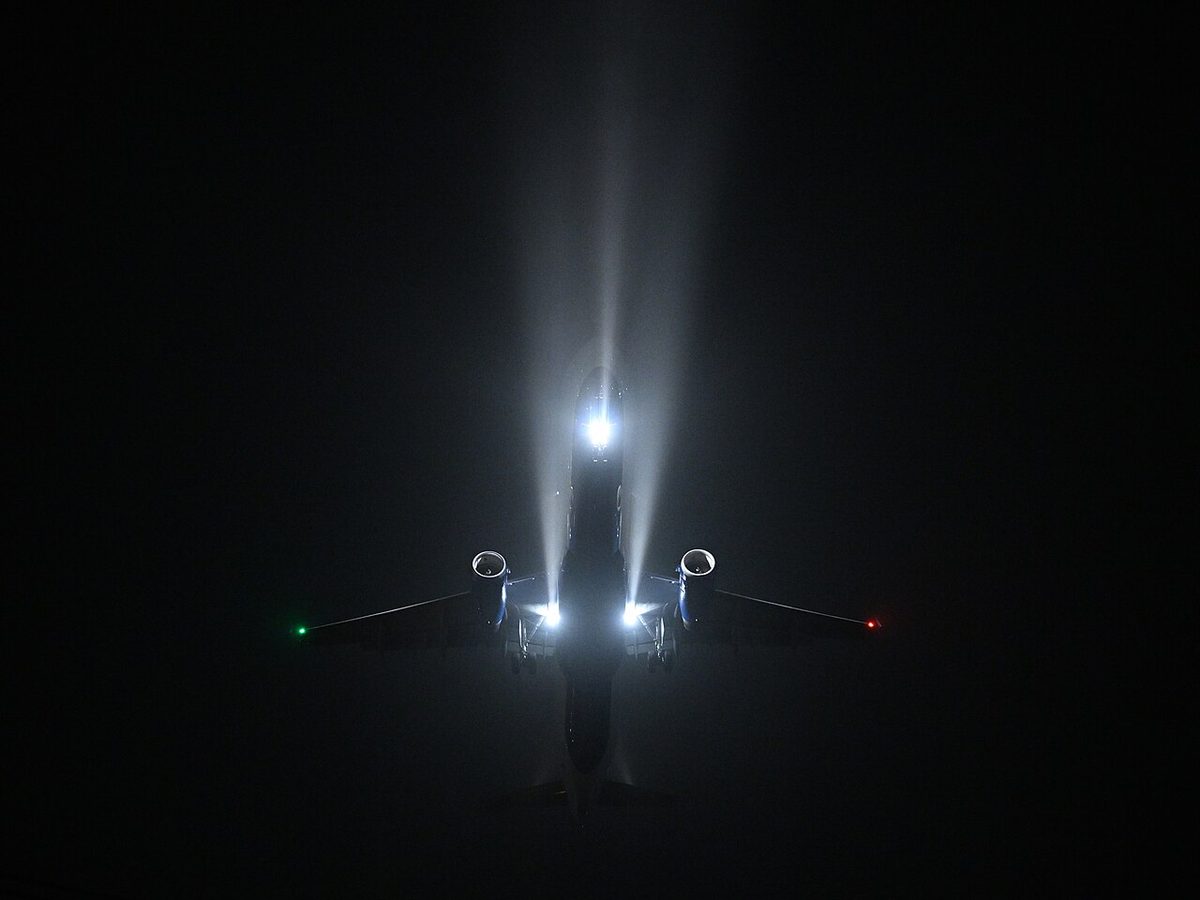
Landing lights are also used to signal. By night a pilot acknowledges a light signal from the tower by flashing the landing lights on and off twice, or the navigation lights if no landing light is fitted. Repeated switching of the landing lights is the visual urgency signal, and an intercepting aircraft that lowers its gear and shows steady landing lights over the runway means "land at this aerodrome" (see interception and visual signals).
Taxi and runway turn-off lights
The taxi light, on the nose gear leg, lights the path ahead on the ground. On the A320 the NOSE switch has three positions: TAXI lights the taxi light, T.O adds the take-off light, and OFF switches both off. Both lights are on the nose gear strut and go out automatically when the gear retracts. On 737s whose TAXI switch has an AUTO position, the taxi light likewise goes out when the nose gear retracts; on LED-equipped 737s, with both the landing and taxi lights on, the landing light function overrides the taxi light. On the E190-E2 the nose landing and taxi lights work only with the gear down.
Runway turn-off lights light the area beside and ahead of the aircraft as it turns onto or off a runway. On the 737 they sit in the wing roots and light the area in front of the main gear. On the A320 the RWY TURN OFF switch controls them, and they also go out when the gear retracts.
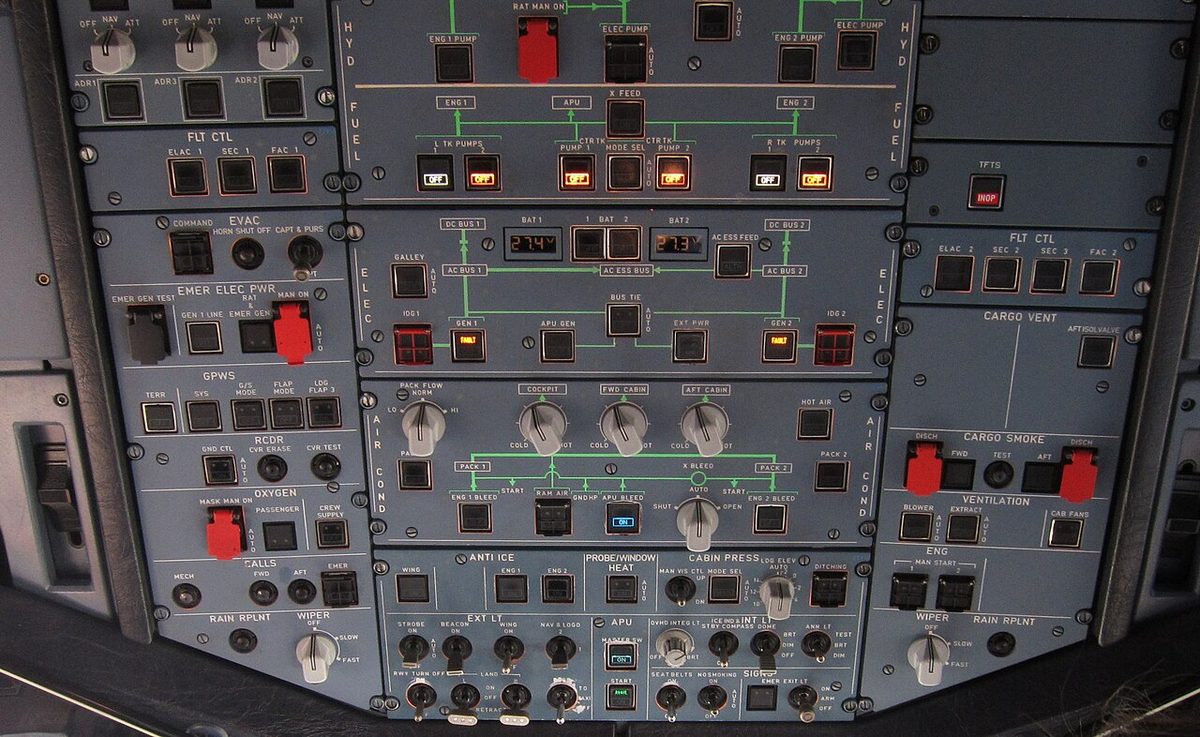
The A320 procedures show how the lights are combined through a flight:
- taxi: NOSE at TAXI and RWY TURN OFF ON, with STROBE ON to cross a runway;
- take-off: NOSE at T.O, RWY TURN OFF ON and LAND ON;
- above the acceleration altitude: NOSE and RWY TURN OFF OFF, while the landing lights may stay on according to airline policy;
- approach, at flaps 2 when the gear is lowered: NOSE at T.O and RWY TURN OFF ON;
- after landing: LAND to RETRACT, then STROBE to AUTO and NOSE to TAXI on leaving the runway;
- at the gate: WING OFF, and BEACON OFF once all engines have spooled down.
Logo and wing lights
Logo lights light the operator's logo on the fin. On both the A320 and the 737 they are mounted on the upper surface of each horizontal stabiliser and shine on the fin. The A320 lights them through the NAV & LOGO switch, but only when the main landing gear is compressed or, depending on the aircraft, when the flaps or slats are extended. On the 737 they are among the cabin and utility loads that lose power when the CAB/UTIL switch is set to OFF.
Wing lights, also called wing illumination, wing inspection or ice formation lights, are mounted on the fuselage sides and aimed outboard at the wing leading edges, so that the crew can check for ice at night. The A320's wing lights also light the engine air intakes. On aircraft without an electronic ice detector they may be the only means of seeing ice at night, and light aircraft approved for flight in icing conditions carry a similar ice light aimed at the wing leading edge (see ice protection and ice detection). The 737 also has wheel well lights in the nose and main gear wheel wells.
Exam tip: red left, green right, white tail; 110°, 110° and 140°. Anti-collision lights are displayed by day as well if fitted, flashing lights may be switched off if they dazzle or distract, and the steady navigation lights stay on. On the A320, strobes at AUTO come on only when the main gear is not compressed, so they are selected ON to cross a runway.
Frequently asked questions
When should the aircraft beacon be switched on?
Airline procedures switch the red anti-collision beacon on before engine start or pushback and off once the last engine has spooled down, so that it tells ground staff that engines are running or about to run. Under SERA an aircraft fitted with anti-collision lights also displays them by day, in flight and on the movement area, and at night every aircraft in flight shows anti-collision and navigation lights.
What is the difference between a beacon and a strobe light?
Both are flashing anti-collision lights. The beacon is red and mounted on the top and bottom of the fuselage; airlines run it from before engine start until shutdown. Strobes are high-intensity white lights at the wingtips and tail. On the A320 their AUTO position lights them only when the main gear is not compressed, and the crew selects them ON to cross a runway.
Why do pilots turn off the strobes in cloud?
In cloud or haze the white flashes reflect back into the flight deck. They distract the crew, spoil night vision and can cause flicker vertigo, a disorientation brought on by light flickering at roughly 4 to 20 times a second. SERA allows the pilot to switch off or dim flashing lights that affect the crew's duties or dazzle an observer, and 14 CFR 91.209 lets the pilot in command turn the anti-collision lights off in the interest of safety.
What colour are aircraft navigation lights?
The left (port) wingtip light is red and the right (starboard) light green, each showing from dead ahead through 110 degrees to its own side. A white tail light covers the remaining 140 degrees, 70 degrees either side of dead astern. The FAA calls them position lights and requires them from sunset to sunrise under 14 CFR 91.209; SERA requires them at night in flight.
What are runway turn-off lights used for?
Runway turn-off lights light the area beside and ahead of the aircraft as it turns onto or off a runway, complementing the forward-pointing taxi and landing lights. On the Boeing 737 they sit in the wing roots and light the area in front of the main gear. On the A320 they are controlled by the RWY TURN OFF switch and go out automatically when the landing gear retracts, like the taxi and take-off lights.
Test yourself on Aircraft Exterior Lighting
The v1prep banks cover this topic in Aircraft General Knowledge (021), with a worked explanation for every answer. EASA ATPL, PPL, IR and CPL, the FAA written tests and A320/B737 type ratings.
Start practising →Sources and further reading
- ICAO Annex 2, Rules of the Air
- EASA Easy Access Rules for Standardised European Rules of the Air (SERA)
- EASA Easy Access Rules for Large Aeroplanes (CS-25), CS 25.1383 to 25.1403, Lights
- 14 CFR 91.209, Aircraft lights
- 14 CFR 91.205, Powered civil aircraft with standard category U.S. airworthiness certificates, instrument and equipment requirements
- FAA Aeronautical Information Manual, Chapter 4 Section 3, Airport Operations
Library articles are written for study and exam preparation. They do not replace your aircraft's approved documentation, your operator's procedures or the regulations themselves.