Doors, Emergency Exits and Escape Slides
Aircraft doors and emergency exits are the openings through which people and cargo enter and leave the fuselage. On pressurised aeroplanes the passenger doors are plug-type, held shut by cabin pressure, and exits high above the ground carry escape slides that, once armed with a girt bar, inflate automatically when opened in an emergency.
An airliner's fuselage is a pressure vessel, and every door and exit is a hole in it. Each opening must stay shut and carry the pressure loads for tens of thousands of flights, yet open quickly, often in darkness, when the aircraft has to be evacuated. Doors and emergency exits resolve that conflict through plug-type design, interlocks and warnings, and through escape slides that turn a high doorway into a usable exit within seconds.
For large aeroplanes the requirements sit in CS-25 and 14 CFR Part 25: fuselage doors in 25.783, emergency exits and their arrangement in 25.807 and 25.809, egress assist means such as slides in 25.810, exit marking in 25.811 and access to the exits in 25.813. Together they serve the evacuation standard, under which an aeroplane with more than 44 passenger seats must be shown to empty in 90 seconds using half its exits (see emergency evacuation).
Plug-type doors
A plug-type door is larger than the opening it closes. Cabin pressure, which in flight is higher than the pressure outside, pushes it outwards against the frame, so the more the cabin is pressurised the more firmly it is seated. To open it, the door is first pulled inwards, then turned and moved out through the opening. Locking pins engaging the fuselage structure back up the plug effect, and while the cabin is pressurised no one can open the door in flight. Passenger doors on modern pressurised aircraft are plug-type for this reason (see airframe structure and construction).
The A320's passenger doors are plug-type doors that open outwards and forwards. They are worked by hand, with a damper actuator that brakes their travel in normal use and, in emergency mode with the slide armed, drives the door open quickly so that one crew member can open it against the wind. Each has a mechanical locking indicator, a slide armed indication and a red CABIN PRESSURE light, discussed below.
Several safeguards stop a door from being opened, or the aircraft pressurised, at the wrong time:
- Pressurisation interlocks prevent pressurisation with a door unlocked; on the Embraer E190 E1, a door vent flap that is not closed stops the cabin being pressurised above 0.5 psi. On the ground, air/ground logic biases the outflow valve fully open, so that the cabin is not pressurised while people may be opening the doors.
- Residual pressure warning. The A320's red CABIN PRESSURE light flashes if both engines are stopped, the slides are disarmed and the cabin is still pressurised by more than 2.5 hPa. It is visible from outside through the door window, warning ground staff that the door could be forced open violently.
- Door indications. Doors not closed and locked are shown in amber on the A320's ECAM DOOR/OXY page and by amber door annunciations on the 737; a door not locked also triggers the take-off configuration warning on many types.
- Wind limits. The 737's entry and service doors must not be operated in winds above 40 kt or left open in gusts above 65 kt.
Cargo doors and airstairs
Cargo doors are larger and heavier than passenger doors. Many are hinged at the top, open upwards and are driven by an electric motor or a hydraulic power pack, with lock-out features against opening in flight. The A320's forward and aft cargo doors open outwards and upwards, powered by the yellow hydraulic system's electric pump, with a hand pump as back-up; mechanical locks hold them open or closed independently of hydraulic pressure, and they can be opened only from outside. Its bulk cargo door, by contrast, is a manually operated plug-type door that opens inwards and upwards and can also be opened from inside. The 737's two cargo doors, on the lower right side, are plug-type pressure doors that open inwards, hinged at their upper edges, with a balance mechanism that makes them easy to swing open.
An outward-opening cargo door cannot be held shut by cabin pressure, so its hinges, latches and locks carry the pressure load, and their indications matter. If such a door fails in flight, the hold depressurises suddenly while the cabin above is still pressurised. Without relief the floor between them can collapse and sever the flight control runs, as on the Turkish Airlines DC-10 lost in 1974. Blow-out panels between cabin and hold equalise the pressure in such a failure (see pressurisation safety valves and warnings).
Airstairs are stairs built into the aircraft that let passengers board and leave where no jet bridge or ground stairs are available. On A320s fitted with them, a green stair symbol on the ECAM DOOR/OXY page shows that the stair door is not closed.
Emergency exits
CS 25.807 classifies emergency exits by size and position. Passenger doors are floor-level exits, such as the Type C doors of the A320 and the Type I doors of the E190; the Type III exit is a smaller opening, at least 20 in wide and 36 in high, typically over the wing. Each type is credited with a number of passengers, and the exits fitted therefore set the maximum seating. CS 25.807(g) allows 55 passenger seats for each Type C exit and 35 for each Type III exit on each side of the fuselage.
The A320 family shows the arithmetic. The A320 has a floor-level Type C door at each end and two overwing Type III exits between them on each side, written C-III-III-C, which gives 55 + 35 + 35 + 55 = 180 seats. The basic A319 is C-III-C and the classic A321 C-C-C-C. Modifications that credit the floor-level doors as over-performing exits, written C-III-III-C in the type certificate data sheet, raise the A320's certified maximum to 195, but only as an envelope: any layout above 180 seats needs its own approval. The Embraer E190 has four Type I exits, two passenger doors on the left and two service doors on the right, with one overwing Type III exit on each side of the E190-E2 and two on each side of the longer E195-E2.
| Aircraft | Cabin exits | Flight crew exits |
|---|---|---|
| Airbus A320 | 4 passenger doors (Type C), 4 overwing exits (Type III) | 2 sliding windows |
| Boeing 737 | 2 entry and 2 service doors, 4 overwing exits (Type III) | 2 sliding windows |
| Embraer E190-E2 | 4 doors (Type I), 2 overwing exits (Type III) | 2 cockpit side windows |
Under CS 25.810 and 14 CFR 25.810, every non-overwing Type A, B or C exit, and any other non-overwing exit whose sill is more than 1.83 m (6 ft) above the ground with the gear extended, needs an approved means of helping the occupants down, normally a slide that deploys automatically when the exit is opened from inside in an emergency.
Overwing emergency exits
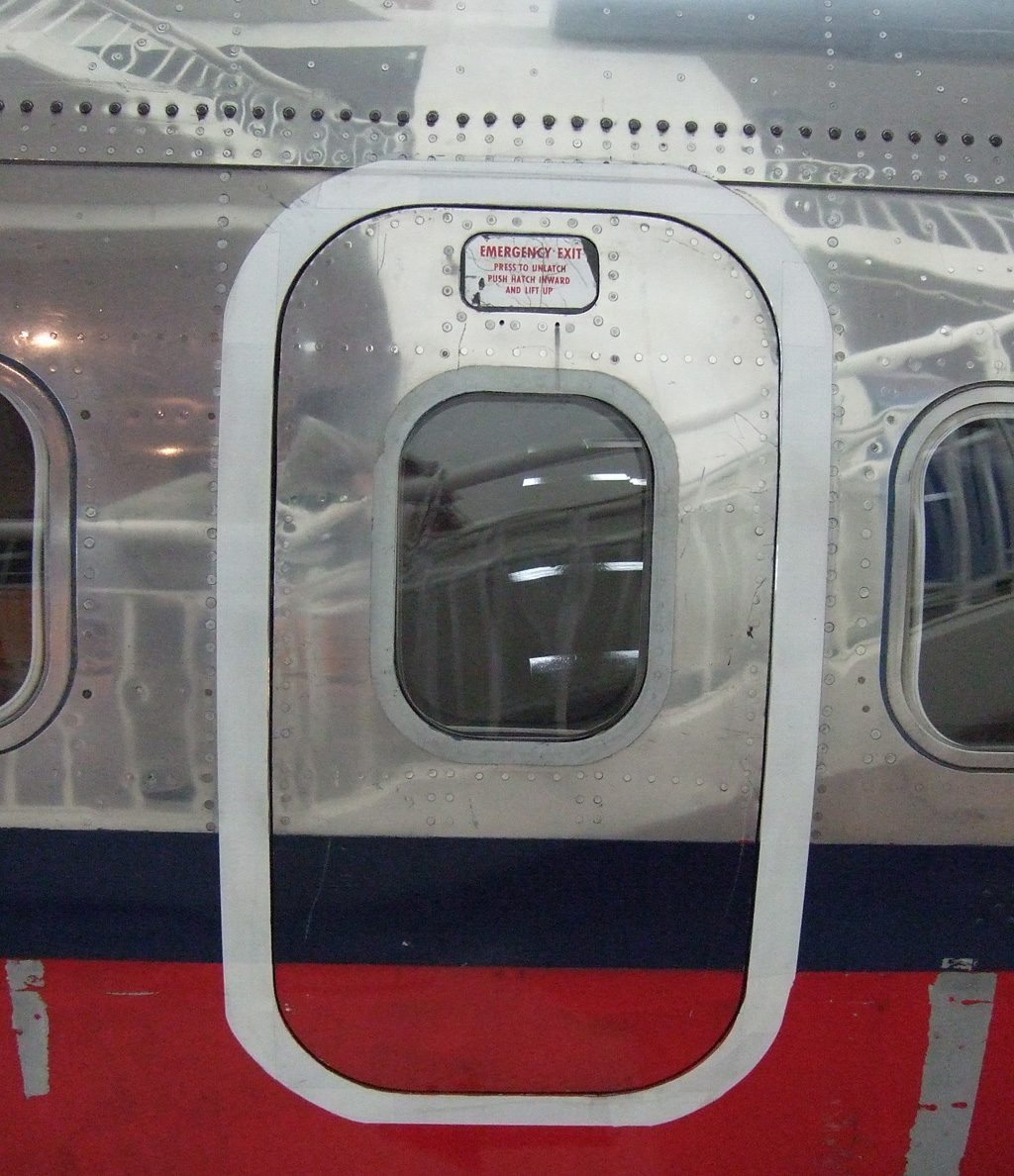
An overwing emergency exit leads onto the wing, and because the passenger beside it may have to open it, exit row seating is restricted (see cabin safety and passenger management). The A320's overwing exits open inwards: the user removes the handle cover, which lights a handle light and a SLIDE ARMED indication, pulls the control handle, lifts the exit out of its frame and throws it clear. Their slides, single-lane and deployed off the wing trailing edge, are permanently armed and have no arming lever, so the passenger has nothing else to do.
The 737's four Type III overwing exits are canopy-type doors held in place by mechanical locks and cabin pressure. A 28 V DC flight lock locks them when three of the four entry and service doors are closed, either engine is running and the aircraft is in the air or both thrust levers are advanced; they unlock when any condition is no longer met or DC power is lost. An exit not closed and locked, or a flight lock not engaged, lights the OVERWING warning light, the DOORS annunciator and MASTER CAUTION. Escape straps stowed above the aft overwing exits are pulled out and attached to a ring on the top of the wing.
Escape slides and slide rafts
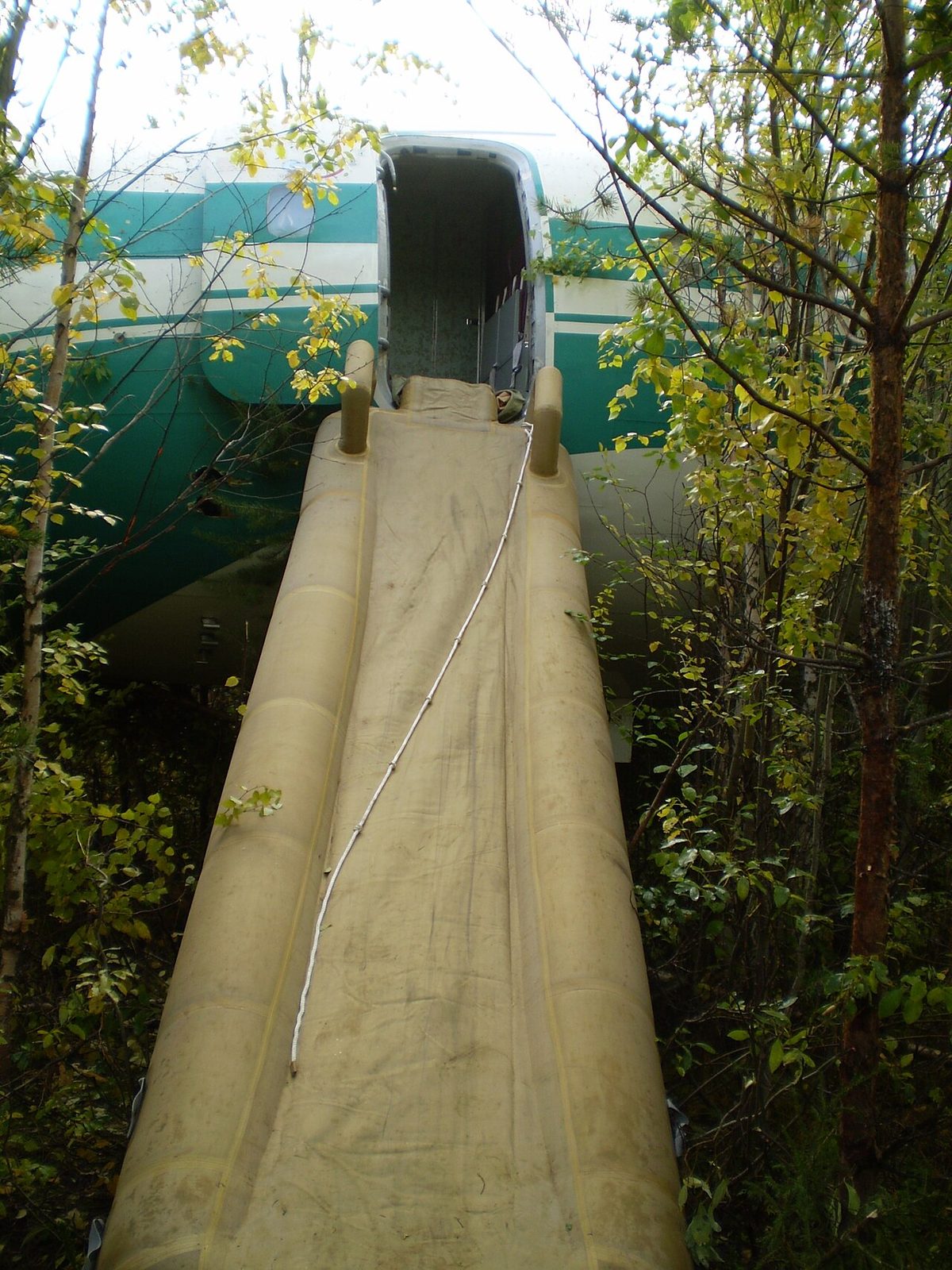
An escape slide is an inflatable chute from the door sill to the ground. Each A320 passenger door carries a single-lane slide or, on aircraft equipped for flights over water, a single-lane slide raft that can be detached to float. Once a slide raft has been disconnected, the line that still ties it to the aircraft must be cut, or a sinking fuselage could drag it under (see forced landing and ditching). The 737's door slides are not certified as water landing equipment and may not inflate properly in water; a detachment handle near the top frees a slide that would obstruct the exit, after which it is completely free of the aircraft.
Slide arming and girt bars
On the A320, as on many airliners, the slide is packed in a container on the lower inboard side of the door. A girt bar is attached to the slide. With the slide arming lever at ARMED, the girt bar is locked into fittings in the floor; at DISARMED it stays on the door. If an armed door is opened from inside, the girt bar stays in the floor fittings, pulls the slide out of its container and the slide inflates. The ECAM DOOR/OXY page shows an armed slide as a white SLIDE indication.
Arming follows a fixed routine: doors are armed once they are closed and before the aircraft moves, and disarmed on arrival before any door is opened, with a cross-check between cabin crew members. Several features guard against firing a slide at the gate:
- a white light on the A320 door comes on if the handle is operated while the slide is still armed, a last warning to stop;
- opening a door from outside disarms it automatically, on the A320 and the E190 E1;
- on the 737 the girt bar must be installed for taxi, take-off and landing on revenue flights.
Slide inflation
A slide must inflate within seconds, even in still air. Each slide has a slide inflation bottle of compressed gas. When the slide is pulled from its pack, the bottle discharges through one or more aspirators, venturi inflators in which the gas jet draws in surrounding air, so the slide fills with a mixture of bottled gas and outside air within seconds. If the automatic discharge fails on an A320, a crew member can open the bottle's valve by hand. On the A320 the cabin intercommunication data system (CIDS) also monitors slide bottle pressure, and the escape slide lights, on their own batteries, come on when an armed door opens.
Warning: an armed door opened at the gate fires the slide into the jet bridge or at the ground crew. Arming and disarming are always called and cross-checked, never assumed.
Flight deck escape
The pilots' normal way out is the flight deck door, which on the A320 and the 737 unlocks automatically when electrical power is lost. The A320's reinforced door can be forced open only from the flight deck side. The 737's door has a decompression panel that opens automatically during a decompression and also provides an emergency exit: release pins separate it from a jammed door.
If the door cannot be used, the crew leave through the side windows. A direct vision (DV) window is an opening side window at each pilot station, which slides back along a track. It lets the pilot see out if the windscreen is obscured, can be opened in flight once the aircraft is depressurised and, if large enough, serves as an emergency exit. The A320's two sliding windows are its flight crew emergency exits, and a red ring below the release button, visible from outside, shows that a window is not properly locked. Above each window a compartment holds a flight deck escape rope long enough to reach the ground. The 737's two sliding flight deck windows are its crew exits, with an escape strap in a compartment above and aft of each, and the E190-E2's type certificate lists its two cockpit side windows, 483 mm by 508 mm, as flight crew emergency exits.
Exam tip: plug-type doors are larger than their frames and held shut by cabin pressure; a slide is required above a sill height of 1.83 m (6 ft); a girt bar locked in the floor arms the slide; opening from outside disarms it; overwing slides on the A320 are permanently armed; and slides inflate from a gas bottle through aspirators that draw in outside air.
Frequently asked questions
Why can't aircraft doors be opened in flight?
Passenger doors on pressurised aircraft are plug-type: they are larger than the opening in the fuselage and must be pulled inwards before they can be turned and moved out. In flight the cabin pressure presses each door against its frame with a force far greater than anyone could overcome, and locking pins back this up. Door interlocks also prevent the cabin from being pressurised unless the doors are closed and locked.
What is a girt bar on an aircraft door?
The girt bar is a bar attached to the end of the escape slide. When the crew arms the door, the bar is locked into fittings in the cabin floor. If the door is then opened from inside, the bar stays on the floor, pulls the slide out of its container as the door swings away, and the slide inflates. Disarmed, the bar stays on the door and the door opens normally.
How does an aircraft escape slide inflate?
A bottle of compressed gas on the slide discharges through one or more aspirators, venturi inflators in which the gas jet draws in outside air, so the slide fills with bottled gas and ambient air within seconds. On the A320 a crew member can open the bottle's valve by hand if the automatic discharge fails, and the cabin system monitors each slide bottle's pressure.
What is the difference between an escape slide and a slide raft?
An escape slide is designed to get people from the exit down to the ground. A slide raft, fitted for flights over water, can also be detached from the aircraft to float as a life raft. On the A320, after the slide raft is disconnected, the line still linking it to the aircraft must be cut, or a sinking fuselage could drag it under. The Boeing 737's door slides are not certified as water landing equipment.
How do pilots escape from the flight deck?
If the flight deck door cannot be used, the pilots leave through the opening side windows. On the A320 the two sliding windows are emergency exits, with an escape rope stowed above each that reaches the ground; the Boeing 737 has an escape strap above and aft of each sliding window. On the 737 a decompression panel in the flight deck door can also be separated from a jammed door to give a way out.
Test yourself on Doors, Emergency Exits and Escape Slides
The v1prep banks cover this topic in Aircraft General Knowledge (021), with a worked explanation for every answer. EASA ATPL, PPL, IR and CPL, the FAA written tests and A320/B737 type ratings.
Start practising →Sources and further reading
- EASA Easy Access Rules for Large Aeroplanes (CS-25), CS 25.783 Fuselage doors and CS 25.807 to 25.813 Emergency exits and egress
- 14 CFR 25.810, Emergency egress assisting means and escape routes
- 14 CFR 25.807, Emergency exits
- EASA Type-Certificate Data Sheet EASA.A.064, Airbus A318, A319, A320, A321
- FAA Aviation Maintenance Technician Handbook, Airframe (FAA-H-8083-31B), Chapter 1, Aircraft Structures
- EASA Easy Access Rules for Air Operations (Regulation (EU) No 965/2012)
Library articles are written for study and exam preparation. They do not replace your aircraft's approved documentation, your operator's procedures or the regulations themselves.