The Eye and Vision
The eye focuses light through the cornea and lens onto the retina, whose cone cells give sharp colour vision in good light at the centre and whose rod cells give sensitive black-and-white vision in dim light away from it. That split governs how pilots scan, see at night and adapt to darkness.
Of all the senses, vision is the most important for safe flight, as the FAA's Aeronautical Information Manual (AIM) puts it. About 1.2 million neurones link the eyes to the brain, against about 50,000 for the ears, and sight dominates orientation. Yet the eye is not a uniform camera. Only a small patch at the centre of the retina sees fine detail and colour, and it works only in good light. The rest of the retina detects movement and dim light but little detail, and at the exact point where the optic nerve leaves the eye it sees nothing at all.
Almost every rule of pilot vision follows from that design:
- read instruments and search for traffic by looking directly and in short steps
- look slightly to one side of a dim light at night
- protect dark adaptation for half an hour
- move the head so that nothing hides in a blind spot.
This article explains the eye itself. Defects and eye protection are in vision defects and eye protection, and the errors of interpretation in visual illusions.
Structure of the eye
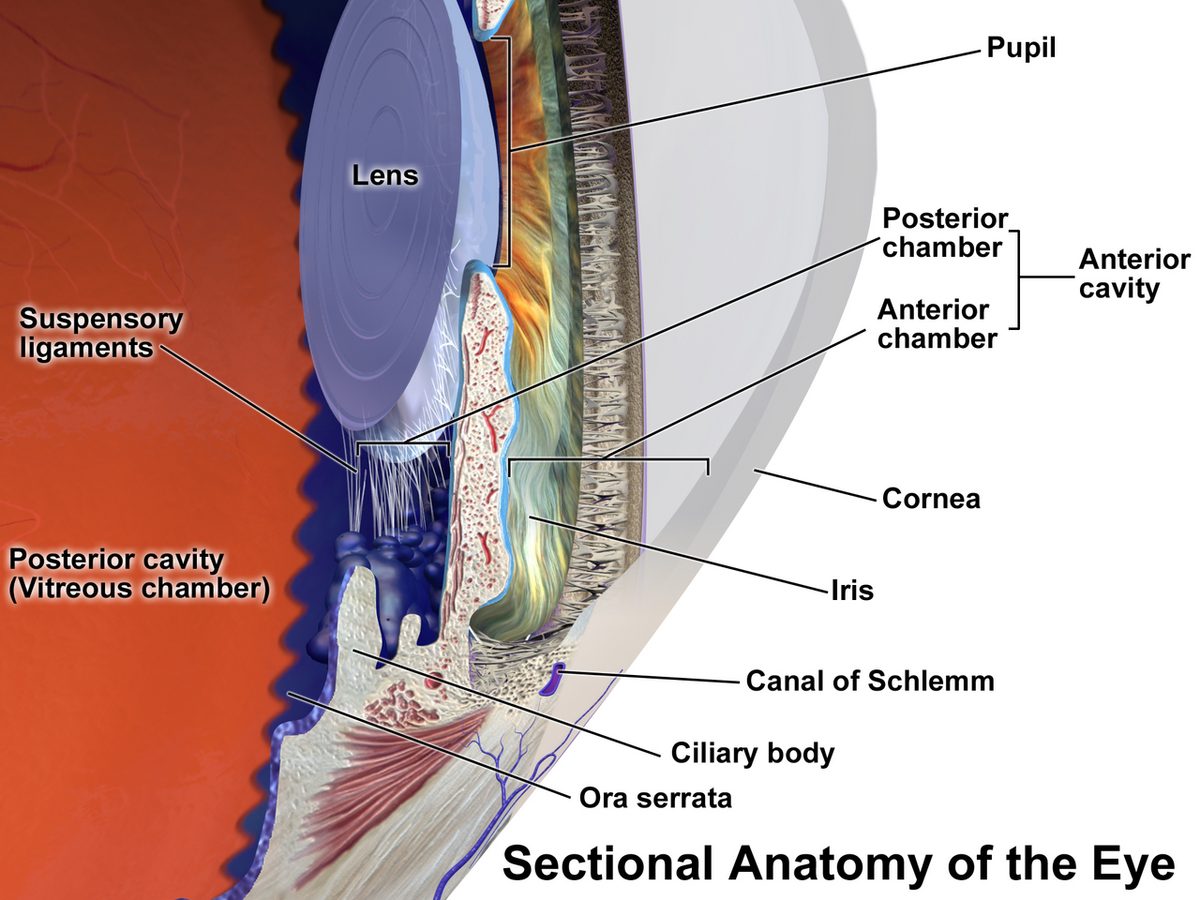
Light reaches the retina through a series of transparent structures:
- The cornea, the clear window at the front of the eye, is a fixed focusing device. Its curved shape bends the incoming light and provides 70 to 80 per cent of the eye's total focusing power.
- The aqueous humour is the watery fluid filling the chambers between the cornea and the lens. Its pressure, normally 10 to 20 mmHg, keeps the eyeball's shape; it drains through a small channel, the canal of Schlemm.
- The iris, the coloured ring, opens and closes the pupil to control the light admitted. The pupil's diameter can change the light entering by a factor of only about 5 to 1, far too little to cover the range from daylight to a dark night.
- The lens supplies the remaining fine focus. The ciliary muscles around it change its shape: they thicken it to focus on near objects and flatten it for distant ones. This is accommodation, and it weakens with age and with fatigue.
- The retina lines the back of the eye and contains the light-sensitive cells. The optic nerve carries their signals to the brain.
With nothing to focus on, such as a clear sky above cloud, a uniform haze or darkness, the eye does not rest at infinity. It settles at a near focus, which ATPL texts put at just under 1 m to about 1.5 m and the AIM at 10 to 30 ft. Distant aircraft then fall out of focus: this is empty-field myopia. The remedy is to refocus deliberately on a distant object, a wingtip or a cloud edge before each outside scan.
Rods, cones and the fovea
The retina contains two kinds of light-sensitive cell with opposite strengths:
| Cones | Rods | |
|---|---|---|
| Light needed | Good light | Dim light |
| Colour | Yes | No, black and white only |
| Detail | Fine | Poor |
| Best at detecting | Shape, colour, detail | Movement and faint light |
| Location | Concentrated at the fovea | Around the fovea, densest about 10° from it |
| Vision type | Photopic | Scotopic |
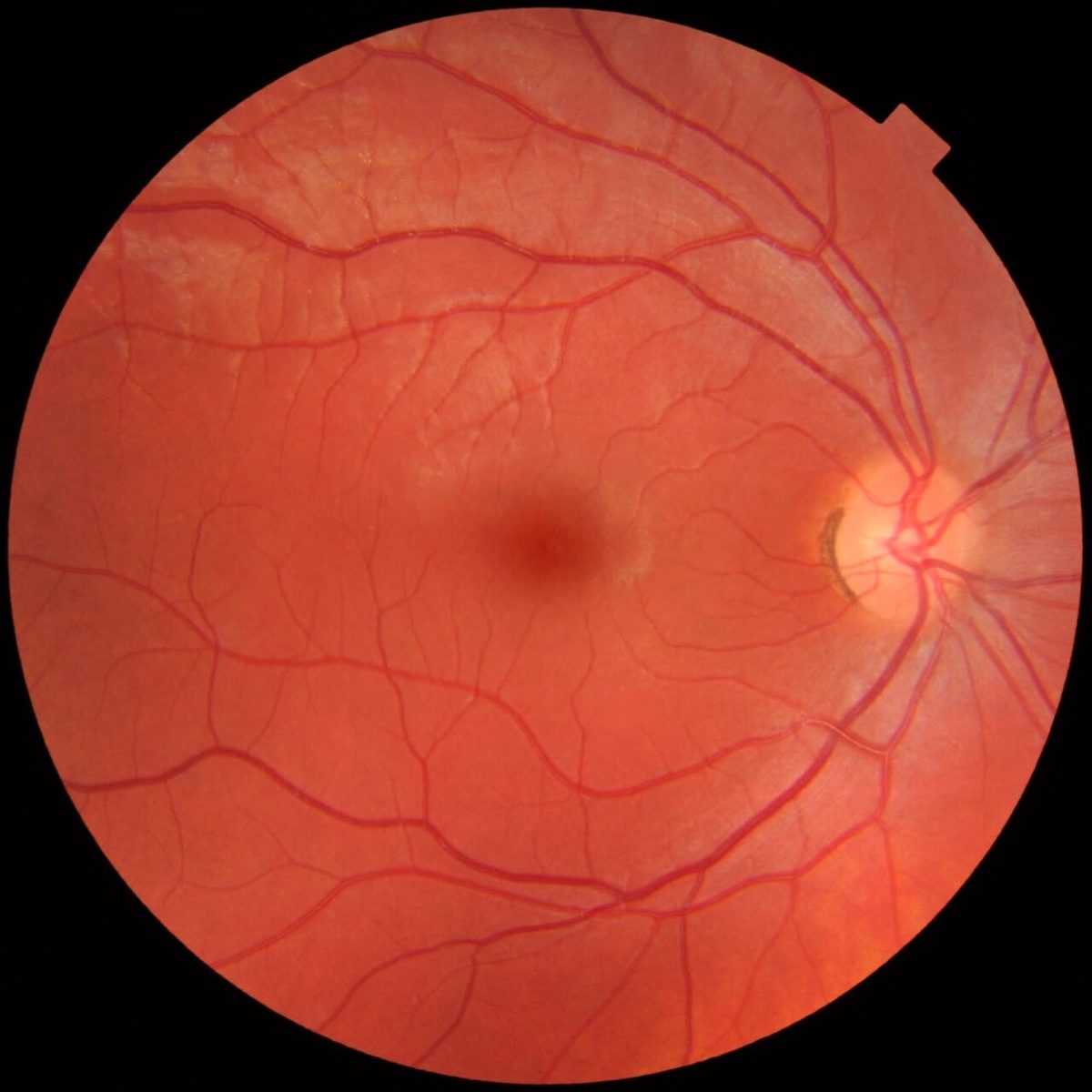
The fovea is a small pit at the centre of the retina made up only of cones. Anything that needs examination is brought to focus there, and it is the only part of the retina where vision reaches 6/6 (20/20). It contains no rods, which is the key to night vision.
The blind spot
Where the optic nerve leaves the eye, at the optic disc, there are no rods or cones. Any image that falls on it is not detected. This physiological blind spot exists by day and by night in each eye. Normally the other eye covers the gap, so it goes unnoticed.
It becomes dangerous when one eye's view is blocked, for example by a windscreen pillar. An aircraft on a collision course holds a constant relative bearing, so its image does not move across the retina. It can stay in the blind spot of the unobstructed eye from first sighting range until very late. Moving the head, and the body if necessary, during the lookout scan uncovers anything hidden this way (see visual scanning).
The night blind spot is a different thing. Because the fovea has no rods, the centre of the visual field is blind to dim light at night. The FAA describes this central area as 5 to 10 degrees wide.
Visual acuity and central vision
Visual acuity is the eye's ability to resolve detail. It is expressed as a Snellen fraction: 6/6 in metres, or 20/20 in feet, means reading at 6 m (20 ft) what a normal eye reads at that distance, while 20/40 means reading at 20 ft what a normal eye reads at 40 ft.
Central vision, using the fovea, is the only sharp vision. Acuity falls off steeply away from it: at 5° from the fovea it is down to 20/40, about half as good, and at about 25° it is 20/200, a tenth. The AIM gives an example. An aircraft recognisable at 7 miles in central vision would have to be as close as 7/10 of a mile to be recognised outside it.
Peripheral vision covers the rest of a field of view about 200° wide. It sees little detail but is good at detecting movement, and it supplies much of the sense of orientation. Two consequences follow. Reading anything, an instrument, a label or a registration, needs central vision. The eye also sees detail only while it is still: it moves in short jumps called saccades and samples the scene during the pauses. Lookout is therefore flown as a series of short eye movements, each area held briefly in central vision, never as a continuous sweep.
Depth perception and stereopsis
Depth perception uses several cues. The binocular ones come from having two eyes:
- Stereopsis: each eye sees a slightly different image, and the brain fuses them into depth. It is useful only to about 60 m (200 ft).
- Convergence: the eyes turn inwards to fix a near object, and the brain senses the angle.
Beyond about 60 m, depth and distance are judged from monocular cues learned by experience:
- the retinal size of objects of known size
- perspective
- obscuration of far objects by near ones
- the loss of colour and contrast with distance (atmospheric perspective)
- the relative movement of near and far objects.
Every judgement of height and distance on an approach therefore rests on monocular cues, which is why they can be fooled (see visual illusions) and why a pilot with sight in one eye can land safely.
Photopic, mesopic and scotopic vision
| Vision | Light level | Cells working | Characteristics |
|---|---|---|---|
| Photopic | Daylight, good artificial light | Cones | Colour, fine detail, sharp central vision |
| Mesopic | Dusk, dawn, twilight | Rods and cones | Colour and detail fading; both systems in use |
| Scotopic | Darkness | Rods only | No colour, poor detail, central night blind spot, good detection of faint light and movement |
Dark adaptation
The pupil alone cannot cover the range of light levels, so the retina adapts chemically. Bright light bleaches the visual pigment in the rods and cones almost instantly, and in darkness it slowly regenerates. Light adaptation, from dark to bright, takes about 10 seconds. Dark adaptation takes about 7 minutes for the cones and about 30 minutes for the rods.
The AIM states that complete dark adaptation needs at least 30 minutes in total darkness. A moderate degree can be reached in about 20 minutes under dim red cockpit lighting. Any degree of dark adaptation is lost within a few seconds of looking at a bright light, and the clock then starts again.
The AIM lists four things that impair dark adaptation:
- cabin altitudes above 5,000 ft
- carbon monoxide from smoking or exhaust fumes
- a lack of vitamin A in the diet
- prolonged exposure to bright sunlight.
The rods need a lot of oxygen, so night vision is the first function to suffer from hypoxia. ATPL texts quote a loss of night vision, without supplemental oxygen, of about 5 per cent at 1,100 m, 18 per cent at 2,800 m, 35 per cent at 4,000 m and 50 per cent at 5,000 m. Smoking 20 cigarettes a day costs about 20 per cent more (see carbon monoxide). The FAA recommends supplemental oxygen above 5,000 ft at night.

Night vision techniques
- Off-centre viewing. Look slightly to one side of a dim object so that its image falls on the rods. ATPL texts say 10 to 15 degrees to one side; FAA handbooks say 5 to 10 degrees off centre.
- Keep the eyes moving. The rods respond to movement and change, and a dim image stared at fades out. Scan in short movements with brief pauses.
- Protect adaptation. Finish bright-light tasks, such as the walk-round under floodlights, well before departure. Avoid bright lights for about 30 minutes before a night flight, and close one eye when a torch or bright light must be used.
- Keep the cockpit dim. Red cockpit lighting preserves the rods' adaptation, but it severely distorts colours: red and magenta markings on charts become hard or impossible to read, and it is difficult to focus on nearby objects under it. The AIM advises red light only where the best possible outside night vision is needed, with white light available for reading. FAA handbook guidance prefers dim white lighting, turned down as low as still allows the instruments and charts to be read.
Exam tip: At night look slightly off centre (ATPL texts: 10 to 15°), because the fovea has only cones and the rods are densest about 10° from it. Dark adaptation takes about 30 minutes (rods) and is lost in seconds. Night vision degrades from about 5,000 ft cabin altitude.
Flash blindness
Flash blindness is a temporary loss of vision after exposure to intense light. The flash bleaches the visual pigment of the retina, often leaving an afterimage, and wipes out dark adaptation, which then has to be rebuilt. Its classic source in flight is lightning: a nearby discharge can temporarily blind the crew. The standard defence in areas of thunderstorms is to turn the cockpit lights fully up, which reduces the contrast between the dark cockpit and the flash (see thunderstorms). Laser beams aimed at aircraft can dazzle a crew in the same way, with glare, flash blindness and afterimages, and the effect is worst at night, when the eye is dark-adapted.
By day, excessive light produces glare. The AIM describes light reflected from the canopy, cloud, water, snow and desert that causes squinting, watering eyes and even temporary blindness. Sunglasses protect against it (see eye protection).
Frequently asked questions
Why does a dim light disappear when you look straight at it at night?
The fovea, at the centre of the retina, contains only cones, and cones need good light. At night the centre of the visual field therefore becomes a night blind spot, which the FAA describes as 5 to 10 degrees wide. The rods that work in dim light lie around the fovea, with their greatest density about 10 degrees out. Looking slightly to one side of the light places its image on the rods, and it reappears.
How long does dark adaptation take?
The cones adapt to darkness in about 7 minutes, the rods in about 30 minutes. The FAA's AIM says complete dark adaptation needs at least 30 minutes in total darkness, and a moderate degree can be reached in about 20 minutes under dim red cockpit lighting. A few seconds of bright light destroy it and restart the process, so pilots avoid bright lights before a night flight and close one eye when a light must be used.
What is the blind spot of the eye?
Each eye has a blind spot where the optic nerve leaves the retina, at the optic disc, because there are no rods or cones there. Normally the other eye covers the gap. If a windscreen pillar blocks one eye's view, an aircraft on a constant relative bearing can stay hidden in the blind spot of the other eye until very late. Moving the head during the lookout scan uncovers it.
What are photopic, mesopic and scotopic vision?
Photopic vision is vision in good light, using the cones: colour and fine detail, centred on the fovea. Scotopic vision is vision in darkness, using only the rods: no colour, poor detail, and a blind area at the centre of the gaze. Mesopic vision is the range in between, such as dusk or twilight, when rods and cones are both working.
Does red cockpit lighting help night vision?
Dim red light preserves the rods' dark adaptation, and the AIM says a moderate degree of adaptation can be reached within 20 minutes under it. But red light severely distorts colours, so red and magenta chart markings become hard or impossible to read, and it makes it difficult to focus on nearby objects. The FAA therefore prefers dim white lighting, as low as still allows the instruments and charts to be read.
How far does stereoscopic depth perception work?
Stereopsis, the depth perception that comes from the slightly different image seen by each eye, is useful only to about 60 m (200 ft). Beyond that range, and therefore throughout an approach to land, pilots judge distance and height from monocular cues such as the size of familiar objects, perspective, obscuration, relative movement and the haze of distance.
Test yourself on The Eye and Vision
The v1prep banks cover this topic in Human Performance and Limitations (040), with a worked explanation for every answer. EASA ATPL, PPL, IR and CPL, the FAA written tests and A320/B737 type ratings.
Start practising →Sources and further reading
- FAA Aeronautical Information Manual, Chapter 8 Section 1 (8-1-2 Effects of Altitude, 8-1-6 Vision in Flight)
- FAA Pilot's Handbook of Aeronautical Knowledge (FAA-H-8083-25), Chapter 17, Aeromedical Factors
- FAA Civil Aerospace Medical Institute, Pilot Safety Brochures (Pilot Vision)
- FAA Airplane Flying Handbook (FAA-H-8083-3C), Chapter 11, Night Operations
Library articles are written for study and exam preparation. They do not replace your aircraft's approved documentation, your operator's procedures or the regulations themselves.