B737 Doors, Exits and Emergency Equipment
The Boeing 737 doors, exits and emergency equipment are the entry, service and flight deck doors, the overwing exits and sliding flight deck windows used for evacuation, the flight deck door access system, and the crew oxygen, emergency lighting and portable equipment carried for emergencies.
The Boeing 737 NG has two passenger entry doors, two service doors, two cargo doors and a flight deck door. For an emergency evacuation the passengers use the four entry and service doors and four overwing exits, and the flight crew can leave through the two sliding flight deck windows. The flight deck door locks electrically, and an access system lets the cabin crew request entry and, if the pilots do not answer, get in.
This article follows the 737 NG flight crew operations manual (FCOM) and notes the 737 MAX differences. The general principles are in doors, emergency exits and escape slides and flight deck security; the Airbus approach is in A320 doors and emergency equipment.
Doors and exits
An amber exterior door annunciation means that door is not closed and locked. The entry and service doors must not be operated in winds above 40 kt, nor left open in gusts above 65 kt. Each door slide has a detachment handle near its top, used if the deployed slide would obstruct the evacuation; once detached the slide is completely free of the aeroplane. The slide is not certified as water landing equipment and may not inflate properly in water. On revenue flights the slide girt bar is installed for taxi, take-off and landing.
The two lower cargo doors, on the right side of the fuselage, are plug-type, inward-opening pressure doors hinged at their upper edges, each locked by two latches, with a balance mechanism that lets them be swung open with little effort.
In the 737 MAX family the EASA type certificate data sheet keeps, for the 737-8, the 737-800's two Type I doors and two Type III overwing exits on each side, with a maximum of 189 passengers. The 737-9 and 737-8200 can have an extra mid exit door on each side, which lifts the 737-9 to 220 passengers and the 737-8200 to 202; the FSB adds mid exit door indications and a MID EXIT DOOR checklist.
Flight deck door security
When closed, the flight deck door locks whenever electrical power is available and unlocks when power is removed. Two concentric deadbolt levers add a mechanical lock: with both turned to the horizontal locked position, the passenger cabin key cannot unlock the door, while with only the forward lever locked the key still works.
The flight deck door access system is controlled from the flight deck:
| Control or light | Function |
|---|---|
| FLIGHT DECK ACCESS SYSTEM switch | Guarded; OFF removes electrical power from the door lock |
| Door lock selector, AUTO | Spring-loaded normal position |
| UNLKD | Unlocks the door; the selector must be pushed in to turn to it |
| DENY | Rejects a keypad entry request and prevents further code entry for a time period; turned to without pushing in |
| LOCK FAIL (amber) | Lock selector at AUTO and the lock has failed, or the access system switch is OFF |
| AUTO UNLK (amber) | A correct emergency access code has been entered |
The access system switch is checked guard closed in the preliminary preflight. Before start the door is closed and locked and the LOCK FAIL light must be out. The Limitations require an operational check of the flight deck door access system, by approved procedures, once each flight day.
Door access and entry video
Outside the door, the emergency access keypad lets a cabin crew member request entry. A code of 3 to 8 digits followed by ENT is entered, and a correct code sounds the flight deck chime. The panel's access lights show red with the door locked or the system switched off, amber once a correct code has been entered, and green when the door is unlocked. Where programmed, pressing 1 then ENT simply sounds the flight deck chime.
After a correct emergency code the amber AUTO UNLK light comes on in the flight deck. If the pilots do not respond, the light flashes and a continuous chime sounds before the timer expires and the door unlocks, so the cabin crew can still enter if the pilots do not respond. A pilot who sees the requester can unlock the door with UNLKD, or select DENY to reject the request and block further code entry for a period.
The flight deck entry video system helps that decision. Its camera selector gives three views: C, a frontal view of the person requesting entry, assuming they face the door; L, a view of the door with a back view of that person; and R, a general view of the forward service door and galley area. The picture can be shown on the multifunction display, but only with the IFE/PASS switch ON.
Decompression panels
The door contains flight deck door decompression panels, which provide an emergency egress path and open automatically during a decompression. Two pressure sensors in the door unlock them if pressurisation is lost. If the door is jammed, pulling the release pins inward separates the decompression panel from the door so that the panel can be opened and the crew can get out.
Flight deck windows and escape straps
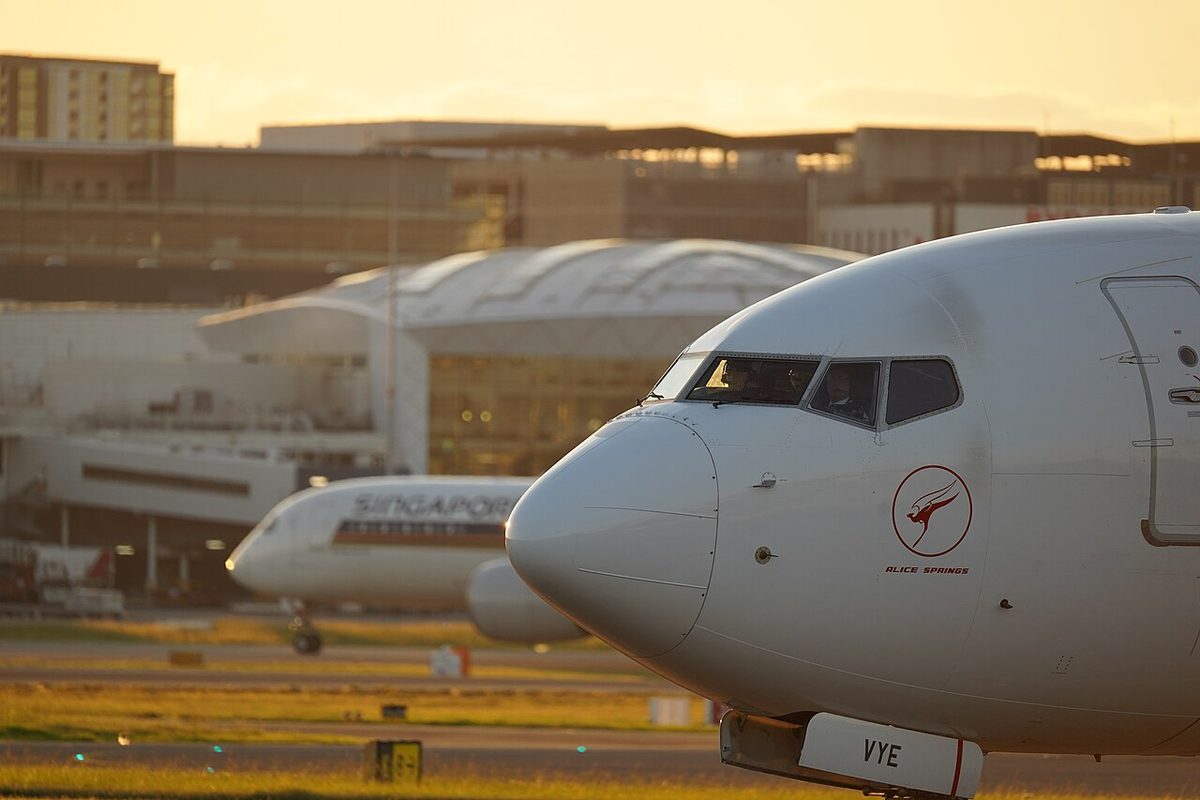
The No. 2 flight deck windows, one on each side, can be opened by the flight crew; only the first officer's can be opened from outside the aeroplane. These two sliding windows are the flight crew's evacuation route. To use one, the crew opens the escape strap compartment above and aft of the window. Before flight the crew checks that the escape ropes, fire extinguisher and crash axe are stowed.
Overwing exits and flight lock
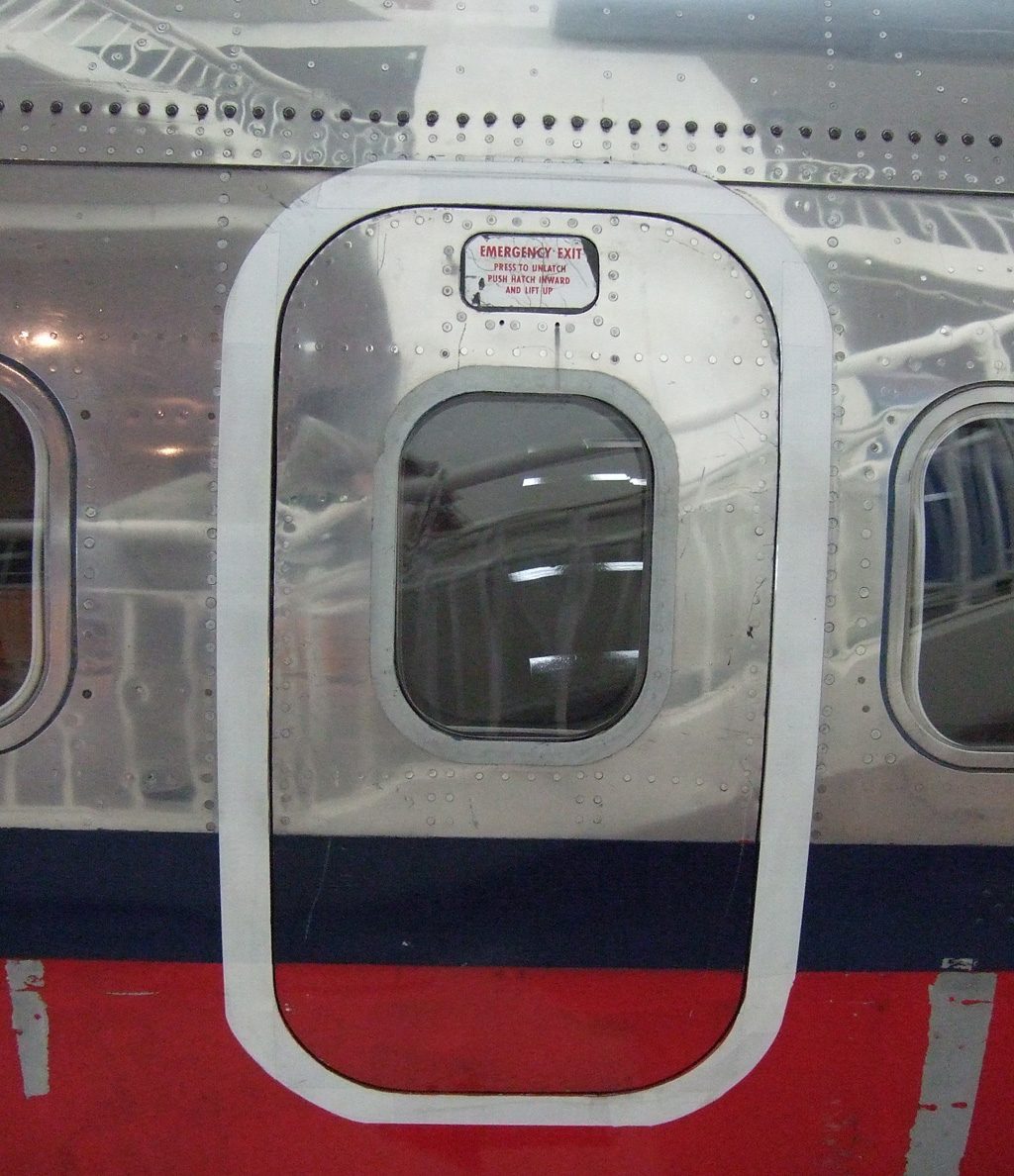
Four Type III emergency exits are fitted over the wings. They are canopy-type doors held in place by mechanical locks and cabin pressure. When passengers are carried, the installation of the handle covers on the overwing exits must be verified before departure. An escape strap is installed above each aft emergency exit door frame, one end attached to the frame and the rest stowed in a tube in the cabin ceiling; in use it is pulled free and attached to a ring on the top surface of the wing.
The overwing exit flight lock is a 28 V DC system that locks the exits automatically for take-off, in flight and for landing, and unlocks them on the ground for an emergency. It locks when:
- three of the four entry and service doors are closed, and
- either engine is running, and
- the air/ground system shows the aeroplane in the air, or both thrust levers are advanced.
The exits unlock when any of these conditions is not met or DC power is lost. If an exit is not fully closed and locked, or its flight lock is not engaged, during the take-off roll or in flight, the LEFT or RIGHT OVERWING light, the DOORS annunciator and MASTER CAUTION come on. If a flight lock has failed locked or a fault is detected, the amber PSEU light on the aft overhead panel lights with the OVERHEAD annunciator and MASTER CAUTION; these indications are inhibited from take-off until 30 seconds after the aeroplane is in the ground mode. On the 737 MAX a MAINT light replaces the PSEU light.
Crew oxygen pressure check
The flight crew and the passengers have two independent oxygen systems. Crew oxygen comes from a single cylinder, at a system pressure that may be as high as 1,850 psi, to quick-donning masks. Squeezing and pulling up the mask's inflation lever releases it from its stowage box, releases the OXY ON flag, starts the oxygen and the mask microphone and inflates the harness. A yellow cross in the flow indicator shows oxygen flowing.
| Mask control | Effect |
|---|---|
| NORMAL/100 % switch at N | Air and oxygen mixture on demand, the ratio depending on cabin altitude |
| NORMAL/100 % switch at 100 % | 100 % oxygen on demand |
| EMERGENCY/test selector, normal position | Automatically 100 % oxygen under positive pressure above a preset cabin altitude |
| EMERGENCY | 100 % oxygen under positive pressure at all cabin altitudes, against smoke and fumes; uses oxygen faster |
| PRESS TO TEST | Tests the positive pressure supply to the regulator |
| Smoke vent valve selector, down | Oxygen flows to the smoke goggles |
On aeroplanes with automatic pressure-breathing masks, pressure breathing occurs above 27,000 ft.
The oxygen pressure drop test is part of the preliminary preflight and needs to be done at only one crew member or observer station. The crew oxygen pressure must not drop by more than 100 psig. A cylinder valve that is not fully open shows itself in one of three ways: the pressure falls rapidly, falls by more than 100 psig, or recovers only slowly to normal.
Warning: before a Halon or equivalent extinguisher is discharged on the flight deck, everyone there must be on oxygen masks with 100 % oxygen and EMERGENCY selected. The agent can take up to 7 minutes to dissipate.
Emergency lighting controls
At ARMED, the EMER EXIT LIGHTS switch on the flight deck makes all emergency lights come on automatically if power to DC bus No. 1 fails or AC power is turned off. OFF prevents the emergency lights from operating if aeroplane power fails, and an amber NOT ARMED light shows whenever the switch is not at ARMED; the Secure procedure sets it OFF. On the aft attendant panel, a guarded passenger cabin emergency lights switch set to ON lights all emergency lights and bypasses the flight deck control.
The flight deck aft dome light has a separate bulb powered by the emergency lighting system for a flight deck evacuation. Self-illuminating exit locator signs mark the forward, middle and aft ends of the cabin, and the photoluminescent floor path marking needs the ceiling and sidewall lights at full intensity to charge. See flight deck, cabin and emergency lighting.
Other emergency equipment
- Emergency locator transmitter (ELT): guarded at ARM, it transmits automatically at its preset g-load; ON activates it by hand. The amber ELT light means it is transmitting on 121.5, 243.0 and 406.0 MHz.
- Protective breathing equipment (PBE): smoke hoods for fighting fires or entering smoke or fumes, giving about 15 to over 20 minutes of oxygen depending on the device.
- Fire extinguishers: water, for fabric, paper and wood fires only, never electrical or grease fires; Halon or equivalent, effective on all fires but mainly electrical, fuel and grease fires.
- Portable oxygen cylinders: charged to 1,800 psi, with a 2 litre per minute walk-around outlet and a 4 litre per minute first aid outlet.
Frequently asked questions
How does the Boeing 737 flight deck door keypad work?
A cabin crew member enters a 3 to 8 digit emergency access code on the keypad followed by ENT. A correct code sounds the flight deck chime and lights the amber AUTO UNLK light; if the crew does nothing, the light flashes and a continuous chime sounds before the timer expires and the door unlocks. The crew can unlock the door with the lock selector at UNLKD, or reject the request with DENY.
What happens if the 737 flight deck door is jammed after a decompression?
The door has two pressure sensors that unlock its decompression panels if pressurisation is lost, and the panels open automatically during a decompression to provide an emergency egress path. If the door itself is jammed, pulling the release pins inward separates the decompression panel from the door so that it can be opened and the crew can get out.
When are the 737 overwing exits locked?
The 28 V DC flight lock engages when three of the four entry and service doors are closed, either engine is running, and the air/ground system shows the aeroplane in the air or both thrust levers are advanced. The exits unlock if any of these conditions is no longer met or DC power is lost, so they can be opened on the ground in an emergency.
How is the 737 crew oxygen pressure drop test judged?
The test needs to be done at only one crew member or observer station. The crew oxygen pressure must not decrease by more than 100 psig. If the oxygen cylinder valve is not fully open, the pressure can fall rapidly, fall by more than 100 psig, or recover slowly to normal, each a sign of a cylinder valve that is not fully open.
What does the 737 EMER EXIT LIGHTS switch do?
At ARMED, it makes all emergency lights come on automatically if power to DC bus No. 1 fails or AC power is turned off. OFF prevents the emergency lights from working if aeroplane power fails, and the amber NOT ARMED light shows whenever the switch is not at ARMED. A guarded switch on the aft attendant panel can turn all emergency lights on, bypassing the flight deck control.
Test yourself on B737 Doors, Exits and Emergency Equipment
The v1prep banks cover this topic in the B737 type-rating bank, with a worked explanation for every answer. EASA ATPL, PPL, IR and CPL, the FAA written tests and A320/B737 type ratings.
Start practising →Sources and further reading
- FAA Flight Standardization Board Report, Boeing 737
- EASA Type Certificate Data Sheet IM.A.120, Boeing 737
- EASA Easy Access Rules for Large Aeroplanes (CS-25), CS 25.783 Fuselage doors, CS 25.807 to 25.813 Emergency exits and egress, CS 25.812 Emergency lighting
- 14 CFR 25.807, Emergency exits
- 14 CFR 25.810, Emergency egress assisting means and escape routes
- 14 CFR 25.812, Emergency lighting
- 14 CFR 121.333, Supplemental oxygen for emergency descent and for first aid, turbine engine powered airplanes with pressurized cabins
Library articles are written for study and exam preparation. They do not replace your aircraft's approved documentation, your operator's procedures or the regulations themselves.