Emergency Evacuation
An emergency evacuation is the rapid removal of all occupants from an aircraft on the ground or on water, through the emergency exits and escape slides, when staying on board is more dangerous than leaving. It is ordered by the commander, or in defined cases started by the cabin crew, and directed by the cabin crew.
An emergency evacuation is the rapid removal of everyone on board an aircraft through its emergency exits, usually down inflatable escape slides, when remaining on board has become more dangerous than leaving. Fire is the classic reason, but smoke, a fuel leak, serious structural damage and a ditching can all make it necessary.
Survival in a post-crash fire is measured in seconds, which is why large aeroplanes are designed and certified around the speed of evacuation. An aeroplane with more than 44 passenger seats must show that all its occupants can leave within 90 seconds with only half of the exits usable, in a full-scale demonstration or, for derivatives of a tested type, by analysis. Everything else in this article, from door arming to exit row seating, serves that goal. Yet an evacuation also causes injuries, from falls on slides and crowding at exits, so the decision to order one is a real judgement, not a reflex.
When to evacuate
The commander decides whether to evacuate. The choice is between an evacuation through the emergency exits and slides, a precautionary disembarkation by the normal doors and stairs or jet bridge when there is a problem but no immediate threat, and keeping everyone seated while the situation is assessed. A fire that cannot be controlled, smoke in the cabin, fuel leaking near a heat source, serious damage or water entering the fuselage usually call for an evacuation; a hot brake or an engine indication with the rescue services in attendance may not. Operators also define whether and when the cabin crew may start an evacuation themselves.
Before ordering an evacuation the commander must ensure that the aircraft is stopped and all engines are shut down: running engines can suck people into an intake or blow them off a slide or wing. The flight crew set the parking brake, run the evacuation checklist, tell ATC and alert the rescue and fire-fighting service. ICAO Annex 14 sets that service the objective of reaching any point of each operational runway within 3 minutes in optimum visibility and surface conditions.
After a rejected take-off or a landing incident the crew may first alert the cabin crew while they assess the situation. In one E-Jet operator's procedures, for example, the captain calls "Cabin crew at stations" after stopping from a rejected take-off, and if no evacuation is needed, "Cabin crew and passengers keep your seats". The Boeing 737 rejected take-off procedure leaves the parking brake off after the stop unless an evacuation is necessary, so that hot brakes can cool.
Brace command and brace position
When an impact is expected, a forced landing, a ditching or a landing with gear or control problems, the cabin is prepared in advance: passengers are briefed, loose items stowed, exits and their operators identified and able-bodied passengers asked to help. Shortly before touchdown the flight crew give the brace command, a public address announcement or signal agreed between the commander and the cabin crew and timed as the operator's procedures lay down, and the cabin crew then shout commands telling the passengers to take up the brace position.
The brace position has two purposes: to reduce flailing, and to reduce the secondary impact by prepositioning the body, particularly the head, against the surface it would otherwise strike. People who stay conscious and uninjured can escape; people knocked out by the impact cannot. Guidance has changed as seats have changed. For a forward-facing passenger, ICAO's passenger safety manual (Doc 10086) now describes bending forward with the feet flat on the floor and the hands placed by, or holding, the lower legs rather than on the seat back in front, and the FAA revised its recommended positions in AC 121-24E so that they suit all seat back types. The exact position depends on the seat and is shown on the safety card; passengers who cannot reach a seat in front, infants, and cabin crew on their own seats have positions of their own. In a light aircraft the same principles apply: harnesses tight, loose articles stowed, and doors unlatched just before touchdown so that a distorted airframe cannot jam them.
Door arming and disarming
On the A320, as on many airliners, each passenger door carries its escape slide packed in a container on the lower inside of the door. Arming a door connects the slide to the aircraft: on the A320 the arming lever locks the slide's girt bar into fittings in the floor. If an armed door is opened from inside, the girt bar stays attached to the floor, pulls the slide out of its container, and a gas bottle and aspirators inflate it within seconds. With the lever at DISARMED the girt bar stays on the door and the door opens normally.
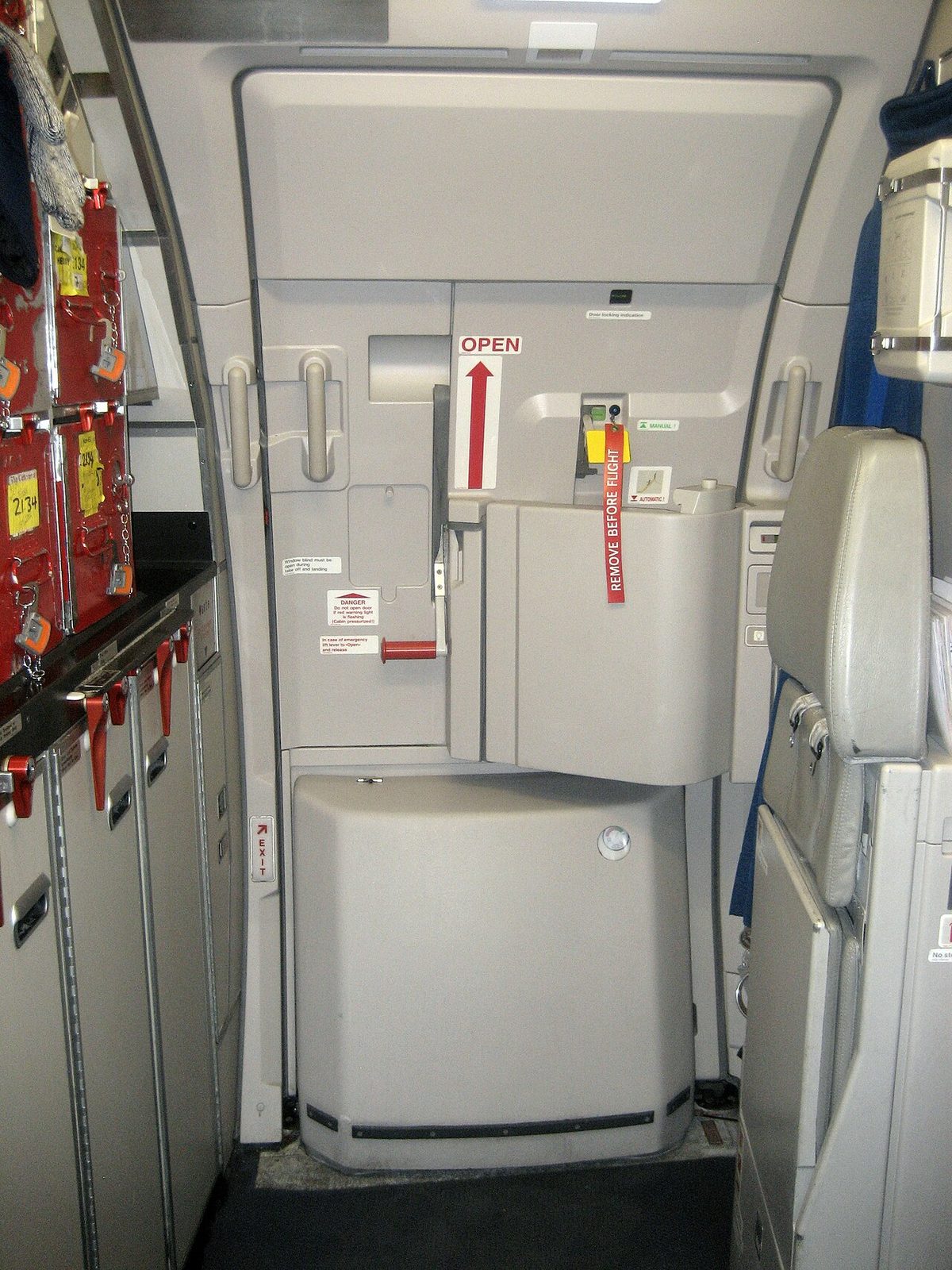
Doors are armed once they are closed and before the aircraft moves, and disarmed after it arrives on stand and before any door is opened. The commands, the cross-check between cabin crew members and the report to the flight deck are laid down in the operator's procedures, because an armed door opened at the gate fires a slide into the jet bridge or at the ground crew. Several safeguards back this up:
- a white light on the A320 door comes on if the handle is lifted while the slide is armed, a last warning to stop;
- opening a door from outside disarms its slide automatically, on the A320 and the Embraer E190 E1;
- the flight crew see armed slides on the A320's DOOR/OXY page and check them disarmed at parking;
- on the Boeing 737 the girt bar must be installed for taxi, take-off and landing on revenue flights.
On the A320 the door's damper actuator drives an armed door open in an emergency, so one person can open it quickly, and a manual valve on the inflation bottle backs up the automatic inflation. Its overwing exit slides are permanently armed and have no arming lever, so a passenger who opens the exit needs to do nothing else.
Evacuation slides
Under CS 25.810 and 14 CFR 25.810, every non-overwing exit whose sill is more than 1.83 m (6 ft) above the ground, with the aeroplane on the ground and the gear extended, must have an approved means to help the occupants down, as must every non-overwing Type A, B or C exit whatever its height. A slide must deploy automatically when the exit is opened from inside in an emergency. Overwing exits lead onto the wing; on the A320 a single-lane slide at the wing trailing edge takes passengers from the wing to the ground. The Type III overwing exit of a narrow-body such as the 737 is at least 20 in wide and 36 in high.
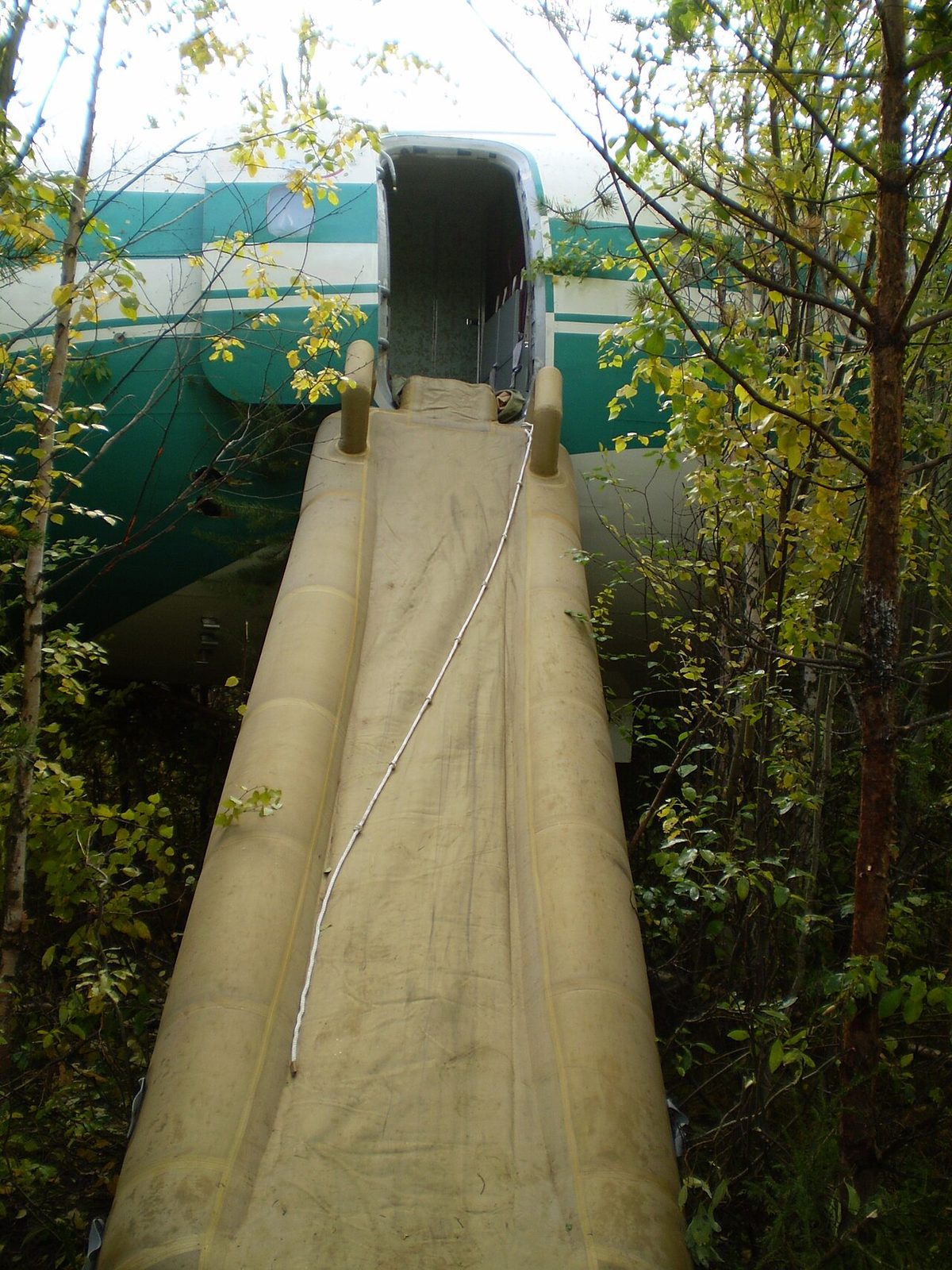
Slides differ with the aircraft's role. The A320's door slides are single-lane; on aircraft equipped for flights over water they are slide-rafts, which can be detached to float, and whose line to the aircraft must be cut after disconnection so that the raft is not dragged down with it. The 737's door slides are not certified as water landing equipment, and a detachment handle frees a slide that would obstruct the exit. On the A320 the escape slide lights and overwing escape route lights, supplied by their own batteries, come on when an armed door or exit opens. In the cabin, floor proximity escape path marking leads people to the exits in smoke and darkness, and the flight crew can leave through the flight deck side windows using the escape ropes stowed above them.
Exit row seating restrictions
The people seated next to the exits will open them. Exit row seating is therefore restricted. Under EASA rules persons with reduced mobility may not sit where they would impede the crew, obstruct emergency equipment or hinder an evacuation, which rules out seats with direct access to an exit. The guidance also excludes children and infants and those travelling with them, and deportees and persons in custody. An able-bodied adult who understands the briefing and can operate the exit is the right choice.
The FAA sets explicit exit row seating restrictions in 14 CFR 121.585: exit seat passengers must have enough mobility, strength and dexterity in both arms, hands and legs, be able to read and understand the instructions and communicate, have adequate vision and hearing, be at least 15 years old, not be responsible for a small child and be willing to act. The additional exit row briefing under 121.585 lets passengers who cannot or will not perform the functions ask to be reseated.
Conducting the evacuation
The commander gives the evacuation command over the public address and, where fitted, with an evacuation signal. On the A320 the guarded COMMAND pushbutton on the EVAC panel makes EVAC lights flash and a tone sound at the cabin crew stations, and a switch on the panel selects whether the alert can also be triggered from the cabin. In one E-Jet operator's procedures the commander calls "Cabin crew at stations" and then "Emergency, open seat belts, evacuate".
Each cabin crew member checks conditions outside before opening an exit and redirects passengers to another exit if this one is unusable, for example because of fire outside or a slide that has not inflated. The crew then shout short, repeated commands, such as open seat belts, leave everything, come this way, jump and slide. Successful evacuations depend on firm control by the cabin crew, strict discipline and correct use of the equipment, which is why cabin crew practise opening exits, deploying slides and fighting fires in regular training. Under EASA rules aeroplanes with more than 60 passenger seats carry megaphones, one for 61 to 99 seats and two for 100 or more.
Once outside, passengers are moved away from the aircraft and kept together so that the crew can account for everyone. In the United States an evacuation of an aeroplane of more than 12,500 lb maximum certificated take-off weight using its emergency egress system must be reported to the NTSB immediately, whether or not anyone was hurt.
Break-in markings
If the exits cannot be opened, rescuers may have to cut through the fuselage. Break-in markings show the areas where this can be done. Where such areas are marked, the markings are red or yellow lines, outlined in white where needed for contrast, at the corners of each area. If the corner markings are more than 2 m apart, intermediate lines 9 cm by 3 cm are added so that no more than 2 m separates adjacent marks. Crash axes and crowbars carried in the cabin for the crew's use are kept out of sight of the passengers.
Frequently asked questions
How long does an aircraft evacuation take?
Certification requires that an aeroplane with more than 44 passenger seats can be evacuated within 90 seconds using only half of its exits, shown by a demonstration or, for derivatives, by analysis. Real evacuations can be slower, because of smoke, darkness, damage, blocked exits and passengers taking their bags, which is why cabin crew commands are loud, short and repeated, and why passengers are told to leave everything behind.
What does arming the doors mean on an aircraft?
Arming a door connects its escape slide to the aircraft floor, usually by locking the slide's girt bar into floor fittings. If an armed door is opened from inside, the slide is pulled out and inflates automatically. Doors are armed after they are closed and before the aircraft moves, and disarmed after arrival before any door is opened. Opening a door from outside normally disarms it automatically.
Who can sit in an exit row?
Exit row seats go to passengers who can understand the briefing and open the exit. Under EASA rules they are not given to people whose disability or reduced mobility would slow an evacuation, to children, infants and those travelling with them, or to deportees and persons in custody. FAA rules add explicit criteria: at least 15 years old, able to read and understand the instructions, with adequate strength, mobility, vision and hearing, and willing to help.
What is the brace position?
The brace position is the posture passengers and cabin crew adopt before an expected impact, on the brace command. It reduces flailing and prepositions the body, especially the head, against the surface it would strike, so that people stay conscious and able to escape. For a forward-facing passenger, current ICAO guidance is to bend forward with the feet flat on the floor and the hands by or holding the lower legs, but the right position depends on the seat and is shown on the safety card.
What are break-in markings on an aircraft?
Break-in markings show rescue crews where the fuselage can be cut open to reach the occupants if the exits cannot be used. They are red or yellow lines, outlined in white where needed for contrast, marking the corners of each suitable area. If corner markings are more than 2 m apart, intermediate lines 9 cm by 3 cm are added so that adjacent marks are no more than 2 m apart.
Test yourself on Emergency Evacuation
The v1prep banks cover this topic in Operational Procedures (070), with a worked explanation for every answer. EASA ATPL, PPL, IR and CPL, the FAA written tests and A320/B737 type ratings.
Start practising →Sources and further reading
- 14 CFR 25.803, Emergency evacuation
- 14 CFR 25.810, Emergency egress assisting means and escape routes
- 14 CFR 121.585, Exit seating
- EASA Easy Access Rules for Large Aeroplanes (CS-25)
- EASA Easy Access Rules for Air Operations (Regulation (EU) No 965/2012)
- ICAO Annex 14, Aerodromes, Volume I, Aerodrome Design and Operations
- ICAO Doc 10086, Manual on Information and Instructions for Passenger Safety (ICAO Store)
- FAA Advisory Circular AC 121-24E, Passenger Safety Information Briefing and Briefing Cards
Library articles are written for study and exam preparation. They do not replace your aircraft's approved documentation, your operator's procedures or the regulations themselves.