B737 Communications
The Boeing 737 communication system comprises the radio, interphone, cockpit voice recorder and communication crew alerting systems. The captain, first officer and first observer each control their audio through an audio control panel, whose audio system sits in a common remote electronics unit, while radio tuning panels set the VHF and HF frequencies.
The Boeing 737 communication system lets the crew speak to air traffic control and their company, to each other, to the cabin crew, the ground crew and the passengers, and it records what is said on the flight deck. The flight crew operations manual (FCOM) divides it into four parts: the radio communication system, the interphone communication system, the cockpit voice recorder system and the communication crew alerting system.
Each pilot works it through two panels: an audio control panel (ACP), which decides what is heard and on which system the next transmission goes out, and a radio tuning panel (RTP), which sets the frequency of a radio. This article follows the 737 Next Generation (NG) FCOM, many of whose items are qualified "most variants"; the 737 MAX shares the B-737 type rating, and its own FCOM is the reference for its panels. The general principles are in VHF, HF and satellite communications and aircraft interphone and audio systems, and the Airbus approach in A320 communications and datalink.

Communication system overview
| System | What it provides | Key points |
|---|---|---|
| VHF | Primary short-range voice, ACARS | Three independent radios; VHF-1 antenna on top, VHF-2 and VHF-3 below |
| HF | Long-range voice | Two radios on one antenna, on most variants in the vertical stabiliser |
| SATCOM (where fitted) | Data and voice | Up to two simultaneous calls |
| Flight interphone | Private flight deck network | Ground crew jack at the external power receptacle |
| Service interphone | Flight deck, cabin crew and external jacks | SERVICE INTERPHONE switch controls the external jacks |
| Passenger address (PA) | Announcements and music | Flight crew have the highest priority |
| Cockpit voice recorder | Four channels, 120 minutes | Erase only on the ground with the parking brake set |
The lower-fuselage antennas are susceptible to multipath interference from nearby structures or vehicles, which may disrupt VHF communications; the upper antenna is less susceptible. Boeing's non-AFM operational information therefore recommends the VHF radio connected to the top antenna for primary ATC communications on the ground.
Some audio cannot be turned down. The aurals for ground proximity warnings, altitude alerts, TCAS advisories and radar predictive windshear alerts are heard through the speakers and headsets at preset volumes, and the crew can neither adjust nor switch them off. On battery power alone the flight interphone, service interphone, PA and VHF No. 1 remain available, a point linked to the B737 electrical system.
Audio control panels and the REU
An ACP is installed at the captain's, the first officer's and the first observer's stations. The second observer has a headphone jack only and hears the same audio as the first observer, controlled from the first observer's ACP.
The audio systems themselves are not in the panels. The captain's, first officer's and observer's audio systems are housed in a common remote electronics unit (REU) in the electrical and electronic (E/E) compartment. They function independently and have separate circuit breakers. The ACP is the control head for its station's system:
- Transmitter selector switches (MIC SELECTOR): pushing one selects that system for the next transmission. Only one can be selected at a time, and pushing a second deselects the first. Reception over the selected system is possible whether or not its receiver switch is on.
- CALL light on a transmitter selector (most variants): comes on with a chime when someone wants to communicate on that system, and resets when the microphone is keyed, the control wheel microphone switch is pressed or the RADIO-INT switch is moved to RADIO.
- Receiver switches: any number may be selected. A push selects reception of the related radio or navigation receiver, a second push deselects it, and rotating the switch sets the volume.
- Filter switch: V (voice) for the voice audio of the NAV and ADF receivers, R (range) for their station identifier code, and B (both).
- ALT-NORM switch: NORM for normal operation, ALT for degraded mode.
On the control wheel, the push-to-talk switch (most variants) has two positions: RADIO keys the oxygen mask or boom microphone on the system chosen by the transmitter selector, while INT keys it directly onto the flight interphone, bypassing the selector.
On the most common variants the oxygen mask microphone is enabled, and the boom microphone disabled, when the left oxygen mask panel door opens. Returning to the boom microphone needs the door closed and the RESET/TEST switch pushed. The two flight deck speakers are in the ceiling above the pilots' seats; there is none at the observer station. They are muted while either pilot transmits on the push-to-talk microphone, but not during oxygen mask microphone operation, and they always operate for the GPWS, altitude alert, TCAS and predictive windshear aurals.
Exam tip: one transmitter at a time, any number of receivers. Selecting a second transmitter deselects the first.
ACP degraded mode
With its ALT-NORM switch at ALT, a crew station's audio system works in degraded mode, with a single radio for transmission and reception:
| Crew station | Radio available in degraded mode |
|---|---|
| Captain | VHF-1 |
| First officer | VHF-2 |
| Observer | VHF-1 |
Degraded mode has further limitations. The hand microphone cannot be used. The altitude alert, GPWS and windshear aurals are not heard on an audio system in degraded mode; they are still heard on the other side, provided that side's ALT-NORM switch is not also at ALT. The passenger address cannot be reached through the ACP, but the crew can still use the service interphone handset and the PA microphone where these are installed on the control stand.
Radio tuning panels
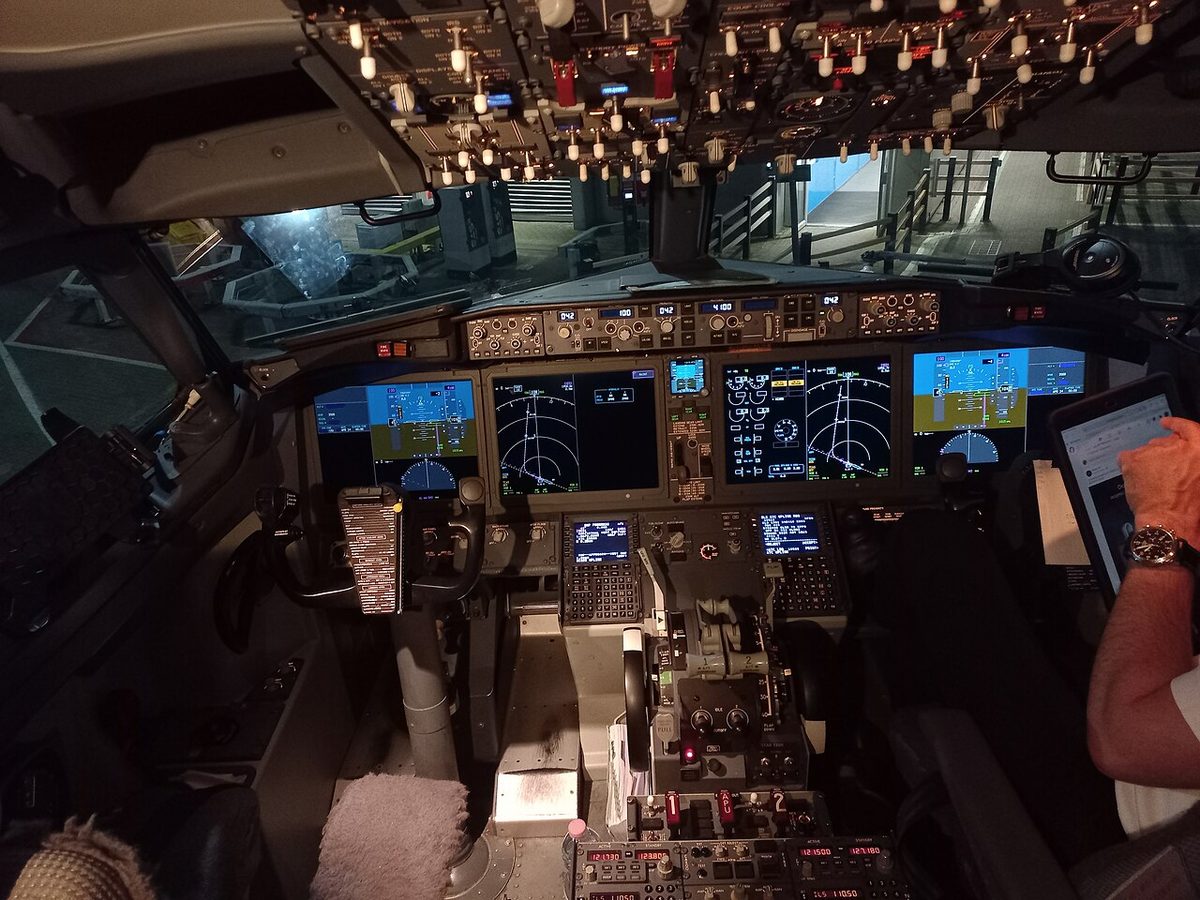
The radio tuning panel tunes the communication radios. Its ACTIVE frequency indicator shows the frequency tuned to the selected radio, or DATA when that radio is in data mode, and VHF frequencies are displayed with six digits in 8.33 kHz channel spacing. On the frequency selector the first digit is always 1; the outer knob changes the second and third digits in 1 MHz steps and the inner knob the fourth to sixth digits in 8.33 kHz steps.
Other controls and indications:
- VHF TEST switch: removes the automatic squelch, so background noise is heard. This tests the receiver and improves the reception of weak signals.
- AM light (white): HF AM is selected; extinguished, HF upper sideband (USB) is selected.
- PANEL FAIL: the radio tuning panel itself has failed.
- FAIL FAIL: the selected radio has failed.
The navigation receivers are tuned separately, on the VHF NAV control, whose TFR switch swaps the standby and active frequencies; see B737 flight instruments and displays.
HF, SELCAL and datalink
On the most common variants the HF antenna is in the vertical stabiliser, and both HF radios use it. While either radio is transmitting, the antenna is disconnected from the other, which can then neither transmit nor receive; both can receive at the same time if neither is transmitting. Keying the transmitter after a frequency change tunes the antenna, with a tone that normally lasts up to 7 seconds. A tone longer than 7 seconds, to a maximum of 15, means the system has failed to tune. The last 100 tuned frequencies are stored, so retuning to one of them is very short and the tone may not be noticed.
Warning: HF operation is prohibited during refuelling, a memory item in the Limitations. Keying an HF radio while the aeroplane is being fuelled can injure people or start a fire.
SELCAL monitors the selected frequencies on the VHF and HF radios. Each aeroplane has its own four-letter code; when a ground station calls it, a two-tone chime sounds and the white SELCAL light for that radio comes on.
ACARS is an addressable digital datalink that exchanges data and messages between the aeroplane and a ground operations centre over an onboard VHF radio, described in ACARS and aircraft datalink. It is limited to messages that will not create an unsafe condition if improperly received. Pre-departure clearances, digital ATIS, oceanic clearances, weight and balance and take-off data messages are allowed, provided they are verified by approved operational procedures. Where a printer is fitted, its blue MSG light shows an incoming message or a test, the amber PAPER light low paper and the amber FAIL light a printer failure or a test. CPDLC exchanges data with ATC (controller-pilot data link communications).
On aircraft with SATCOM, voice calls are controlled from the CDUs and ACPs and the ACARS datalink through the communications management unit (CMU). An incoming call brings a SELCAL chime and the CALL light. The system supports two simultaneous calls; with both in use, a higher-priority incoming call terminates the lowest-priority one, PREEMPTED shows momentarily, and the pilot is prompted to answer or reject the new call.
Interphone, PA and crew calls
The flight interphone is an independent network whose main purpose is private communication between the flight deck crew, without intrusion from the service interphone. The ground crew can join it through a jack at the external power receptacle.
The service interphone links the flight deck, the flight attendant stations and external jacks around the aeroplane. With the SERVICE INTERPHONE switch OFF, as set in the preliminary preflight, the external jacks are deactivated but the flight deck and flight attendants can still talk. The service interphone handset jack, with a microphone fitted, reaches the flight attendant stations, and with the switch ON any external jack, bypassing the ACP.
The passenger address speakers are in the lavatories, the forward galley, near the aft entry and service doors and in the passenger service units. PA inputs have a fixed priority:
- The flight crew, selecting PA on the ACP and speaking through the boom, oxygen mask or hand-held microphone at the PA microphone jack on the aft electronic panel. This pre-empts all music and other announcements, including flight attendant announcements in progress.
- The flight attendant handsets.
- The pre-recorded announcement and music system (PRAM), in which manual messages take priority over automatic ones and both over music.
The call system connects the stations:
| Action | Result |
|---|---|
| GRD CALL switch, forward overhead panel | Horn in the nose wheel well, until released |
| ATTEND switch, forward overhead panel | Two-tone chime in the cabin, pink master call lights |
| PILOT CALL switch, external power panel | Single high-tone chime on the flight deck |
| Flight attendant calls the flight deck | Blue call light and single high-tone chime |
| NO SMOKING or FASTEN BELT sign changes | Single low-tone chime in the cabin |
In the cabin the master call lights show pink for a call from the flight deck or another attendant station, blue for a passenger seat call and amber for a lavatory call. The Call RESET switch on the attendant handset clears the pink lights, cancels the call and disconnects the handset from the PA.
Cockpit voice recorder
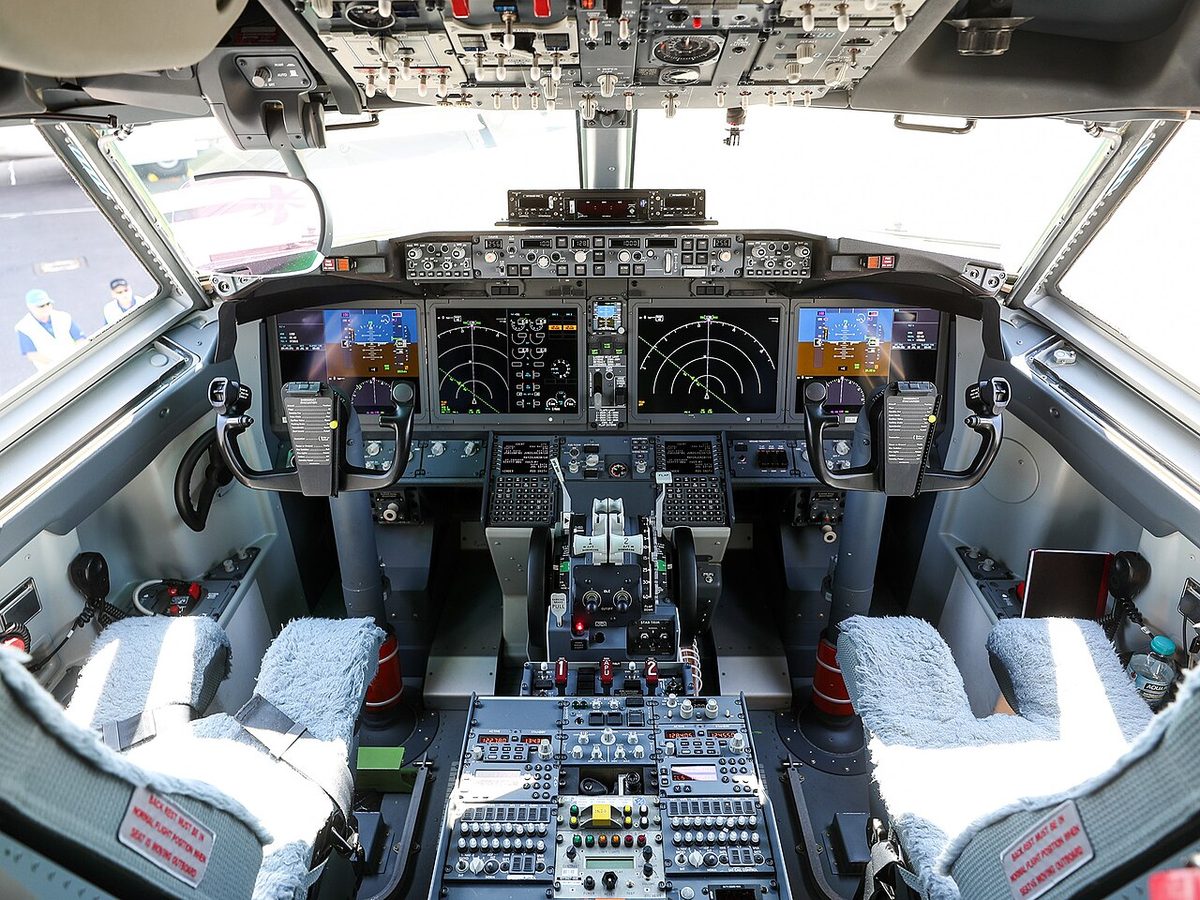
The cockpit voice recorder (CVR) records flight deck audio on four independent channels for 120 minutes, erasing older recordings automatically. One channel records the area microphone; the others record the ACP headset audio and transmissions of the two pilots and the observer. The general rules are in flight recorders.
On the most common variant the area microphone is activated when an engine is started or the VOICE RECORDER switch is set to ON. In AUTO the switch powers the recorder from the first engine start until 5 minutes after the last engine shutdown; ON powers it until the first engine start and then trips the switch back to AUTO.
The red ERASE switch, held for 2 seconds, erases all four channels, and works only on the ground with the parking brake set. Pushing TEST for 5 seconds flashes the STATUS light once, a momentary green meaning no fault was found, and a tone may be heard through a headset plugged into the HEADPHONE jack. Where a recorder independent power supply (RIPS) is fitted, it powers the CVR for 10 minutes after aircraft power is interrupted, by a normal shutdown or any other loss of power.
Frequently asked questions
What is ACP degraded mode on the Boeing 737?
Setting the ALT-NORM switch of an audio control panel to ALT puts that crew station's audio system into degraded mode. Only one radio remains for transmission and reception: VHF-1 at the captain's and the observer's stations, VHF-2 at the first officer's. The hand microphone cannot be used, the altitude alert, GPWS and windshear aurals are not heard on that system, and the passenger address cannot be reached through the ACP.
What is the remote electronics unit on the 737?
The captain's, first officer's and observer's audio systems are not inside the audio control panels. They are located in a common remote electronics unit (REU) in the electrical and electronic compartment, where they function independently and have separate circuit breakers. The audio control panel at each station is the control head that selects receivers, transmitters and volume for its own audio system.
Why should the top VHF antenna be used for ATC on the ground in a 737?
The VHF-1 antenna is on the upper fuselage, while the VHF-2 and VHF-3 antennas are on the lower fuselage. The lower antennas are susceptible to multipath interference from nearby structures or vehicles, which may disrupt communications. For that reason Boeing's operational information recommends the VHF radio connected to the top antenna for primary ATC communications on the ground.
Can both HF radios on the 737 be used at the same time?
Only for reception. The two HF radios share a common antenna, so while either of them is transmitting the antenna is disconnected from the other, which can then neither transmit nor receive. Both can receive simultaneously as long as neither is transmitting. HF must not be keyed while the aeroplane is being fuelled, because injury to personnel or fire can occur.
How long does the 737 cockpit voice recorder record?
The cockpit voice recorder records flight deck audio on four independent channels for 120 minutes, and anything older is erased automatically. One channel takes the area microphone; the others record the audio and transmissions of the two pilots and the observer. Where a recorder independent power supply is fitted, it keeps the recorder running for 10 minutes after aircraft power is lost or switched off.
Test yourself on B737 Communications
The v1prep banks cover this topic in the B737 type-rating bank, with a worked explanation for every answer. EASA ATPL, PPL, IR and CPL, the FAA written tests and A320/B737 type ratings.
Start practising →Sources and further reading
- FAA Flight Standardization Board Report, Boeing 737
- ICAO Annex 10, Aeronautical Telecommunications (Volume III, communication systems)
- 14 CFR 121.319, Crewmember interphone system
- 14 CFR 91.609, Flight data recorders and cockpit voice recorders
- SKYbrary, Aircraft Communications, Addressing and Reporting System (ACARS)
- SKYbrary, Controller Pilot Data Link Communications (CPDLC)
Library articles are written for study and exam preparation. They do not replace your aircraft's approved documentation, your operator's procedures or the regulations themselves.