Flight Recorders
Flight recorders are crash-protected recorders that preserve a record of an aircraft's flight for accident and incident investigation: the cockpit voice recorder captures flight deck audio and the flight data recorder captures flight parameters, fed through a data acquisition unit.
Flight recorders, popularly called black boxes, keep a record of what an aircraft did and what its crew heard and said, in a form that survives an accident. The cockpit voice recorder (CVR) captures the sound of the flight deck and the flight data recorder (FDR) the flight parameters. After an accident they are often the investigators' most important evidence, and after an incident they explain what the crew could not.
Around the crash-protected recorders sits a family of unprotected equipment that uses the same data every day: the units that collect it, the quick access recorder that makes it easy to download, and the condition monitoring systems that watch the engines and systems for maintenance. ICAO Annex 6 sets the international standards; in Europe the carriage rules are in the CAT.IDE part of the air operations regulation. See accident and incident investigation for how the recordings are used.
Purpose of flight recorders
The primary purpose is safety investigation. The recorders let investigators reconstruct the flight path, control inputs and system states, and hear the crew's conversation, alarms and radio calls. The same data serve secondary purposes: trend analysis of aircraft and engine performance, trouble-shooting of intermittent faults, and the operator's flight data monitoring programme.
The recorders are painted bright orange or yellow to be found among wreckage, and are normally installed at the rear of the aircraft, where the structure usually suffers least in an impact. The memory sits in a crash-protected case built to survive impact, fire and immersion; the Boeing 737 DFDR, housed behind an access door in the aft cabin ceiling, survives pressure to a depth of 20,000 ft (6,096 m).
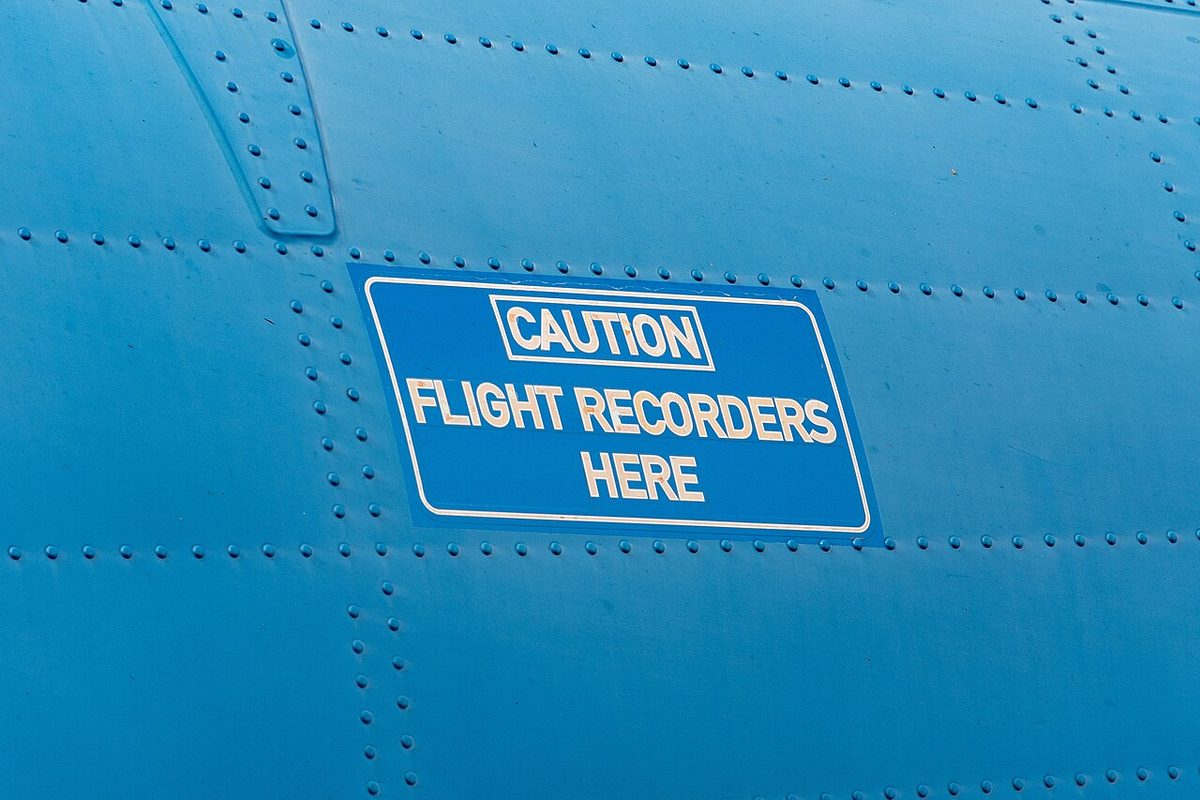
Their use is controlled. Under the EU air operations rules the commander ensures that the recorders are not switched off in flight. After an accident or serious incident the recordings must not be erased, the recorders are deactivated once the flight is completed, and the operator preserves the original data for 60 days unless the investigating authority directs otherwise. Cockpit voice recordings are further protected: apart from a safety investigation, the competent authority, the courts or a serviceability check, they may be used only under an operator procedure and with the prior consent of all the crew members and maintenance personnel concerned.
Cockpit voice recorder
The CVR records, on separate channels:
- voice communications transmitted and received by radio;
- the aural environment of the flight deck, picked up by an area microphone, including alarms, clicks and engine sounds;
- crew communication on the interphone and the passenger address;
- audio signals fed into the headsets and speakers.
On the Boeing 737 NG it has four channels and keeps 120 minutes: one channel for the area microphone and three for the pilots' and observer's audio. The A320 CVR has a four-track crash-protected recorder, a remote microphone behind the overhead panel and a hot mike function, which records each pilot's microphone even when the push-to-talk switch is not pressed.
| Aeroplane (EASA CAT) | Minimum CVR duration |
|---|---|
| All, since 1 January 2019 | The preceding 2 hours |
| Over 27,000 kg MCTOM, first CofA on or after 1 January 2021 | The preceding 25 hours |
| Older rule, ended 1 January 2019 | 30 minutes on many types |
The CVR must start automatically before the aircraft first moves under its own power and keep recording until the end of the flight. In practice it starts with the first engine, or with the electrical network: the A320's runs for the first 5 minutes after the aircraft is powered and with any engine running. It stops 5 minutes after the last engine is shut down. On the ground the crew can start it earlier, with the A320's GND CTL pushbutton or by selecting the 737's VOICE RECORDER switch to ON, which trips back to AUTO at the first engine start.
The ERASE function works only on the ground with the parking brake set, and the button must be held for about 2 seconds; some installations also require all engines stopped. The TEST button runs a built-in test and shows a good result on a status light or needle.
A recorder independent power supply (RIPS) keeps the CVR running after aircraft power is lost; on the 737 it provides 10 minutes. EASA requires such an alternate power source on aeroplanes over 27,000 kg first issued with a certificate of airworthiness on or after 5 September 2022. Aeroplanes with datalink equipment first issued with an individual certificate of airworthiness on or after 8 April 2014 must also record datalink messages under CAT.IDE.A.195.
Flight data recorder
The FDR, today usually a digital flight data recorder (DFDR), continuously records flight parameters with a time reference and, on most commercial aeroplanes, keeps at least the most recent 25 hours, overwriting the oldest data. It starts automatically before the aircraft can move under its own power, normally at the first engine start, and stops 5 minutes after the last engine is shut down. An EVENT button on the flight deck marks the recording so that analysts can find a moment quickly.
The basic parameters include time, altitude, airspeed, heading, pitch and roll attitude, normal acceleration, thrust or power on each engine, thrust lever position and flap, slat, spoiler and speedbrake configuration. Aeroplanes above 27,000 kg add primary flight control and trim positions, radio altitude, navigation data, flight deck warnings and landing gear position, and modern installations record far more. The A320's system comprises a flight data interface and management unit, the DFDR and a three-axis linear accelerometer.
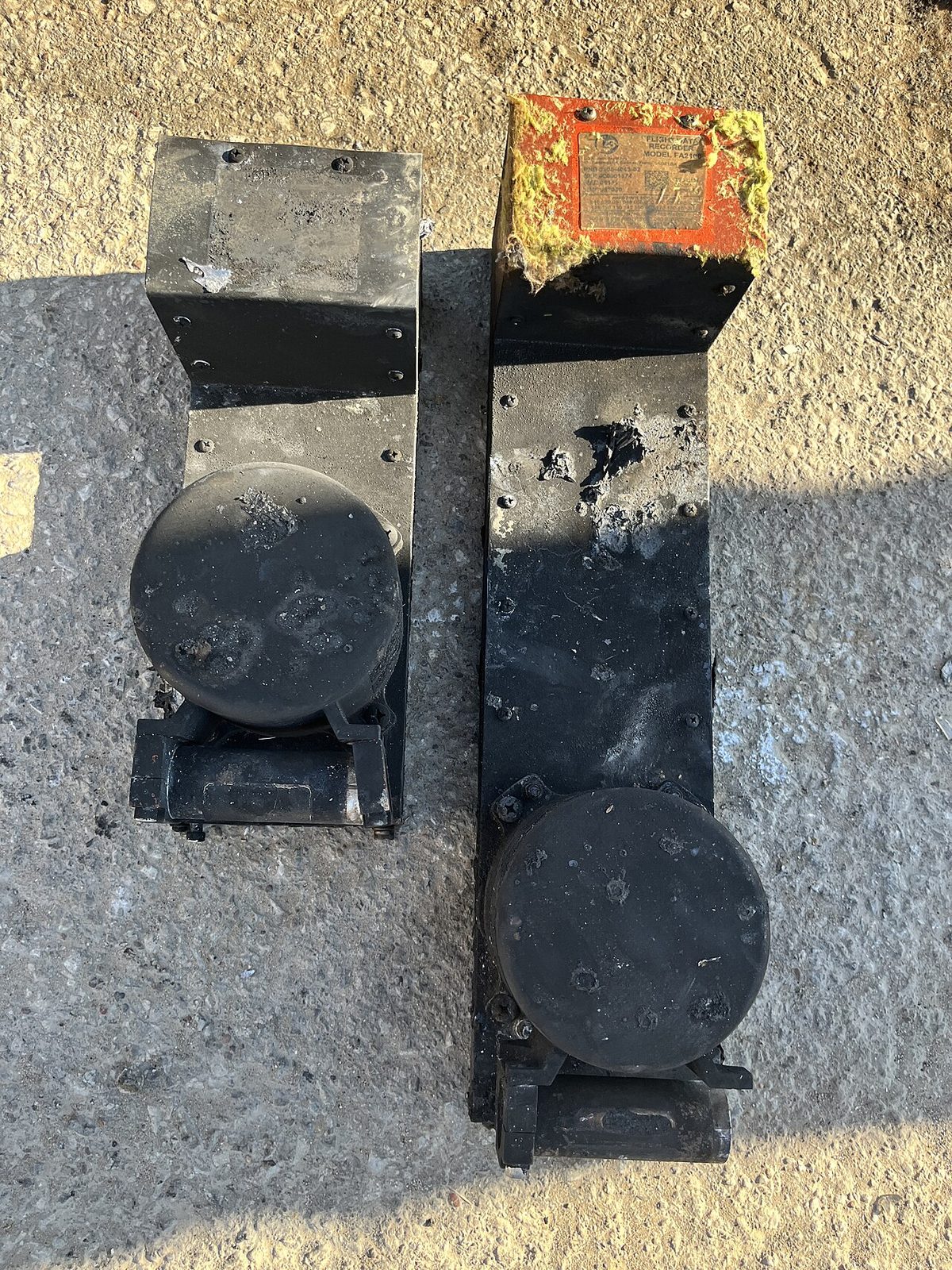
In Europe CAT.IDE.A.190 requires an FDR on commercial aeroplanes above 5,700 kg MCTOM and on multi-engine turbine aeroplanes with more than nine passenger seats, the engine type and the date of the first individual certificate of airworthiness deciding the details. Part-NCO imposes no flight recorder carriage requirement. In the United States 14 CFR 91.609, together with the Part 121 and 135 rules, sets the equivalent requirements.
Combined recorders
A combined voice and flight data recorder (CVFDR) puts both functions in one crash-protected unit. An aeroplane that needs only one of the two recorders may carry a single combination recorder. An aeroplane of more than 5,700 kg MCTOM that needs both may carry two combination recorders instead of a separate CVR and FDR, so that the loss of one unit still leaves both voice and data.
Data acquisition units
The FDR does not read the sensors itself. A flight data interface unit (FDIU) collects the parameters from the aircraft's computers and data buses, and from analogue sensors and discrete switches, converts them into a single digital data stream and sends it to the recorder (see avionics computers and data buses).
On larger aircraft the acquisition unit is part of an aircraft integrated data system (AIDS). A data management unit (DMU) collects and processes system data and compiles reports for storage and printing; part of the data goes to the FDR through the FDIU for the mandatory parameters, and the rest to a separate maintenance recorder. In some architectures a data interface and acquisition unit (DIAU) performs the collection and feeds the condition monitoring system.
Quick access recorder
The crash-protected FDR is not designed for everyday downloading. A quick access recorder (QAR) stores a copy of the flight data on unprotected, easily removable or downloadable media, usually in the electronics equipment bay. On the Boeing 737 it holds about 25 hours of the same information as the DFDR and gives maintainers quick access to it.
QAR data feed the operator's flight data monitoring (FDM) programme, which EASA requires for aeroplanes above 27,000 kg MCTOM and which must be non-punitive. The FAA's equivalent voluntary programme is Flight Operational Quality Assurance (FOQA), described in AC 120-82. Analysts look for exceedances such as unstable approaches, hard landings and warnings, and for trends, not for individuals to blame.
Underwater locator beacon
Each recorder carries an underwater locator beacon (ULB), also called an underwater locating device: a small cylinder clamped to the front of the unit and activated by immersion. It sends ultrasonic pulses at 37.5 kHz for at least 90 days, or 30 days on older units, so that ships and divers with hydrophones can find a recorder lying on the seabed. The Boeing 737 FCOM gives 30 days for most variants and 90 days for some.
The ULB is not an emergency locator transmitter. It does not transmit on the search and rescue frequencies of 121.5 or 406 MHz, and it works only under water; finding the aircraft on land or at sea is the task of the ELT (see emergency beacons).
Exam tip: know the numbers that are asked: CVR 2 hours (25 hours above 27,000 kg for aeroplanes first issued with a CofA from 1 January 2021), FDR 25 hours, start before the aircraft moves under its own power, stop 5 minutes after the last engine shutdown, ULB at 37.5 kHz for 90 days (30 on older units), recordings kept 60 days after an accident or serious incident.
Condition monitoring systems
An aircraft condition monitoring system (ACMS) uses the same stream of data for maintenance rather than investigation. On the Boeing 737 it monitors key engine and aircraft system performance in every phase of flight; the crew controls it through the MCDU, and its reports go to the printer or to the ACARS unit for downlink. Engine trend monitoring is a typical use. Related systems do the same at component level: the 737's airborne vibration monitoring displays the vibration of the engine rotors, and maintenance also uses it to balance the low pressure rotor.
Sending reports to the ground by ACARS lets an airline's maintenance control see an exceedance or a developing fault before the aircraft lands, order parts and plan the work, which shortens troubleshooting on the ground. Condition monitoring, the QAR and the crash-protected recorders therefore share one principle: the data an aircraft produces are recorded, and used, long before anything goes wrong.
Frequently asked questions
How long does a cockpit voice recorder record?
Under current EASA rules, CAT.IDE.A.185, every CVR on a commercial aeroplane must retain at least the last 2 hours of recording. Aeroplanes of more than 27,000 kg maximum certificated take-off mass first issued with a certificate of airworthiness on or after 1 January 2021 need 25 hours. Older CVRs kept only 30 minutes, a minimum that ended on 1 January 2019. The recording is a loop: the oldest audio is overwritten.
What is the difference between a flight data recorder and a quick access recorder?
The flight data recorder is the crash-protected, mandatory recorder kept for accident investigation, normally at the rear of the aircraft. A quick access recorder is an optional, unprotected recorder, usually in the electronics bay, that keeps a copy of the flight data on media that are easy to remove or download, for flight data monitoring and maintenance. On the Boeing 737 the QAR holds about 25 hours of the same data as the DFDR.
How long does the underwater locator beacon on a flight recorder transmit?
The underwater locator beacon clamped to each recorder is activated by immersion in water and sends ultrasonic pulses at 37.5 kHz for at least 90 days on current units and 30 days on older ones, so that ships and divers can find a recorder on the seabed. It does not transmit on the search and rescue radio frequencies; locating the aircraft itself is the job of the ELT.
Why are black boxes orange?
Despite the nickname, flight recorders are painted bright orange or yellow so that searchers can find them among wreckage or under water. They are normally installed at the rear of the aircraft, where the structure usually suffers least in an impact, and their memory is held in a case built to withstand impact, fire and deep-water pressure. The Boeing 737 DFDR, for example, survives pressure to a depth of 20,000 ft.
Can pilots erase the cockpit voice recorder?
Only on the ground. The erase function works only with the aircraft on the ground and the parking brake set, and the button must be held for about 2 seconds; some installations also require all engines stopped. It lets crews clear routine conversation after a normal flight. After an accident or serious incident the recordings must not be erased, and the recorders are deactivated after the flight so that the data are not overwritten.
Test yourself on Flight Recorders
The v1prep banks cover this topic in Instrumentation (022), with a worked explanation for every answer. EASA ATPL, PPL, IR and CPL, the FAA written tests and A320/B737 type ratings.
Start practising →Sources and further reading
- ICAO Annex 6, Operation of Aircraft, Part I, International Commercial Air Transport, Aeroplanes (flight recorders)
- EASA Easy Access Rules for Air Operations (Regulation (EU) No 965/2012), CAT.IDE.A.185 to 200, CAT.GEN.MPA.105 and CAT.GEN.MPA.195
- AIP France, GEN 1.7, Differences from ICAO Standards, Recommended Practices and Procedures (Annex 6, Part I, flight recorders)
- 14 CFR 91.609, Flight data recorders and cockpit voice recorders
- FAA AC 120-82, Flight Operational Quality Assurance
Library articles are written for study and exam preparation. They do not replace your aircraft's approved documentation, your operator's procedures or the regulations themselves.