Aircraft Interphone and Audio Systems
An aircraft's audio and interphone systems route every radio, navigation audio and intercom channel to the crew's headsets and loudspeakers, and link the flight deck with the ground crew, the cabin crew and the passengers through the flight, service and cabin interphones and the passenger address system.
Every voice on an airliner passes through its audio system. The external radios, VHF, HF and satellite, carry the aircraft's traffic with the outside world, but inside the aircraft a second set of networks connects the pilots with each other, with the engineer at the nose during push-back, with the cabin crew and with the passengers. Airbus lists them as the flight, cabin and service interphones and the passenger address; Boeing's 737 groups the radios, the interphones, the cockpit voice recorder and the crew alerting under one communication system.
Many everyday problems start here: a transmission sent on the wrong radio, a missed cabin call, a howl from the loudspeaker, a microphone left transmitting. Knowing how audio is routed lets a crew find the fault quickly, and use the systems as intended in a depressurisation or an evacuation.
Audio control panels
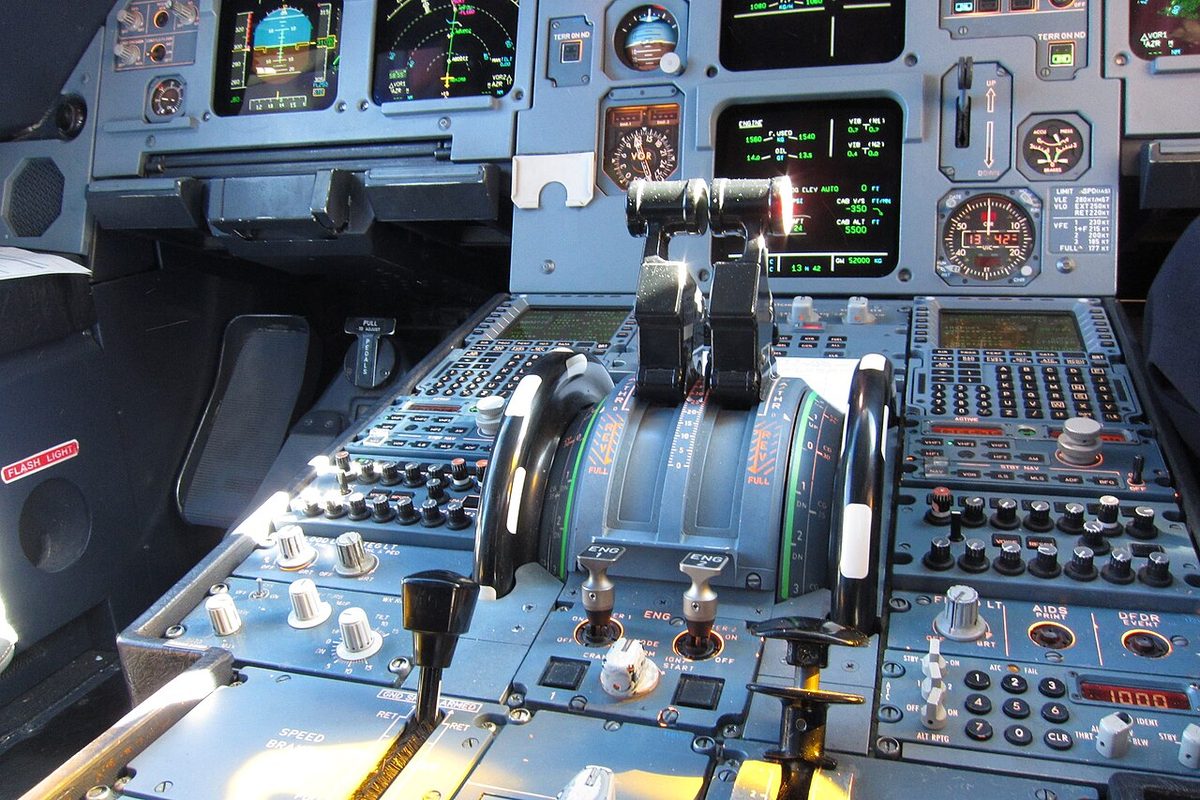
Each crew station has an audio control panel (ACP), called the audio selector panel (ASP) in European operating rules, which require one accessible to each required flight crew member for IFR operations. The panel does two separate jobs:
- Reception: a knob or key for each radio, interphone and navigation receiver switches its audio on and sets its volume. Several can be selected at once.
- Transmission: a row of keys selects the one system that the microphone will key, whether a VHF or HF radio, the flight interphone, the cabin interphone or the passenger address. Selecting a second key deselects the first.
The panel also shows calls: on the A320 a transmission key flashes for an incoming SELCAL, the INT key for a call from the ground crew and the CAB key for a call from the cabin. A voice filter suppresses the Morse identifiers of VOR and ADF so that voice can be heard; Boeing's version offers voice, range or both.
On the A320, tuning and listening are split. The radio management panels set the frequencies; the audio management unit (AMU) takes the audio of every system and distributes it to the three ACPs. A radio can therefore be tuned and not heard, or heard and not keyed, which is the first thing to check when a call goes unanswered. Aural warnings bypass the volume controls: the A320's loudspeaker knobs do not affect aural alerts, and on the 737 ground proximity, altitude alert, TCAS and predictive windshear warnings sound at preset volumes that the crew cannot adjust or turn off.
Each type has a way round a failed panel or audio channel:
| Type | Control | Effect |
|---|---|---|
| A320 | AUDIO SWITCHING selector to CAPT 3 or F/O 3 | The pilot uses the third occupant's ACP with their own acoustic equipment; AUDIO 3 XFRD shows on ECAM |
| Boeing 737 | ALT-NORM switch to ALT (degraded mode) | Captain and observer keep VHF-1, first officer VHF-2; no hand microphone; warnings not heard on that side |
| E190-E2 | ACP backup (BKUP) mode | Left pilot keeps VHF 1, right pilot VHF 2 |
Flight interphone
The flight interphone is the private voice network of the flight deck. On the Boeing 737 it is an independent system whose purpose is communication between the flight crew without intrusion from the service interphone; on the A320 it is hosted by the audio management units. The pilots use it through their boomsets, hand microphones or oxygen mask microphones, so that they can talk to each other in a noisy flight deck or with masks on. For commercial air transport, EASA requires a flight interphone system, with headsets and microphones for every flight crew member, in any aeroplane operated by more than one flight crew member (CAT.IDE.A.170).
The same network reaches outside the aircraft. The ground engineer who supervises push-back and engine start plugs a headset into a jack at the nose, at the external power receptacle on the 737 or on the nose gear maintenance panel on the A320, and joins the flight interphone, heard on the INT channel.
Service interphone and ground call
The service interphone system links jacks at servicing points around the airframe, used by maintenance and ground staff, with each other and with the flight deck; the A320 has seven such jacks. The external jacks are not always live. On the 737 a SERVICE INTERPHONE switch activates them; at OFF the external jacks are dead but the flight deck can still talk to the flight attendants, whose stations are on the same system. On the A320 the jacks become usable 10 seconds after landing with the landing gear locked down; if the gear is not locked down, the SVCE INT OVRD button makes them live.
Calls between flight deck and ground use a horn and lights, because the engineer may not be wearing a headset:
- the flight crew call the ground with the A320's MECH button, which sounds a horn outside and lights a blue COCKPIT CALL light at the external power panel, or the 737's GRD CALL switch, which sounds the ground call horn in the nose wheel well;
- the ground calls the flight deck from a button at the external power panel, which gives a chime on the 737, and on the A320 a buzzer with the MECH light and INT key flashing on the ACPs.
On the 737 the same nose wheel well horn also alerts ground staff to an equipment cooling overheat while the aircraft is on the ground.
Cabin interphone and crew call
The cabin interphone lets the flight crew talk to the cabin crew, and the cabin crew stations talk to each other. On the A320 the crew select CAB on the ACP and speak through the boom, mask or hand microphone; the cabin system, including interphone and passenger address, is managed by the cabin intercommunication data system (CIDS). In commercial air transport EASA requires a crew member interphone system in aeroplanes with a maximum certificated take-off mass over 15,000 kg or more than 19 passenger seats (CAT.IDE.A.175); the FAA sets the threshold at a seating capacity of more than 19 passengers and requires the interphone to work independently of the passenger address, apart from handsets, headsets, microphones, selector switches and signalling devices (14 CFR 121.319).
The cabin crew call system attracts attention before anyone speaks:
| Call | Airbus A320 | Boeing 737 |
|---|---|---|
| Flight deck to cabin | CALLS panel: pink lights at the station, CAPTAIN CALL on its panel, high-low chime | ATTEND switch: two-tone chime, pink master call lights |
| Cabin to flight deck | ATT lights flash on the ACPs, buzzer | Blue call light, single high chime |
For an emergency, the A320's guarded EMER button makes the pink lights flash at every station, shows EMERGENCY CALL and sounds three high-low chimes. Cabin master call lights use colour: on the 737, pink for a crew call, blue for a passenger seat call and amber for a lavatory call. The E190-E2 gives a single high-low chime with a green light for a cabin call and a triple high-low chime with a red light for an emergency call. The A320's call buzzer on the flight deck is inhibited during take-off and landing, and the FAA's sterile flight deck rule (14 CFR 121.542) bars non-essential activities and communications, including those between cabin and flight deck, during taxi, take-off, landing and all flight below 10,000 ft except cruise.
Passenger address and PRAM
The passenger address (PA) system, also called the public address in FAA rule titles, broadcasts to loudspeakers in the cabin, galleys and lavatories. The flight crew reach it through the ACP, by pressing and holding the PA key and speaking into the boomset, mask or hand microphone with no push-to-talk needed on the A320, or through a dedicated handset or PA microphone. On the A320 a PA IN USE light shows when the PA is in use from the cockpit or the cabin. EASA requires a PA in aeroplanes with more than 19 passenger seats (CAT.IDE.A.180); the FAA sets the same threshold and requires it to be accessible for immediate use from two flight crew stations (14 CFR 121.318).
Inputs have priorities. On the 737, a flight crew announcement comes first and pre-empts music and any announcement in progress; flight attendant handsets come second; the pre-recorded announcement and music (PRAM) system third, with manual messages ahead of automatic ones and both ahead of music. Some announcements are automatic: when the passenger oxygen masks drop, the A320 PA plays pre-recorded instructions, and on the 737 a single low chime sounds in the cabin whenever the fasten belt or no smoking signs come on or go off. In an emergency descent the PA is one of the first things the crew use, to warn the cabin (see decompression).
Microphones, headsets and push-to-talk
The flight deck has three kinds of microphone:
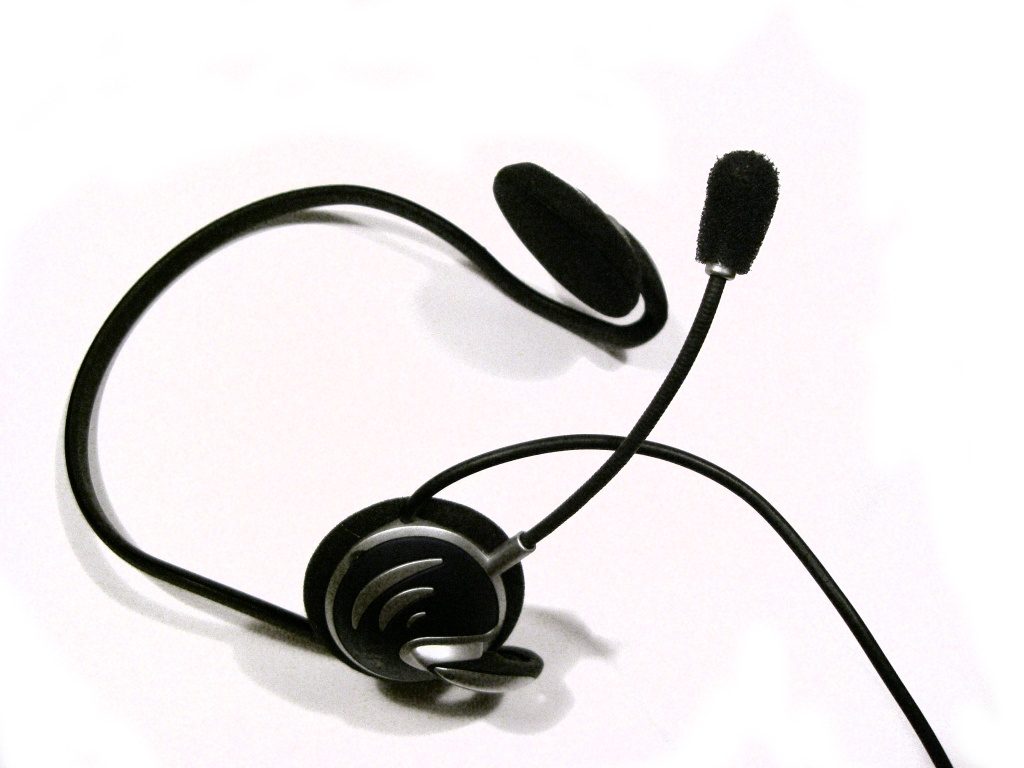
- the boom microphone, on an arm from a headset; the combination is a boomset;
- the hand microphone, with its own switch;
- the oxygen mask microphone, built into each crew mask.
A mask microphone takes over when the mask is in use, in a way that varies by type. On most 737s the mask microphone is enabled and the boom disabled as soon as the left oxygen mask stowage door opens, and the boom returns only when the door is closed and the RESET/TEST switch pushed; on the E190-E2, OXY AUTO selects the mask microphone and turns the loudspeakers on when the mask leaves its box. On the 737, a pilot who cannot be heard on the boom microphone after the mask panel door has been opened should suspect that the mask microphone is still selected.
A push-to-talk (PTT) switch on the sidestick or control wheel keys the microphone. On the A320 the sidestick selector transmits through the system chosen on the ACP when squeezed and leaves boom and mask microphones dead when released. On the 737 the control wheel switch has two positions: RADIO transmits through the selected system, INT goes straight onto the flight interphone, bypassing the selector. Speaking with the microphone touching the lips, or too close to them, distorts the voice (see radiotelephony transmitting technique). Headsets also protect hearing: noise-induced hearing loss is permanent and starts around 4 kHz, above the speech range, so it goes unnoticed for years.
Hot mike and acoustic feedback
A hot microphone, or hot mike, is live without the PTT being pressed. On the A320 the INT/RAD switch does this: at RAD it transmits only while held, but at INT it latches and leaves the microphone live on the interphone, so the pilots can talk hands-free. The emergency descent procedure asks the crew to establish communication with their oxygen masks on, but to avoid continuous interphone use, because the mask microphones also transmit breathing noise. If the sidestick RADIO switch is squeezed while INT is selected, the radio takes priority. The cockpit voice recorder uses the same principle, taking each crew microphone hot so that speech is recorded whether or not anyone transmits (see flight recorders).
A hot mike is useful on the interphone and harmful on a radio. A PTT jammed in the transmit position, or a transmit selection left on, is a stuck microphone: the carrier blocks the frequency, and total silence on a busy frequency is the classic symptom (see radio communication failure).
Acoustic feedback, the Larsen effect, is the howl heard when a microphone picks up the output of a loudspeaker and feeds it back. It can occur when mask microphones are live with the cockpit loudspeakers on: the 737's flight deck speakers are muted while a pilot transmits with the push-to-talk, but not for oxygen mask microphone operation, and on the E190-E2 taking a mask out of its box turns the speakers on. Airbus tells crews to reduce the loudspeaker volume, while keeping it loud enough to hear the radio.
On-board mobile telephony
An onboard mobile telephony system (OMTS) lets passengers use their own phones in flight. A small base station in the cabin serves the phones, a network control unit stops them from registering with networks on the ground, and the traffic goes out by satellite. Airbus documents call it the GSM Onboard System, after the GSM mobile standard. The industry standard for such systems is ARINC 824.
On the A320, use is prohibited below 3,000 m (about 10,000 ft) above ground and in some geographical areas, and the system switches itself off when it detects those conditions. Phones may not be used in the lavatories or on the flight deck. The flight crew can shut the system down with the MOBILE COM button on the overhead panel, but it takes about 4 minutes to disconnect: the ECAM shows GSM DISC < 4 MN, then NO MOBILE, and passengers can keep calling in the meantime. Crew devices follow separate rules; the FAA, for instance, restricts airline pilots' use of personal wireless devices and laptops at their duty stations during flight time (14 CFR 121.542).
Frequently asked questions
What is the difference between flight, service and cabin interphone?
The flight interphone is the private network of the flight deck, used between the pilots and with a ground engineer plugged in at the nose during push-back. The service interphone links jacks around the airframe used by maintenance and ground staff, and on some types the cabin crew stations. The cabin interphone links the flight deck with the cabin crew stations and the stations with each other. The passenger address is separate again, a one-way broadcast to the cabin.
What does an audio control panel do?
The audio control panel, called the audio selector panel in European operating rules, is where each pilot chooses what to hear and where to transmit. Reception knobs switch on and set the volume of each radio, interphone and navigation receiver, several at a time. Transmission keys select the one system the microphone keys, whether a VHF or HF radio, the interphone, the cabin or the passenger address. Call lights on the panel show SELCAL, cabin and ground calls.
What is a hot mike on an aircraft?
A hot mike is a microphone that is live without the push-to-talk switch being pressed. Crews can select it on the interphone to talk hands-free, although Airbus asks crews wearing oxygen masks to avoid continuous interphone use because of the breathing noise. The cockpit voice recorder also takes each crew microphone hot. A microphone must never be left transmitting on a radio, because that is a stuck microphone, which blocks the frequency for everyone.
What is the Larsen effect in the cockpit?
The Larsen effect is acoustic feedback, the howl produced when a microphone picks up a loudspeaker's output and feeds it back into the loudspeaker. On the flight deck it can occur when oxygen mask microphones are live with the cockpit loudspeakers on, since on the Boeing 737, for example, the speakers are not muted for mask microphone operation. Airbus tells crews to reduce the loudspeaker volume, while keeping it loud enough to hear the radio.
What has priority on the passenger address system?
On the Boeing 737, a flight crew announcement made through the audio control panel or the flight deck PA microphone has the highest priority and pre-empts music and any announcement in progress. Flight attendant handset announcements come second, and the pre-recorded announcement and music system (PRAM) third, with manual messages ahead of automatic ones and both ahead of music. An announcement from the flight deck therefore takes precedence over everything else on the PA.
Can passengers use mobile phones in flight?
Only through an approved on-board mobile telephony system, which lets phones connect to a small base station in the cabin instead of ground networks and routes the calls by satellite. On the A320 its use is prohibited below 3,000 m (about 10,000 ft) above ground, in some geographical areas, in the lavatories and on the flight deck, and the system switches itself off when it detects a prohibited condition. The flight crew can also shut it down from the overhead panel.
Test yourself on Aircraft Interphone and Audio Systems
The v1prep banks cover this topic in Communications (090), with a worked explanation for every answer. EASA ATPL, PPL, IR and CPL, the FAA written tests and A320/B737 type ratings.
Start practising →Sources and further reading
Library articles are written for study and exam preparation. They do not replace your aircraft's approved documentation, your operator's procedures or the regulations themselves.