ACARS and Aircraft Datalink
ACARS (Aircraft Communications Addressing and Reporting System) is a digital datalink that exchanges short addressed text messages between aircraft and ground systems, above all between airlines and their aircraft, over VHF, HF or satellite links operated by datalink service providers such as ARINC and SITA.
Datalink is the exchange of messages between an aircraft and the ground as digital data rather than speech. A message sent from the ground to the aircraft is an uplink, one sent from the aircraft to the ground a downlink, whether the aircraft is parked at the gate or in cruise. The oldest and still the most widespread system is ACARS, which airlines first used to automate routine reports to their operations centres and which now also carries departure clearances, ATIS broadcasts and, on many long-haul aircraft, the controller-pilot messages of FANS 1/A.
For the crew, datalink turns part of the radio workload into text: clearances that can be read twice, printed and loaded into the flight management system, and company messages that no longer need a voice frequency. It brings its own discipline too, because a message can be delayed, misaddressed or misread like any other, and because the rules on which messages may be trusted, and how they are acknowledged, differ from one application to the next.
What datalink is
Voice radio has well-known weaknesses. Many aircraft share one frequency and only one station can talk at a time; accents and language cause misunderstandings; VHF channels are scarce and reach only to the radio horizon, about 200 NM for an aircraft at FL300; and HF, which reaches much further, is noisy and tiring to monitor. Beyond VHF range, crews traditionally passed position reports to a radio operator who relayed them to the controller. Data link communications answer these weaknesses: each message is addressed to one aircraft or ground system, can be queued and stored, and arrives in a fixed format that computers can read.
The traffic is divided by purpose. Air traffic services communications pass between aircraft and ATS units: clearances, requests and reports. Aeronautical operational control (AOC) communications pass between an aircraft and its operator, which needs them to exercise operational control of the flight, and aeronautical administrative communications carry the operator's business traffic. The A320 operating manual makes the same split between AOC applications, used with the airline's operations centre, and ATC applications, used with air traffic control centres. Some messages go automatically, with no crew action; others are composed, read and answered by the crew on a control and display unit.
ACARS
ACARS, the Aircraft Communications Addressing and Reporting System (Boeing's manuals expand it as the ARINC Communications Addressing and Reporting System), is an addressable digital datalink: each message carries the address of the aircraft or ground system for which it is meant, and the network delivers it there. It was designed by ARINC to automate routine exchanges between aircraft and their airlines that had until then been made by voice.
The classic example is the set of OOOI times: OUT of the gate, OFF the ground, ON the ground and IN at the gate. The aircraft's own systems detect each event and downlink the time without crew action, so that the airline can follow its fleet, gates, crew duty time and fuel as the day unfolds.
Coverage grew with the aircraft's needs. ACARS began on VHF; satellite links through geostationary Inmarsat satellites were added in the 1990s for oceanic and remote areas; and because those satellites cannot be seen above about 80° of latitude, the service was extended to HF in 2001 to close the polar gap.
ACARS was built for airline messages, and aircraft certification reflects that. The Boeing 737 flight manual, for example, limits ACARS to messages that would not create an unsafe condition if improperly received. It allows pre-departure clearances, digital ATIS, oceanic clearances, weight and balance and take-off data only when they are verified by approved operational procedures. Data that arrives by ACARS is therefore checked, as the operator's procedures require, before it is used.
Service providers: ARINC and SITA
Aircraft do not talk to their airline directly. A datalink service provider (DSP) operates the ground stations, satellite gateways and the network behind them, and routes each downlink to the airline's host computer or to the ATS unit concerned, and each uplink back to the aircraft. Two providers operate worldwide networks:
- ARINC (Aeronautical Radio, Incorporated), founded in the United States and now part of Collins Aerospace;
- SITA (Société Internationale de Télécommunications Aéronautiques), set up by airlines in 1949 to share their communications networks.
An airline contracts with one or more providers and loads a list of them into the aircraft, which scans for a usable ground station in the airline's order of priority. Each provider's VHF network uses its own frequencies; in Airbus documentation, ARINC's European network appears as ARINC EUROPE on 131.825 MHz. Airbus tells crews not to change the scan selection unless instructed to: the aircraft may lose its VHF datalink, and traffic routed through another provider can raise the airline's charges.
The communications management unit
On board, a communications management unit (CMU) controls the datalink and selects the frequencies of the data radio. On the A320 the job is done by the air traffic service unit (ATSU), which hosts the airline (AOC) and ATC applications and the router, selects the VHF frequency from the aircraft's position and the airline's scan list, and automatically chooses the best available medium among VHF, HF and satellite. Where VHF coverage exists it is normally used; elsewhere the system turns to satellite or HF.
The crew work with datalink through:
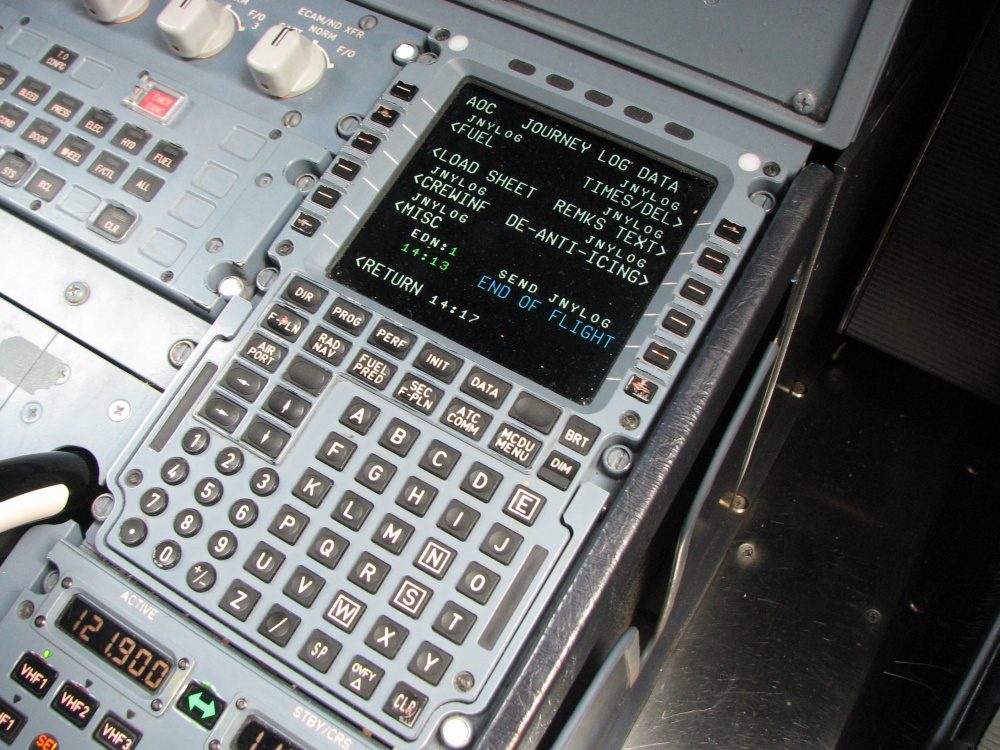
- the MCDU (multipurpose control and display unit) or the FMS control display unit, on which AOC pages are called up, messages written and uplinks loaded;
- on Airbus aircraft with ATC datalink, a datalink control and display unit (DCDU) in front of each pilot for ATC messages;
- a printer, for a paper copy of clearances and weather;
- attention-getters: a chime, a light or a memo, such as ACARS CALL on the A320's ECAM, which appears when the ground has asked for a voice call on VHF.
The data radio is normally one of the VHF sets, dedicated to it. The A320 keeps VHF 3 for ACARS, VHF 1 for ATC and VHF 2 for ATIS and company frequencies, and its manual forbids using VHF 3 for voice with ATC unless VHF 1 and VHF 2 are both inoperative. When VHF 3 is set to voice, VHF datalink stops and the ECAM shows VHF 3 VOICE. The E190-E2 likewise uses VHF 3 for ACARS.
In Europe, CAT.IDE.A.195 requires datalink communications to be recorded on datalink-equipped aeroplanes first issued with an individual certificate of airworthiness on or after 8 April 2014, a date limit that the French AIP lists among its differences from ICAO (see flight recorders).
VHF data link and HF data link
The original ACARS radio link is a character-oriented VHF channel, limited like VHF voice to line of sight. VHF data link (VDL) is the family of ICAO-standardised digital VHF links that followed. Its Mode 2, VDL Mode 2, carries ACARS traffic and is also the subnetwork of the Aeronautical Telecommunication Network (ATN) used for controller-pilot datalink in Europe: the French AIP notes that datalink in Europe implements only the VDL Mode 2 subnetwork. In the United States, domestic CPDLC also uses multi-frequency VDL Mode 2 radios.
HF data link (HFDL) carries ACARS messages over HF radio, using sky-wave propagation to cover oceans, remote land and the polar regions. The data frequency is tuned automatically. On the A320 the crew can switch an HF set between data and voice on the radio management panel, and HF data serves as an alternative when neither VHF nor satellite is available.
| Link | Coverage | Typical use |
|---|---|---|
| VHF (original ACARS, VDL Mode 2) | Line of sight, about 200 NM at FL300 | Over land and near coasts; the normal choice where available |
| Geostationary satellite (SATCOM) | Global except the polar regions above about 80° latitude | Oceanic and remote areas; voice as well as data |
| HF data link | Worldwide, including the polar regions | Where VHF and satellite are unavailable; subject to HF propagation |
Operational control messages
Most ACARS traffic is operational control communications between the aircraft and the operator's operations control centre, dispatch and maintenance. Each airline designs its own AOC applications with its service provider, so the pages differ from one operator to the next, but the A320 manual lists typical preflight functions: the flight log, departure and take-off delay messages, weather and NOTAM requests and loadsheet requests. The same channel carries position and fuel reports, en-route weather, arrival information and journey log data.
The flight management computer takes part too. On the Boeing 737, company datalink can downlink data from the FMC manually or automatically, and uplink data from a ground station into the FMC; most uplinks need a crew selection before they are used. On the A320, an AOC flight plan can be uplinked into the secondary flight plan, where the crew review and modify it. Loadsheets and take-off data may also arrive by ACARS, which is why operators prescribe cross-checks against the flight documents and between the pilots.
The ground can also ask the crew to call: on the A320 a COMPANY CALL or ACARS CALL memo appears when a message requests voice contact on VHF. Datalink complements company voice frequencies and operational control; it does not replace them.
Pre-departure and departure clearances
Clearance delivery lends itself to datalink: long route clearances and their readbacks congest the delivery frequency and invite errors, and the FAA's AIM names both problems among the reasons for its datalink clearance services.
In the United States, many towers have the Terminal Data Link System, with two functions. A pre-departure clearance (PDC) goes from the tower to the airline or its service provider, which forwards it to the aircraft by ACARS or, for aircraft without datalink, to a printer at the departure gate. A PDC needs no acknowledgement or readback. An aircraft filing several flight plans receives only one PDC per departure airport within an 18-hour period, and a clearance revised before delivery is given by voice instead. A CPDLC departure clearance (CPDLC-DCL) is uplinked from the tower through the FANS avionics, requires a response from the crew and can carry revised clearances. It needs a logon to the FAA's national data authority, KUSA; operators need a CPDLC/FANS authorisation and must show the capability in Items 10a and 18 (DAT/) of the flight plan. Both services are for subscribers only, and the AIM encourages pilots to call clearance delivery whenever an automated clearance raises a question.
In Europe the equivalent is the departure clearance (DCL) service, published in each aerodrome's AIP entry. At Toulouse-Blagnac, for example, the crew initiate the request 10 minutes before the scheduled start-up time and must return the acknowledgement, the echo-back, within 3 minutes of the clearance; without a reply 3 minutes before start-up they call the delivery frequency. The request is not made if the planned flight does not follow the published SIDs and climb gradients. Unless the message says otherwise, the DCL is also the start-up clearance, and push-back and taxi are given on the ground frequency. Where collaborative decision making is in use, as at Lyon-Saint-Exupéry, the clearance request downlink is timed from the target off-block time.
Exam tip: a US PDC needs no readback, but a CPDLC-DCL and a European DCL must be acknowledged by datalink. Whichever route it takes, the crew compare the clearance with the flight plan and the FMS and query anything unexpected by voice.
ARINC 623 ATS applications
The European DCL, the oceanic clearance (OCL) and digital ATIS (D-ATIS) belong to a family of character-oriented ATS applications defined in the ARINC 623 standard and carried over the ACARS network, often shortened to ATS 623. Airbus offers them as optional applications of FANS A+ and FANS B+, the versions of its FANS packages that add ATS 623 applications and datalink recording. ATS 623 services deliver a clearance or information in response to a crew request. The exchange of clearances, instructions and requests with the controller in flight is done by voice or by CPDLC.
| Application | Network | Typical use |
|---|---|---|
| AOC applications | ACARS | Airline messages, OOOI times, loadsheets, weather |
| ATS 623: DCL, OCL, D-ATIS | ACARS | Departure and oceanic clearances, ATIS |
| FANS 1/A: CPDLC and ADS-C | ACARS | Oceanic and remote airspace |
| ATN B1: CPDLC | ATN over VDL Mode 2 | European upper airspace |
A D-ATIS received by datalink is an ordinary ATIS broadcast in text form. On first contact the crew still report the code letter, because the controller needs to know which edition they hold, however it reached them.
Datalink never removes the voice channel. Anything time-critical, and distress and urgency messages, normally go by voice, and any doubt about a datalink clearance is resolved by voice before it is followed (see radiotelephony transmitting technique).
Frequently asked questions
What is ACARS used for?
ACARS is a datalink used mainly between an aircraft and its airline. It sends the OOOI times (out, off, on, in) automatically and carries delay reports, weather and NOTAM requests, loadsheets, take-off data, flight plan uplinks and maintenance data. It also carries some air traffic services, such as departure clearances, oceanic clearances and digital ATIS, and the FANS 1/A controller-pilot messages used over the oceans. Safety-relevant data received by ACARS is verified before use.
What is the difference between ACARS and CPDLC?
ACARS is a message network, built originally for airline operational messages. CPDLC is an air traffic control application, a text dialogue between pilot and controller using standard message elements in place of routine voice clearances and requests. FANS 1/A CPDLC travels over the ACARS network, while the European ATN B1 version uses the Aeronautical Telecommunication Network over VHF Data Link Mode 2. CPDLC can therefore use ACARS, but ACARS is not itself CPDLC.
Does a pre-departure clearance need a readback?
In the United States a pre-departure clearance (PDC), delivered through the airline by ACARS or to a gate printer, needs no acknowledgement or readback. A CPDLC departure clearance does require a response from the crew, and so does the European departure clearance (DCL) service, where the crew return an echo-back within the time set in the aerodrome's AIP entry, 3 minutes at Toulouse-Blagnac. In every case the crew check the clearance against the flight plan and call delivery if anything is unclear.
Who are ARINC and SITA?
They are the two datalink service providers with worldwide networks. ARINC, Aeronautical Radio, Incorporated, was founded in the United States and is now part of Collins Aerospace. SITA, the Société Internationale de Télécommunications Aéronautiques, was set up by airlines in 1949 to share their communications networks. Both operate VHF ground stations and connect satellite and HF links, routing messages between aircraft, airlines and ATS units. Each airline sets the order in which its aircraft scan the providers.
What is HFDL and why is it used?
HF data link (HFDL) carries ACARS messages over HF radio. Sky-wave propagation takes HF far beyond VHF line of sight, so HFDL serves the oceans, remote land and above all the polar regions, where geostationary satellites cannot be seen above about 80 degrees of latitude. It was added to the ACARS service in 2001 to close that polar gap. The avionics tune the HF data frequencies automatically, and HF data is used when neither VHF nor satellite is available.
Test yourself on ACARS and Aircraft Datalink
The v1prep banks cover this topic in Communications (090), with a worked explanation for every answer. EASA ATPL, PPL, IR and CPL, the FAA written tests and A320/B737 type ratings.
Start practising →Sources and further reading
- SKYbrary, Aircraft Communications, Addressing and Reporting System (ACARS)
- FAA Aeronautical Information Manual, Chapter 5 Section 2 (5-2-2, Automated Pre-Departure Clearance Procedures)
- AIP France, AD 2 LFBO Toulouse-Blagnac (22.3.1, departure clearance data-link service)
- AIP France, GEN 1.7, Differences from ICAO Standards and Recommended Practices (Annex 6 data link recording, Annex 10 Volume III ATN)
- ICAO Doc 10037, Global Operational Data Link (GOLD) Manual (copy on SKYbrary)
- ICAO Annex 10, Aeronautical Telecommunications (Volume III, communication systems)
- EASA, Easy Access Rules for Air Operations (Regulation (EU) No 965/2012), CAT.IDE.A.195
Library articles are written for study and exam preparation. They do not replace your aircraft's approved documentation, your operator's procedures or the regulations themselves.