Controller-Pilot Data Link Communications (CPDLC)
Controller-pilot data link communications (CPDLC) is an air traffic control application in which controller and pilot exchange clearances, instructions, requests and reports as standard text messages over a data link instead of by voice, with voice kept as the backup and for anything time-critical.
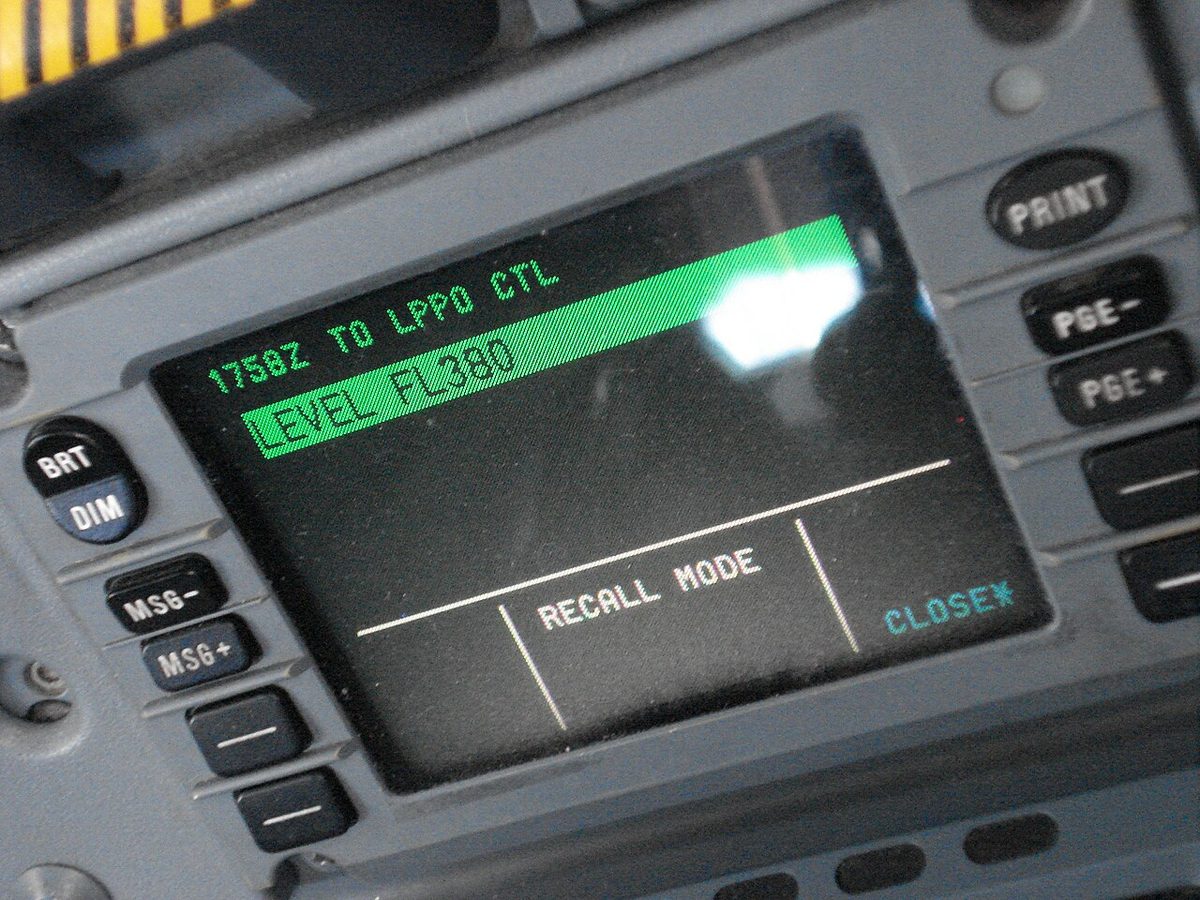
Controller-pilot data link communications (CPDLC) let a controller and a pilot exchange ATC messages as text. Instead of speaking a clearance and hearing it read back, the controller selects a standard message, the avionics display it on the flight deck, and the pilot answers with a standard response. The dialogue is logged at both ends, it does not occupy a voice frequency, and a route or level clearance can be loaded into the flight management system without being typed in.
CPDLC began over the oceans, where it replaced HF voice relayed through radio operators, and has spread to busy continental airspace: European upper airspace, where aircraft flying IFR above FL285 must be equipped for it, and the United States, where the FAA's Data Comm programme delivers departure clearances and en-route messages. Everywhere, voice remains available and takes over for anything urgent. Knowing when to leave the screen and pick up the microphone is as much a part of CPDLC as the logon.
What CPDLC is
CPDLC is one of the applications carried by aircraft datalink (see ACARS and aircraft datalink). Messages are built from a fixed set of message elements, defined in ICAO's PANS-ATM (Doc 4444) and its Global Operational Data Link (GOLD) Manual, Doc 10037. An uplink message element goes from the ground to the aircraft, such as UM117 CONTACT (unit) (frequency); a downlink element goes from the aircraft to the ground, such as DM20 REQUEST VOICE CONTACT. Free text elements exist for anything the standard set cannot express.
Each element carries a response attribute that tells the crew how to answer:
| Attribute | Crew responses | What closes the dialogue |
|---|---|---|
| W/U | WILCO, UNABLE, STANDBY | WILCO or UNABLE |
| A/N | AFFIRM, NEGATIVE, STANDBY | AFFIRM or NEGATIVE |
| R | ROGER, UNABLE, STANDBY | ROGER (FANS 1/A aircraft cannot send UNABLE here) |
| N | None | Nothing is required |
STANDBY tells the controller the message has been seen but keeps it open. ROGER is the only correct answer to an uplink free text message. The avionics add technical responses such as NOT CURRENT DATA AUTHORITY when a message comes from a unit that is not controlling the flight. Some messages close themselves: an instruction to report levelling at FL310 stays open until the aircraft levels, when the avionics send the report.
The FAA's en-route service shows the range: altimeter settings, transfer of communications, initial contact, route clearances including airborne reroutes, level and speed assignments, crossing constraints, holding, and advisory and emergency messages. In the United States an altimeter setting received by CPDLC is not to be used for an instrument approach.
The gains are fewer blocked and misheard transmissions, no readback errors on long route clearances, less frequency congestion and, over the oceans, direct contact with the controller instead of a relay. The costs are time and attention. A message and its answer take longer than a quick voice exchange, the reply depends on someone reading a screen, and a clearance read on a display can be misread as easily as one heard. CPDLC therefore suits strategic, non-urgent traffic.
Because messages are time-stamped, the aircraft clock must be accurate: Airbus requires UTC to within ±1 second for ATC datalink and warns that a wrong time can cause messages to be rejected or obsolete ones to be accepted. Airbus crews therefore do not set the clock by hand for FANS operations.
FANS 1/A
The Future Air Navigation System (FANS) was ICAO's concept for communication, navigation and surveillance by satellite and data link. Boeing's implementation is called FANS-1 and Airbus's FANS-A; the two work together and are known jointly as FANS 1/A, which bundles three applications:
- ATS facilities notification (AFN), the logon that tells a ground system the aircraft exists and what it can do;
- CPDLC;
- ADS-C, automatic dependent surveillance by contract, in which the FMS reports position and intent to the ATS units the aircraft is connected to (see ADS-B and ADS-C).
FANS 1/A messages travel over the ACARS network, by VHF, satellite or HF data link, so they work far from any ground station. That makes FANS 1/A the standard of oceanic and remote airspace. Direct pilot-controller messages replace position reports relayed through HF radio operators, and with RNP 4 navigation and ADS-C they allow much smaller oceanic separation minima than voice position reports (see separation standards). On the North Atlantic, the data link mandate requires FANS 1/A CPDLC and ADS-C, or equivalent, between FL290 and FL410 inclusive (see oceanic operations).
FANS 1/A has limits that the GOLD Manual and the AIM spell out. Its message set differs in places from PANS-ATM: most emergency downlinks carry the attribute N, no response required, on FANS 1/A aircraft, whereas PANS-ATM expects a response, so ATC must acknowledge a MAYDAY by other means.
ATN and protected-mode CPDLC
The Aeronautical Telecommunication Network (ATN) is ICAO's own digital network for air-ground and ground-ground communications. Its first operational package, ATN Baseline 1 (ATN B1), was deployed in Europe under the name LINK 2000+ and provides four data link services:
- DLIC, data link initiation capability, the logon;
- ACM, ATC communications management, for transfers between sectors;
- ACL, ATC clearances, requests and reports;
- AMC, ATC microphone check, which lets a controller tell every connected aircraft to check that its microphone is not stuck when a carrier blocks the frequency.
ATN B1 uses protected mode CPDLC (PM-CPDLC), which adds an application-level integrity check to each message, covering the flight identification, to protect against corruption and against a message being delivered to the wrong aircraft. In Europe it runs only on the VDL Mode 2 subnetwork, and ADS-C is not provided over the ATN. Airbus calls the package FANS B, for high-density continental airspace, and aircraft fitted with both standards use FANS 1/A over the ocean and ATN B1 over Europe.
The certification basis sets how far the crew may rely on it. The Boeing 737 flight manual, for instance, states that its PM-CPDLC installation is intended for the cruise phase only and for non-critical messages.
Logon and ATS facilities notification
Nothing flows until the aircraft has a connection. The crew start with a CPDLC logon, entering the logon address of the ATS unit, its four-letter ICAO location indicator, and the flight identification exactly as filed in Item 7 of the flight plan. The ground system matches the logon to the filed flight plan, using the aircraft identification and registration; a wrong indicator simply produces a failed logon rather than a connection to the wrong unit. The flight plan must also declare the capability: J1 in Item 10a for ATN B1 over VDL Mode 2, and J2 to J7 for FANS 1/A over the various HF, VHF and satellite links.
On FANS 1/A aircraft the logon is the ATS facilities notification (AFN):
- The aircraft sends an AFN contact with its address and application capabilities.
- The ground system acknowledges it.
- The ground system sends a CPDLC connection request.
- The aircraft replies with a connection confirm, and the connection is open.
Only the current data authority, the unit controlling the flight, can exchange CPDLC messages with it. Before the boundary it nominates the next data authority, which connects in advance; at the transfer the first connection ends and the second becomes active. These hand-offs are automatic, so a manual logon is needed only at first contact, on entering CPDLC airspace from non-CPDLC airspace, and after any interruption of the service. A transfer message tells the crew whether to CONTACT the next unit, which means calling it by voice, or only to MONITOR its frequency without calling.
Exam tip: the logon address is the four-letter ICAO location indicator of the ATS unit; in US domestic airspace every logon goes to KUSA. Uplink means ground to aircraft and downlink aircraft to ground, whether or not the aircraft is airborne.
Data link mandates and Data Comm
In Europe, the data link mandate (DLM) was first laid down in Regulation (EC) No 29/2009, as amended by Implementing Regulation (EU) 2015/310. Aircraft operating as general air traffic under IFR above FL285 in the airspace defined by the regulation had to be capable of the data link services from 5 February 2020, with exemptions for some older aircraft and for some already fitted with FANS 1/A. Implementing Regulation (EU) 2023/1770, which EASA calls the airspace usage requirements, repealed Regulation 29/2009 and now carries the requirement for DLIC, ACM, ACL and AMC above FL285. EASA's type certificate data sheet for the A320 family records that optional FANS modifications installed to meet this mandate, as defined in Regulation 29/2009 and amended by Regulation 2015/310, comply with the data link section of CS-ACNS.
In the United States, Data Comm is the FAA's CPDLC programme. At towers with the Terminal Data Link System, a CPDLC departure clearance (CPDLC-DCL) is uplinked through the FANS avionics and needs a crew response. En route, the FAA's AIM states the operating principle plainly: voice remains the primary and controlling air-ground means of communication. The FAA uses FANS 1/A with VDL Mode 2 domestically and is not implementing ATN B1; all domestic logons go to a single national data authority, KUSA. Transfer of communications sets up the data link with the next sector automatically, and the initial contact message is a safety check: the pilot's altitude downlink is compared with the altitude stored in the ATC system, and any mismatch is resolved by voice.
Reverting to voice
Voice is the primary means of communication; CPDLC takes routine traffic off it. Reversion to voice communication is therefore a normal procedure, not a failure. The crew revert to voice:
- in any emergency, and for every distress or urgency message, because a datalink message can be delayed and nobody can be sure the controller is looking at the screen;
- whenever there is doubt about a data link message, its meaning or whether it applies to them;
- when an operational timer runs out, meaning an expected answer has not arrived;
- when a response has not been transmitted correctly;
- when ATC asks for voice contact, or data link is lost.
A clearance settled by voice should not leave a conflicting CPDLC message open, so the crew deal with the pending message as the operator's procedures require. The reverse also applies: when voice is impossible, CPDLC can still carry MAYDAY and PAN PAN downlinks with fuel endurance and persons on board. The A320 emergency descent procedure, for instance, uses CPDLC to notify ATC when voice contact cannot be established or is poor. A total loss of voice with data link still working is not a total communications failure (see radio communication failure).
Warning: never accept a CPDLC clearance that does not make sense for the aircraft's position or flight plan. Reply UNABLE or query it by voice; a message delivered to the wrong flight looks just as convincing on the screen as the right one.
Frequently asked questions
What is CPDLC and where is it used?
CPDLC, controller-pilot data link communications, lets controller and pilot exchange clearances, requests and reports as standard text messages instead of by voice. It is used over the oceans and remote areas with FANS 1/A, where it replaces HF voice relayed through radio operators; in European upper airspace above FL285 through the ATN B1 data link services; and in the United States through the FAA's Data Comm programme for departure clearances and en-route messages.
What is the difference between FANS 1/A and ATN B1?
FANS 1/A is the older, oceanic standard. It combines a logon called ATS facilities notification, CPDLC and ADS-C, and its messages travel over the ACARS network by VHF, satellite or HF. ATN B1 is the European continental standard. It provides CPDLC in protected mode, with extra checks that a message reaches the right aircraft uncorrupted, over the Aeronautical Telecommunication Network using VDL Mode 2 only, and it does not carry ADS-C.
How does a pilot log on to CPDLC?
The crew enter the logon address of the ATS unit, its four-letter ICAO location indicator, with the flight identification exactly as filed in the flight plan. The ground system matches the logon to the flight plan using the aircraft identification and registration, then opens the CPDLC connection. A wrong indicator simply gives a failed logon. Later transfers between units happen automatically, so a manual logon is needed only at first contact, on entering CPDLC airspace from elsewhere, or after an interruption.
When should a pilot revert from CPDLC to voice?
Voice is used for anything time-critical and for every distress or urgency message, because a data link message can be delayed and the controller may not be looking at the screen. The Airbus procedures also require reverting to voice when there is any doubt about a data link message, when an operational timer runs out without a response, and when a response has not been transmitted correctly. If voice fails, CPDLC can still carry MAYDAY and PAN PAN messages.
What is the European data link mandate?
European rules, first Regulation (EC) No 29/2009 as amended and now Regulation (EU) 2023/1770, require aircraft flying IFR as general air traffic above FL285 in the airspace they define to be capable of the ATN B1 data link services. For aircraft the requirement applied from 5 February 2020, with exemptions for some older aircraft and for some already fitted with FANS 1/A. The services are logon (DLIC), communications management (ACM), clearances (ACL) and the ATC microphone check (AMC).
Test yourself on Controller-Pilot Data Link Communications (CPDLC)
The v1prep banks cover this topic in Communications (090), with a worked explanation for every answer. EASA ATPL, PPL, IR and CPL, the FAA written tests and A320/B737 type ratings.
Start practising →Sources and further reading
- FAA Aeronautical Information Manual, Chapter 5 Section 3 (5-3-1, CPDLC and message element tables)
- ICAO Doc 10037, Global Operational Data Link (GOLD) Manual (copy on SKYbrary)
- SKYbrary, Controller Pilot Data Link Communications (CPDLC)
- SKYbrary, Regulation 29/2009 Data Link Services for the Single European Sky
- EASA, Commission Implementing Regulation (EU) 2023/1770 (airspace usage requirements, AUR)
- EUROCONTROL LINK 2000+ WikiLink, Frequently Asked Questions (flight plan filing for data link)
- FAA International Notice, North Atlantic Data Link Mandate
- FAA Advisory Circular AC 90-117, Data Link Communications
Library articles are written for study and exam preparation. They do not replace your aircraft's approved documentation, your operator's procedures or the regulations themselves.