A320 Doors and Emergency Equipment
The A320's doors and emergency equipment are its passenger doors with escape slides, overwing exits, cargo doors, cockpit door and sliding windows, together with the systems that monitor the doors and slides, signal an evacuation and light the way out.
The A320 fuselage has five families of openings: four passenger doors, four cabin emergency exits over the wings, two cockpit emergency exits (the sliding windows), three cargo compartment doors and four avionics compartment access doors. In all, the standard A320 offers its passengers eight emergency exits: the four floor-level passenger doors and the four overwing exits, two on each side.
Around them sit the systems that make an evacuation work: slides armed and monitored, door status shown to both the flight crew and the cabin crew, an evacuation alert that can be sounded from the cockpit or the cabin, and emergency lighting that works when the aircraft's own power has gone. The general requirements are described in doors, emergency exits and escape slides and emergency evacuation.
Passenger doors and slides
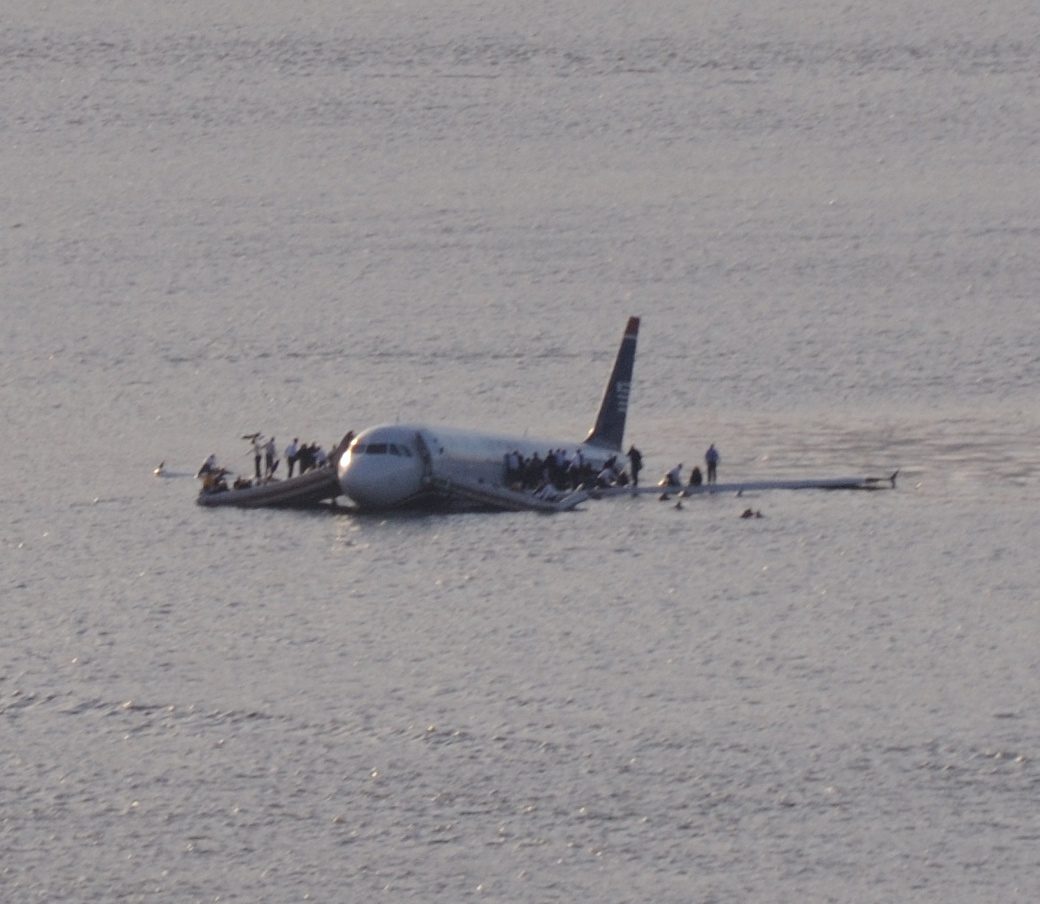
The passenger doors are plug-type and open outward and forward. They are operated by hand, by the cabin crew or ground staff, with hydraulic damping. The door damper actuator has two functions: in normal operation it brakes the door's travel, and in emergency mode, with the slide armed, it drives the door open by itself, using compressed gas from a cylinder in the door, so that one crew member can open it quickly even against the wind.
The slide is packed in a container on the inboard lower side of the door. Its girt bar is attached to the slide. With the slide arming lever at ARMED, the girt bar is locked into fittings in the floor; at DISARMED it stays on the door. If the door is opened from inside while armed, the girt bar stays in the floor fittings, pulls the slide out of its container and inflation starts automatically. Gas from a compressed-gas cylinder inflates the slide and drives aspirators that draw in outside air to complete the inflation within seconds. If the bottle does not discharge, a crew member can open its valve by hand.
Opening a door from outside automatically disarms the door and the slide, so ground staff cannot fire a slide at the stand. From outside, the handle is reached by pushing a flap and then lifted fully, to a horizontal green line.
Depending on the configuration, each passenger door carries either a single-lane escape slide or a single-lane slideraft, which detaches from the aircraft to serve as a raft. Once it is disconnected, the rope that still ties it to the fuselage must be cut, or the raft stays tethered to a sinking aircraft.
Door lights
Each passenger door has three indications of its own, independent of the ECAM:
- a mechanical locking indicator;
- a slide armed warning light, white, which comes on when someone starts to lift the handle while the slide is still armed: the last warning that continuing will deploy the slide;
- a red cabin pressure warning light, which flashes when both engines are stopped, the slide is disarmed and the cabin differential pressure is above 2.5 hPa. It can be seen through the door window from outside and warns that residual pressure could force the door open violently.
Door and slide monitoring
The Door and Slide Control System (DSCS) generates the door warnings in two places: on the ECAM and on the indicators at each door, so that the flight crew and the cabin crew have independent information. Door and slide pressure sensors near the exits are connected to the cabin intercommunication data system (CIDS), which also monitors slide bottle pressure (see A320 cabin systems and CIDS).
On the ECAM DOOR/OXY page:
| Symbol | Meaning |
|---|---|
| Green outlined door | Closed and locked |
| Amber door | Not locked |
| SLIDE, white | Slide armed; the label disappears when the slide is disarmed |
| Stair symbol, green | Stair door not closed (aircraft with air stairs) |
A door that is not closed triggers a caution, not a warning: single chime, amber MASTER CAUT and the DOOR page, with no local warning, and it is inhibited in certain flight phases. At parking, the pilot flying checks on the DOOR/OXY page that the slides are disarmed and tells the cabin crew if one is not.
Exam tip: green outline means closed and locked, amber means not locked, and a white SLIDE label means armed. A missing SLIDE label means disarmed, not a failure.
Overwing emergency exits
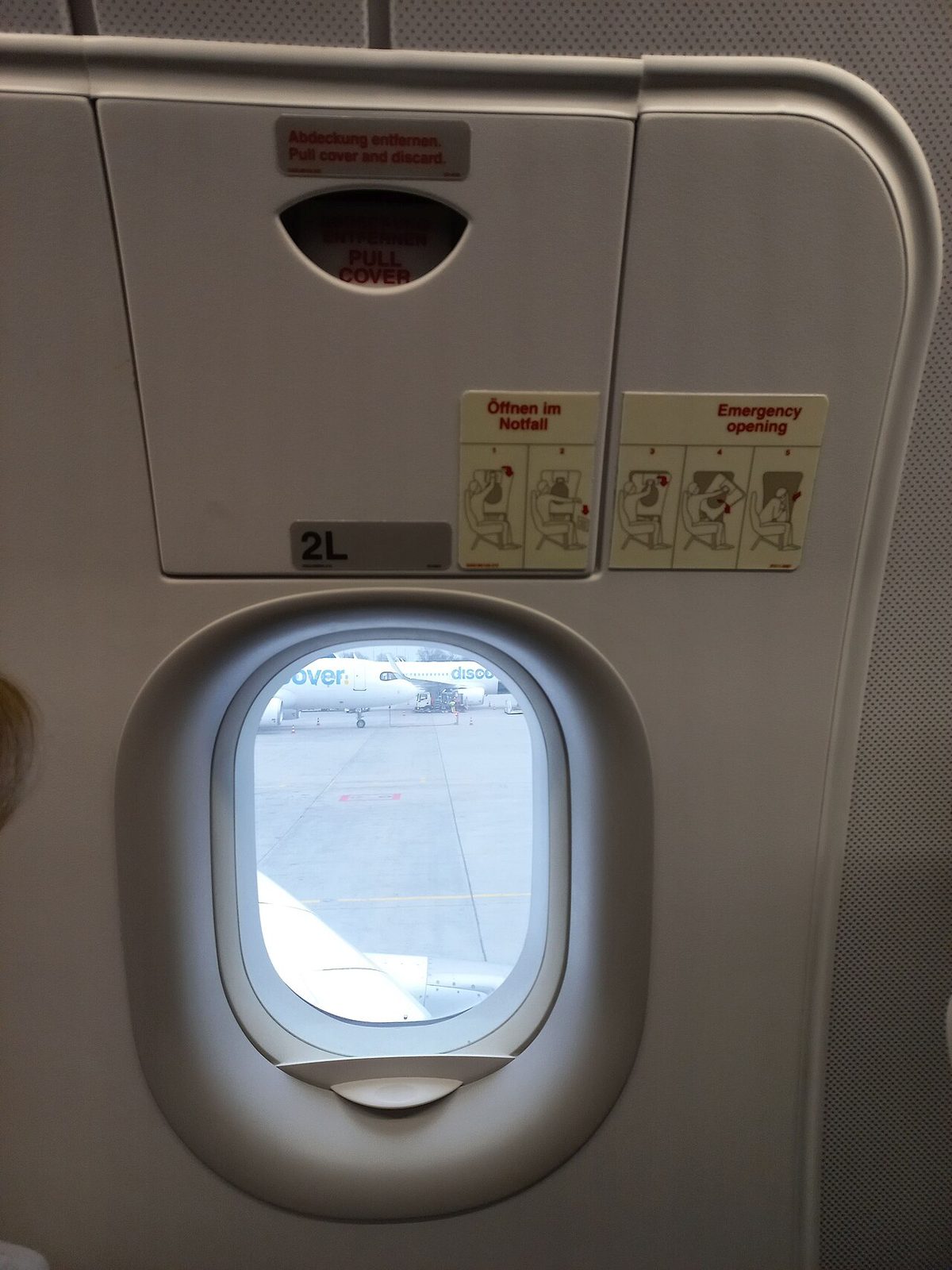
The four overwing exits open inward. The handle cover is removed first, which lights the HANDLE LIGHT and the SLIDE ARMED indication; pulling the control handle then frees the exit, which moves inward, is lifted out of its frame by the gripmould and is thrown clear. Their single-lane slides are always armed: there is no arming lever, so a passenger opening the exit has nothing to arm. Overwing escape route lights come on automatically when an armed exit is opened.
Cargo doors
The A320 has three cargo compartments under the cabin floor: forward, aft and bulk. The forward and aft cargo doors open outward and upward, from outside only, and lock mechanically in the open and closed positions, so they do not depend on hydraulic pressure to stay put. They are powered by the yellow hydraulic system through its electric pump.
The ground staff work the door at the cargo door manual selector valve. Setting its lever to OPEN or CLOSE starts the yellow electric pump automatically, even with its pushbutton off, and inhibits the other yellow functions except alternate braking and engine 2 reverse. A hand pump on the hydraulic maintenance panel lets the crew pressurise the yellow system for the cargo doors when no electrical power is available.
The landing gear control and interface units (LGCIUs) receive the positions of the selector valves, the locking shaft, the locking handle, the safety shaft and the door sills; a detected electrical failure of certain of these switches is shown as NON LOCKED. With the aircraft in flight, normal cargo door control is not available, and in the emergency electrical configuration (see A320 electrical system) the cargo door control has no supply at all. The forward and aft doors may be operated in winds up to 40 kt, or 50 kt with the nose into wind or the doors on the leeward side, and must be closed before the wind exceeds 65 kt.
The bulk cargo door is different: plug-type, opening inward and upward, mechanically locked and operated by hand, and the only cargo door that can be opened from inside as well as outside.
Cockpit door locking system
The cockpit door is a reinforced door certified to resist forcible intrusion from the cabin, with an electrically controlled locking system. It cannot be forced open from the cabin side; in an emergency it can be forced only from the cockpit side, preserving the crew's way out. The flight crew control its electric latch from the centre pedestal.
The latch is energised to lock. After a complete loss of electrical power it unlocks: the door stays closed but can be pushed open, so access and egress remain possible after a total electrical failure. Security comes from the door structure and the keypad emergency access logic, not from a latch that holds without power. A cabin crew member who needs to enter, for example after a pilot incapacitation, uses the keypad emergency access code; if the flight crew do not respond, the door unlocks after a time delay. See flight deck security for the rules behind the reinforced door.
Cockpit windows, escape ropes and emergency equipment
The two cockpit sliding windows are the flight crew's emergency exits, and the only way out if the door cannot be used. A small compartment above each window holds a cockpit escape rope long enough to reach the ground from the window. When a window is properly closed and locked, the red ring below its release button is hidden; a visible red ring means the window is not locked.
Placards show the location and type of the emergency equipment on board. The FCOM shows a typical installation only, since operators customise both the equipment and its stowage, and the cabin equipment is described in the cabin crew operating manual (CCOM). In the cockpit this includes the smoke hood described in A320 oxygen system. The four avionics compartment access doors, around the nose landing gear bay, are operated by hand for maintenance.
Evacuation signalling
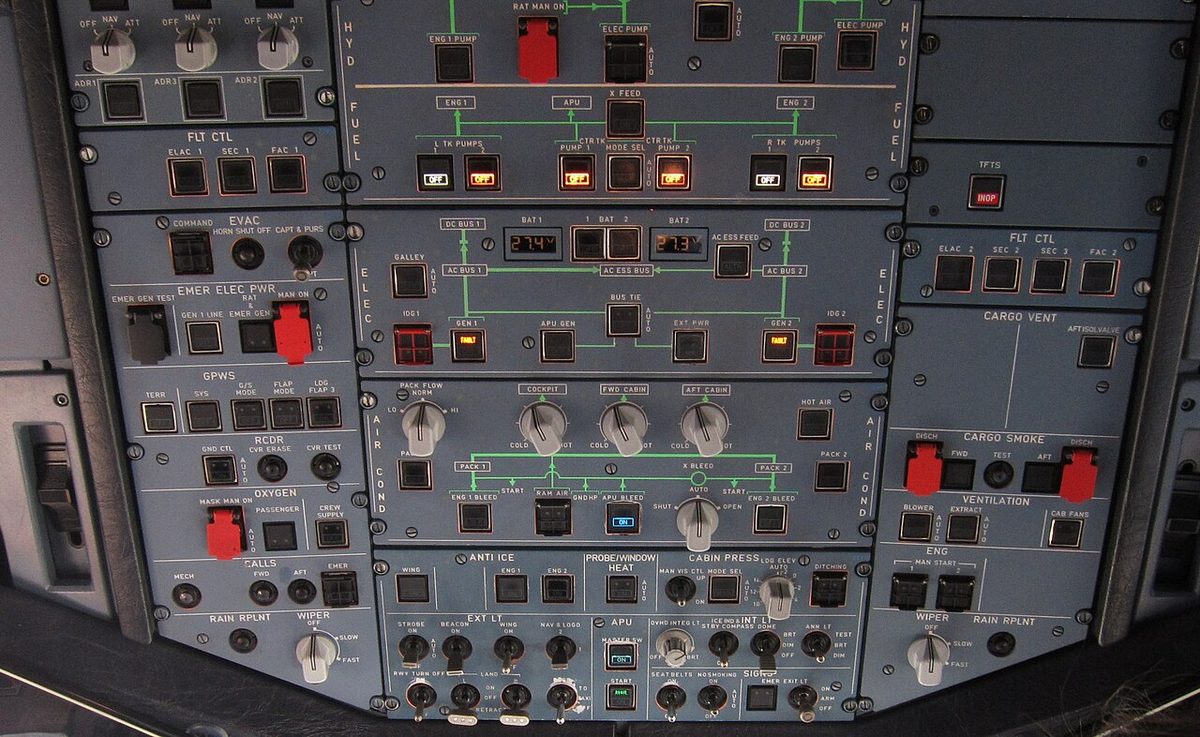
The Evacuation Signalling System (EVAC) lets the evacuation alert be given from the cockpit or the cabin. It is one of the functions of the CIDS.
| Control | Effect |
|---|---|
| COMMAND pushbutton (guarded), ON | Cockpit: EVAC flashes red and, depending on configuration, a horn sounds. Cabin: EVAC lights flash at the forward and aft attendant panels and the evacuation tone sounds |
| CAPT & PURS / CAPT switch at CAPT & PURS | The alert can be activated from the cockpit or from the cabin (cabin CMD pushbutton) |
| CAPT & PURS / CAPT switch at CAPT | The alert can be activated only from the cockpit; a cabin CMD press sounds the cockpit horn for 3 seconds |
| HORN SHUT OFF pushbutton | Silences the cockpit horn |
| RESET pushbutton | Silences the evacuation tone |
The CAPT position keeps the decision in the cockpit while still alerting the crew that the cabin wants to evacuate.
Emergency lighting
The emergency lighting comprises the proximity emergency escape path marking (escape path and exit markers), the overhead emergency lights, the EXIT signs, the lavatory auxiliary lights, which are always on, the overwing escape route lighting and the escape slide lighting. The general principles are in flight deck, cabin and emergency lighting.
The EMER EXIT LT switch on the overhead panel controls it:
- ON lights the overhead emergency lights, the EXIT signs and the proximity marking.
- ARM leaves them to come on by themselves: the exit markers and EXIT signs when normal electrical power or the DC SHED ESS BUS is lost, and the overhead emergency lights when normal power, the DC SHED ESS BUS or AC BUS 1 fails.
- OFF lights the amber EMER EXIT LT OFF light. The switch is set OFF when securing the aircraft.
Whatever the switch position, the LIGHT EMER pushbutton on the purser's panel can turn the emergency lighting on.
Parts of the emergency lighting carry their own power. The escape slide lights and overwing escape route lights come on automatically when the slide is armed and the door or exit is open, and run from internal batteries. Where electrical escape path or exit markers are fitted, internal batteries supply them for at least 12 minutes.
Warning: the automatic switching on after a loss of power described above is what the ARM position provides. A lit amber EMER EXIT LT OFF light means the switch is at OFF.
Frequently asked questions
How do you open the A320 overwing emergency exit?
Remove the handle cover, which lights the handle light and the SLIDE ARMED indication, pull the control handle so that the exit moves inward, lift the exit out of its frame by the gripmould and throw it clear. The overwing exits open inward and their single-lane slides are always armed: there is no arming lever, so nobody has to arm anything before using them.
What does the red light on an A320 passenger door mean?
The red CABIN PRESSURE light flashes when both engines are stopped, the slide is disarmed and the cabin differential pressure is still above 2.5 hPa. It is visible through the door window, so ground staff about to open the door from outside know that residual pressure could force it open violently. The white light, by contrast, warns that the handle is being lifted with the slide armed.
What happens to the A320 escape slide if the door is opened from outside?
Opening a passenger door from outside automatically disarms the door and its slide, so ground crew at a jet bridge or stand cannot deploy it by accident. The slide deploys only when the door is opened from inside with the slide arming lever at ARMED: the girt bar then stays locked in the floor fittings, pulls the slide out of its container and inflation starts.
What happens to the A320 cockpit door after a total loss of electrical power?
The electric latch is energised to lock, so with no electrical power the door unlocks. It stays closed but can be pushed open, which guarantees access and egress. Security rests on the reinforced, intrusion-resistant door and the keypad emergency access logic, not on a latch that holds without power. The door cannot be forced from the cabin side; it can be forced only from the cockpit side.
How are the A320 cargo doors operated?
The forward and aft cargo doors open outward and upward, from outside only, powered by the yellow hydraulic system. Setting the cargo door manual selector valve lever to OPEN or CLOSE starts the yellow electric pump automatically and inhibits the other yellow functions except alternate braking and engine 2 reverse. A hand pump serves when no electrical power is available. The bulk cargo door is manual.
Test yourself on A320 Doors and Emergency Equipment
The v1prep banks cover this topic in the A320 type-rating bank, with a worked explanation for every answer. EASA ATPL, PPL, IR and CPL, the FAA written tests and A320/B737 type ratings.
Start practising →Sources and further reading
- EASA Easy Access Rules for Large Aeroplanes (CS-25), CS 25.783 Fuselage doors, CS 25.807 to 25.813 Emergency exits and egress, CS 25.812 Emergency lighting
- 14 CFR 25.810, Emergency egress assisting means and escape routes
- 14 CFR 25.812, Emergency lighting
- 14 CFR 121.587, Closing and locking of flightcrew compartment door
- EASA Type Certificate Data Sheet EASA.A.064, Airbus A318, A319, A320, A321
- EASA Easy Access Rules for Air Operations (Regulation (EU) No 965/2012), ORO.SEC.100
Library articles are written for study and exam preparation. They do not replace your aircraft's approved documentation, your operator's procedures or the regulations themselves.