A320 Oxygen System
The A320 oxygen system comprises a cockpit fixed system, in which a high-pressure cylinder supplies quick-donning crew masks with diluted or pure oxygen, a cabin fixed system of chemical generators feeding drop-down passenger masks, and portable equipment for crew protection and first aid.
The A320 carries three separate oxygen systems. A cockpit fixed oxygen system gives the flight crew breathing oxygen from a single high-pressure cylinder after a depressurisation or when smoke and noxious gases are present. A cabin fixed oxygen system of chemical generators protects passengers and cabin crew after a depressurisation. Portable equipment in the cockpit and the cabin protects crew members during on-board emergencies and provides oxygen for first aid.
The two fixed systems work in opposite ways. The crew system is regulated, can be switched off and is tested before flight, and the crew must carry enough of it to fly a long way after a decompression. The passenger system has no tank to check: each generator starts once and runs until it is exhausted, after 13 to 22 minutes. The general principles are covered in crew oxygen systems, passenger and portable oxygen and hypoxia and hyperventilation.
Oxygen system overview
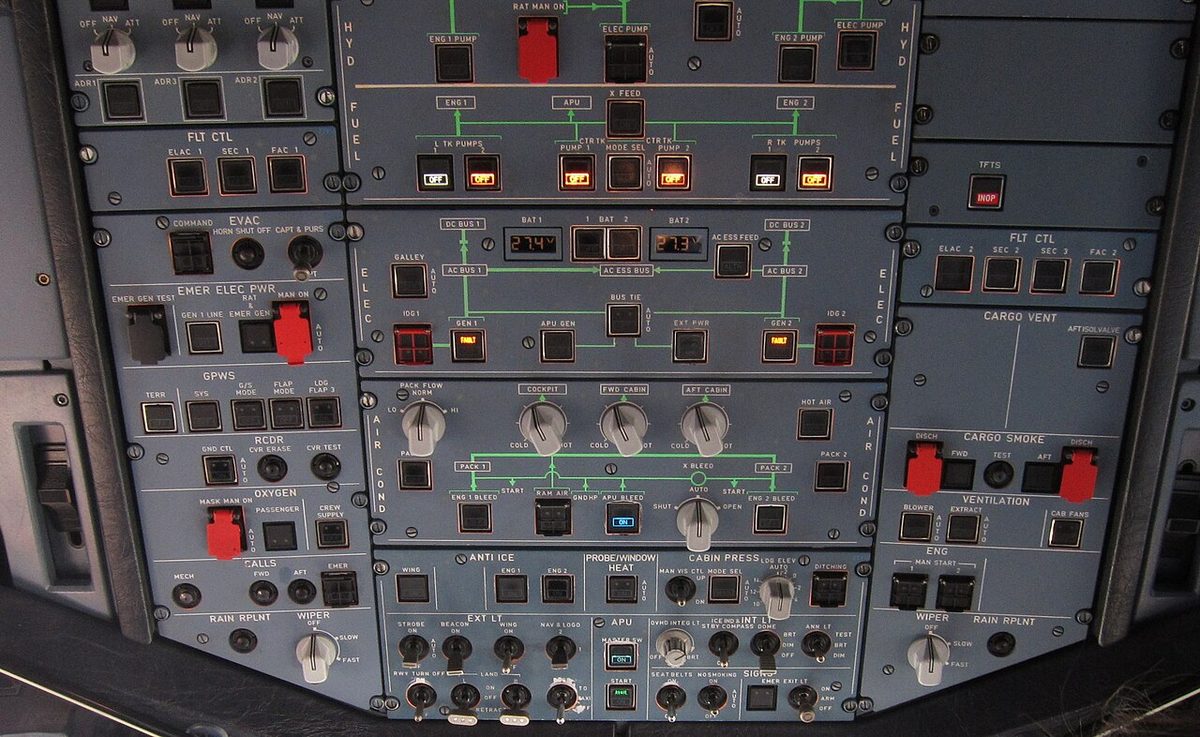
The controls sit on the OXYGEN panel of the overhead panel: the CREW SUPPLY pushbutton for the crew system, and for the passengers the guarded MASK MAN ON pushbutton, the PASSENGER SYS ON light and the HI ALT LANDING pushbutton. Indications are on the ECAM DOOR/OXY page, which also shows the doors, the slides and the cabin vertical speed.
| System | Source | Protects | Against |
|---|---|---|---|
| Cockpit fixed | High-pressure cylinder | Cockpit occupants | Depressurisation, smoke, noxious gases |
| Cabin fixed | Chemical generators | Passengers and cabin crew | Depressurisation |
| Portable | Portable equipment | Crew members; first aid | On-board emergencies |
Cockpit fixed oxygen system
The crew cylinder is in the left-hand lower fuselage. Two overpressure safety systems vent its oxygen overboard through a safety port if the pressure becomes too high. Downstream, a supply solenoid valve lets the crew shut off the distribution system; the CREW SUPPLY pushbutton controls it. At ON, the normal position in flight, the valve is open and low-pressure oxygen reaches the masks. At OFF the valve closes and a white OFF light comes on. The second pilot (CM2) selects it OFF when securing the aircraft.
There are three or four full-face quick-donning masks, one at each crew seat, stowed in boxes beside the seats. Each box holds a microphone lead with a quick-disconnect for the mask microphone. The regulator is mounted on the mask, so dilution and overpressure are selected on the mask itself.
Crew masks and selectors
Squeezing the red grips pulls the mask out of its box and inflates the harness: the right-hand grip unlocks the box's two-flap door and lets the harness inflate. As soon as the left flap door opens, the mask is supplied with oxygen; once the door closes again with the mask still supplied, an OXY ON flag appears. The blinker flowmeter, yellow, flashes while oxygen is flowing.
The RESET/TEST control slide on the box has two jobs. After the mask has been used, pressing RESET cuts off the oxygen and the mask microphone. Pressing TEST checks the blinker, the regulator supply, the sealing of the system downstream of the valve, the sealing of the regulator and the operation of the system.
The regulator supplies diluted oxygen, pure oxygen or oxygen under positive pressure, through two controls on the mask:
- The N/100% selector chooses dilution. At N (normal) it supplies a mixture of air and oxygen whose oxygen content increases with cabin altitude, until at high cabin altitude the mask delivers 100 % oxygen. At 100% it supplies pure oxygen at all cabin altitudes. The selector locks down at 100 % when the mask is pulled out of its box; pushing it up from underneath releases it to N, and pressing it again returns it to 100 %.
- The emergency pressure selector, the knob marked EMERGENCY, creates an overpressure in the mask that clears condensation or fogging and prevents smoke, smell or ash from entering. Pressing the knob gives an overpressure for a few seconds; turning it in the direction of the arrow makes it permanent.
Overpressure is available only with the N/100% selector at 100 %, and it starts automatically if the cabin altitude exceeds 30,000 ft.
On aircraft with a head-up display, the pilot whose HUD is deployed turns the head towards the other pilot to don the mask quickly. Each mask may carry a removable, optional film that protects the visor against scratches.
Exam tip: N gives diluted oxygen that saves the cylinder, 100 % gives pure oxygen at all cabin altitudes, and EMERGENCY gives pure oxygen under positive pressure. Overpressure needs 100 % and comes on by itself above 30,000 ft cabin altitude.
Crew oxygen in an emergency descent
The EMER DESCENT procedure opens with three memory items: CREW OXY MASKS USE, SIGNS ON and EMER DESCENT INITIATE. Later in the procedure the crew set CREW OXY MASKS DILUTION NORM: the N position saves oxygen, and a mask left at 100 % may not have enough for the whole emergency descent profile. The crew make sure they can communicate with the masks on, and avoid continuous use of the interphone, to limit interference from the breathing noise in the masks. For the decompression itself see decompression.
Crew oxygen tests and minimum pressure
Flight crew oxygen mask test
The test uses the controls of the stowage box and the mask regulator. Because it can produce a loud noise in the headsets, the crew first warn any ground crew connected to the interphone. The sequence is:
- CREW SUPPLY pushbutton checked ON; LOUDSPEAKERS on, ACP INT reception knob out and adjusted, INT/RAD switch at INT.
- Press and hold the RESET/TEST slide in the direction of the arrow: the blinker turns yellow briefly, then black.
- Keep it held and press the emergency pressure selector: the blinker stays yellow as long as the selector is pressed, and the oxygen flow is heard through the loudspeakers.
- Release: the RESET/TEST slide returns up, and the N/100% selector is at 100 %.
- Press the emergency pressure selector again: the blinker must not turn yellow, which shows that the mask is no longer supplied. Check that the selector has not been turned to permanent overpressure.
Pressure indications
During the preliminary cockpit preparation, pressing the DOOR key on the ECAM control panel shows the oxygen pressure. On the DOOR/OXY page:
| Indication | Meaning |
|---|---|
| Pressure green | 800 psi or more |
| Pressure pulsing green | Below 800 psi; the DOOR/OXY page is displayed automatically |
| Pressure amber | Below 400 psi |
| Amber half frame (on ground) | Below 1,500 psi: check against the minimum pressure table |
| REGUL LO PR amber | Low pressure in the low-pressure circuit (50 psi) |
| CKPT OXY amber (normally white) | Below 400 psi, low pressure detected, or CREW SUPPLY OFF |
Minimum flight crew oxygen pressure (LIM-OXY)
The FCOM limitation gives the minimum bottle pressure for the number of people using the cockpit system, as a function of a reference temperature. On the ground the reference temperature is the average of the outside air temperature and the cockpit temperature; in flight it is the cabin temperature minus 10 °C (minus 18 °F). Because the pressure of a given mass of gas rises with temperature, the minimum rises with the reference temperature: for two crew members it is 656 psi at -10 °C, 731 psi at 20 °C and 806 psi at 50 °C.
| Users (reference temperature 20 °C) | Minimum bottle pressure |
|---|---|
| 2 crew members | 731 psi |
| 2 crew members + 1 observer | 959 psi |
| 2 crew members + 2 observers | 1,215 psi |
The minimum covers the preflight checks, use of oxygen when only one pilot is in the cockpit, the unusable quantity, normal leakage and the more demanding of two emergencies:
- after a loss of cabin pressure, with the regulators at NORMAL, the emergency descent for all crew members and observers for 13 minutes, then cruise at FL 100 for two crew members for 107 minutes;
- protection against smoke with 100 % oxygen for all crew members and observers for 15 minutes at 8,000 ft cabin altitude.
These times assume a sealed mask and may be shorter for a bearded crew member. The cabin is not part of the calculation: passenger oxygen comes from separate generators.
Cabin fixed oxygen system
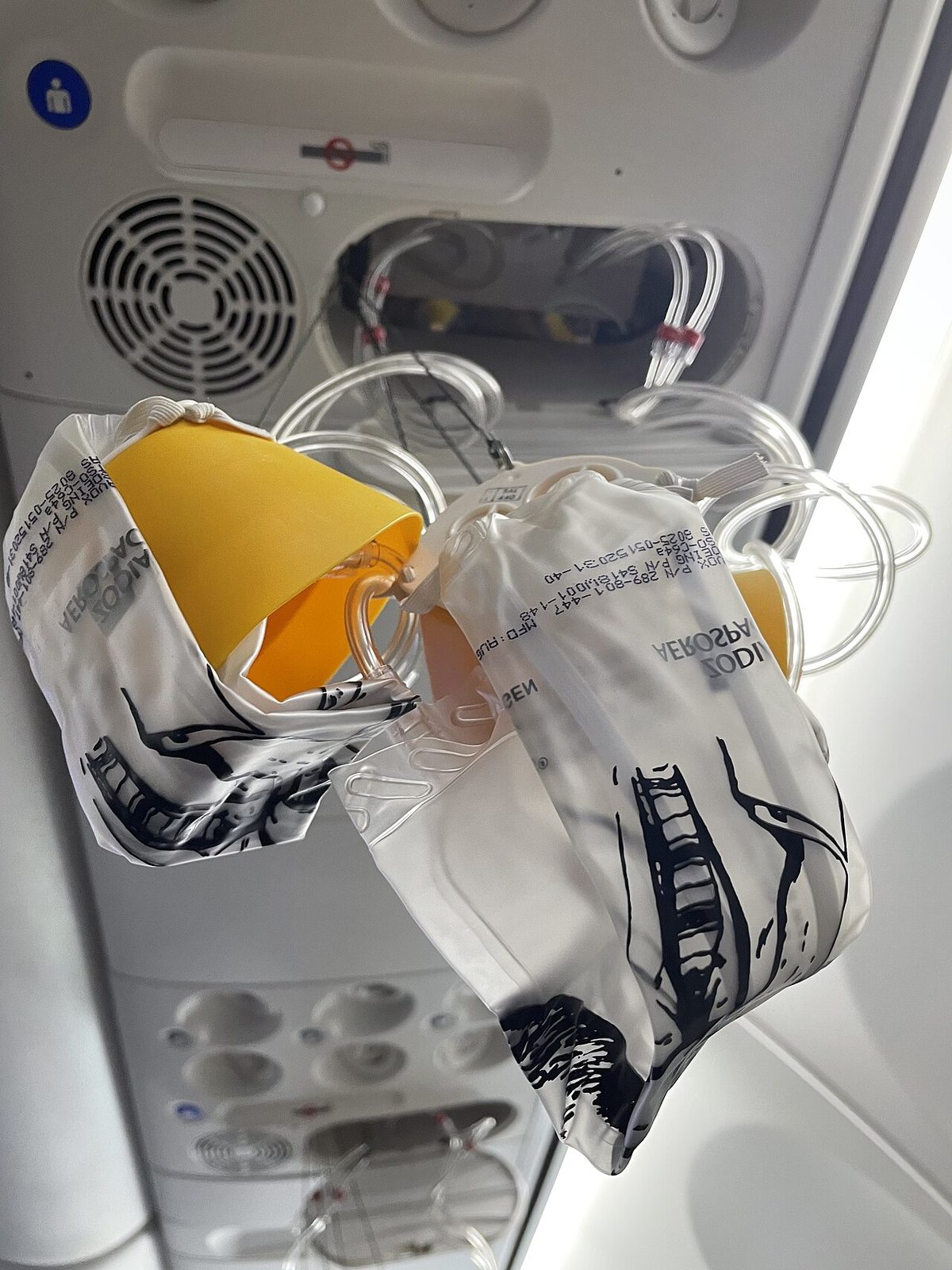
The cabin system uses chemical oxygen generators, each feeding a group of two, three or four masks; in the lavatories, gaseous generators replace the chemical ones. The masks are stowed in containers above the passenger seats, in the lavatories, in each galley and at each cabin crew station. When a container opens and the masks drop, oxygen generation begins only when a passenger pulls a mask towards the seat; a mask left hanging starts nothing. The mask then receives pure oxygen under positive pressure for about 13 or 15 minutes, or up to 22 minutes depending on the generator, until the generator is exhausted.
The chemical reaction releases heat, so a smell of burning, some smoke and a rise in cabin temperature can accompany the normal working of the generators. Crews and passengers who know this are less likely to mistake it for a fire.
Passenger mask deployment and reset
The MASK MAN ON pushbutton is guarded in the AUTO position. At AUTO the mask doors open automatically when the cabin altitude exceeds 14,000 ft (+250 ft, -750 ft). Pressing the pushbutton opens the doors whatever the cabin altitude, so the flight crew can override the automatic control. When the masks are released, the passenger address system broadcasts pre-recorded instructions, and the white PASSENGER SYS ON light comes on as soon as the mask door control is activated.
The HI ALT LANDING pushbutton is for operations at high-altitude airfields, where the cabin altitude on the ground can approach or exceed 14,000 ft. Selected ON, it raises the automatic release threshold to 16,000 ft (+250 ft, -750 ft) and so prevents a spurious deployment.
In the EMER DESCENT procedure, if the cabin altitude is above 14,000 ft, the crew press MASK MAN ON. This confirms that the passenger masks are released. Once the aircraft reaches a safe flight level and cabin oxygen is no longer needed, the crew tell the cabin crew.
After use, the masks are restowed and the system is reset for rearming. A manual release tool lets crew members open the mask doors by hand after an electrical failure. The TMR RESET pushbutton on the cabin oxygen maintenance panel is for maintenance staff, who use it to reset the control circuit after the system has operated; pressed ON, it puts out the PASSENGER SYS ON light. Its white FAULT light comes on when the door latch solenoids have been energised for more than 30 seconds.
Note: the PASSENGER SYS ON light stays on after a deployment until the TMR RESET pushbutton is pressed, so a lit SYS ON on the ground tells the crew the system has operated since it was last reset.
Portable oxygen and smoke hood
Portable oxygen in the cockpit and the cabin protects crew members during on-board emergencies and serves for first aid. In the cockpit, one item of portable breathing equipment (PBE) is stowed in a container at the right aft side. It is a hood that protects the eyes and the respiratory system of one crew member fighting a fire, or in smoke, noxious gas or a depressurisation. A chemical air regeneration system in the breathing key regenerates the air; the wearer breathes through an oronasal mask, and the exhaled breath returns to the regeneration system. The hood works for at least 15 minutes.
The container carries a serviceability indicator. On a yellow indicator, a crack means the protection may be insufficient and the hood must not be used. On a red and green indicator, green means the hood can be used and red that it cannot.
Frequently asked questions
At what cabin altitude do the A320 passenger oxygen masks drop?
With the MASK MAN ON pushbutton guarded at AUTO, the mask doors open automatically when the cabin altitude exceeds 14,000 ft, with a tolerance of +250 ft and -750 ft. With the HI ALT LANDING pushbutton ON, used at high-altitude airfields, the threshold rises to 16,000 ft. Pressing MASK MAN ON opens the doors at any time, and the EMER DESCENT procedure calls for it if the cabin altitude is above 14,000 ft.
How long does the A320 passenger oxygen last?
Each chemical generator feeds a group of two, three or four masks and supplies pure oxygen under positive pressure for about 13 or 15 minutes, or up to 22 minutes depending on the generator fitted, until it is exhausted. Generation starts only when a passenger pulls a mask towards the seat. The reaction produces heat, so a burning smell, smoke or a rise in cabin temperature can be normal.
What is the minimum crew oxygen pressure on the A320?
It depends on the number of occupants using the cockpit system and on a reference temperature. At a reference temperature of 20 °C the FCOM table requires 731 psi for two crew members, 959 psi with one observer and 1,215 psi with two. On the ground the DOOR/OXY page half-frames the pressure in amber below 1,500 psi, prompting the crew to check it against the table.
Why do A320 pilots select N on the oxygen mask during an emergency descent?
The N position supplies diluted oxygen, a mixture of air and oxygen whose oxygen content rises with cabin altitude, so it uses far less of the cylinder than 100 %. The EMER DESCENT procedure sets the masks to NORM because a mask left at 100 % may not have enough oxygen for the whole emergency descent profile. The minimum bottle pressure itself assumes the regulator at NORMAL for the descent case.
What does the EMERGENCY knob on the A320 crew oxygen mask do?
It creates an overpressure inside the mask, which clears condensation and fogging and keeps smoke, smells and ash out. Pressing the knob gives an overpressure for a few seconds; turning it in the direction of the arrow makes it permanent. Overpressure is available only with the N/100% selector at 100 %, and it starts automatically if the cabin altitude exceeds 30,000 ft.
Test yourself on A320 Oxygen System
The v1prep banks cover this topic in the A320 type-rating bank, with a worked explanation for every answer. EASA ATPL, PPL, IR and CPL, the FAA written tests and A320/B737 type ratings.
Start practising →Sources and further reading
- EASA Easy Access Rules for Large Aeroplanes (CS-25), CS 25.1439 to CS 25.1453, protective breathing equipment and oxygen
- EASA Easy Access Rules for Air Operations (CAT.IDE.A.235 Supplemental oxygen, pressurised aeroplanes)
- 14 CFR 121.333, Supplemental oxygen for emergency descent and for first aid, turbine engine powered airplanes with pressurized cabins
- EASA Type Certificate Data Sheet EASA.A.064, Airbus A318, A319, A320, A321
- FAA Aviation Maintenance Technician Handbook, Airframe (FAA-H-8083-31B), Chapter 16, Cabin Environmental Control Systems
- EASA, Explanatory Note to ED Decision 2018/001/R, Part-FCL theoretical knowledge learning objectives (021 Airframe and Systems)
Library articles are written for study and exam preparation. They do not replace your aircraft's approved documentation, your operator's procedures or the regulations themselves.