Aircraft Ground De-icing and Anti-icing
Ground de-icing removes frost, ice and snow from an aircraft before flight. Anti-icing applies a fluid that stops new contamination forming for a limited period, the holdover time. Together they meet the clean aircraft concept: no take-off with contamination adhering to critical surfaces.
Ground de-icing is the removal of frost, ice, snow and slush from an aircraft on the ground. Ground anti-icing is the application of a fluid that stops fresh contamination forming for a limited time. The two are often done together, and both serve one rule, the clean aircraft concept: no take-off with contamination adhering to the wings, tail, control surfaces, propellers, engine inlets or other critical surfaces.
The rule exists because small amounts of contamination do disproportionate harm. FAA Advisory Circular 20-117 notes that ice, frost or snow with the roughness of medium or coarse sandpaper on a wing's leading edge and upper surface can reduce lift by as much as 30 per cent and increase drag by 40 per cent. The wing then stalls at a lower angle of attack and a higher speed, and the stall warning, set for a clean wing, may not sound first (see stall). The added weight matters far less than the roughness.
Icing conditions on the ground
Airframe contamination on the ground comes from several sources: frost formed on clear nights, snow, freezing rain, freezing drizzle and freezing fog falling or depositing on a parked or taxiing aircraft, and slush or water thrown up by the wheels onto the gear, flaps and fuselage. Its formation is explained in airframe icing.
Manufacturers define icing conditions for the use of the aircraft's own ice protection. The Airbus A320 definition is typical. Icing conditions exist when the outside air temperature (OAT) on the ground, or the total air temperature in flight, is +10 °C or below and there is visible moisture: cloud, fog with a visibility of 1,600 m (1 SM) or less, rain, snow, sleet or ice crystals. They also exist on the ground at an OAT of +10 °C or below when the aircraft is operating on ramps, taxiways or runways where snow, standing water or slush may be ingested by the engines or freeze on nacelles and probes. The +10 °C threshold allows for aerodynamic cooling at the engine intake, where ice can form even when the air is slightly above freezing. Engine anti-ice is therefore used on the ground as well as in flight.
Clean aircraft concept
Both regulatory systems put the clean aircraft concept into law:
- EASA. Under CAT.OP.MPA.250 the operator must establish ground de-icing and anti-icing procedures and the related inspections. The commander may begin the take-off only if the aircraft is clear of any deposit that might adversely affect its performance or controllability, except as the operator's procedures and the flight manual permit.
- FAA. 14 CFR 121.629 prohibits take-off with frost, ice or snow adhering to the wings, control surfaces, propellers, engine inlets or other critical surfaces. It requires airlines to run an approved ground de-icing and anti-icing programme with holdover time tables and pre-take-off checks. 14 CFR 91.527 applies the same prohibition to large and turbine-powered multi-engine aeroplanes.
The FAA rules were shaped by accidents, among them Air Florida Flight 90 and USAir Flight 405. On 13 January 1982 the Air Florida Boeing 737 was de-iced at Washington National, then waited nearly 50 minutes in continuing snow before taking off with snow or ice on its wings and the engine anti-ice off. Ice on the engine inlet pressure probes made the EPR gauges over-read, so the engines were producing less thrust than the crew believed. The aircraft struck a bridge and fell into the Potomac River, and 78 people were killed, four of them on the bridge. On 22 March 1992 USAir Flight 405, a Fokker F28, stalled just after take-off from New York LaGuardia with ice on its wings.
Critical surfaces and frost
Critical surfaces are those on which contamination can affect lift, control or engine operation. The list in 91.527 includes the wings, stabilising and control surfaces, propellers, windshield, powerplant installations and flight instrument systems. Wings without leading-edge slats, the so-called hard wings, are especially sensitive to contamination near the leading edge.
Frost contamination is a frequent case. On clear, calm nights the aircraft's surfaces cool by radiation below the frost point of the air, and ice crystals deposit directly from the water vapour. Frost on the wing must be removed; polishing it smooth is not an accepted treatment, and the former FAA allowance for polished frost was removed from the operating rules effective 1 February 2010.
The one general exception is thin hoarfrost: a uniform white crystalline deposit so thin that surface features such as paint lines and markings can be seen beneath it. It is typically accepted on the upper fuselage, provided all vents and ports are clear. Snow is not an exception either, even dry snow that looks as if it will blow off during the take-off run: the rules make no allowance for it.
Cold-soaked fuel frost
Cold-soaked fuel frost (CSFF) forms on the wing skin over the fuel tanks after a long cruise. The fuel cools to well below freezing at altitude and warms only slowly on the ground, so the skin above it stays cold. When humid air meets the cold skin, frost forms even though the air is above freezing and nothing is falling.
Because it forms in otherwise benign weather, CSFF is easily missed. Some flight manuals allow a limited amount under strict conditions:
- FAA rules. 91.527 allows frost under the wing in the fuel tank area if the FAA authorises it, and some manuals accept up to 1/8 in (3 mm) there.
- Embraer E190-E2. CSFF on the upper wing is accepted only inside a marked area, with no precipitation or visible moisture and a temperature above 0 °C. A 3 mm allowance in the E190 manual applies to the underside of the wing only.
Any allowance applies only as written. Without one, CSFF is removed like any other frost.
De-icing and anti-icing fluid types
De-icing removes contamination that is already present. Anti-icing protects a clean surface against contamination forming. The fluids used are glycol-based freezing point depressants, mixed with water in proportions chosen for the temperature and the protection needed.
| Fluid | Properties | Main use |
|---|---|---|
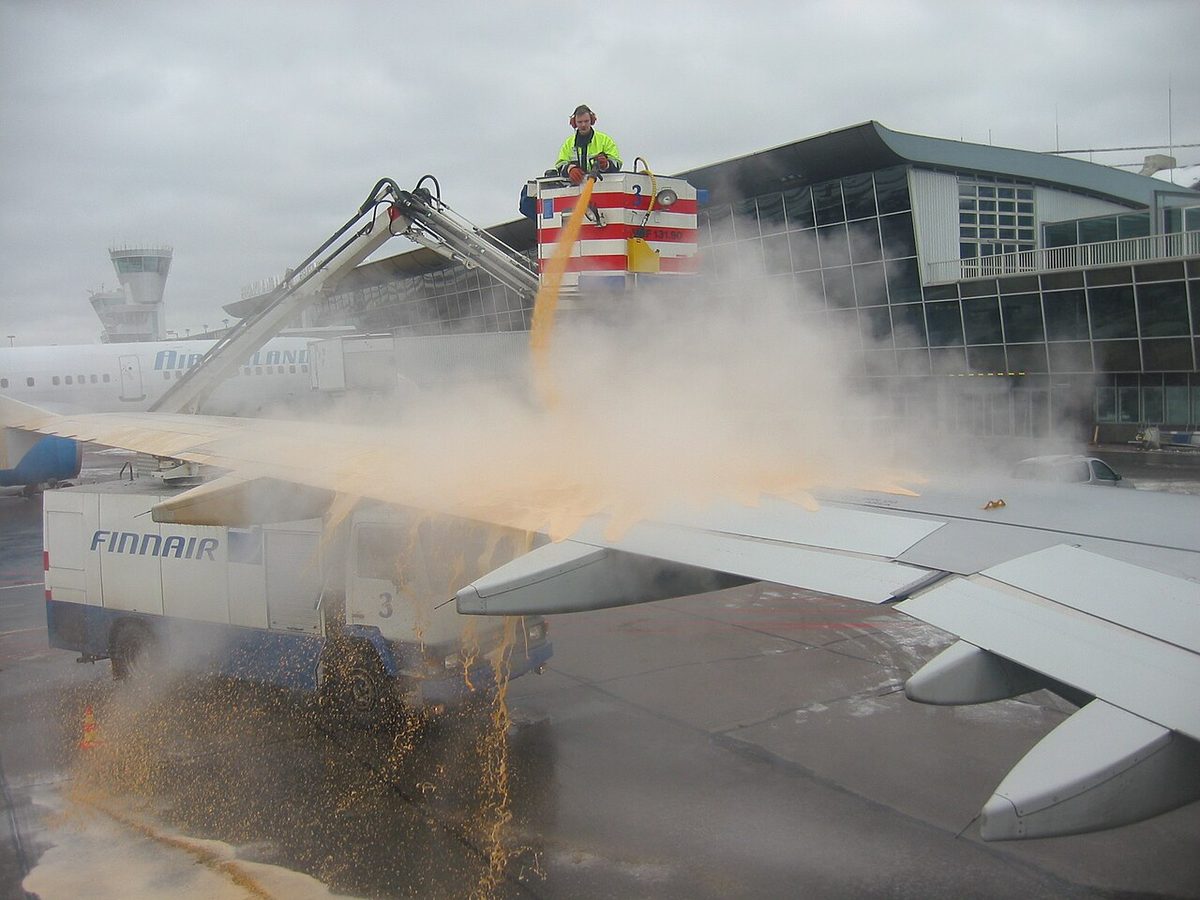
| Type I | Unthickened, applied heated, dyed orange | De-icing; short anti-icing protection only |
| Type II | Thickened | Anti-icing for aircraft rotating at about 100 kt or more |
| Type III | Thickened, formulated for lower rotation speeds | Anti-icing for slower aircraft, such as commuter turboprops |
| Type IV | Thickened, dyed green | Anti-icing with the longest holdover times of the standard fluids |
The thickened fluids are designed to cling to the surface while the aircraft waits, then flow off under the shear of the airflow during the take-off run, leaving little on the wing by rotation. On an aeroplane that rotates much below about 100 kt the fluid would still be on the wing at lift-off and would itself degrade lift. Such aeroplanes use Type I or Type III, and turbojets generally use Types I, II and IV.
One-step and two-step procedures
The one-step procedure uses a single application of heated fluid to remove the contamination and leave a protective film. It suits light contamination, such as frost with no precipitation.
The two-step procedure separates the tasks:
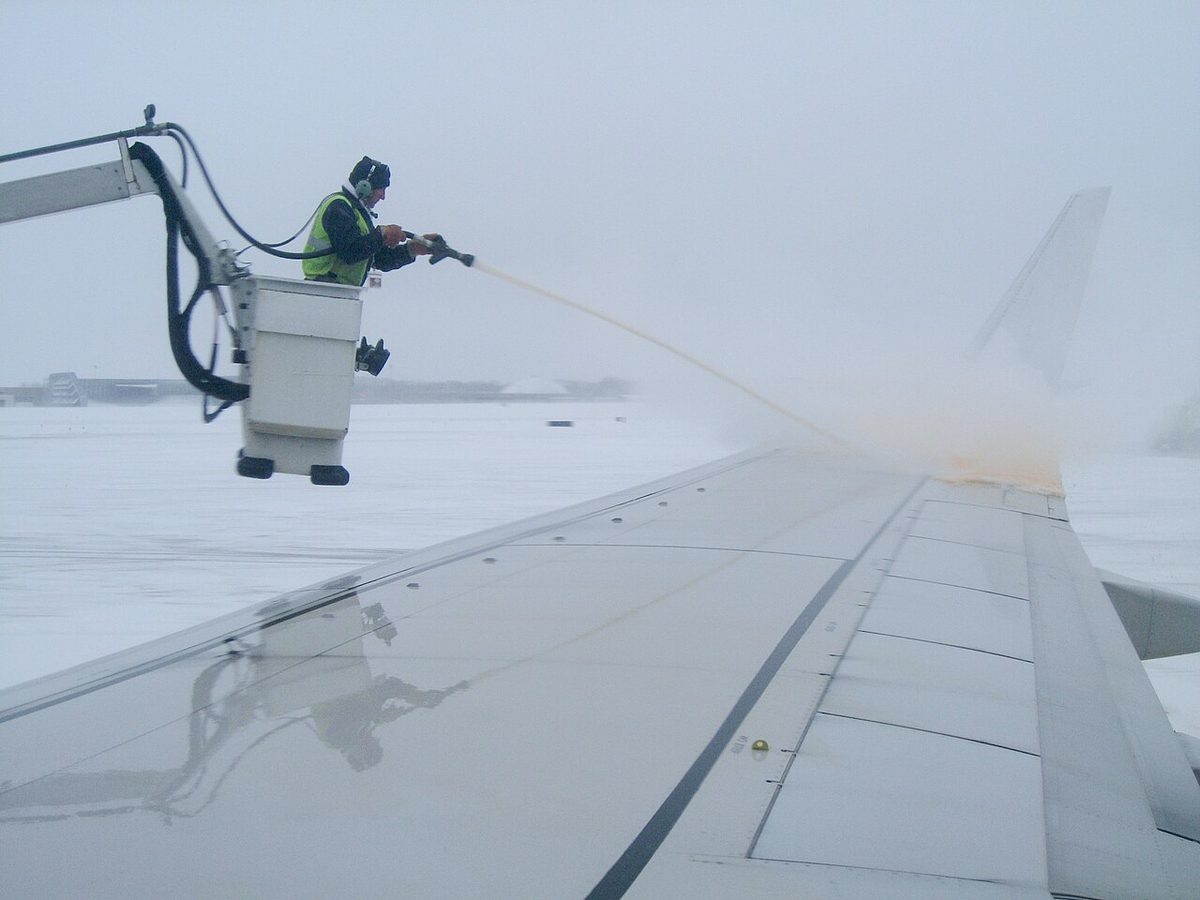
- De-icing. Heated fluid, often Type I, removes the contamination.
- Anti-icing. A second fluid, often a thickened Type II or IV, is applied before the first-step fluid can freeze, to protect the clean surface.
During spraying, the engine and APU bleeds to the air conditioning are closed so that fluid fumes are not drawn into the cabin. The aircraft is configured as the manufacturer specifies. When treatment is complete, the de-icing crew tell the flight crew the fluid type and mixture and the time the final step began. The crew record them, because the holdover time depends on them.
Holdover time
Holdover time (HOT) is the estimated time for which an anti-icing fluid will stop frost, ice or snow forming on the treated surfaces. It starts at the beginning of the final application: the anti-icing step in a two-step procedure, or the single application in a one-step procedure.
HOTs are read from tables for the fluid type and concentration, the OAT, and the type and intensity of precipitation. The FAA, for example, publishes updated tables every winter. They are estimates, not guarantees:
- Heavy precipitation, strong wind and jet blast from other aircraft shorten the protection.
- Freezing fog is among the conditions with the shortest times.
- Whatever the table says, visible contamination on a critical surface means the aircraft is not clean.
If the holdover time expires before take-off, the protection can no longer be assumed. The classic exam answer is that the complete de-icing and anti-icing process must be repeated. Both systems also describe an alternative, the pre-take-off contamination check described below.
Exam tip: holdover time starts at the beginning of the final (anti-icing) application; Type IV gives the longest holdover; thickened fluids are for aircraft rotating at about 100 kt or more.
Pre-take-off contamination check
EASA guidance (GM1 CAT.OP.MPA.250) defines a pre-take-off contamination check as a check of the treated surfaces made when the holdover time has been exceeded, or when there is any doubt about the anti-icing protection, normally from outside the aircraft just before the take-off run. The FAA rules distinguish two checks:
- Pre-take-off check. Made within the holdover time, normally visually from inside the aircraft, to confirm that the treated surfaces still look free of contamination.
- Pre-take-off contamination check. Required when the holdover time has been exceeded. Take-off is permitted only if this check, completed within five minutes before beginning the take-off and normally from outside the aircraft, confirms that the critical surfaces are clean. Otherwise the aircraft is de-iced again.
In every system the final judgement rests with the commander. If snow is settling on the wing, or the fluid no longer looks as if it is absorbing the precipitation, the aircraft goes back for treatment whatever the clock says.
Engine ice shedding run-ups
Engine anti-ice protects the intake lip, but in freezing fog, freezing precipitation or snow, ice can still build up on the fan blades and spinner during long periods at ground idle. Ice that sheds from the intake or fan in large pieces can damage the engine, so manufacturers specify periodic run-ups to shed it while it is small. The figures are type-specific:
- Airbus A320. When the OAT is +3 °C or below in icing conditions for more than 30 minutes, the crew set the parking brake, or hold the brakes, and accelerate the engines to about 70 per cent N1 for 30 seconds, at intervals of no more than 30 minutes and again just before take-off. In freezing rain, freezing drizzle, freezing fog or heavy snow, extra momentary run-ups to 70 per cent N1 are made at intervals of no more than 10 minutes. The taxi-in time is recorded after landing to show how much taxi-out time remains for the next flight.
- Embraer E190-E2. In one operator's procedures, a run-up to 60 per cent N1 for 10 seconds is required when the OAT is 3 °C or below with visible moisture and the engines have been at ground idle for 30 minutes or more. The first-generation E190 uses 54 per cent N1 for 30 seconds, or until the vibration indication is normal.
Run-ups need a surface where the brakes will hold and a clear area behind the aircraft for the jet blast. For an E190-E2 take-off with anti-ice on, one operator sets at least 60 per cent N1 and checks the engine parameters before releasing the brakes.
Frequently asked questions
What is the clean aircraft concept?
The clean aircraft concept is the rule that an aircraft must not take off with frost, ice, snow or slush adhering to its critical surfaces, such as the wings, tail, control surfaces, propellers and engine inlets. Even a thin layer as rough as sandpaper can cut maximum lift and raise the stalling speed. EASA and FAA rules make the commander responsible for a clean aircraft at take-off, except where the flight manual allows a specific deposit.
What is holdover time in de-icing?
Holdover time is the estimated time for which an anti-icing fluid will stop frost, ice or snow forming on the treated surfaces. It starts at the beginning of the final, anti-icing application and depends on the fluid type and concentration, the outside air temperature and the type and intensity of precipitation. The published times are estimates; heavy precipitation, strong wind and jet blast shorten them.
What is the difference between Type I and Type IV de-icing fluid?
Type I is an unthickened fluid, dyed orange and applied hot, used mainly to remove contamination; its holdover time is short. Type IV is a thickened fluid, dyed green, which clings to the wing and gives the longest holdover time of the standard fluids. It shears off during the take-off run, so it is meant for aeroplanes rotating at about 100 kt or more. Type I followed by Type IV is a common two-step treatment.
What happens if the holdover time runs out before take-off?
The protection can no longer be assumed. Exam material commonly states that the whole de-icing and anti-icing process must then be repeated. EASA guidance and FAA Part 121 programmes also allow a pre-take-off contamination check, normally made from outside the aircraft just before take-off; under the FAA rule it must be completed within five minutes before take-off. Take-off follows only if the check shows the critical surfaces are clean; otherwise the aircraft is treated again.
Why do jet engines need ice shedding run-ups on the ground?
In freezing fog, freezing precipitation or snow, ice can build up on the fan blades and spinner during long periods at ground idle, even with engine anti-ice on. Periodic run-ups to a moderate thrust shed it in small pieces before it grows large enough to damage the engine or cause vibration. The thrust, duration and interval are type-specific; the A320, for example, uses about 70 per cent N1 for 30 seconds at intervals of no more than 30 minutes.
Test yourself on Aircraft Ground De-icing and Anti-icing
The v1prep banks cover this topic in Operational Procedures (070), with a worked explanation for every answer. EASA ATPL, PPL, IR and CPL, the FAA written tests and A320/B737 type ratings.
Start practising →Sources and further reading
- ICAO Doc 9640, Manual of Aircraft Ground De-icing/Anti-icing Operations
- EASA Easy Access Rules for Air Operations (CAT.OP.MPA.250, Ice and other contaminants, ground procedures)
- 14 CFR 121.629, Operation in icing conditions
- 14 CFR 91.527, Operating in icing conditions
- FAA Advisory Circular AC 20-117, Hazards Following Ground Deicing and Ground Operations in Conditions Conducive to Aircraft Icing
- NTSB AAR-82/08, Air Florida Flight 90, Collision with 14th Street Bridge near Washington National Airport, 13 January 1982
Library articles are written for study and exam preparation. They do not replace your aircraft's approved documentation, your operator's procedures or the regulations themselves.