Spoilers and Speed Brakes
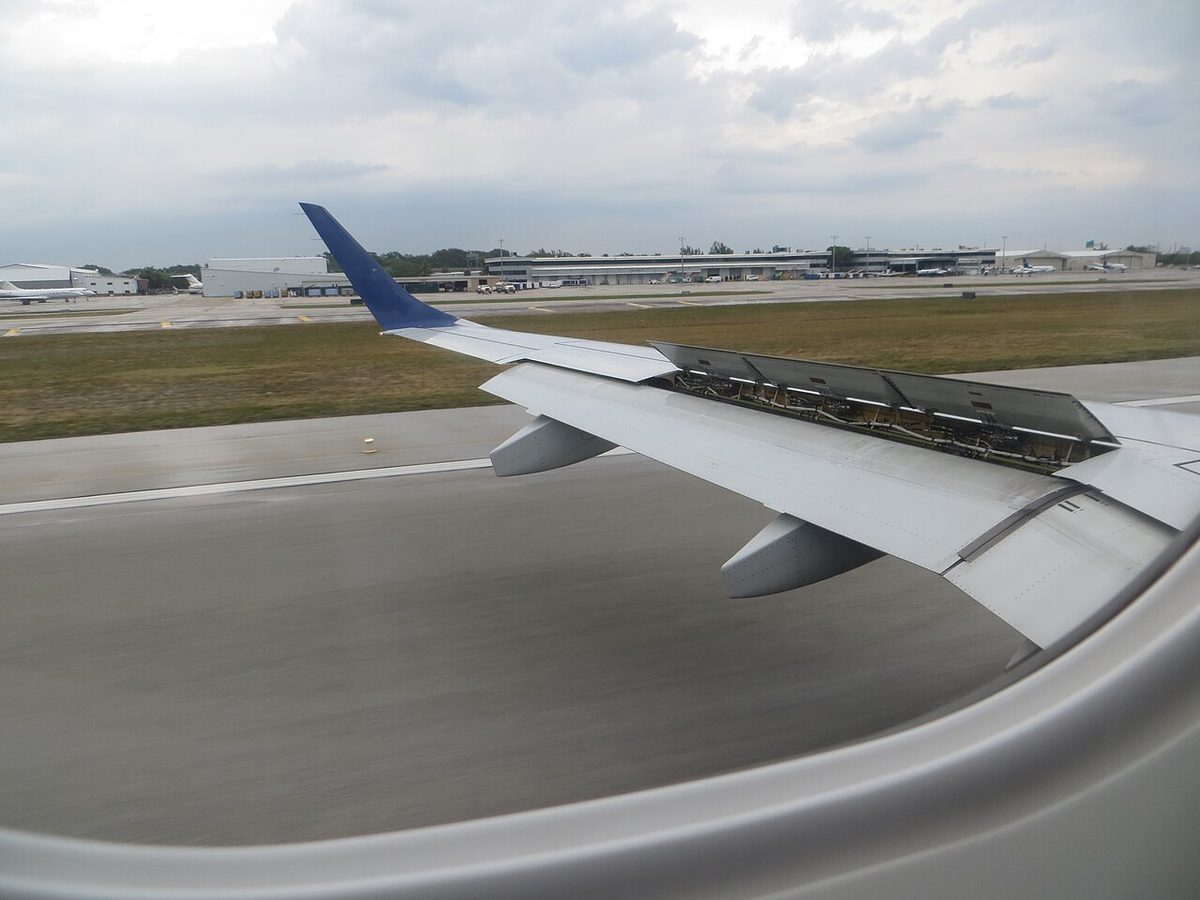
Spoilers are hinged panels on the upper surface of the wing that rise to reduce lift and increase drag. Flight spoilers raised on one wing assist roll control and raised on both act as speed brakes; ground spoilers, with the flight spoilers, dump lift after touchdown so that the wheel brakes work.
A spoiler is a hinged panel on the upper surface of the wing, ahead of the flaps, that rises into the airflow to spoil lift and add drag. Jet transports carry a row of them on each wing and use them in three ways: asymmetrically, to help the ailerons roll the aeroplane; symmetrically in flight, as speed brakes; and all together after touchdown, to dump lift. The aerodynamics of roll spoilers is covered in roll control, adverse yaw and spoilers; this article covers the system that commands them.
Getting the spoilers right matters at both ends of a flight. In the descent they let the crew lose height or speed faster than idle thrust alone allows. On landing, ground spoilers that fail to deploy leave much of the aeroplane's weight on the wing instead of the wheels, and the landing distance grows, so crews check and call their deployment on every landing.
Flight and ground spoilers
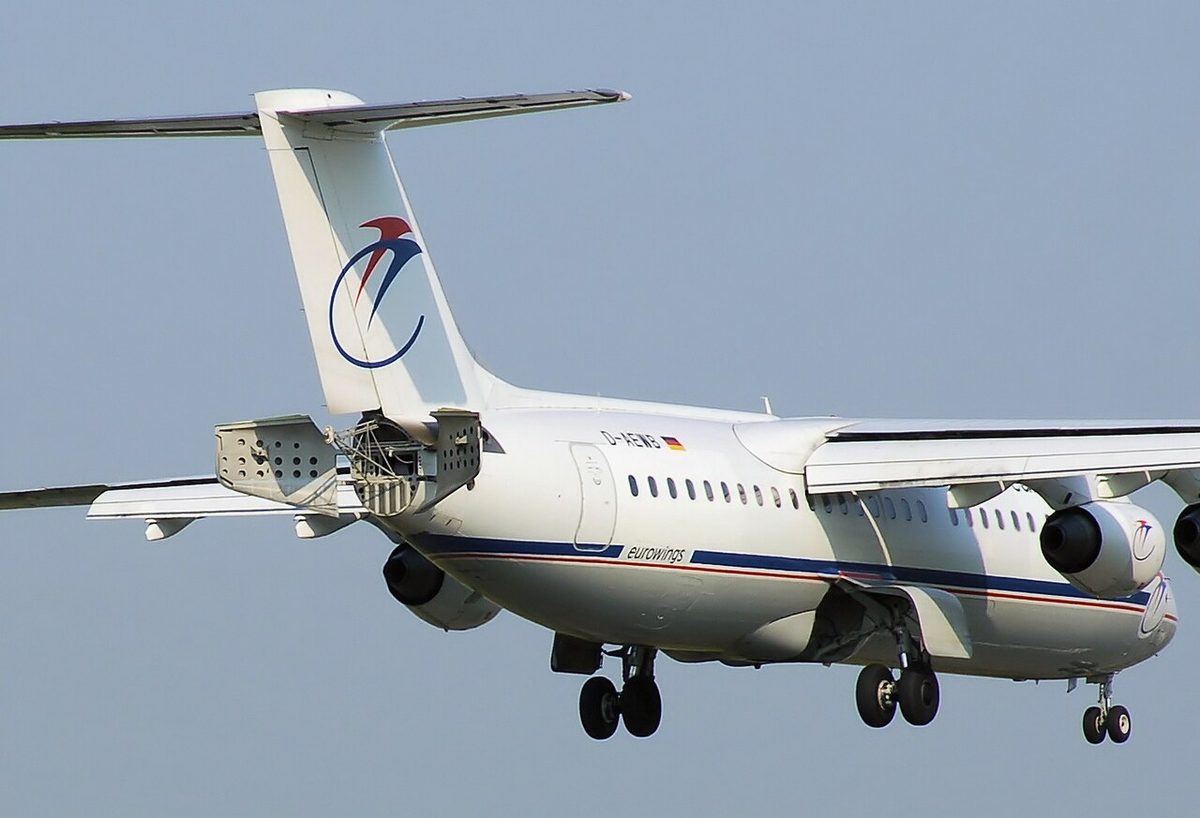
Flight spoilers can be used in the air. They assist the ailerons in roll and, raised together, act as speed brakes. Ground spoilers, or lift dumpers, are panels, often the inboard ones, that deploy only on the ground. After touchdown all the panels rise together. Air/ground logic from sensors on the landing gear, traditionally a squat switch, keeps the ground spoilers from deploying in flight.
| Type | Panels per wing | Ground spoilers only | Flight spoilers |
|---|---|---|---|
| Boeing 737 NG | 6 | 2 (panels 1, 6, 7 and 12 in all) | 4, for roll and as speed brakes |
| Airbus A320 | 5 | Spoiler 1 | Spoilers 2 to 5 for roll; 2, 3 and 4 as speed brakes |
| Embraer E190 E1 | 5 | Panels 1 and 2 | Panels 3 to 5, multifunction spoilers |
Spoilers are split between hydraulic systems so that a failure stays symmetrical. On the 737 each of systems A and B powers a different set of flight spoiler pairs, and system A powers all four ground spoilers. On the A320 each spoiler's servojack takes power from the green, yellow or blue system and is controlled by one of the three spoilers and elevator computers (SECs). If a spoiler fails, the symmetrical one on the other wing is inhibited.

Speed brake lever and use
A speed brake increases drag to steepen the descent or reduce speed. At a given thrust, more drag means a steeper descent gradient and a higher rate of descent, so the speed brakes help meet a crossing restriction, recover a high approach or slow to the turbulence penetration speed. In an emergency descent they go to the maximum in-flight position with the thrust at idle. The ideal speed brake adds drag with no loss of lift and no change of pitching moment. A fuselage-mounted air brake comes close; wing spoilers always reduce lift, a compromise accepted because the panels are already there for roll control.
The speed brake lever sits on the pedestal. On the Boeing 737 it has four positions:
- DOWN, in a detent: all flight and ground spoilers faired.
- ARMED: the automatic speed brake system is armed for landing.
- FLIGHT DETENT: all flight spoilers at their maximum in-flight deflection. The lever must not be moved beyond it in flight, because that causes buffeting and is prohibited.
- UP: all flight and ground spoilers fully extended, for use on the ground.
Boeing's operating limitations say not to deploy the speed brakes in flight below 1,000 ft radio altitude, and an amber SPEEDBRAKES EXTENDED light comes on in flight if the lever is beyond ARMED with the flaps beyond 10 or below 800 ft radio altitude.
On the A320 the lever has a hardpoint at the half position. With the autopilot engaged the maximum speed brake deflection is reached at half lever, and moving it further gives nothing more. Speed brake extension is inhibited with the flaps at FULL, with angle of attack protection or alpha floor active, with a thrust lever above MCT, with an elevator fault, or if SEC 1 and SEC 3 both have faults. If an inhibition occurs with the speed brakes out, they retract and stay retracted until the condition clears and the crew resets the lever. Extending them raises VLS, so the crew must have a speed margin first, especially before a turn, to avoid triggering alpha floor. On the E190 E1 the speed brakes retract automatically with flaps 2 or more, or with the thrust levers above 70° TLA in a go-around.
Warning: in a windshear escape, a terrain avoidance pull-up or a stall recovery, the speed brakes are retracted to give the wing all the lift it can produce. It is a recall item in the 737's windshear and terrain avoidance manoeuvres and in the A320's stall recovery and EGPWS warning procedures.
Roll spoilers and spoiler mixing
A spoiler mixer turns the roll input into commands for the spoiler actuators. It is driven from the aileron system and raises the spoilers on the wing whose aileron goes up, the descending wing, while those on the other wing stay down. The deflection is proportional to the roll demand, and a follow-up from each spoiler actuator closes its control valve when the panel reaches the commanded position.
On the 737 NG the first officer's control wheel is cabled to the spoiler PCUs through the spoiler mixer. The flight spoilers begin to rise once the wheel is turned more than about 10°. On the 737 MAX the spoilers are signalled electrically, which made room for manoeuvre load alleviation, a landing attitude modifier and emergency descent speedbrakes. On the E190 E1 a small wheel input moves only the ailerons, and the multifunction spoilers join in as the wheel angle grows. On the A320 the computers combine ailerons, spoilers 2 to 5 and rudder in normal law.
The two functions add. With the speed brakes out, a roll input raises the spoilers further on one wing and lowers them on the other from the selected setting. When the sum would exceed the travel available, roll wins: on the A320 the corresponding surface on the other wing is retracted until the difference between the two equals the roll order.
Outboard aileron lockout
On a long, flexible swept wing, an outboard aileron at high speed twists the wing so much that its effect falls and can reverse. Many large jets therefore carry inboard ailerons as well and use outboard aileron lockout: with the flaps retracted, the outboard ailerons are inhibited and roll control comes from the inboard ailerons and the spoilers; when the flaps are extended for low-speed flight, the outboard ailerons are brought back in. Spoilers suit this role because they spread their lift loss across the chord instead of concentrating it at the trailing edge, so they twist the wing far less, and they stay effective at transonic speeds. The 737 and the A320, with one aileron on each wing, rely on the spoilers to add roll authority instead (see flutter and aeroelasticity).
Automatic ground spoilers
After touchdown the wing is still producing much of the aeroplane's lift. Ground spoilers destroy it, transferring the weight to the main wheels so that the brakes, whose force depends on the load on the tyres, become fully effective, and they add aerodynamic drag. Without them the landing roll is longer, and on the A320 the autobrake does not activate unless they extend.
The automatic ground speed brake function is armed by the crew before landing and deploys when its conditions are met, typically main wheel spin-up, air/ground sensing and thrust levers at idle, or reverse selection. If the aeroplane goes around or bounces back into the air, the spoilers retract when the wheels spin down or the thrust levers are advanced.
| Boeing 737 NG | Airbus A320 | |
|---|---|---|
| Armed by | Lever to ARMED, green SPEED BRAKE ARMED light | Lever pulled up to armed, GND SPLRS ARMED memo |
| Landing, armed | Radio altitude below 10 ft, a strut compressed, both thrust levers at idle, main wheels spun up above 60 kt | Both main gears on the ground and both thrust levers at or below idle, or reverse selected |
| Lever not armed | Wheels above 60 kt, both thrust levers at idle and reverse thrust levers raised, on landing or in a rejected take-off | Reverse selected on one engine |
| Rejected take-off | Lever is DOWN for take-off, so the row above applies | Armed for take-off: above 72 kt, deploys when both thrust levers are set to idle |
| Retraction | Either thrust lever advanced: lever moves to DOWN | Disarmed after landing, or a thrust lever above 20° in a touch-and-go |
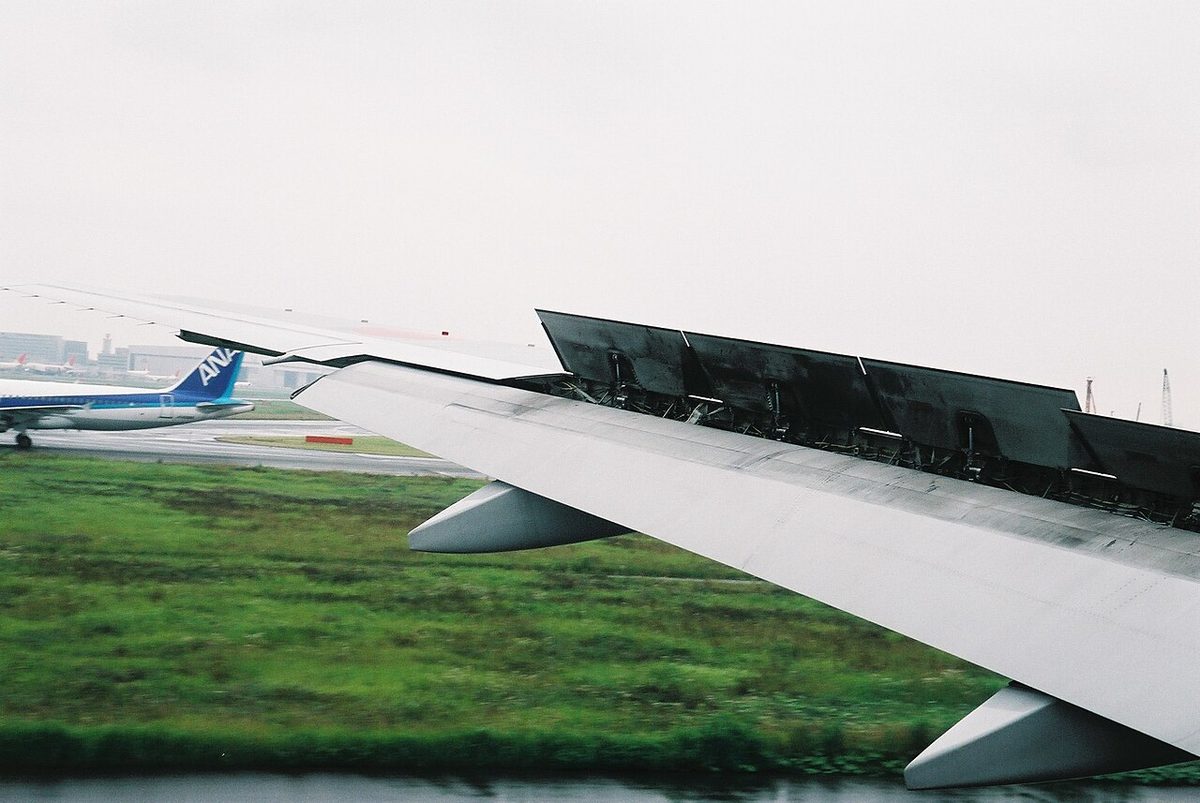
On the 737, compression of any landing gear strut enables the flight spoilers, while compression of the right main strut opens the ground spoiler interlock valve mechanically. An amber SPEED BRAKE DO NOT ARM light shows an abnormal condition in the automatic system. At touchdown the pilot monitoring checks the lever and calls "SPEED BRAKES UP", or "SPEED BRAKES NOT UP" if it has not moved. The A320 adds phased lift dumping, partial deployment once one main gear is on the ground, and if no spoilers extend the crew sets idle and full reverse and brakes manually. On the E190 E1 the ground spoilers deploy with weight on wheels, thrust levers below 26° TLA and wheel speed above 45 kt or airspeed above 60 kt (see anti-skid and autobrake).
Spoiler blowback
Spoiler blowback, also called blowdown, is the retraction of a raised spoiler by the airflow. At high speed the air load on a fully deflected panel can exceed the force its actuator can produce, so the panel is pushed back towards the wing and gives less than the selected deflection. Wing speed brakes are generally cleared up to VMO/MMO, with blowback limiting their effect at the top of the range.
Loss of power has a similar effect. On the A320 a spoiler that loses hydraulic pressure keeps the deflection it had, or a smaller one if the air load pushes it down, whereas a spoiler that loses its electrical control or develops a fault is retracted, and a SEC failure retracts the spoilers it controls. A raised spoiler cannot flutter, one of the reasons spoilers are trusted with roll control at high speed.
Exam tip: flight spoilers rise on the wing with the up-going aileron. Speed brakes reduce lift as well as adding drag. Ground spoilers are inhibited in flight by air/ground logic, and blowback is the airflow pushing a spoiler down when its actuator cannot hold it.
Frequently asked questions
What is the difference between flight spoilers and ground spoilers?
Flight spoilers can be used in the air: raised on one wing they assist the ailerons in roll, and raised on both wings by the speed brake lever they act as speed brakes. Ground spoilers, also called lift dumpers, are panels that deploy only on the ground, with the flight spoilers, to destroy lift after touchdown or in a rejected take-off. Air/ground logic from the landing gear stops them deploying in flight.
How do automatic ground spoilers know the aircraft has landed?
The crew arm the system before landing, and it deploys when its touchdown conditions are met: typically main wheel spin-up, landing gear struts compressed and thrust levers at idle, or reverse thrust selected. On the Boeing 737 the lever must be armed, radio altitude below 10 ft, a strut compressed, both thrust levers at idle and the main wheels spun up above 60 kt. Advancing a thrust lever retracts them for a go-around.
Why are speed brakes retracted in a windshear or terrain escape?
Wing spoilers used as speed brakes reduce lift as well as adding drag, and on the A320 they raise the lowest selectable speed, VLS. In a windshear escape, a terrain avoidance pull-up or a stall recovery the crew needs all the lift the wing can give, so the Boeing 737's windshear, terrain avoidance and stall recovery procedures and the A320's stall recovery and EGPWS procedures all have the speed brakes retracted.
What is spoiler blowback?
Spoiler blowback, or blowdown, is the retraction of a raised spoiler by the airflow. At high speed the air load on a fully deflected panel can exceed what its actuator can hold, so the panel is pushed back towards the wing and gives less than the selected deflection. Speed brakes are generally cleared up to VMO and MMO, with blowback limiting their deflection near the top of the speed range.
What happens to roll control when the speed brakes are extended?
Roll and speed brake demands are added. A roll input raises the spoilers further on one wing and lowers them on the other from the speed brake setting. If the sum would exceed the travel available, roll wins: on the A320 the corresponding spoiler on the other wing is retracted until the difference between the two equals the roll order.
Test yourself on Spoilers and Speed Brakes
The v1prep banks cover this topic in Aircraft General Knowledge (021), with a worked explanation for every answer. EASA ATPL, PPL, IR and CPL, the FAA written tests and A320/B737 type ratings.
Start practising →Sources and further reading
- FAA Pilot's Handbook of Aeronautical Knowledge (FAA-H-8083-25), Chapter 6, Flight Controls
- FAA Airplane Flying Handbook (FAA-H-8083-3C)
- EASA Easy Access Rules for Large Aeroplanes (CS-25)
- FAA Flight Standardization Board Report, Boeing 737
- EASA, Explanatory Note to ED Decision 2018/001/R, Part-FCL theoretical knowledge learning objectives
Library articles are written for study and exam preparation. They do not replace your aircraft's approved documentation, your operator's procedures or the regulations themselves.