Roll Control, Adverse Yaw and Spoilers
Roll control is the means of rotating an aeroplane about its longitudinal axis, by ailerons that raise the lift of one wing and lower that of the other, often assisted by spoilers. Adverse yaw is the yaw away from the intended roll caused by the extra induced drag of the rising wing.
Roll control rotates an aeroplane about its longitudinal axis, and it is how every turn begins. On a light aeroplane it is provided by two ailerons; on a jet transport by ailerons and a row of spoiler panels on each wing, mixed together by linkages or computers. Whatever the hardware, a rolling moment comes from making one wing lift more than the other; how roll control fits with the elevator and rudder is covered in primary flight controls.
That simple idea has a side effect that runs through the whole subject. Changing the lift of a wing also changes its induced drag, so a roll with ailerons alone yaws the nose the wrong way. The designs described here, from the Frise aileron of a trainer to the roll spoilers and inboard ailerons of an airliner, exist largely to deal with that yaw and with the extra problems that high speed and a flexible wing bring.
How roll control works
The ailerons are hinged to the outer trailing edge of each wing and move in opposite directions. Turning the wheel or moving the stick to the right raises the right aileron and lowers the left one. The lowered aileron increases the camber, and so the lift, of the left wing; the raised aileron reduces the lift of the right wing. The difference in lift, acting on the long arm to the wingtips, rolls the aeroplane to the right.
As the aeroplane rolls, the descending wing meets the air at an increased angle of attack and the rising wing at a reduced one. This damping in roll opposes the motion, so a steady aileron deflection produces a steady rate of roll, not a steady bank angle. The pilot rolls to the bank wanted and then centres the ailerons. Fly-by-wire aircraft make the relationship explicit: in the A320's normal law, side-stick deflection commands a roll rate, up to 15° per second at full deflection.
A lowered aileron also raises the local angle of attack of its own wing. Close to the stall that can stall the outer wing it was meant to lift, which is why a wing drop near the stall is not corrected with aileron until the angle of attack has been reduced (see stall).
Adverse and proverse yaw
Adverse yaw is the yaw away from the direction of roll that appears when ailerons are used. The down-going aileron gives the rising wing more lift and therefore more induced drag; the up-going aileron reduces both on the descending wing. The rising wing is held back, and the nose swings away from the intended turn: roll right, and the nose yaws left. Because induced drag is greatest at a high lift coefficient, adverse yaw is most marked at low airspeed.
The pilot's cure is rudder applied in the direction of the roll, enough to keep the slip ball centred, as described in turning flight. Designers reduce the need for it in several ways, and one device produces the opposite effect. Proverse yaw, also called favourable yaw, is yaw in the same direction as the roll. A spoiler raised on the descending wing adds drag on that side, so it yaws the nose into the turn.
Exam tip: adverse yaw comes from the aileron that goes down, on the wing that goes up. The extra drag is induced drag on the rising wing.
Differential and Frise ailerons
Differential ailerons are linked so that the up-going aileron moves through a larger angle than the down-going one. The larger upward deflection adds drag on the descending wing, bringing the drag of the two wings closer together. Adverse yaw is reduced but not removed.
A Frise aileron has its hinge set well behind its leading edge, and its nose is shaped so that when the aileron is raised the nose projects below the lower surface of the wing into the airflow. That adds drag on the descending wing, while the lowered aileron's nose stays shrouded within the wing and adds little. The protruding nose also acts as an aerodynamic balance, lightening the control force. Many light aeroplanes use one or both designs, and all of them still need some rudder for a balanced turn.
Aileron-rudder interconnect
An aileron-rudder interconnect, or aileron-rudder coupling, links the aileron and rudder circuits through springs or a linkage, so that the rudder moves automatically in the direction of roll whenever the ailerons are deflected. It co-ordinates turns without pilot rudder input on some light aeroplanes, and the pilot can override it with the pedals.
On transport aircraft the same job is done electronically. The Boeing 737's yaw damper provides turn co-ordination as well as Dutch roll damping, and in the A320's normal law the flight controls combine the ailerons, spoilers and rudder so that the pilot does not need the rudder to co-ordinate a turn. Yaw dampers are described in lateral and directional stability.
Inboard and outboard ailerons
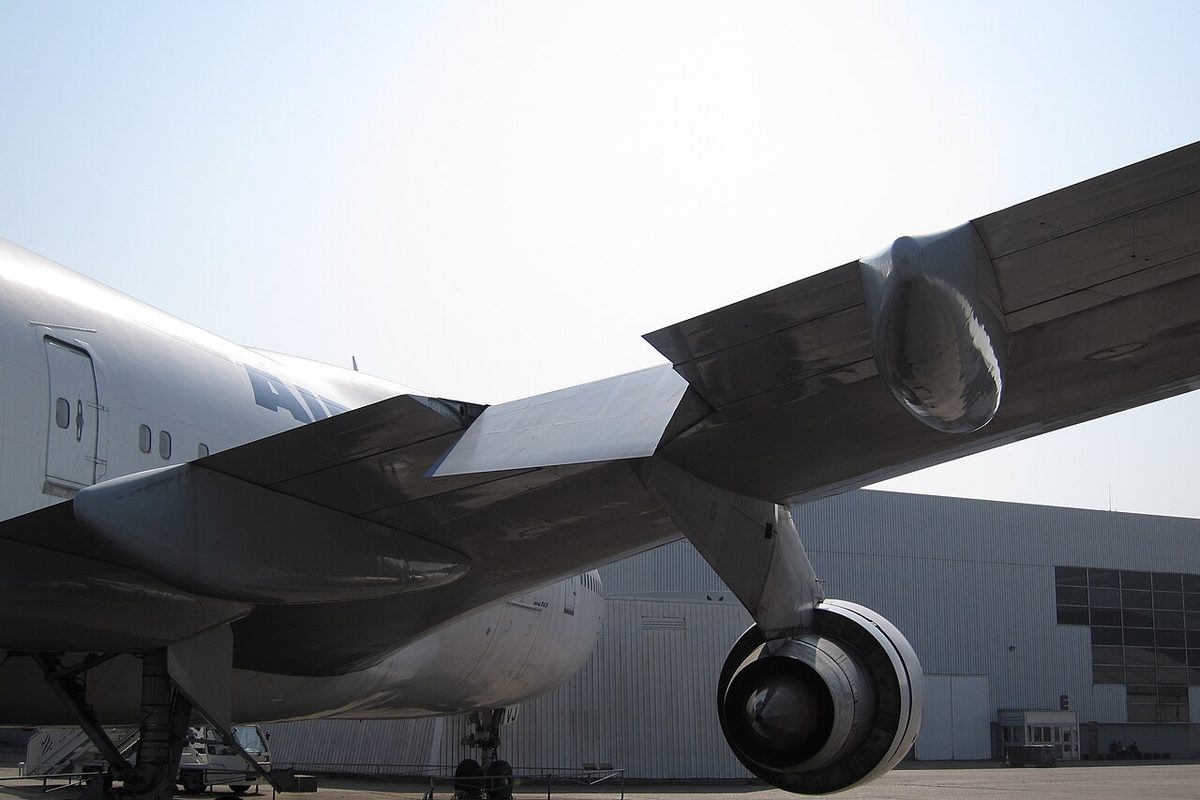
Ailerons are placed near the tips because there they produce the most rolling moment for a given force. On a long, thin, swept wing at high speed that position becomes a problem. The air load on a deflected aileron acts at the trailing edge, well behind the wing's torsional axis near the spars, and it twists the flexible outer wing: a down-going aileron twists the tip nose-down and reduces its angle of attack. As dynamic pressure rises, the twist cancels more of the aileron's effect, until above a critical speed the wing rolls the wrong way. This high-speed aileron reversal is explained in flutter and aeroelasticity.
Many jet transports therefore carry two pairs of ailerons. Outboard ailerons give strong roll control at low speed, where the loads are small, and are locked out when the flaps are retracted. Inboard ailerons, also called high-speed or all-speed ailerons, sit on a stiffer part of the wing with a shorter arm and twist it far less; they work at all speeds and, with the spoilers, provide the roll control at high speed. When the flaps are extended the outboard ailerons are brought back into use. The A320 has a single aileron on each wing, which droops 5° when the flaps are extended and works with the spoilers.
Roll spoilers
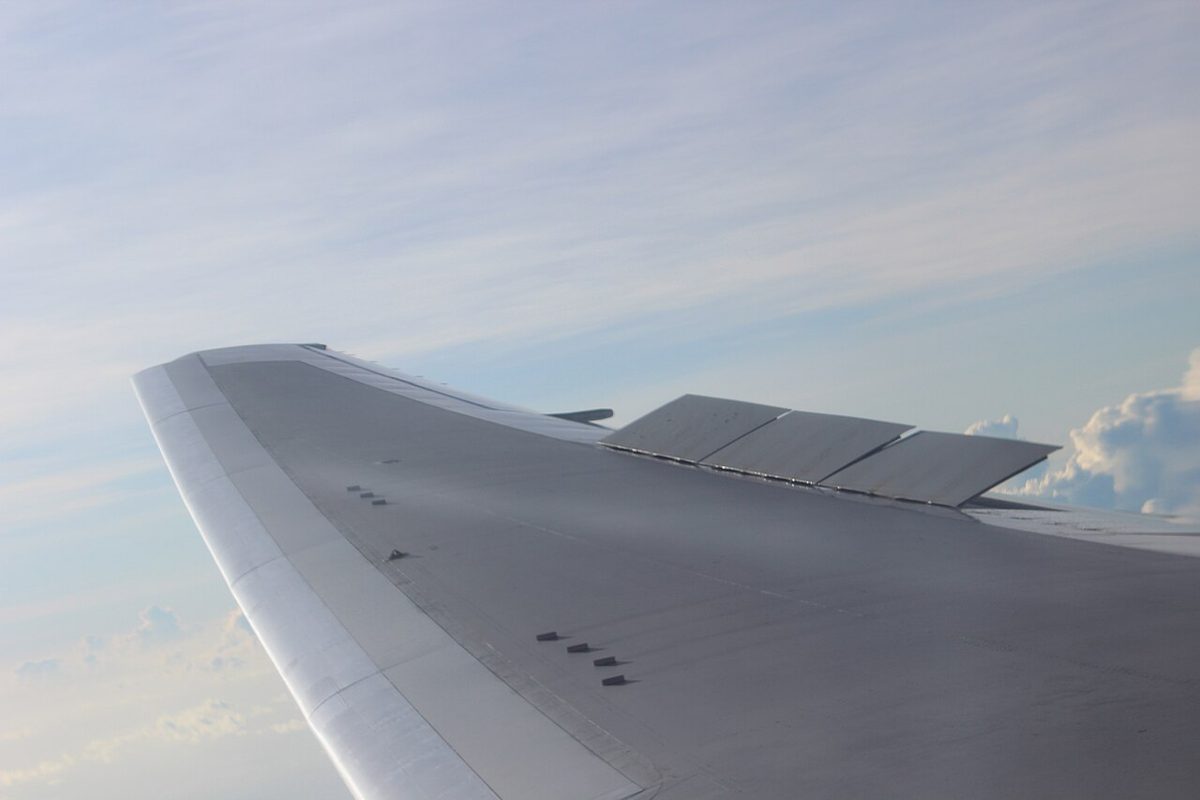
A spoiler is a hinged panel on the upper surface of the wing, ahead of the flaps. Raised, it disturbs the airflow over the wing behind it, reducing lift and increasing drag. A roll spoiler, or roll control spoiler, is used asymmetrically: it rises on the wing whose aileron goes up, the descending wing, and stays flush on the other. A mixer in the aileron system, or the flight control computers, raises the spoilers according to the roll demand.
On the Boeing 737 NG roll control comes from two ailerons and eight flight spoilers; the spoilers begin to rise once the control wheel is turned more than about 10°, on the wing with the up aileron. The A320 has one aileron and four roll spoilers on each wing. Having two independent systems also gives redundancy: on the 737, if the aileron system jams, force on the first officer's control wheel still rolls the aeroplane through the spoilers, and if the spoilers jam, the captain's wheel still works the ailerons.
| Compared with ailerons, roll spoilers | Reason |
|---|---|
| Produce no adverse yaw | Drag rises on the descending wing, so the yaw is proverse |
| Twist the wing less | The lift loss is spread across the chord behind the spoiler, not concentrated at the trailing edge |
| Stay effective at transonic speeds | They do not depend on flow over a trailing-edge surface behind a shock wave |
| Cannot flutter | A raised spoiler disturbs the flow without the alternating lift and hinge moment that feed flutter |
| Leave the trailing edge free | More span is available for flaps |
| Always reduce total lift | A spoiler can only destroy lift, so a roll brings a small net loss of lift |
Flight spoilers and spoiler blowdown
A flight spoiler is a spoiler used in the air. Most serve two roles. Moved asymmetrically they are roll spoilers; raised together on both wings by the speed brake lever they become speed brakes, increasing drag for a steeper descent or to lose speed. The two functions add: with the speed brakes out, a roll input raises the spoilers further on one wing and lowers them on the other. When the sum of the two demands exceeds the travel available, roll wins. On the A320, for example, the corresponding surface on the other wing retracts until the difference between the two equals the roll order.
A wing-mounted speed brake inevitably costs some lift as well. The ideal speed brake adds drag with no loss of lift and no change of pitching moment, which a fuselage-mounted air brake comes closer to achieving. Ground spoilers, or lift dumpers, are a separate function: after touchdown all the panels rise to destroy lift, putting the weight on the wheels so that the brakes work, and they are prevented from deploying in flight.
Spoiler blowdown, also called blow-back, is the retraction of a spoiler by the airflow. At high airspeed the aerodynamic load on a fully raised panel can exceed what its actuator can hold, so the panel is pushed back towards the wing and gives less than the selected deflection. The same thing happens after a hydraulic failure: an A320 spoiler that loses pressure keeps the deflection it had, or a smaller one if the air load pushes it down. Speed brakes are generally cleared up to VMO/MMO, with blowdown limiting their deflection at the top of the range.
Note: speed brakes have their own operating limits. The Boeing 737 limitations, for example, tell crews not to deploy the speed brakes in flight below 1,000 ft radio altitude, and the A320 inhibits speed brake extension with the flaps at FULL, when the angle of attack protection is active or with the thrust levers above MCT.
Frequently asked questions
What causes adverse yaw?
When the ailerons are deflected, the down-going aileron increases the lift of the rising wing and with it that wing's induced drag, while the up-going aileron reduces lift and induced drag on the descending wing. The drag difference yaws the nose away from the intended turn: roll right and the nose swings left. It is strongest at low airspeed and high lift coefficient, and is countered by rudder applied in the direction of the roll.
How do Frise ailerons reduce adverse yaw?
A Frise aileron is hinged well behind its leading edge. When it is raised, its nose projects below the lower surface of the wing into the airflow and adds drag on the descending wing, while the lowered aileron's nose stays shrouded. That extra drag balances part of the induced drag of the rising wing. The protruding nose also gives some aerodynamic balance. Rudder is still needed for fully balanced turns.
What are differential ailerons?
Differential ailerons are linked so that the up-going aileron moves through a larger angle than the down-going one. The larger upward deflection adds drag on the descending wing, so the drag difference between the wings, and with it the adverse yaw, is reduced. Many light aeroplanes use them, sometimes together with Frise ailerons, but neither design removes the need for co-ordinating rudder.
Why do airliners use spoilers for roll control?
A roll spoiler rising on the descending wing reduces that wing's lift and adds drag on the same side, so the yaw it produces is in the direction of the roll, with no adverse yaw. Spoilers twist the wing far less than an outboard aileron, stay effective at transonic speeds, cannot flutter and leave the trailing edge free for large flaps. Their drawback is a small net loss of lift during the roll.
Why are outboard ailerons locked out at high speed?
At high dynamic pressure the air load on an outboard aileron, acting near the flexible wingtip and behind the wing's flexural axis, twists the wing. The twist reduces the aileron's effect and above a critical speed can reverse it, so the wing rolls the wrong way. Many jets therefore use only inboard ailerons and spoilers when the flaps are retracted, and bring the outboard ailerons in when the flaps are extended for low-speed flight.
Test yourself on Roll Control, Adverse Yaw and Spoilers
The v1prep banks cover this topic in Principles of Flight (081), with a worked explanation for every answer. EASA ATPL, PPL, IR and CPL, the FAA written tests and A320/B737 type ratings.
Start practising →Sources and further reading
- FAA Pilot's Handbook of Aeronautical Knowledge (FAA-H-8083-25), Chapter 6, Flight Controls
- FAA Airplane Flying Handbook (FAA-H-8083-3C), Chapter 3, Basic Flight Maneuvers
- EASA, Explanatory Note to ED Decision 2018/001/R, Part-FCL theoretical knowledge learning objectives
- EASA Easy Access Rules for Large Aeroplanes (CS-25)
Library articles are written for study and exam preparation. They do not replace your aircraft's approved documentation, your operator's procedures or the regulations themselves.