Anti-Skid and Autobrake
Anti-skid is the system that releases and reapplies the brake pressure on each wheel so that it keeps rolling near the slip that gives maximum friction, preventing locked wheels. Autobrake applies the brakes automatically, at a selected deceleration after landing or with maximum pressure in a rejected take-off.
An anti-skid system keeps the wheels of a braking aircraft from locking. It watches the speed of each braked wheel and, whenever one starts to slow faster than the aircraft itself, releases that brake for an instant and then reapplies it. An autobrake goes a step further and applies the brakes without the pilot's feet: after landing at a deceleration the crew has selected, and in a rejected take-off with maximum pressure.
Together they let a crew brake hard without judging the runway surface. Certified landing and accelerate-stop distances assume the anti-skid works, and its benefit is greatest on a wet or contaminated runway, where a locked wheel gives almost no braking.
Purpose of anti-skid
Braking friction depends on wheel slip, the difference between the speed of the tyre's surface and the aircraft's ground speed. Friction rises as slip increases to a peak at roughly 10 to 15 per cent, then falls away; a locked wheel, at 100 per cent slip, gives much less braking and almost no side force, so it stops the aircraft poorly and cannot steer it. A locked tyre also wears through in a patch, the tyre flat spot, and on a wet runway it can start reverted-rubber aquaplaning or burst.
A pilot cannot feel the onset of a skid through the pedals of a heavy, fast aircraft with little aerodynamic drag. The anti-skid, also known by the name Maxaret, does it for every braked wheel, holding each near the peak of the friction curve. This is why the flight manual distances assume it is working, and why a dispatch with it inoperative carries heavy penalties.
Wheel speed sensing
Each braked wheel has a wheel speed transducer, a wheel speed sensor mounted in the axle that typically counts the teeth of a rotating exciter ring and sends a signal proportional to wheel speed to the anti-skid controller. Most transport systems give each main wheel its own transducer, so each wheel can be protected individually.
The controller also needs a reference: how fast the aircraft is really moving. The A320's brake and steering control unit (BSCU) computes a reference speed from the horizontal acceleration measured by the air data and inertial reference units, falling back to the fastest main wheel speed if all three fail. Wheel spin-up, the rapid rise in wheel speed at touchdown, is an important signal in its own right: it enables braking, and on many types it is one of the triggers for the ground spoilers and the autobrake.
Mechanical and electronic anti-skid
All anti-skid systems use the same controlling parameter: wheel deceleration. The system has a datum, the anti-skid datum deceleration, set higher than any deceleration the aircraft itself can achieve; European training texts quote about 18 ft/s² (about 6 m/s²). A wheel slowing faster than that cannot be following the aircraft. It must be starting to skid, so the brake pressure is reduced until the wheel recovers.
The first systems were mechanical. The mechanical anti-skid system uses a small flywheel driven by the wheel through a spring. When the wheel decelerates suddenly, the flywheel runs on by inertia, and the relative movement between the two opens a valve that releases the brake pressure.
The electronic anti-skid system has three elements: the wheel speed transducer, a control box that computes each wheel's deceleration and compares it with the datum, and a servo valve in the brake line that modulates the pressure. It reacts faster, can be tuned for each aircraft and can be tested before use; modern transport aircraft use electronic systems.
Skid control and pressure modulation
When a skid begins, the controller commands the servo valve, sometimes called the anti-skid valve, to reduce the pressure to that brake until the wheel speeds up again, then lets the pressure rise once more. Refinements make the cycle smoother:
- Adaptive pressure bias modulation reapplies a lower pressure than the one that caused the skid, so the wheel does not go straight back into it.
- A modulator valve in the brake line gives full flow on the first application, for a quick response, and restricted flow afterwards, so the anti-skid can adjust the pressure without large swings.
Systems with a reference speed can also work on slip directly. The A320's BSCU orders a brake release when a wheel's speed falls below about 0.87 times the reference speed, which holds the slip near the value that gives the best braking, and the ECAM WHEEL page shows the released brakes.
Protection depends on the brake mode. On the Boeing 737 the normal brake system gives each main wheel individual anti-skid protection, while the alternate system protects the main wheels in pairs. On the A320, anti-skid remains in alternate braking while the yellow hydraulic system supplies the brakes, but is lost when the brakes are fed by the accumulator alone or the A/SKID & N/W STRG switch is OFF.

Locked wheel and touchdown protection
Further functions protect the wheels where simple skid control is not enough.
Touchdown protection keeps the brakes released until the aircraft is on the ground and the wheels have spun up. While the air/ground system shows the aircraft airborne, the anti-skid holds the brakes off even with a pedal pressed; on the 737 it releases both normal and alternate brakes in flight for this purpose. Advanced systems compare wheel speed with inertial ground speed and allow braking only once the wheels have reached it. The aim is to prevent landing on locked wheels, which would flat-spot or burst the tyres.
Locked wheel protection deals with a wheel that has locked on a patch of ice, water or oil: the controller releases that brake completely until the wheel spins up again, then reapplies the pressure. One way of detecting it is to compare the speeds of paired wheels. On the E190-E2 the inboard wheels are compared with each other and the outboard wheels with each other, and the slower wheel is released if it is 33 per cent slower than the other; the function is disabled when the fastest wheel is below 30 kt.
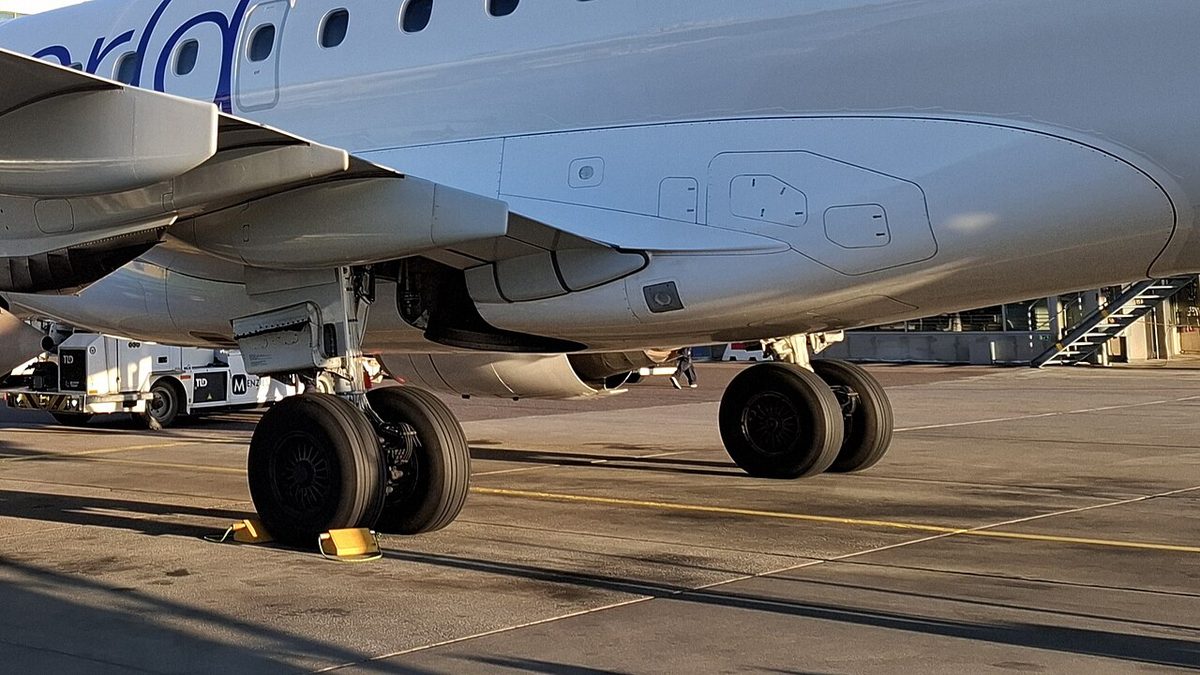
Hydroplane protection
When a braked wheel aquaplanes it spins down, and the anti-skid reads this as a skid and releases the brake, so braking achieves nothing until the tyre regains contact. If every braked wheel on a bogie aquaplanes at once, the system loses its reference. Hydroplane protection detects this and releases the pressure on some of the wheels, typically two on a four-wheel bogie, so that they spin up and restore a valid wheel speed; if aquaplaning persists, the other pair is released. On the Boeing 737 both the normal and the alternate brake systems provide skid, locked wheel, touchdown and hydroplane protection (see aquaplaning).
At very low speed the anti-skid is switched off so that the pilot has full control of the brakes for taxiing and tight turns. European training texts give about 20 mph (32 km/h); the A320's anti-skid is deactivated below 20 kt ground speed and the E190-E2's below 10 kt.
Autobrake modes
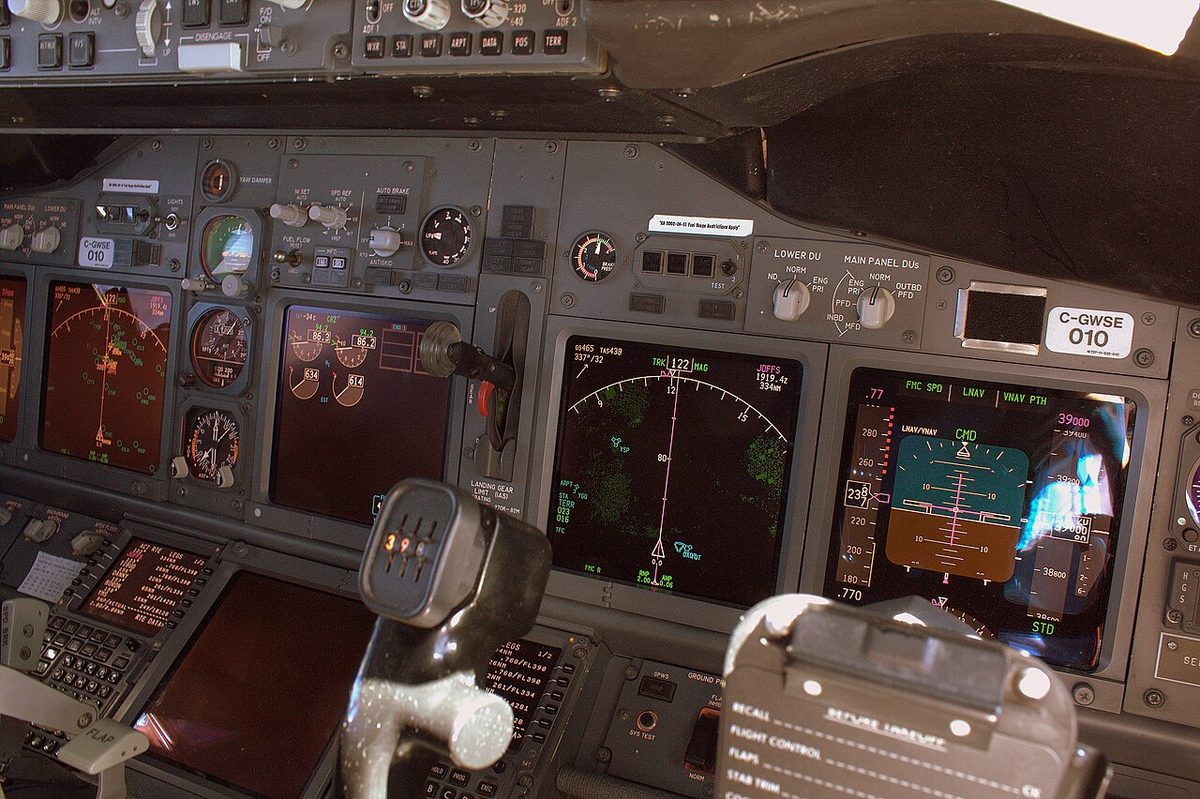
The autobrake uses the normal brake system to apply a selected deceleration automatically. It is armed before landing by selecting a setting: 1, 2, 3 or MAX on the Boeing 737, LO or MED on the A320, whose MAX setting cannot be armed in flight. It is not available in alternate braking, and anti-skid protection continues while it operates.
Braking starts on touchdown, once the system senses the aircraft on the ground:
- Boeing 737: both thrust levers at idle and main wheel spin-up.
- Airbus A320: the command to extend the ground spoilers. LO then applies pressure progressively 4 s after the spoilers deploy, aiming at 1.7 m/s² (5.6 ft/s²); MED after 2 s, aiming at 3 m/s² (9.8 ft/s²). If no ground spoilers extend, the autobrake does not activate and the crew must brake manually.
- Embraer E190-E2: both thrust levers at idle or in reverse with wheel speed above 60 kt.
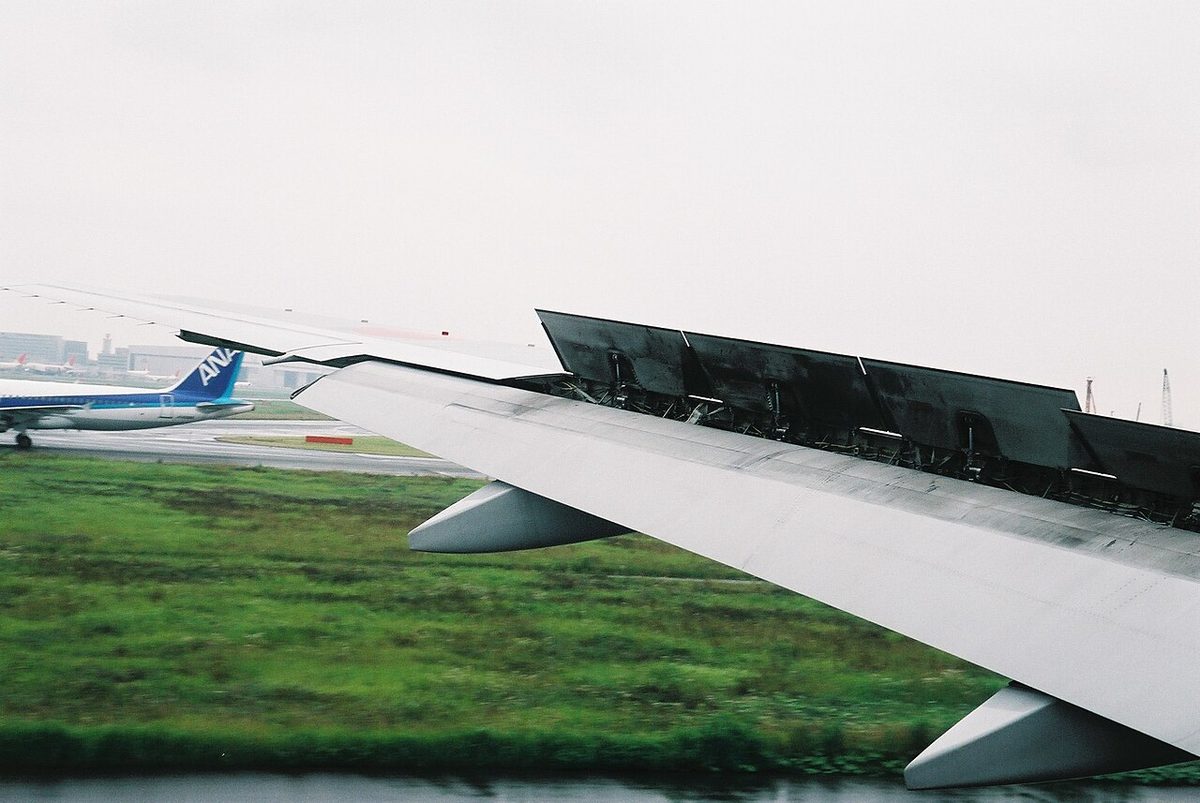
The autobrake controls deceleration, not pressure. As reverse thrust and spoilers add their share, it reduces brake pressure to hold the selected rate, so the brakes absorb less of the energy. On a dry runway even the 737's MAX landing setting decelerates less than full pedal braking. On a slippery runway the friction available, not the setting, decides the deceleration: the A320's green DECEL light, which comes on when the actual deceleration reaches 80 per cent of the selected rate, may then stay off although the autobrake is working (see landing distance).
The crew takes over by braking. On the 737, applying manual brakes, moving the speed brake lever to the down detent or advancing a thrust lever disarms the autobrake and lights AUTO BRAKE DISARM, except that thrust lever movement in the first 3 seconds after touchdown is ignored; on the A320, sufficient pedal deflection disarms it. Airbus crews disengage it with the pedals before 20 kt, and Boeing crews before taxi speed.
Rejected take-off autobrake
In the autobrake RTO mode the system is armed before take-off and applies maximum brake pressure the moment a rejected take-off begins, without waiting for the pilot's reaction. European training texts describe a generic RTO mode that acts when all thrust levers are closed above about 85 kt. Each type sets its own thresholds:
| Arms | Activates | |
|---|---|---|
| Boeing 737 NG | On the ground, wheel speed below 60 kt, thrust levers at idle, anti-skid and autobrake serviceable | Thrust levers retarded to idle at or above 90 kt wheel speed |
| Airbus A320 | MAX pressed before take-off, with green pressure, anti-skid powered and an ADIRU available | Ground spoiler extension command with wheel speed above 72 kt |
| Embraer E190-E2 | On the ground, average wheel speed below 60 kt, no failures | Average wheel speed above 60 kt with both thrust levers at idle or reverse |
Below the activation speed the RTO mode does nothing, and the pilot brakes manually. On the 737 a landing made with RTO still selected gives no automatic braking. During a reject the crew monitors the deceleration; if the AUTO BRAKE DISARM light comes on or the deceleration is not enough, the 737 procedure is to brake manually at once (see take-off procedures and rejected take-off).
Exam tip: anti-skid is controlled by wheel deceleration. Touchdown protection prevents braking before spin-up, locked wheel protection releases a locked wheel completely until it spins up again, and hydroplane protection releases some wheels of a bogie. Autobrake works only through the normal brake system.
When anti-skid is lost, braking changes character. On the A320, alternate braking without anti-skid limits brake pressure to 1,000 psi, and the LOSS OF BRAKING memory items transfer control from the BSCU to the alternate brake control unit: reverse to maximum, brake pedals released, A/SKID & N/W STRG switch OFF, then pedals pressed again with no more than 1,000 psi, and short parking brake applications if there is still no braking. Dispatch with an inoperative anti-skid is covered in brake energy and tyre speed limits.
Frequently asked questions
What does an anti-skid system do?
It stops the wheels locking when the brakes are applied. A sensor on each wheel measures its speed, and when a wheel slows down faster than the aircraft could, which means it is starting to skid, the system releases that brake's pressure and then reapplies it. The wheel keeps rolling near the slip that gives the most friction, so the aircraft stops sooner and can still be steered.
What is touchdown protection?
Touchdown protection stops the brakes from being applied before the wheels are on the ground and spinning. While the air/ground system shows the aircraft airborne, the anti-skid holds the brakes released even if a pedal is pressed. After touchdown, once the wheels have spun up, braking is allowed. It prevents landing on locked wheels, which would flat-spot or burst the tyres.
How does the RTO autobrake work?
RTO is armed before take-off. If the crew rejects the take-off by closing the thrust levers above a set wheel speed, the system applies maximum braking at once, without waiting for the pedals. On the Boeing 737 it arms below 60 kt wheel speed and acts if the thrust levers are retarded to idle at or above 90 kt; below 90 kt there is no autobraking and the pilot brakes manually.
Why does the autobrake not achieve the selected deceleration on a slippery runway?
The autobrake can only ask for a deceleration; the tyres and runway decide what is available. On a wet or contaminated surface the anti-skid releases the brakes whenever the wheels start to skid, so the achieved deceleration falls short of the setting. On the A320 the green DECEL light then stays off, which does not mean the autobrake has failed.
Can an aircraft take off with the anti-skid inoperative?
Often yes, under the minimum equipment list, but with penalties. The accelerate-stop distance increases, so V1 and the take-off mass are reduced using anti-skid inoperative performance data, and European training texts prohibit take-off from a wet runway in this state. On the Boeing 737, assumed temperature reduced thrust take-off is not permitted and the RTO autobrake cannot be armed.
Test yourself on Anti-Skid and Autobrake
The v1prep banks cover this topic in Aircraft General Knowledge (021), with a worked explanation for every answer. EASA ATPL, PPL, IR and CPL, the FAA written tests and A320/B737 type ratings.
Start practising →Sources and further reading
- FAA Aviation Maintenance Technician Handbook, Airframe (FAA-H-8083-31B), Chapter 13, Aircraft Landing Gear Systems
- 14 CFR 25.735, Brakes and braking systems
- EASA Easy Access Rules for Large Aeroplanes (CS-25), CS 25.735 Brakes and braking systems
- FAA AC 91-79B, Aircraft Landing Performance and Runway Excursion Mitigation
- FAA AC 120-62, Takeoff Safety Training Aid
- EASA Easy Access Rules for Aircrew (Part-FCL), theoretical knowledge syllabus, 021 Airframe, Systems, Electrics, Power Plant
Library articles are written for study and exam preparation. They do not replace your aircraft's approved documentation, your operator's procedures or the regulations themselves.