Longitudinal Stability
Longitudinal stability is an aeroplane's stability in pitch, about its lateral axis: its tendency to return to the trimmed angle of attack and speed after a disturbance. It is provided mainly by the tailplane and depends on how far the centre of gravity lies ahead of the neutral point.
Longitudinal stability is stability in pitch. It decides whether an aeroplane, once trimmed, holds its angle of attack and speed when a gust or a brief control input disturbs it, and how the control forces tell the pilot that speed or load factor has changed. It is the one form of stability that can usually be studied on its own, because a pitching motion does not by itself cause roll or yaw.
Its main ingredients are the tailplane, the position of the centre of gravity (CG) relative to a point called the neutral point, and the behaviour of the elevator when the pilot lets go. Together they explain the forward and aft CG limits, the different feel of the same aeroplane at different loadings, and the two pitch oscillations, the phugoid and the short period, that every conventional aeroplane possesses. The general ideas of static and dynamic stability are set out in aircraft axes and stability fundamentals.
Static longitudinal stability
Static longitudinal stability is the initial tendency of an aeroplane, after a disturbance in pitch, to return to its trimmed angle of attack. Suppose an upward gust raises the angle of attack of both the wing and the tailplane:
- The wing's lift increases. The change can be taken to act at the wing's aerodynamic centre, near 25 % of the mean aerodynamic chord. When the CG lies behind that point, as it usually does, the extra lift pitches the nose further up. A wing on its own is therefore statically unstable in pitch.
- The tailplane's lift also changes, upwards. Acting on a long arm behind the CG, that change pitches the nose down, against the disturbance.
If the tailplane's nose-down moment exceeds the wing's nose-up moment, the aeroplane has positive static longitudinal stability. On a graph of pitching moment coefficient against angle of attack, a stable aeroplane shows a negative slope: a nose-up disturbance produces a nose-down moment. The tailplane's contribution grows with its area and its moment arm, which makes the horizontal stabiliser the primary source of pitch stability.
Most other parts of the aeroplane work against it:
- The fuselage is usually destabilising, because its own aerodynamic centre lies ahead of the CG.
- Downwash from the wing reduces the change in tailplane angle of attack for a given disturbance, weakening the tail's contribution. A T-tail placed above the downwash keeps more of it.
- A propeller ahead of the CG develops a force across its disc that grows with angle of attack, a destabilising effect that is greatest at high power and low airspeed.
- A thrust line below the CG makes the nose rise when power is increased.
- Flap increases the downwash at the tail and reduces the dynamic pressure there, and the usual net result is destabilising.
Because power and flap both erode stability, the least stable condition is often a powered approach or a go-around, and the neutral point in that configuration may be what sets the aft CG limit.
The tailplane and tail download
Stability and trim are separate questions. Stability depends on how the pitching moments change when the angle of attack changes; trim depends on whether they balance in the first place.
On a conventional aeroplane the wing's lift, taken at its aerodynamic centre, normally acts behind the CG, and a cambered wing also produces a nose-down pitching moment about that point. Lift and weight therefore form a nose-down couple. The tailplane balances it with a tailplane download, also called tail download or tail downforce, and normally flies at a negative angle of attack to produce it. In vertical equilibrium the wing must then support the weight plus the download, so the download costs induced drag, called trim drag, and raises the stalling speed. The further forward the CG, the larger the download, which is why a forward CG raises both the stall speed and the fuel burn (see centre of gravity).
The download is not what makes the aeroplane stable. Stability comes from the change in tail force when the angle of attack changes, and it exists whenever the CG is ahead of the neutral point, whatever the size or even the direction of the trimming load.
Exam tip: FAA texts explain pitch stability through this balance: with the CG ahead of the centre of lift the aeroplane is nose-heavy, and if the speed falls the tail download weakens, the nose drops and speed is regained. That is the answer FAA knowledge tests expect, and it describes how a conventional aeroplane behaves; the underlying condition is still a CG ahead of the neutral point.
The download changes with configuration. Lowering flap increases the downwash angle at the tail, which makes the tail's angle of attack more negative and increases the download, a nose-up effect that opposes the nose-down moment of the flap itself. On a thin tailplane contaminated by ice, the same extra downwash can stall it, as described in tail configurations.
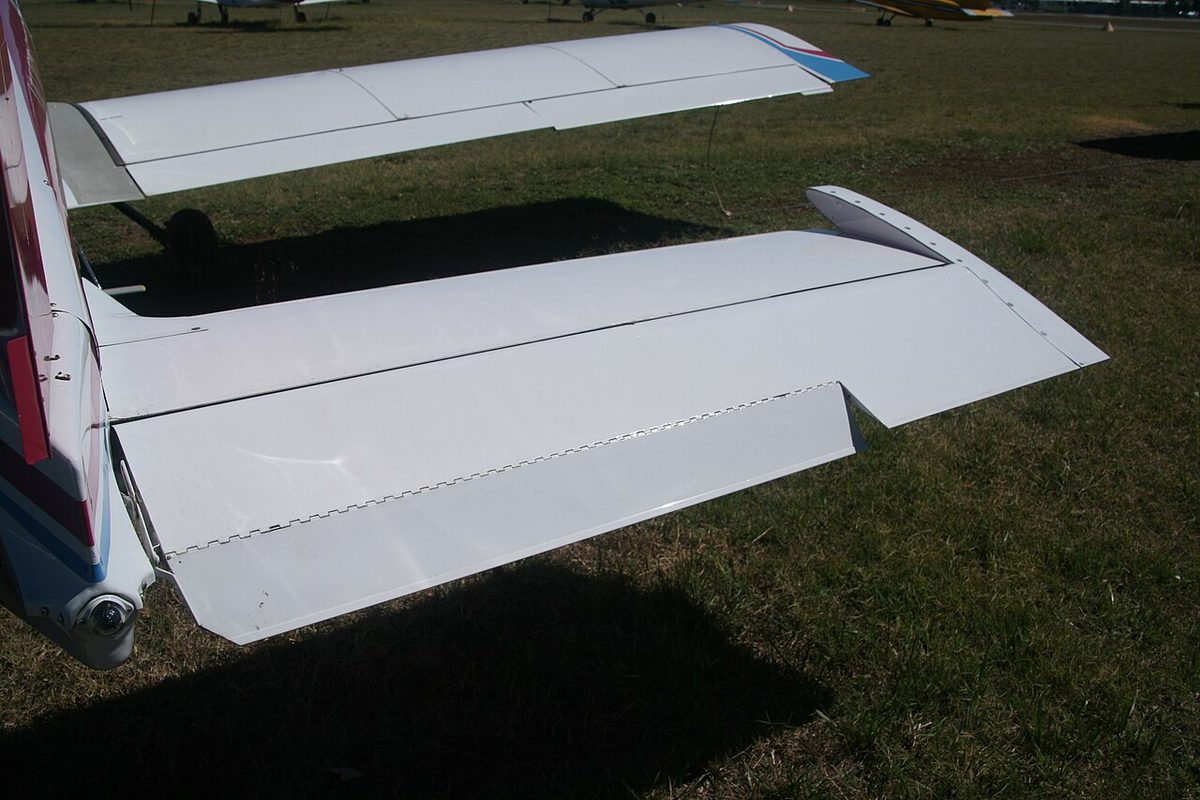
The trimming load is set either by an elevator held deflected by a trim tab or by a trimmable horizontal stabiliser, whose whole surface changes incidence while the elevator stays close to neutral. The second produces less trim drag and is the norm on jet transports.
CG, neutral point and static margin
Moving the CG forward lengthens the tailplane's moment arm and shortens the wing's, so stability increases; moving it aft does the reverse. Somewhere aft lies a CG position at which the stabilising and destabilising changes exactly cancel. That position is the neutral point (NP): the CG location at which the sum of the changes in tail and wing moments caused by a disturbance is zero, giving neutral static longitudinal stability. It can be pictured as the aerodynamic centre of the whole aeroplane, and it is the most aft CG position at which the aeroplane is not statically unstable.
The static margin is the distance the CG lies ahead of the neutral point, usually expressed as a percentage of the mean aerodynamic chord. It is the direct measure of static longitudinal stability: the larger the margin, the stronger the restoring moment. With the CG behind the neutral point the margin is negative, and a disturbance in pitch grows instead of dying away.
The CG limits keep the margin within a usable band:
- The aft CG limit lies some distance ahead of the neutral point to guarantee a minimum static margin, so in service the CG never reaches the neutral point. Spin recovery can also set the aft limit on light aeroplanes.
- The forward CG limit guarantees a minimum of controllability. The critical case is usually raising the nose in the landing flare, at low speed and in ground effect.
| Effect | CG forward | CG aft |
|---|---|---|
| Static margin and stability | Larger; more stable | Smaller; less stable |
| Stick forces and stick force per g | Heavier, higher | Lighter, lower |
| Controllability | Less | More |
| Tail download and trim drag | Greater | Smaller |
| Stall speed | Higher | Lower |

Warning: a CG behind the aft limit can remove the margin entirely. In 2003 Air Midwest flight 5481, a Beech 1900D, pitched up uncontrollably after take-off; the NTSB found a mis-rigged elevator combined with a CG well aft of the certified limit.
Stick-fixed and stick-free stability
The analysis so far assumes the elevator stays where it was. That is stick-fixed stability: the pilot holds the controls, or an irreversible powered control system holds the surface, and tailplane and elevator respond to a disturbance as one surface.
If the pilot lets go, an unbalanced elevator is free to trail with the airflow. When a disturbance raises the tailplane's angle of attack, the free elevator floats up towards the new relative airflow, which cancels part of the tail's change of lift. The tail becomes less effective, so stick-free static stability is less than stick-fixed stability and the stick-free neutral point lies ahead of the stick-fixed one. Horn balances, inset hinges and tabs change the floating tendency, and designers use them to keep an adequate stick-free margin.
Stick-free stability matters because it governs what the pilot feels. With positive stick-free stability a trimmed aeroplane needs a steady pull to hold a speed below the trim speed and a steady push to hold one above it, and when released it tends back towards the trim speed. On fully powered, irreversible controls the elevator cannot float; the forces come from an artificial feel system that senses dynamic pressure, and the feel and trim systems are designed to give the pilot the same message.
Stick force and stick force gradient
On a manual control the stick force is the force the pilot applies to balance the aerodynamic hinge moment on the surface, which is the surface force multiplied by its distance from the hinge line. That force is proportional to dynamic pressure, so for a given deflection the stick force rises with the square of the indicated airspeed.
The stick force gradient is the change in stick force per knot of speed away from the trim speed. It is how the pilot senses speed stability: a stable gradient means a pull below the trim speed and a push above it, so a speed change is felt before it is seen on the airspeed indicator. The gradient depends on the stick-free static margin; it becomes shallower as the CG moves aft and vanishes at the stick-free neutral point.
Where aerodynamics would spoil the gradient, systems restore it. A Mach trim system adds nose-up trim as Mach number increases, deliberately more than is needed simply to balance Mach tuck, so that the stick-force gradient stays stable (see high-speed flight). The Boeing 737's speed trim system improves speed stability at low weight, aft CG and high thrust when the autopilot is not engaged.
Stick force per g, manoeuvre point and manoeuvre margin
Stick force per g is the additional pull needed to increase the load factor by 1 g in a steady pull-up or turn. It tells the pilot how hard the wing is being loaded: too high and the aeroplane is tiring to manoeuvre, too low and a small pull can overstress it. The anti-servo tab on a stabilator is fitted partly to raise it.
In a steady pull-up the aeroplane is also rotating in pitch. The pitch rate increases the tailplane's angle of attack and adds a damping moment that the elevator must overcome, so more elevator, and more force, is needed for each g than static stability alone would suggest. The CG position at which the elevator angle per g (stick-fixed) or the stick force per g (stick-free) would fall to zero therefore lies behind the corresponding neutral point. That position is the manoeuvre point, and the distance of the CG ahead of it is the manoeuvre margin. As the CG moves aft the manoeuvre margin shrinks and so does the stick force per g, one of the reasons the aft limit is where it is.
Exam tip: do not confuse this manoeuvre margin, a CG distance, with the manoeuvre margin of performance, the load factor that can be pulled at cruise altitude before buffet onset, typically 1.3 g. See buffet and buffet margin.
Dynamic modes: phugoid and short period
After a disturbance in pitch, the motion of a conventional aeroplane combines two oscillations of very different character.
The short-period oscillation is a rapid pitching motion in which the angle of attack, the pitch rate and the load factor change sharply while speed and height stay almost constant. ATPL texts give its period as about one to two seconds or less. Because it changes the angle of attack so quickly, at a rate close to a pilot's reaction time, pilot inputs easily reinforce it, and certification requires it to be heavily damped. A pilot who meets it should relax or release the controls and let the damping work instead of chasing it. The damping comes mainly from the tailplane and decreases at high altitude.
The phugoid oscillation is a slow exchange of kinetic and potential energy. The nose drops, the aeroplane descends and gains speed; the extra speed gives extra lift, so it climbs, loses speed and the nose drops again. Pitch attitude, height and airspeed all vary noticeably, while the angle of attack stays almost constant. The period grows with true airspeed: ATPL texts quote one to two minutes, while in a light aeroplane it is tens of seconds. The phugoid may be only lightly damped, but it is so slow that the pilot or the autopilot removes it with small, unhurried corrections; a pilot often does so without noticing.
| Short period | Phugoid | |
|---|---|---|
| Speed and height | Almost constant | Vary |
| Angle of attack | Varies rapidly | Almost constant |
| Period | About 1 to 2 s or less | Tens of seconds (light aeroplane); 1 to 2 min in ATPL texts |
| Damping | Heavy; required by certification | Often light; acceptable |
| Pilot response | Relax or release the controls | Small, unhurried corrections |
Frequently asked questions
What is the neutral point of an aircraft?
The neutral point is the centre of gravity position at which a change in angle of attack produces no restoring pitching moment, because the changes in the tail and wing moments cancel out. With the CG there the aeroplane has neutral static longitudinal stability, and with the CG behind it the aeroplane is unstable in pitch. It can be thought of as the aerodynamic centre of the whole aeroplane, and the aft CG limit is always set some distance ahead of it.
What is static margin?
Static margin is the distance the centre of gravity lies ahead of the neutral point, normally expressed as a percentage of the mean aerodynamic chord. It measures static longitudinal stability directly: the larger the margin, the stronger the nose-down moment that follows a nose-up disturbance. Moving the CG aft reduces it, and at the neutral point it is zero. The aft CG limit exists to guarantee a minimum static margin.
Why does the tailplane produce a downforce?
On a conventional aeroplane the wing's lift acts behind the centre of gravity and a cambered wing adds a nose-down moment of its own, so the aeroplane is nose-heavy. The tailplane balances this with a download acting on a long arm behind the CG. The wing must then carry the weight plus that download, so a forward CG, which needs a larger download, raises the stall speed and the trim drag.
How does the centre of gravity position affect longitudinal stability?
A forward CG lengthens the tailplane's moment arm, so the aeroplane is more stable, with heavier stick forces, a higher stick force per g, more trim drag and a higher stall speed. An aft CG reduces the static margin, makes the aeroplane less stable and lighter to handle, and lowers the stick force per g, so it is easier to overstress. With the CG behind the neutral point the aeroplane becomes unstable in pitch.
What is the difference between the phugoid and the short-period oscillation?
The short period is a rapid pitch oscillation, quoted as one to two seconds or less, in which the angle of attack and load factor change at almost constant speed and height; certification requires it to be heavily damped. The phugoid is a slow exchange of speed and height, lasting tens of seconds in a light aeroplane and quoted as one to two minutes in ATPL texts, at almost constant angle of attack; it may be only lightly damped.
What is stick force per g?
Stick force per g is the extra pull needed to increase the load factor by one g in a steady pull-up or turn. It depends on the manoeuvre margin, the distance of the centre of gravity ahead of the manoeuvre point, so it falls as the CG moves aft. A low value means a small pull can produce a large load factor and overstress the aeroplane; a high value makes it tiring to manoeuvre.
Test yourself on Longitudinal Stability
The v1prep banks cover this topic in Principles of Flight (081), with a worked explanation for every answer. EASA ATPL, PPL, IR and CPL, the FAA written tests and A320/B737 type ratings.
Start practising →Sources and further reading
- FAA Pilot's Handbook of Aeronautical Knowledge (FAA-H-8083-25), Chapter 5, Aerodynamics of Flight
- FAA Aviation Handbooks and Manuals, Aircraft Weight and Balance Handbook (FAA-H-8083-1B)
- EASA, Explanatory Note to ED Decision 2018/001/R, Part-FCL theoretical knowledge learning objectives
- EASA Easy Access Rules for Large Aeroplanes (CS-25)
- NTSB AAR-04/01, Loss of Pitch Control During Takeoff, Air Midwest Flight 5481
Library articles are written for study and exam preparation. They do not replace your aircraft's approved documentation, your operator's procedures or the regulations themselves.