Buffet and Buffet Margin
Buffet is the irregular shaking of an aircraft caused by separated, unsteady airflow striking the wing, tail and fuselage, either near the stall or behind shock waves at high Mach number. The buffet margin is the extra load factor the aircraft can pull before buffet begins.
Buffet is the shaking an aircraft feels when separated, turbulent airflow strikes its wing, tailplane and rear fuselage. It appears at the two ends of the speed range. At low speed and high angle of attack it is the natural warning of an approaching stall. At high Mach number it is the sign that shock waves on the wing have become strong enough to separate the boundary layer, the process described in high-speed flight.
For a jet transport the two kinds of buffet set the edges of the usable speed range at altitude. The higher the aircraft flies, and the heavier it is, the closer those edges come. The buffet margin, conventionally 0.3 g and often quoted as 1.3 g of manoeuvre capability, is how operators and flight management systems keep enough room between them for turns and turbulence, and it is one of the main factors in choosing a cruise level.
What buffet is
A wing produces smooth, steady forces only while the boundary layer stays attached. Where it separates, the flow behind breaks into a turbulent wake whose pressures fluctuate rapidly. Those fluctuating pressures act on the wing itself and on whatever lies downstream, usually the tailplane and rear fuselage, and the structure shakes. The phenomenon is called aerodynamic buffet when the emphasis is on the unsteady flow, and airframe buffet when it is on the vibration the crew feels through the seat, the controls and the instrument panel. Exam texts use both terms for the same event, and buffet onset is the point at which it first becomes perceptible.
Buffet is a forced vibration. It lasts only as long as the separation that causes it, and it stops when the pilot removes the cause. That distinguishes it from flutter, a self-excited oscillation in which the airflow feeds energy into a coupled bending and twisting motion of the structure (see flutter and aeroelasticity).
Not all buffet is a warning of a limit. Extended speed brakes, landing gear or flaps can make the airframe rumble because they, too, shed a separated wake. On the Boeing 737 NG, moving the speed brake lever beyond the FLIGHT DETENT causes buffeting and is prohibited in flight. The two kinds that matter for the flight envelope are low-speed and high-speed buffet.
Low-speed (stall) buffet
As the angle of attack increases towards the critical angle, the adverse pressure gradient on the upper surface grows and the separation point creeps forward from the trailing edge. The turbulent wake from the separated region washes back over the tailplane and rear fuselage, and the aeroplane shakes. Felt before the stall this is pre-stall buffet, a natural stall warning; heavier buffeting at and beyond the stall is stall buffet. For large aeroplanes, CS 25.201 and 14 CFR 25.201 accept buffeting strong enough to deter further speed reduction as one of the ways a stall can be identified.
Low-speed buffet is always an angle of attack phenomenon, so it moves with everything that moves the stall speed. It rises with weight and with a forward centre of gravity, and with load factor it rises as √n, like the stall speed (see load factor and flight envelope).
At high altitude a second effect joins in. Above about M 0.4 compressibility lowers CLmax and the stalling angle, so at cruise Mach numbers the wing reaches separation at a lower lift coefficient than at low speed. The 1 g low-speed buffet speed therefore rises with altitude even as an equivalent airspeed. Manufacturers show this on the speed scale. On the Boeing 737 NG the top of the minimum manoeuvre speed amber bar gives 1.3 g of manoeuvre capability to the stick shaker below approximately 20,000 ft, and 1.3 g to low-speed buffet above it. On the Airbus A320, VLS above 20,000 ft is corrected for Mach so that it keeps a buffet margin of 0.2 g.
Exam tip: low-speed buffet onset is close to the stall speed adjusted for altitude and load factor. At high altitude it is the buffet, not the low-altitude stall warning, that defines the low-speed edge of the envelope.
High-speed (Mach) buffet
Above the critical Mach number, air accelerating over the upper surface becomes locally supersonic and returns to subsonic speed through a shock wave. The pressure jump across the shock imposes a steep adverse gradient on the boundary layer. Once the shock is strong enough the boundary layer separates behind it, and the turbulent wake strikes the tail and rear fuselage: this is high-speed buffet, also called Mach buffet or shock-induced buffet. The same separation causes the loss of lift known as shock stall and adds to the drag rise. A shock lying near a control hinge can also cause control buzz, and the rearward shift of the centre of pressure can produce the nose-down trim change known as Mach tuck.
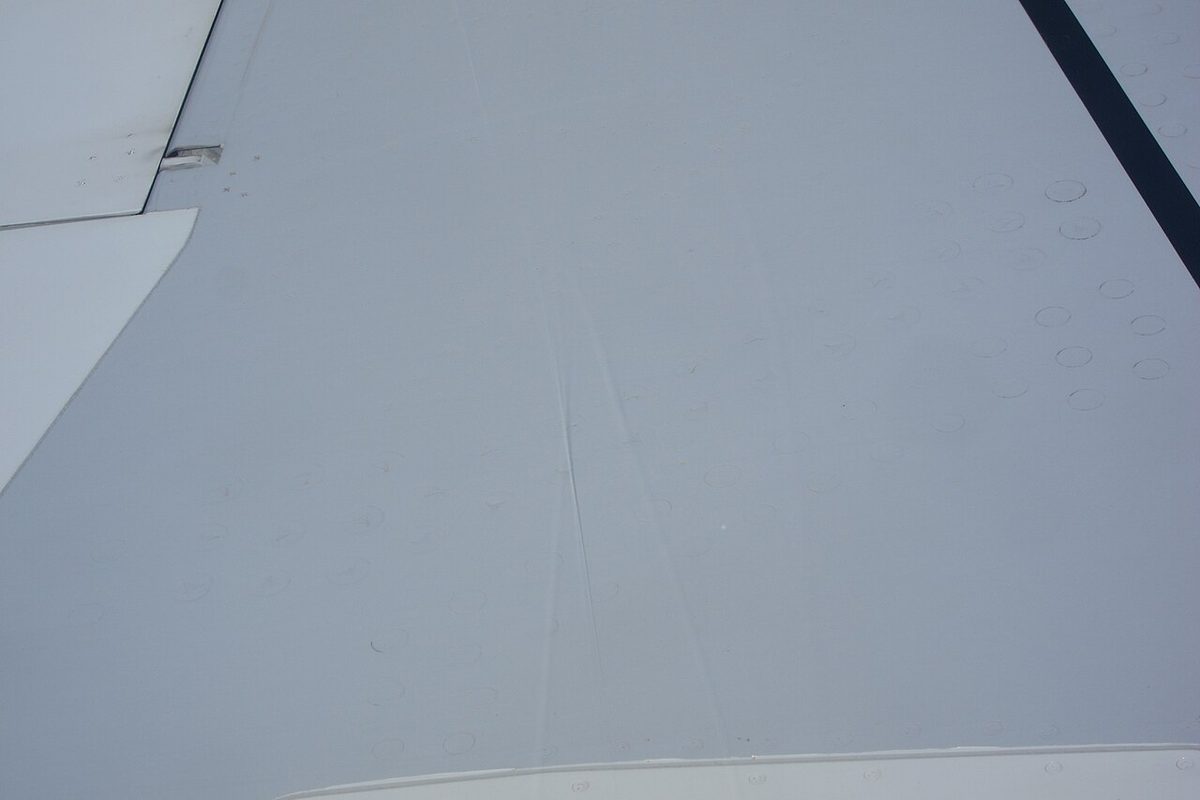
High-speed buffet must be avoided rather than explored. It occurs at high dynamic pressure, where the loads it imposes are large, and it can be accompanied by a nose-down trim change. The cure is to reduce the Mach number and, if buffet was triggered by manoeuvring, the load factor as well.
Because the critical Mach number falls as the angle of attack rises, anything that raises the angle of attack at a given Mach number lowers the high-speed buffet onset Mach number:
- Weight. A heavier aircraft needs a higher angle of attack at the same Mach number.
- Altitude. Thinner air needs a higher lift coefficient for the same Mach number.
- Load factor. A turn or pull-up, and every upward gust, raises the angle of attack.
- Forward centre of gravity. The larger tail download must be carried by extra wing lift, which acts like extra weight.
The maximum operating Mach number MMO is set with a margin to buffet onset, but MMO is a fixed number while the buffet onset Mach number moves. An aircraft that is manoeuvring or in turbulence, particularly when heavy and high, can meet high-speed buffet below MMO.
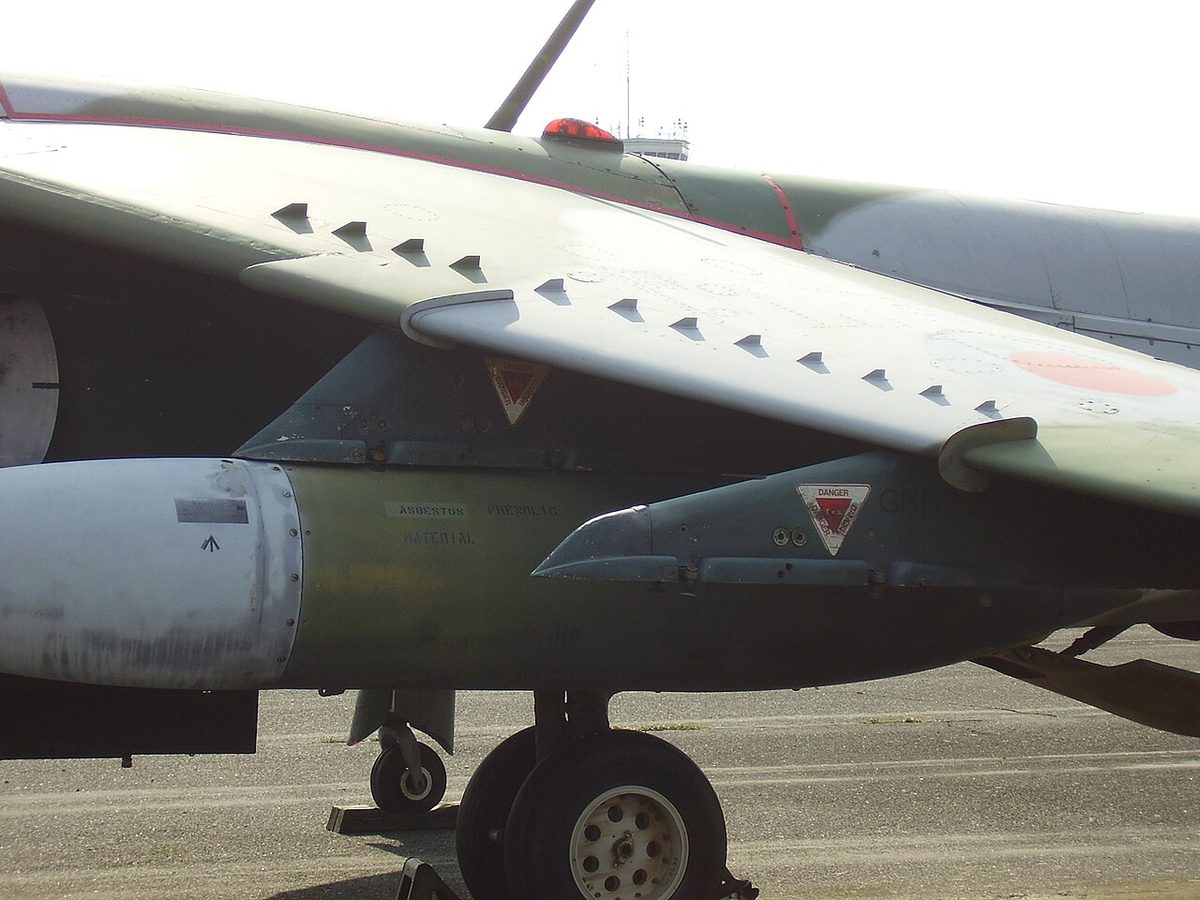
Designers push the onset back with sweepback, thin and supercritical sections, and vortex generators, small vanes that mix high-energy air into the boundary layer so that it survives the shock with less separation (see swept wings).
The buffet onset boundary chart
The flight manual of a jet transport contains buffet onset data, usually as a chart. For a given weight, centre of gravity position and pressure altitude, it shows the Mach numbers at which low-speed and high-speed buffet begin at 1 g, and how those Mach numbers close in as the load factor rises. Read the other way, it gives the load factor, and so the bank angle, at which buffet will start at a chosen Mach number. Crews use it, or the flight management system that contains the same data, to check the manoeuvre capability of a planned cruise level and to find the maximum altitude for the current weight.
The buffet onset boundary is the resulting pair of curves. Between them lies the buffet-free region; outside them, on the low-speed or the high-speed side, the aircraft buffets. The boundaries move as follows:
| Change | Low-speed buffet boundary | High-speed buffet boundary | Usable speed range |
|---|---|---|---|
| Higher altitude | Moves to a higher Mach number | Moves to a lower Mach number | Narrower |
| Higher weight | Moves to a higher speed | Moves to a lower Mach number | Narrower |
| Higher load factor (turn, gust) | Moves to a higher speed | Moves to a lower Mach number | Narrower |
| Forward centre of gravity | Moves as for a weight increase | Moves as for a weight increase | Narrower |
| Aft centre of gravity | Moves to a lower speed | Moves to a higher Mach number | Wider |
Every factor that narrows the range also narrows the margin at a given flight level. The combination to watch is high altitude early in a long flight, at high weight, in turbulence.

Buffet margin and the 1.3 g rule
The buffet margin is the difference between the load factor the aircraft is flying at, 1 g in straight and level flight, and the load factor at which buffet begins. It is quoted in g. A buffet margin of 0.3 g means the wing can produce 1.3 times the aircraft's weight in lift before either buffet boundary is reached.
A margin of 0.3 g, or 1.3 g of manoeuvre capability, is the conventional figure used by manufacturers and operators to set the maximum cruise altitude. Its practical meaning comes from the level-turn formula n = 1 ÷ cos φ: 1.3 g is the load factor of a level turn at about 40° of bank, and it also covers a moderate vertical gust. At 1.3 g the low-speed buffet speed is about 14 per cent higher than at 1 g, because √1.3 is about 1.14. Some operators and some operations use a different figure, and the operator's policy and the flight manual decide.
Type examples show how the rule reaches the cockpit:
- Airbus A320. The MAX REC FL on the MCDU PROG page gives at least a 0.3 g buffet margin. The crew may enter a higher cruise flight level, but the FMGS accepts it only if the margin is still greater than 0.2 g; otherwise it rejects the entry with the message CRZ ABOVE MAX FL.
- Boeing 737 NG. With flaps up, the bottom of the maximum manoeuvre speed amber bar gives 1.3 g of manoeuvre capability to high-speed buffet, and the top of the minimum manoeuvre speed bar gives 1.3 g to the stick shaker or, above approximately 20,000 ft, to low-speed buffet. Boeing notes that 1.3 g corresponds to 40° of bank in level flight.
The buffet margin is one of two limits on cruise altitude. The other is thrust: the thrust-limited maximum altitude is where the thrust required to hold the cruise speed equals the maximum cruise thrust available, and it falls on a hot day. The maximum altitude shown by a flight management system is the lower of the two. Both are covered in buffet boundaries and maximum altitude.
Exam tip: a buffet margin of 0.3 g = 1.3 g capability = about 40° of bank in a level turn. At the aerodynamic ceiling the margin is zero.
The margin matters most in turbulence. The turbulence penetration speed in the flight manual balances the gust load margin, which favours a lower speed, against the buffet margin at altitude, which favours a higher one. If turbulence is met at high altitude where the margins are small, the standard advice is to fly the rough-air speed and descend to widen them. On the A320, when the flight controls have reverted to alternate or direct law at high altitude, Airbus advises descending, and notes that about 4,000 ft below REC MAX significantly reduces the occurrence of stall warnings in turbulence.
The coffin corner
As altitude increases at a given weight, the low-speed buffet boundary rises in Mach number, because the thinner air demands a higher lift coefficient and compressibility lowers the lift coefficient at which separation starts. The high-speed buffet boundary falls, because the higher angle of attack lowers the critical Mach number. Eventually the two meet. That altitude is the aerodynamic ceiling, also called the buffet-limited ceiling or coffin corner. There, only one speed can be flown at 1 g without buffet; any turn, gust or speed change in either direction produces buffet, low-speed on one side and Mach buffet on the other.
The coffin corner is a limit, never an operating point. The 1.3 g margin keeps aircraft well below it, and at a higher weight it is lower still. Ignoring the margin has a clear consequence: above its maximum altitude the aircraft sits between the buffet boundaries with little thrust in reserve, where a turn or a gust can trigger buffet or a loss of speed from which the only recovery is a descent.
Some fly-by-wire aircraft protect the low-speed edge automatically. On the A320 the angle of attack at which high angle of attack protection begins is reduced as a function of Mach at high flight levels, so that the protection guards the buffet boundary rather than only the low-speed stall. The protection is a safety net, not a substitute for choosing a level with the proper margin.
Warning: climbing above the recommended maximum altitude to top weather or save fuel removes the margin that turbulence and turns rely on. A heavy aircraft at its maximum altitude can be pushed into buffet by a gust or a routine turn.
Frequently asked questions
What is the difference between low-speed buffet and high-speed buffet?
Low-speed buffet, or stall buffet, comes from boundary layer separation at a high angle of attack as the wing approaches the stall. High-speed buffet, or Mach buffet, comes from separation behind shock waves on the wing above the critical Mach number. In both cases the turbulent wake shakes the airframe. The first is cured by reducing the angle of attack, the second by reducing the Mach number and the load factor.
Why do airlines use a 1.3 g buffet margin?
A 1.3 g margin means the aeroplane can pull 1.3 times its weight in lift, 0.3 g more than level flight, before buffet starts. That covers a level turn at about 40 degrees of bank or a moderate gust. Operators and flight management systems use it to set the maximum recommended cruise altitude for the current weight, because higher up the margin shrinks and any gust or turn would cause buffet.
What is the coffin corner?
The coffin corner is the altitude at which the low-speed buffet boundary and the high-speed buffet boundary meet for a given weight. There is then only one speed at which the aeroplane can fly at 1 g without buffet, and any turn, gust or speed change produces buffet. It is also called the aerodynamic ceiling. Aircraft are never operated there: the buffet margin keeps them well below it.
Does a heavier aircraft have a smaller buffet margin?
Yes. A heavier aircraft needs a higher lift coefficient and angle of attack at any given speed. The low-speed buffet boundary moves to a higher speed, and because the critical Mach number falls with angle of attack the high-speed buffet boundary moves to a lower Mach number. The usable speed range narrows at every altitude, which is why the maximum cruise altitude is lower early in a long flight.
Is buffet the same as flutter?
No. Buffet is a forced vibration: separated airflow with fluctuating pressures shakes a structure that would otherwise be steady, and it stops when the separation stops. Flutter is a self-excited aeroelastic oscillation in which the airflow feeds energy into a coupled bending and twisting motion, so its amplitude can grow until the structure fails. Buffet is a warning; flutter is a structural failure mode.
Test yourself on Buffet and Buffet Margin
The v1prep banks cover this topic in Principles of Flight (081), with a worked explanation for every answer. EASA ATPL, PPL, IR and CPL, the FAA written tests and A320/B737 type ratings.
Start practising →Sources and further reading
- FAA AC 61-107B, Aircraft Operations at Altitudes Above 25,000 Feet MSL and/or Mach Numbers Greater Than .75
- FAA Pilot's Handbook of Aeronautical Knowledge (FAA-H-8083-25), Chapter 5, Aerodynamics of Flight
- FAA Airplane Flying Handbook (FAA-H-8083-3C), Transition to Jet-Powered Airplanes
- EASA Easy Access Rules for Large Aeroplanes (CS-25)
- Airplane Upset Prevention and Recovery Training Aid, Revision 3 (ICAO and manufacturers)
- EASA, Explanatory Note to ED Decision 2018/001/R, Part-FCL theoretical knowledge learning objectives
Library articles are written for study and exam preparation. They do not replace your aircraft's approved documentation, your operator's procedures or the regulations themselves.