Landing Gear Indication and Configuration Warnings
Landing gear indication shows the crew whether each gear leg is down and locked, in transit or up and locked. Configuration warnings back it with sound: one when the aeroplane approaches to land with a leg not locked down, another when take-off thrust is set with flaps, trim, spoilers or brakes wrongly positioned.
Landing gear indication tells the crew where each gear leg is: down and locked, travelling, or up and locked. Configuration warnings add sound to that picture. One warns that the aeroplane is approaching to land with a leg not locked down; another, the take-off configuration warning, sounds when take-off thrust is set with the flaps, trim, spoilers or parking brake in the wrong position.
Both guard against some of the most avoidable accidents in aviation. A wheels-up landing with serviceable gear, or a take-off with the flaps retracted, needs no failure at all, only a missed check. Certification standards therefore require them on large aeroplanes: CS 25.729 and 14 CFR 25.729 call for a gear position indicator and an aural warning, and CS 25.703 and 14 CFR 25.703 for a take-off warning system.
Gear position indication
Each gear leg carries sensors that detect when its locks engage. Classic designs use microswitches on the uplocks and downlocks. Transport aircraft use proximity sensors read by dedicated computers, such as the proximity switch electronic unit (PSEU) of the Boeing 737 or the two landing gear control and interface units (LGCIUs) of the Airbus A320. The sensors drive the landing gear position indicator on the flight deck, which follows a near-universal code:
| Indication | Meaning |
|---|---|
| Green | Gear down and locked |
| Red | Gear in transit, unlocked, or not where the lever has selected |
| No light | Gear up and locked |
This is the origin of three greens: one green light for the nose gear and one for each main gear, the landing gear downlock indication that a tricycle undercarriage is ready for landing. Each leg has its own light, so every downlock is confirmed separately. Some light aircraft simplify the display, with a single green light for all gear down and locked and an amber light for gear up and locked.
The bulbs of a lamp-type indicator are usually duplicated. With a single bulb, a burnt-out filament would leave a leg that is down and locked looking unsafe; with two, both must fail before the indication is lost. Many transport aircraft also monitor the gear doors, because a door left unlocked in flight adds drag and can be damaged by the airflow.
Three airliner families show how the principle is applied:
- Boeing 737. On the centre panel each gear has a red light above a green one. The red light comes on while that gear disagrees with the lever, including the time in transit, and also when the gear is not down and locked with a thrust lever at idle below 800 ft AGL. The green light means down and locked. A second, separate set of green lights with its own circuits sits on the overhead panel, and a gear counts as down and locked as long as one green light for it, centre or overhead, is lit.
- Airbus A320. The LDG GEAR panel shows a green triangle for each gear locked down and a red UNLK light when a gear is not locked in the selected position. It is wired to LGCIU 1 only, so the ECAM WHEEL page, which shows two triangles per gear, one from each LGCIU, is the cross-check: green for downlocked, red for in transit, nothing for uplocked, amber crosses for a failed LGCIU. One green triangle per gear is enough to confirm it downlocked. The same page shows L/G CTL in amber when lever and gear disagree and the gear is not moving to match.
- Embraer E190. The first-generation E190 shows a leg in transit as an amber cross-hatched box, and gives an LG LEVER DISAG warning if gear and lever still disagree 20 seconds after the lever was moved.
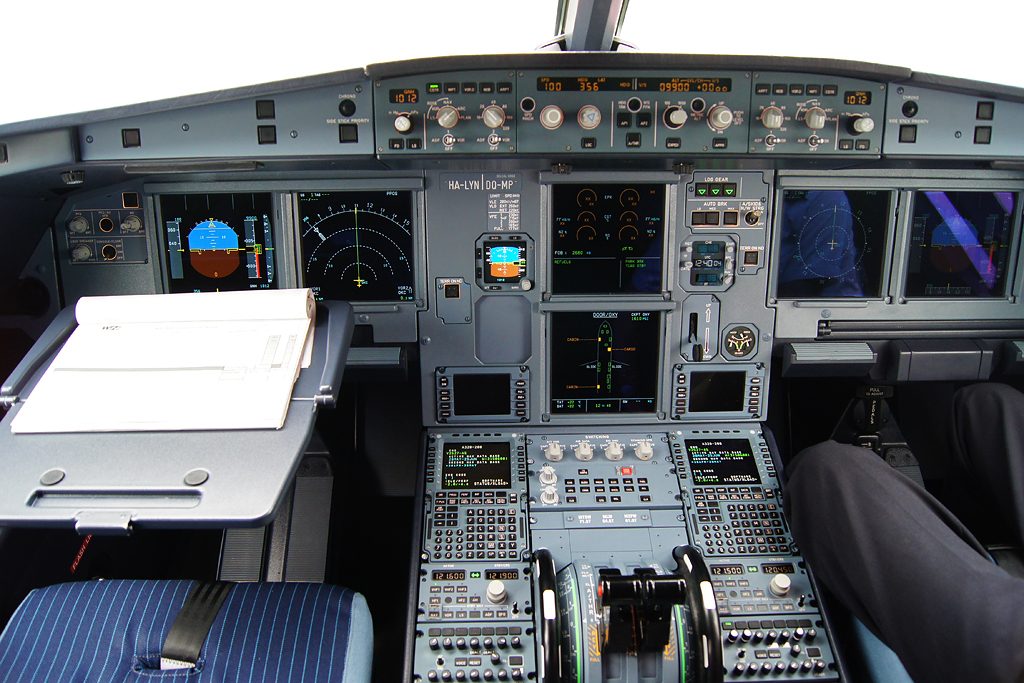
Mechanical gear position indicators
Electrical indication depends on sensors, wiring and power. A mechanical gear position indicator does not. It is a flag, pointer or viewing port, linked to the gear or placed where a crew member can see part of the mechanism, that shows a leg is down and locked even after an electrical failure. It is most valuable after an emergency extension, when the normal indication may be unavailable or in doubt (see landing gear retraction and extension).
Outside help is more limited. A light aircraft pilot may see a leg in a mirror, and a tower fly-by lets controllers look at the gear, but they report only what they see, with phrases such as "landing gear appears down". Nobody outside the aeroplane can confirm that a leg is locked.
The same sensors that watch the locks also tell the aeroplane whether it is on the ground. Proximity sensors on the gear legs detect strut compression, the air/ground or weight-on-wheels signal: the 737 has six, two on each gear. On the ground this signal locks the gear lever in the down position, and it switches many other systems, including the take-off configuration warning, between their ground and flight modes.
Gear not down warning
The landing gear not down warning, the gear warning horn, catches an approach continued with the gear up. It cannot know the pilot's intention, so it infers it from the configuration. European training texts describe the classic design as a throttle-operated switch: the horn sounds when a throttle is less than about one third open and any gear is not down and locked. On a light retractable it sounds when the throttle is closed, or landing flap is selected, with the gear not down and locked.
Transport aircraft refine the logic with flap position and radio altitude, and the warning becomes harder to silence the closer the aeroplane is to landing. On the Boeing 737 the landing gear warning horn is a steady horn that sounds, with a gear not down and locked, as follows:
| Flap position | Horn sounds when | Can it be silenced? |
|---|---|---|
| Up to 10 | Below 800 ft RA, with a thrust lever between idle and about 20° of thrust lever angle, or with an engine not operating and the other thrust lever below 34° | Yes, with the HORN CUTOUT switch, but not below 200 ft RA |
| 15 to 25 | A thrust lever below about 20°, or an engine not operating and the other thrust lever below 34° | No |
| More than 25 | Whatever the thrust lever position | No |
The Embraer E190-E2 uses the same principle. With flaps 0 to 4, its LDG GEAR aural warning needs a thrust lever below 45° (60° with one engine inoperative) and a radio altitude below 700 ft; the first-generation E190 uses 38° and 57°, and with flaps 5 or full its warning sounds whatever the thrust and cannot be silenced. On the A320 a red arrow lights on the gear lever when the gear is not locked down in the landing configuration, with a red ECAM warning, and the L/G NOT DOWN aural, unlike most others, cannot be silenced with the MASTER WARN pushbutton.
Training texts also call this horn the landing configuration warning, and Boeing's 737 manuals the landing gear configuration warning, because flap position is one of its inputs. On the 737 it is a function of the PSEU, which also handles the take-off configuration warning, the gear indication and air/ground sensing.
Ground proximity warning systems add an independent layer. GPWS Mode 4A, which compares radio altitude with airspeed and configuration rather than thrust, gives "TOO LOW GEAR" when the aeroplane is low and slow with the gear up; on the 737 a guarded GEAR INHIBIT switch suppresses that alert (see GPWS and TAWS).
Warning horn and isolation switch
A horn that sounds at the wrong moment tempts pilots to silence it, and one that cannot be silenced is a nuisance in training and on the ground. Older designs answer with a horn isolation switch, which temporarily silences the gear warning, for example on practice approaches flown at low power with the gear up, or during ground servicing with the engines running. Its weakness is plain: a switch left in the isolated position removes the warning for the approach that needs it. European training texts prefer an airspeed switch, which inhibits the horn above a set speed and cannot be left switched off; some aircraft have both.
Modern designs allow silencing only where a genuine warning is least likely. The 737 HORN CUTOUT switch works only with flaps up to 10 and above 200 ft RA. The first-generation E190's LG WRN INHIB may be used only when both radio altimeters have failed, since its warning logic depends on radio altitude. Whatever the type, a gear horn is answered by checking the gear, never by silencing it first.
The sound itself carries meaning. On the 737 the landing gear warning is a steady horn, while the take-off configuration and cabin altitude warnings share an intermittent one; European training texts make the same distinction between a steady gear horn and an intermittent take-off configuration horn. Sharing a tone proved fatal in the Helios Airways accident of 2005, when the crew took the cabin altitude warning for a configuration warning (see flight warning and alerting systems).
Exam tip: steady horn in flight, gear not down; intermittent horn on the ground with thrust set, take-off configuration. On the 737, an intermittent horn in flight is the cabin altitude warning.
Take-off configuration warning
The take-off configuration warning works the other way round. It is armed only on the ground and sounds when the thrust levers are advanced for take-off with the aeroplane not set up for it. CS 25.703 and 14 CFR 25.703 require an aural warning in the early part of the take-off roll, while a rejected take-off is still a low-speed stop. On the Boeing 737 it gives an intermittent horn and red TAKEOFF CONFIG lights if either forward thrust lever is advanced with:
- the trailing edge flaps outside the 1 to 25 take-off range, or in skew, asymmetry or uncommanded motion;
- the leading edge devices not in take-off position, or moving uncommanded;
- the speed brake lever not DOWN, or the spoiler control valve open;
- the parking brake set;
- the stabiliser trim outside the take-off range.
The A320 shows CONFIG warnings on the ECAM. Its T.O CONFIG pushbutton simulates take-off power, so that the crew can test the configuration before take-off and see T.O CONFIG NORMAL if all is well. Most items respond to the test, among them slats, flaps, pitch and rudder trim, speed brakes, doors and BRAKES HOT, but CONFIG PARK BRK ON and the thrust lever check appear only when take-off power is actually set. The E190-E2 also warns when the flaps disagree with the take-off setting entered in the FMS, and other types monitor flight control locks and doors.
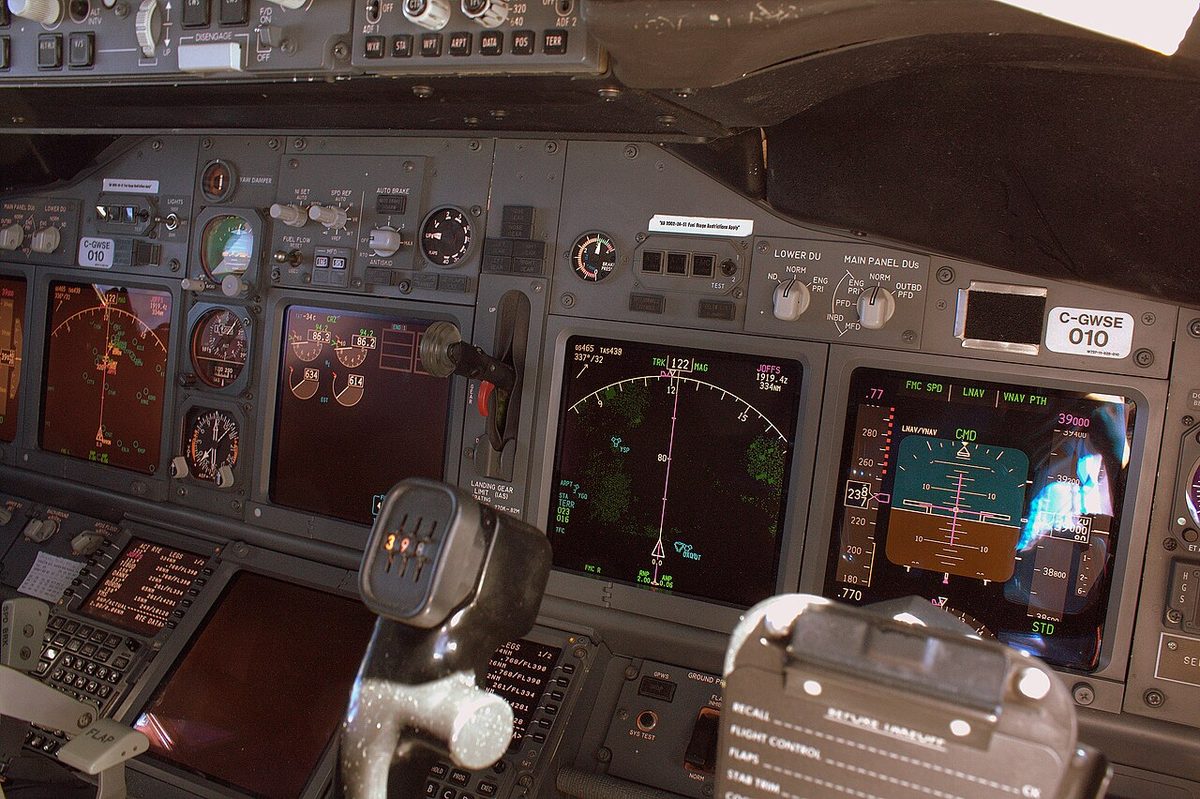
The warning is a last line of defence, and it can be defeated. In the Northwest Airlines Flight 255 accident at Detroit in 1987 and the Spanair Flight 5022 accident at Madrid in 2008, both McDonnell Douglas MD-82s, the flaps and slats were not set for take-off, the checklists did not catch it and the take-off warning did not sound. Crews therefore check flaps, trim and speed brakes in their flows and checklists and against the take-off data, and treat the warning as a check of those checks.
Using the indications
Two habits make the systems work. The first is a fixed gear check, such as "gear down, three greens" at the same point on every approach, tied to a physical action like touching the selector, so that the horn is never the first reminder. The second is a disciplined response to an indication that looks wrong.
A missing green is far more often a failed bulb, a dimmed panel or a tripped circuit breaker than an unlocked leg, so the indication is checked first, against the second set of lights on the 737, the WHEEL page on the A320 or the mechanical indicators. Meanwhile one pilot flies the aeroplane and watches the flight path and the fuel. On 29 December 1972 the crew of Eastern Air Lines Flight 401, a Lockheed L-1011, became absorbed by a nose gear indication and flew into the Florida Everglades without noticing the descent. The division of duties that crews now follow comes from accidents like this one (see landing gear, flap and trim malfunctions).
Warning: a light, a horn or an ECAM message is only as good as the sensor behind it. When indications disagree, the flight manual procedure, not the most reassuring indication, decides what the crew believes.
Frequently asked questions
What does three greens mean in aviation?
Three greens are the three green landing gear lights, one for the nose gear and one for each main gear, that come on when each leg is down and locked. A red light means a leg is in transit or does not agree with the gear lever, and no light means up and locked. Pilots check for three greens at a fixed point on every approach before landing.
When does the landing gear warning horn sound?
It sounds when the aeroplane appears to be landing with a gear leg not down and locked. On a light retractable the triggers are a closed throttle or landing flap selected. Transport aircraft add flap and radio altitude logic: on the Boeing 737, with flaps more than 25 the horn sounds whatever the thrust lever position and cannot be silenced.
What is a horn isolation switch?
A horn isolation switch temporarily silences the landing gear warning horn, for example during practice approaches at low power with the gear up or during ground servicing with the engines running. Its danger is that a pilot may forget to reset it and then land with no warning at all. An airspeed switch, which inhibits the horn only above a set speed, is the preferred design.
What is a take-off configuration warning?
It is an aural warning, with lights or messages, given when take-off thrust is set on the ground with the aeroplane wrongly configured: flaps or slats outside the take-off range, stabiliser trim outside the take-off band, speed brakes not stowed, the parking brake set or, on some types, doors or control locks not secured. CS 25.703 and 14 CFR 25.703 require it on large aeroplanes. It is disabled in flight.
Why do airliners have a mechanical gear position indicator?
The normal gear indication depends on sensors, wiring and electrical power, any of which can fail. A mechanical indicator, such as a flag, pointer or viewing port linked to the gear, shows that a leg is down and locked without any electrical power. It matters most after an emergency gear extension, when the crew needs independent confirmation that each leg is locked before landing.
Test yourself on Landing Gear Indication and Configuration Warnings
The v1prep banks cover this topic in Aircraft General Knowledge (021), with a worked explanation for every answer. EASA ATPL, PPL, IR and CPL, the FAA written tests and A320/B737 type ratings.
Start practising →Sources and further reading
- 14 CFR 25.729, Retracting mechanism (position indicator and warning device)
- 14 CFR 25.703, Takeoff warning system
- EASA Easy Access Rules for Large Aeroplanes (CS-25), CS 25.703 Take-off warning system and CS 25.729 Retracting mechanism
- FAA Aviation Maintenance Technician Handbook, Airframe (FAA-H-8083-31B), Chapter 13, Aircraft Landing Gear Systems
- FAA Airplane Flying Handbook (FAA-H-8083-3C), Transition to Complex Airplanes
- EASA Easy Access Rules for Aircrew (Part-FCL), theoretical knowledge syllabus, 021 Airframe, Systems, Electrics, Power Plant
- NTSB AAR-88/05, Northwest Airlines Flight 255, McDonnell Douglas DC-9-82, Detroit, 16 August 1987
- FAA Lessons Learned, Eastern Air Lines Flight 401, Lockheed L-1011 N310EA, Everglades, 1972
Library articles are written for study and exam preparation. They do not replace your aircraft's approved documentation, your operator's procedures or the regulations themselves.