Landing Gear Retraction and Extension
Landing gear retraction and extension systems raise the gear into its bays after take-off and lower it for landing, lock it in each position and sequence the doors. Air/ground sensing prevents retraction on the ground, and an alternate system lowers the gear if the normal power source fails.
A retractable landing gear removes the drag of the wheels in flight, but it turns a fixed structure into a mechanism that has to move twice on every flight and be locked in both positions. The system that does this must raise the gear only when the aircraft is airborne, stow it securely, open and close the doors in the right order, and lower and lock it again for landing, with a second means of extension if the first fails.
The legs and shock absorbers themselves are described in landing gear layouts and shock absorbers, the position lights and warning horns in landing gear indication and configuration warnings, and the handling of failures in landing gear, flap and trim malfunctions.
Retraction and extension sequence
On transport aircraft the gear is moved by hydraulic actuators, the gear retraction jacks. Light aircraft use an electrically driven hydraulic power pack, or an electric motor driving a screw jack and a linkage, and a few older types, such as the Fokker F27, used a high-pressure pneumatic system. The airliner sequence for extension runs as follows:
- The selector is moved to DOWN, and pressure goes to the door actuators: the gear doors open.
- With the doors open, pressure reaches the uplock release jacks and the uplocks let go of the legs.
- The legs swing down, driven by their actuators and helped by gravity and the airflow; restrictor valves control the speed so that the gear does not slam down.
- At full travel the downlocks engage.
- The doors close again on most types.
Retraction reverses the order: doors open, downlocks released, legs raised, uplocks engaged, doors closed. In a conventional hydraulic system sequence valves enforce the order, opening the way to the next actuator only when the previous one has completed its travel (see hydraulic valves and actuators); on the A320 it is done electrically. The A320's gear and doors are electrically controlled and hydraulically operated by the Green system: two landing gear control and interface units (LGCIUs) take turns, one controlling a complete gear cycle and handing over to the other after each retraction. Its main gears retract inboard and the nose gear forward.
The selector differs between types. The A320 lever has two positions, UP and DOWN. The 737 lever has three, UP, OFF and DN: the gear is powered by hydraulic system A, and the lever is set to OFF once retraction is complete, removing the pressure from the gear system. Speed limits apply throughout: on the A320, VLO is 220 kt for retraction and 250 kt for extension, and VLE is 280 kt.
Uplocks and downlocks
The landing gear uplock holds the retracted leg in its bay. It is a mechanical latch, typically a spring-loaded hook that engages a roller on the leg, so that the spring keeps it closed if pressure is lost and a leg cannot drop unexpectedly in flight. It is released by hydraulic pressure when the gear is selected down, or by a mechanical or electrical release in an alternate extension. On the 737 the main gears are held up by mechanical uplocks. Some light aircraft hold the gear up by trapped hydraulic pressure instead: if the power pack is then heard running every few minutes, pressure is leaking away and the gear may not stay up.
The landing gear downlock holds the extended gear down against the landing loads. Most designs use geometry rather than force: a geometric downlock is a folding brace that goes over centre when the leg is fully extended. Some add a separate lock held engaged by a spring and released by a single-acting jack, so that pressure is needed only to unlock it. The 737's gear is held at full extension by over-centre mechanical locks and hydraulic locks, and the A320's gear hydraulics stay pressurised while the gear is down if Green pressure is available.
Each lock carries proximity sensors or microswitches that tell the indication system whether the leg is locked up, in transit or locked down. On the A320 the LGCIUs read them; an amber UP LOCK caution means an uplock has engaged while the gear is locked down.
Over-centre locks and side stays
The over-centre side stay is the classic downlock. The side stay, or the drag strut, bracing the leg is made in two halves joined by a hinge. As the leg reaches full extension the hinge passes a small angle beyond the straight line and comes up against a stop. Any load trying to fold the leg now presses the hinge harder against the stop, so the brace cannot collapse. Springs or separate locks keep the hinge over centre; on many light aircraft a spring alone holds the side stay there, which is why a free-fall extension can lock the legs down with no hydraulic pressure at all.
To retract the gear, an actuator or the unlocking jack first pulls the hinge back through the straight line, and only then can the leg fold. In a free-fall extension, springs and air loads have to drive the hinge over centre on their own. The A320's locking springs help its main gear into the locked condition, and aerodynamic forces help the nose gear lock, because a nose gear that retracts forward is pushed down and back into its locks by the airflow.

Gear doors
Landing gear doors close the bays to restore a clean fuselage. Some are attached to the legs and moved by them: on the A320 the doors fitted to the struts are operated mechanically by the gear, and the 737's nose gear doors are mechanically linked to the gear and remain open while it is down. Others have their own actuators: all the A320's gear doors open while the gear is in transit and close once it has reached its position. Designs differ even within a family. The 737's main wheels have no doors at all, rubber seals and oversized hubcaps fairing the outboard wheels; the E190 E1's main gear doors are linked to the legs and leave the wheels uncovered when retracted, while the E190-E2's doors cover them fully.
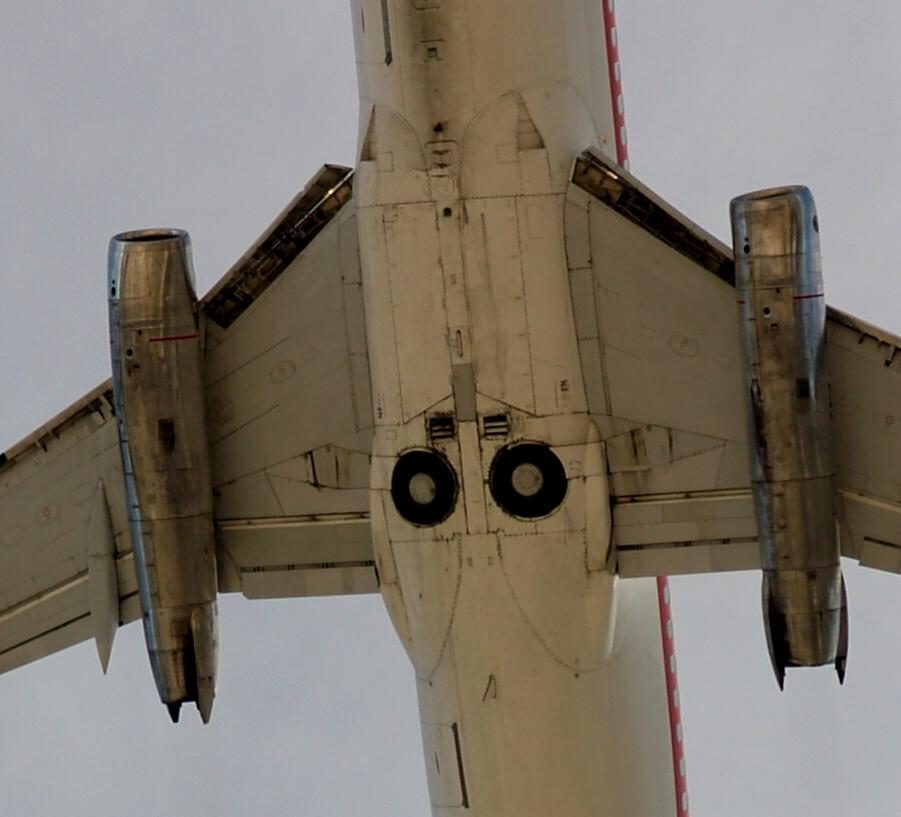
Doors open in flight add drag and can be damaged by the airflow, so many aircraft monitor them too. After a free-fall extension the doors normally remain open, and on some types a large door hangs close enough to the ground to strike the runway unless the landing is gentle; some have a frangible lower portion for this case.
Air/ground sensing
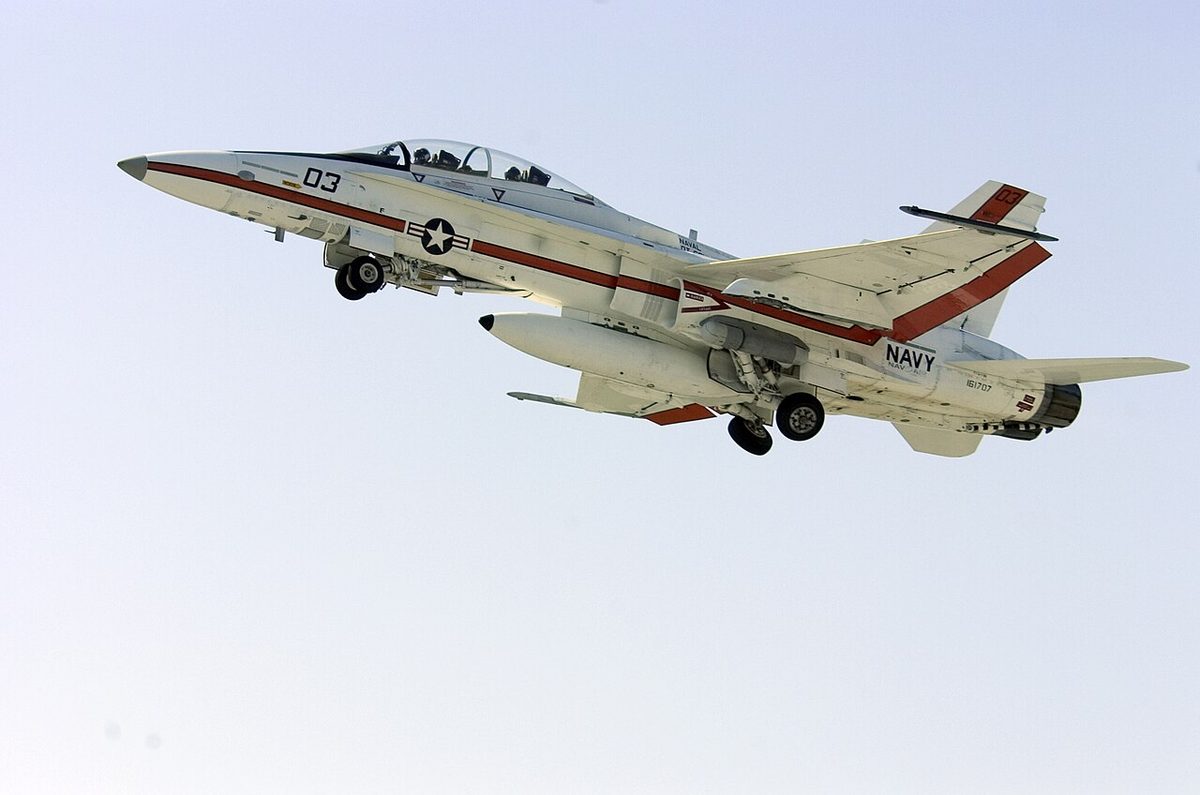
Air/ground sensing, also called ground/flight or weight-on-wheels sensing, tells the aircraft whether it is on the ground. It uses the compression of the main gear shock struts: compressed means on the ground, extended means airborne. The traditional sensor is a squat switch, a microswitch on the strut, also called a ground/flight switch. Modern transport aircraft use contactless inductive or capacitive proximity sensors, which have no moving contacts to wear. The sensors are duplicated, because a false signal could disable pressurisation, autobrake or anti-skid, or deploy the ground spoilers in flight. The 737 takes its signals from six sensors, two on each landing gear, and on the E190 E1 each of two redundant modules, the PSEMs, monitors six, two per leg.
The air/ground logic that results switches many systems between their air and ground modes. On the 737, for example:
| System | In flight | On the ground |
|---|---|---|
| Landing gear lever lock | Solenoid released | Solenoid latched |
| Pressurisation | Programmed pressurisation in automatic modes | Pressurisation only at high power |
| Take-off warning | Disabled | Enabled |
| Stall warning | Enabled | Disabled |
| Thrust reverser | Disabled | Enabled |
| Anti-skid | Brakes released for touchdown protection | Normal anti-skid braking after wheel spin-up |
The signal can mislead. A bounced landing, or a strut that extends in a strong crosswind, can unload a sensor, and the E190 E1 treats a main gear strut that fails to extend fully after lift-off as on the ground. For this reason the gear is selected up only once a positive rate of climb is confirmed, not on the strength of the squat switch.
Selector locks and lever interlocks
The gear selector lock, or baulk, stops the gear being selected up on the ground. A spring-loaded plunger holds the selector in the DOWN position; a solenoid withdraws it when the air/ground system signals that the aircraft is airborne. In light aircraft the squat switch often simply breaks the retraction circuit, so that selecting gear up on the ground does nothing. An override is provided for ground retraction tests and unusual cases, gated to prevent accidental use.
- 737: the lever lock prevents the LANDING GEAR lever moving to UP on the ground; in flight the air/ground system energises a solenoid to open it, and an override trigger in the lever bypasses it.
- A320: an interlock locks the lever in DOWN while either main gear shock absorber is compressed, or the nose wheel steering is not centred. A landing gear safety valve also cuts the hydraulic supply to the gear above 260 kt, and below 260 kt whenever the lever is up.
The nose wheel must also be straight before it retracts, because the bay is shaped for a centred wheel. Centring cams inside the nose oleo turn it straight ahead as the strut extends after lift-off.
Stopping wheel rotation on retraction
Main wheels leave the runway spinning. Retracted like that, they would act as gyroscopes resisting the movement of the leg, rub against the wheel well and throw debris or loose tread into the bay. The brakes are therefore applied on gear retraction, at reduced pressure, to stop the main wheels before they enter the bays.
- 737: the brakes automatically stop the main wheels during retraction, and the nose wheels, which retract forward and have no brakes, are stopped by snubbers in the nose wheel well.
- A320: the normal brake system brakes the main wheels while the doors are opening, and on aircraft fitted with rubbing strips a nose wheel brake band in the nose gear well stops the nose wheels as the doors close.
The 737 also shows why the wheel well is guarded: if a damaged main gear tyre with loose tread strikes a fitting at the opening of the well, that gear stops retracting and free falls back down, and it cannot be retracted again until the fitting is replaced.
Alternate and free-fall extension
Every retractable gear has an alternate gear extension that does not depend on the normal power source. The most common is free-fall gear extension: the uplocks are released mechanically or electrically, the hydraulic pressure holding the gear up is released or isolated, and the gear drops under its own weight, helped by springs and air loads, until the downlocks engage. Other designs use an emergency pressure source to drive the normal actuators: an accumulator, a hand pump, a compressed gas bottle or an electric pump. Light aircraft may use a hand crank, a hand pump or a CO₂ bottle.
- A320: pulling the gravity extension crank out and turning it three turns clockwise isolates the gear from the Green system, unlocks the doors and the gear and lets gravity extend it. The doors remain open. The system can be reset in flight, for example after training, if Green pressure is available.
- 737: with the manual extension access door open, three manual gear extension handles, one each for the right main, nose and left main gear, release the uplocks when pulled to their limit, about 24 inches (61 cm); gravity and air loads pull the gear down and locked. With the door open, retraction is disabled.
- E190 E1: a free-fall lever releases the hydraulic uplocks mechanically, after which the gear cannot be retracted; an ELEC OVRD switch can instead command extension electrically, bypassing the PSEMs. The E190-E2 has no ELEC OVRD switch.
After a genuine failure the gear is normally left down once it shows down and locked, because whatever failed is still failed. The procedures for this, and for a gear that will not lock, are in landing gear, flap and trim malfunctions.
Ground safety pins
On the ground, a gear leg must not fold if someone moves the selector, a test is run or a lock is disturbed. Landing gear safety pins, or ground locks, are pins or sleeves inserted into the mechanism, typically one for each leg, that physically prevent it from moving. Each carries a red warning flag so that a pin still fitted can be seen from outside. Before flight the pins are removed, stowed on board in a designated place and the flight crew told that they have been removed. A pin left in place prevents the gear from retracting after take-off.
Exam tip: uplocks hold the gear up and are spring-held, pressure-released; downlocks hold it down by geometry, a brace locked over centre. The squat switch locks the selector on the ground; the brakes stop the main wheels during retraction; free fall releases the uplocks and lets gravity and air loads extend the gear, leaving the doors open.
Frequently asked questions
What is the difference between an uplock and a downlock?
An uplock is a mechanical latch, typically a spring-loaded hook that catches a roller on the gear leg, which holds the retracted gear in its bay; it is released hydraulically, electrically or mechanically when the gear is selected down. A downlock holds the extended gear down, usually by letting a folding brace go slightly over centre against a stop, so that the landing loads press it harder into place and no hydraulic pressure is needed to keep it locked.
What stops the landing gear being retracted on the ground?
Air/ground sensing. Switches or proximity sensors on the main gear shock struts detect when the struts are compressed by the aircraft's weight, and while they are, a solenoid lock holds the gear lever down or the retraction circuit is broken. On the 737 an override trigger can bypass the lever lock; on the A320 an interlock holds the lever down if either main shock absorber is compressed or the nose wheel steering is not centred.
How does free-fall gear extension work?
Free fall is the usual alternate extension. The crew release the uplocks mechanically or electrically and isolate or release the hydraulic pressure, and the gear drops under its own weight, helped by springs and by the airflow on forward-retracting legs, until the downlocks engage. The doors usually stay open. On the A320 the crew turn a crank three turns clockwise; on the 737 they pull three manual extension handles, one for each gear.
Why are the wheels braked when the landing gear retracts?
Wheels still spinning after take-off would act as gyroscopes resisting the retraction, could rub and damage the tyres against the wheel well structure, and could throw debris or loose tread into the bay. Most retractable gear therefore applies the brakes, at reduced pressure, to the main wheels as they retract. Nose wheels, which usually have no brakes, are stopped by snubbers or a brake band in the wheel well.
What are landing gear safety pins?
Ground safety pins, or ground locks, are pins or sleeves inserted into the gear mechanism so that the legs cannot fold if the gear is selected up or the locks are disturbed while the aircraft is on the ground. Each carries a red warning flag. They must be removed before flight and stowed on board, and the flight crew told that they have been removed, because a pin left in place prevents the gear from retracting.
Test yourself on Landing Gear Retraction and Extension
The v1prep banks cover this topic in Aircraft General Knowledge (021), with a worked explanation for every answer. EASA ATPL, PPL, IR and CPL, the FAA written tests and A320/B737 type ratings.
Start practising →Sources and further reading
- FAA Aviation Maintenance Technician Handbook, Airframe (FAA-H-8083-31B), Chapter 13, Aircraft Landing Gear Systems
- FAA Pilot's Handbook of Aeronautical Knowledge (FAA-H-8083-25), Chapter 7, Aircraft Systems
- FAA Airplane Flying Handbook (FAA-H-8083-3C), Transition to Complex Airplanes
- 14 CFR 25.729, Retracting mechanism (position indicator and warning device)
- EASA Easy Access Rules for Large Aeroplanes (CS-25), CS 25.729 Retracting mechanism
- EASA, Explanatory Note to ED Decision 2018/001/R, Part-FCL theoretical knowledge learning objectives (021 Airframe and Systems)
Library articles are written for study and exam preparation. They do not replace your aircraft's approved documentation, your operator's procedures or the regulations themselves.