Ground Proximity Warning System (GPWS / TAWS)
A ground proximity warning system (GPWS) alerts the flight crew when an aircraft is in potentially hazardous proximity to terrain. A terrain awareness and warning system (TAWS), such as EGPWS, adds a terrain and obstacle database and an accurate position so that it can warn of terrain ahead as well as below.
A ground proximity warning system (GPWS) watches an aircraft's height above the ground, its rate of descent, its configuration and its position relative to the ILS glideslope, and alerts the crew when the combination points to an unplanned meeting with terrain. Its successor, the terrain awareness and warning system (TAWS), adds a worldwide terrain and obstacle database and an accurate position, so it can warn of rising ground ahead and not only beneath. Honeywell's enhanced GPWS (EGPWS) is so common that the names GPWS / EGPWS and TAWS are used almost interchangeably; ICAO speaks of a GPWS with a forward-looking terrain avoidance function.
The purpose is to prevent controlled flight into terrain (CFIT), in which a serviceable aircraft under control is flown into the ground, water or an obstacle. The FAA required GPWS on US air-carrier turbine aeroplanes from the mid-1970s, a period marked by accidents such as TWA Flight 514 in December 1974. The forward-looking TAWS rule followed in March 2000, after accidents like American Airlines Flight 965 near Cali in 1995, where the basic GPWS warning came only seconds before impact.
- GPWS overview
- Mode 1: excessive descent rate
- Mode 2: terrain closure rate
- Mode 3: altitude loss after take-off
- Mode 4: unsafe terrain clearance
- Mode 5: below glideslope
- Modes 6 and 7: callouts and windshear
- EGPWS look-ahead and terrain display
- Obstacle and runway awareness
- Pull up alerts and inhibits
- Frequently asked questions
GPWS overview
The computer draws radio altitude from the radio altimeter; barometric altitude, vertical speed and airspeed or Mach from the air data system; glideslope deviation from the ILS receiver; landing gear and flap positions; and bank angle. Enhanced functions also take GPS or FMS position, track and ground speed.
The basic GPWS alert modes 1 to 5 each compare one measured quantity against a fixed envelope, working roughly between 50 ft and 2,450 ft radio altitude. Modes 6 and 7 add callouts and windshear alerting. Most envelopes have two boundaries: the outer one gives an amber caution, such as "SINK RATE", and the inner one a red warning, "PULL UP", which demands immediate action.
Carriage requirements
| Rule | Aircraft | Equipment |
|---|---|---|
| ICAO Annex 6 Part I | Turbine aeroplanes over 5,700 kg or more than 9 passengers | GPWS with forward-looking terrain avoidance |
| EASA CAT.IDE.A.150 | Turbine, over 5,700 kg or more than 9 passenger seats | TAWS Class A |
| EASA CAT.IDE.A.150 | Piston, over 5,700 kg or more than 9 passenger seats | TAWS Class B |
| EASA CAT.IDE.A.150 | Turbine, 5,700 kg or less, 6 to 9 seats, first CofA after 1 January 2019 | TAWS Class B |
| 14 CFR 121.354 | Part 121 turbine aeroplanes | Class A with terrain display |
| 14 CFR 135.154 | Turbine, 10 or more / 6 to 9 passenger seats | Class A with display / Class B |
| 14 CFR 91.223 | Turbine, 6 or more passenger seats | Class B |
The classes come from FAA TSO-C151 and EASA ETSO-C151. Every class provides forward-looking terrain avoidance, a premature descent alert and a "FIVE HUNDRED" callout. Class A adds the full radio-altitude modes and a terrain display. Class B gives excessive descent rate and altitude loss after take-off alerts; Class C is for voluntary fitment to aircraft not required to carry TAWS.
Mode 1: excessive descent rate
GPWS Mode 1 - excessive descent rate compares barometric descent rate with radio altitude, whatever the configuration, in every phase of flight. Crossing the outer boundary gives the sink rate alert (GPWS Mode 1), "SINK RATE, SINK RATE"; if the descent continues, the pull up warning follows. A typical trigger is a steep, fast final approach. Airbus procedure is to adjust the flight path above 1,000 ft AAL in IMC (500 ft in VMC) and to consider a go-around below, in line with stabilised approach criteria.
Mode 2: terrain closure rate
GPWS Mode 2 - excessive terrain closure rate reacts to how fast radio altitude is decreasing, in other words to ground rising beneath the aircraft. In Mode 2A, with flaps not in the landing position, the caution is "TERRAIN, TERRAIN", followed by "PULL UP". The upper limit of the envelope rises with airspeed to about 2,450 ft radio altitude, and after the warning ends "TERRAIN" continues until roughly 300 ft of height has been regained. Mode 2B, with landing flaps selected, is desensitised; with gear and landing flaps both down the PULL UP is inhibited and only "TERRAIN" is heard. Because Mode 2 measures only the ground underneath, it may give only seconds of warning of a steep slope, which is why look-ahead alerting was developed.
Mode 3: altitude loss after take-off
GPWS Mode 3 - altitude loss after take-off or go-around is armed after take-off or a low go-around while gear or flaps are not in the landing configuration. If barometric altitude is lost, the don't sink alert (GPWS Mode 3) sounds, "DON'T SINK, DON'T SINK". In the classic textbook envelope the alert comes when the height lost reaches about a tenth of the aircraft's height above the ground. It is a caution only: re-establish the climb. The typical cause is a night departure over dark ground, where the acceleration illusion encourages the pilot to lower the nose.
Mode 4: unsafe terrain clearance
GPWS Mode 4 - unsafe terrain clearance compares radio altitude with configuration and airspeed. These are the too low gear / too low flaps alerts (GPWS Mode 4):
- 4A, gear up: "TOO LOW GEAR" at low speed, "TOO LOW TERRAIN" at higher speed. On a typical Honeywell installation the threshold ramps from 500 ft at 190 kt to 1,000 ft at 250 kt.
- 4B, gear down, flaps not in landing position: "TOO LOW FLAPS" at low speed, "TOO LOW TERRAIN" at higher speed, from 245 ft at 159 kt up to 1,000 ft at 250 kt.
- 4C, after take-off: "TOO LOW TERRAIN" if the aircraft settles towards rising ground before reaching a safe height.
Figures vary with aircraft type. Airbus crews go around after "TOO LOW GEAR" or "TOO LOW FLAPS". When a non-standard landing flap is planned, for example a flapless landing, the GPWS flap inhibit switch (FLAP OVRD) stops the nuisance alert. Boeing widebodies label it FLAP OVRD, the 737 FLAP INHIBIT and the A320 FLAP MODE, next to an LDG FLAP 3 button that tells the system flap 3 is the planned landing setting. Some types also have a gear override.
Mode 5: below glideslope
GPWS Mode 5 - below glide slope deviation alerting, often called the GPWS Mode 5 - below glideslope alert, protects ILS approaches with the gear down. On a typical installation the soft glideslope alert (GPWS Mode 5) comes below 1,000 ft radio altitude when 1.3 dots or more below the beam, as a half-volume "GLIDESLOPE". Below 300 ft with 2 dots or more it becomes loud and repeated. Mode 5 is a caution only: regain the glidepath or go around. When a crew is deliberately below the beam, for instance following a visual glide path indicator, the alert can be cancelled with the G/S MODE button on the A320 or the glideslope inhibit on Boeing types.
Modes 6 and 7: callouts and windshear
GPWS Mode 6 - minimums and bank angle callouts gives advisory radio-altitude callouts chosen by the operator, such as "FIVE HUNDRED", "ONE HUNDRED" and "FIFTY" down to "TEN", and "MINIMUMS" at the selected minimum. The bank angle alert, "BANK ANGLE, BANK ANGLE", sounds on the Boeing 737 as the roll angle passes 35°, 40° and 45°.
GPWS Mode 7 - windshear alerting is reactive: it computes the shear already acting on the aircraft from air data and inertial information and announces "WINDSHEAR, WINDSHEAR, WINDSHEAR" after a siren; on the 737 it works below 1,500 ft radio altitude from rotation. Windshear (predictive and reactive) alerting differs in source: predictive alerts come from the weather radar, which detects microburst outflow ahead and gives "WINDSHEAR AHEAD", "GO AROUND, WINDSHEAR AHEAD" or "MONITOR RADAR DISPLAY". Microbursts are covered under thunderstorms.

EGPWS look-ahead and terrain display
EGPWS / TAWS look-ahead terrain alerting compares the projected flight path, built from GPS position, track, ground speed and flight path angle, with the terrain and obstacle database. The envelope reaches further ahead as speed rises. The caution comes typically 40 to 60 seconds before a potential impact ("CAUTION TERRAIN" on Boeing, "TERRAIN AHEAD" on Airbus), the warning 20 to 30 seconds before ("TERRAIN, TERRAIN, PULL UP" or "TERRAIN AHEAD, PULL UP"). This terrain / obstacle ahead alert can protect an aircraft flying level towards a ridge, which the reactive modes cannot.
The terrain awareness display (TAD), or terrain display (TERR), paints the database on the navigation display relative to the aircraft's own altitude. On a typical Boeing installation dotted red is terrain more than 2,000 ft above the aircraft, dotted amber from 500 ft below (250 ft with gear down) to 2,000 ft above, dotted green terrain from 2,000 ft below up to that band, nothing for lower ground, solid amber and red the caution and warning areas, and magenta no data. It is selected with the TERR ON ND button on Airbus types or the EFIS TERR switch on Boeings, and appears automatically when an alert occurs. Limitations forbid navigating by it.
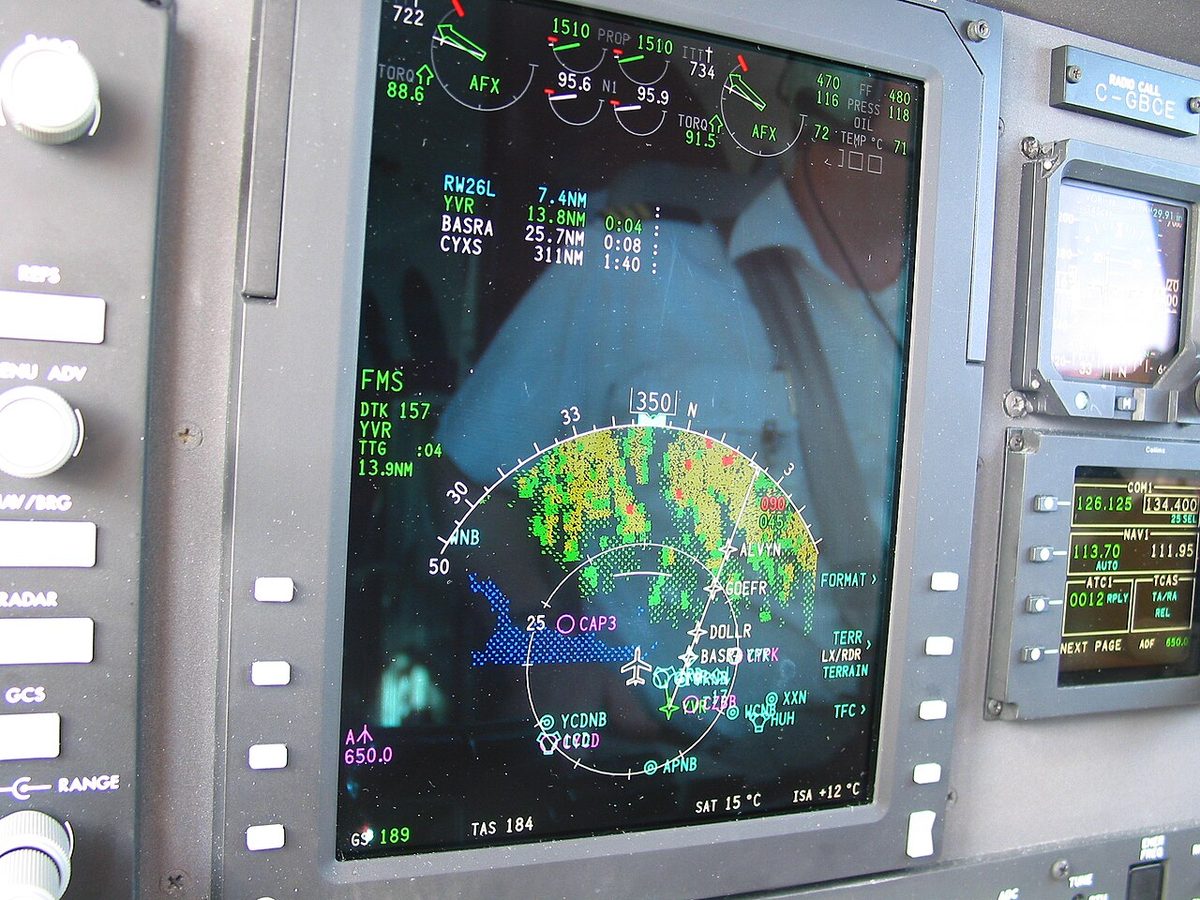
The terrain clearance floor (TCF) uses a runway database to alert "TOO LOW TERRAIN" when the aircraft descends below a floor around the runway, whatever its configuration, protecting non-precision approaches against landing short; A320 documentation includes runways longer than 3,500 ft. The runway field clearance floor (RFCF) does the same using height above runway elevation rather than radio altitude, protecting runways on elevated ground. EGPWS computes a blended geometric altitude from GPS, barometric and radio data to reduce the effect of cold temperatures and altimeter mis-sets (see altimeter settings). If position accuracy degrades, the enhanced functions stand by and the basic modes remain.
Obstacle and runway awareness
The man-made obstacle function extends obstacle alerting to masts, towers and buildings in the database: "CAUTION OBSTACLE" and "OBSTACLE, OBSTACLE, PULL UP" on Boeings, "OBSTACLE AHEAD, PULL UP" on Airbus types. Databases are never complete, so the absence of an alert proves nothing.
The runway awareness and advisory system (RAAS), a Honeywell EGPWS software option, compares GPS position with the runway database and gives aural advisories such as "approaching runway", "on runway" and runway remaining. Its SmartRunway and SmartLanding successors add alerts for unstable approaches and long landings. RAAS has lower priority than any GPWS alert and does not replace NOTAMs or ATIS.
Some aircraft combine functions. ACSS's traffic and terrain collision avoidance system (T2CAS) places TCAS and a performance-based TAWS in one unit and is an alternative to EGPWS on Airbus types. An integrated hazard warning system (IHWS) is a general term for units joining weather radar, predictive windshear, TAWS, TCAS and transponder, such as the integrated surveillance systems of recent widebody types. A ground collision avoidance system (GCAS) in the military sense goes further: the Automatic GCAS fitted to US Air Force F-16s from late 2014 takes control, rolls wings level and pulls about 5 g. Civil TAWS only warns; the crew flies the escape.
Pull up alerts and inhibits
A PULL UP warning is never diagnosed first. On the Boeing 737 the crew disconnect the autopilot and autothrottle, apply maximum thrust, roll wings level and pitch initially to 20°, retract the speedbrakes and leave gear and flaps alone until terrain is cleared. On the A320 (see A320 memory items) the pilot sets AP OFF, pulls to full back stick and holds it, selects TOGA, checks the speedbrakes retracted and keeps the wings level or adjusts bank. Airbus applies the same action to terrain cautions at night or in IMC; only in daylight VMC with the terrain clearly in sight may a caution be handled by adjusting the flight path. The climb continues until the alert stops and safe altitude is reached.
Aural alerts are prioritised: stall first, then windshear, then GPWS, then ACAS/TCAS, whose resolution advisories are inhibited while GPWS or windshear alerts are active. Textbooks classify alerts as genuine, nuisance (correct to specification during a safe procedure) or false (caused by a fault).
Inhibits exist for briefed situations: flap or gear override, glideslope inhibit, and terrain inhibit within 15 NM of an airport not in the database or on procedures known to cause spurious alerts. Airbus states the decision must not rest on crew judgement alone. In 2012 a Sukhoi Superjet 100 on a demonstration flight struck Mount Salak, Indonesia; the crew had attributed valid TAWS warnings to a database problem and inhibited them.
Exam tip: the basic modes rely on radio altitude, air data and ILS deviation, so they cannot see ahead. Only the database functions look forward, and only they depend on position accuracy.
Frequently asked questions
What is the difference between GPWS and TAWS?
A classic GPWS reacts to measurements beneath the aircraft, such as radio altitude, descent rate and glideslope deviation, so it cannot see a cliff ahead in level flight. TAWS, of which Honeywell's EGPWS is the best-known example, keeps the GPWS modes and adds a terrain and obstacle database, GPS position and a look-ahead envelope that warns up to about a minute before a conflict, plus a terrain display.
What should a pilot do after a GPWS PULL UP warning?
Fly the escape manoeuvre immediately, without first trying to work out why. Disconnect the autopilot, set maximum or TOGA thrust, level the wings, pitch up firmly (about 20 degrees initially on Boeing types, full back stick on Airbus types), retract the speedbrakes and leave gear and flaps where they are. Keep climbing until the warning stops and terrain clearance is assured, then tell ATC.
What are the seven GPWS modes?
Mode 1 is excessive descent rate, Mode 2 excessive terrain closure rate, Mode 3 altitude loss after take-off or go-around, Mode 4 unsafe terrain clearance when not in landing configuration, and Mode 5 excessive deviation below the glideslope. Mode 6 provides altitude callouts and the bank angle alert, and Mode 7 is reactive windshear alerting. EGPWS adds look-ahead terrain and obstacle alerts and the terrain clearance floor.
Which aircraft must carry TAWS?
Under EASA Air Ops, turbine aeroplanes over 5,700 kg or with more than nine passenger seats need Class A TAWS, and piston aeroplanes above the same limits need Class B. In the United States, Part 121 turbine aeroplanes need Class A with a terrain display, and Part 91 turbine aeroplanes with six or more passenger seats need at least Class B. ICAO Annex 6 sets the underlying standard.
Can pilots switch off GPWS alerts?
Individual functions can be inhibited for a briefed reason, such as flap or gear override for a planned non-standard landing configuration, glideslope inhibit when deliberately below the beam, and terrain inhibit near airports missing from the database. Manufacturers limit these uses. Inhibiting a warning because the crew believes it is false, without positive confirmation, has led to fatal accidents.
Test yourself on Ground Proximity Warning System (GPWS / TAWS)
The v1prep banks cover this topic in Instrumentation (022), with a worked explanation for every answer. EASA ATPL, PPL, IR and CPL, the FAA written tests and A320/B737 type ratings.
Start practising →Sources and further reading
- ICAO Model Regulation on Ground Proximity Warning Systems (based on Annex 6)
- Regulation (EU) 965/2012, CAT.IDE.A.150 Terrain awareness warning system (UK CAA regulatory library)
- 14 CFR 121.354, Terrain awareness and warning system
- 14 CFR 91.223, Terrain awareness and warning system
- EASA ETSO-C151c, Terrain Awareness and Warning System
- Honeywell MK V and MK VII EGPWS Pilot Guide
- IATA, Performance Assessment of Pilot Response to EGPWS
- FAA Lessons Learned, American Airlines Flight 965, Boeing 757-223 N651AA
Library articles are written for study and exam preparation. They do not replace your aircraft's approved documentation, your operator's procedures or the regulations themselves.