Landing Gear, Flap and Trim Malfunctions
Landing gear, flap and trim malfunctions are failures of the systems that set an aeroplane's configuration and pitch trim: gear that will not extend or indicate locked, flaps that jam, fail to move or split between the wings, and trim that moves without being commanded.
Landing gear, flap and trim malfunctions are failures of the systems that change an aeroplane's configuration and pitch trim: a gear leg that will not show down and locked, flaps that stop short of the selected setting or split between the wings, and a trim system that moves when nobody commanded it. Most of them leave the aeroplane flyable. What makes them dangerous is what they do to the landing, to the fuel state and, above all, to the crew's attention.
The principles are the same in a light retractable and in an airliner: fly the aeroplane first, work the manufacturer's checklist, take the time the fuel allows but no more, and prepare the runway, the rescue services and the cabin for the worst case. Trim runaway is the exception to "take your time": its first actions are memory items, because the out-of-trim force from an uncommanded pitch trim grows for as long as the trim keeps running.
Recognising a gear malfunction
A retractable gear is monitored by position lights or a display, usually one green per leg for down and locked, a red or amber light for gear in transit or unsafe, and a warning horn. On a light aircraft the horn sounds when the throttle is closed or landing flap is selected with the gear not locked down. For large aeroplanes 14 CFR 25.729 and CS 25.729 require a gear position indicator and an aural warning, and each leg has its own down-and-locked sensors. Transport aircraft add the GPWS "TOO LOW GEAR" alert, and many types have a mechanical position indicator that confirms a leg is locked down.
Typical signs of trouble are fewer than three greens, an unsafe light that stays on, an unusually long transit time or a horn with the gear selected down. The first step is to check the indication itself: a failed bulb, a dimmer left at night setting or a tripped circuit breaker is far more common than a genuinely unlocked leg. The flight manual may then allow the gear to be recycled before the emergency extension is used.
Gear problems have a history of capturing the whole crew. On 29 December 1972 Eastern Air Lines flight 401, a Lockheed L-1011, flew into the Florida Everglades while its crew were absorbed by a nose gear indication, and nobody noticed the aircraft descending. On 28 December 1978 United Airlines flight 173, a DC-8, held near Portland, Oregon, for about an hour while the crew dealt with a landing gear indication, and ran out of fuel; ten people died. The lesson is now built into crew procedures: one pilot flies and monitors the flight path and the fuel while the other troubleshoots (see crew resource management).
Emergency gear extension (free fall)
Every retractable gear has an emergency or alternate extension that does not depend on the normal power source. The most common is free fall: the uplocks are released mechanically, by a cable or handle, or electrically, the hydraulic pressure holding the gear up is released, and the gear drops under its own weight until the downlocks engage. On many light aircraft the main legs are then held by an over-centre side stay and a spring, so no pressure is needed to keep them down. Airflow can help or resist the final locking travel depending on which way each leg swings, and the flight manual procedure is often flown at reduced speed to help the legs lock.
Other methods use an alternate pressure source: a hand pump, a hydraulic accumulator, a compressed gas bottle or an electrically driven pump. These can drive a normal sequence with the doors closing afterwards. After a free fall extension the doors normally stay open, adding drag, and on some types a door hangs low enough to touch the runway unless the landing is gentle.
Two airliner examples:
- Airbus A320. Turning the gravity extension crank on the centre pedestal three turns clockwise isolates the gear from the Green hydraulic system, unlocks the doors and the gear, and lets gravity extend it. Springs help the main gear into its locks and aerodynamic forces help the nose gear. The doors remain open.
- Boeing 737. If hydraulic system A is lost, manual gear releases on the flight deck release the uplocks, and gravity and air loads pull the gear down and locked.
Once the gear shows down and locked after an emergency extension following a genuine failure, it is normally left down. Whatever failed in the normal system is still failed, and recycling the gear could leave it stopped in transit with no means of extension left. Types differ: on the 737 NG the gear can be retracted normally after a manual extension if hydraulic system A is available, but on the E190 E1 retraction is impossible after a free-fall extension and maintenance must be called. Gear speeds still apply: VLO, the maximum speed for operating the gear, is often lower than VLE, the maximum speed with the gear extended, because unlocked legs and open doors in transit face higher air loads. On the A320 VLO is 250 kt for extension and 220 kt for retraction, and VLE is 280 kt or M 0.67.

Tower fly-by and visual checks
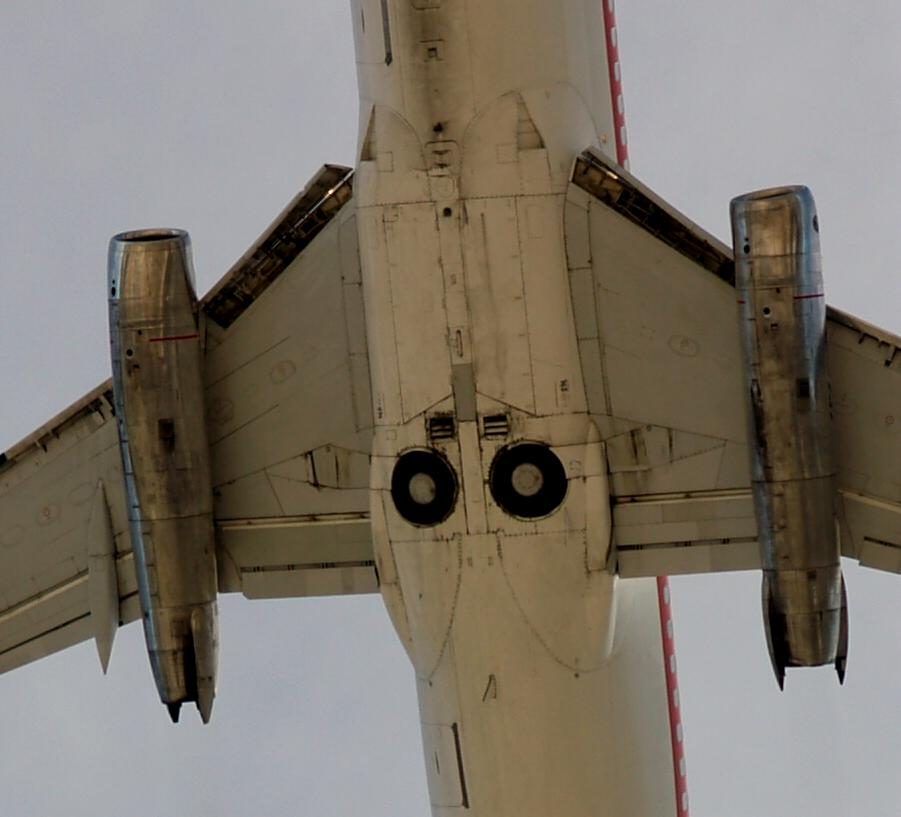
When the indications remain doubtful, the crew can ask for a tower fly-by: a low pass along the runway past the control tower, cleared by ATC as a "low pass", so that controllers or the rescue and fire-fighting service can look at the gear. A light aircraft pilot may also be able to see a leg in a mirror or through a window.
A fly-by has clear limits. An observer can say whether each leg appears to be extended, not whether it is locked, and the view is poor at night or in rain. The pass itself means low-level manoeuvring with an abnormal configuration, extra workload and extra fuel. It is worth flying when the answer could change the landing plan, for example between a normal landing and a partial gear landing.
Gear-up and partial gear landings
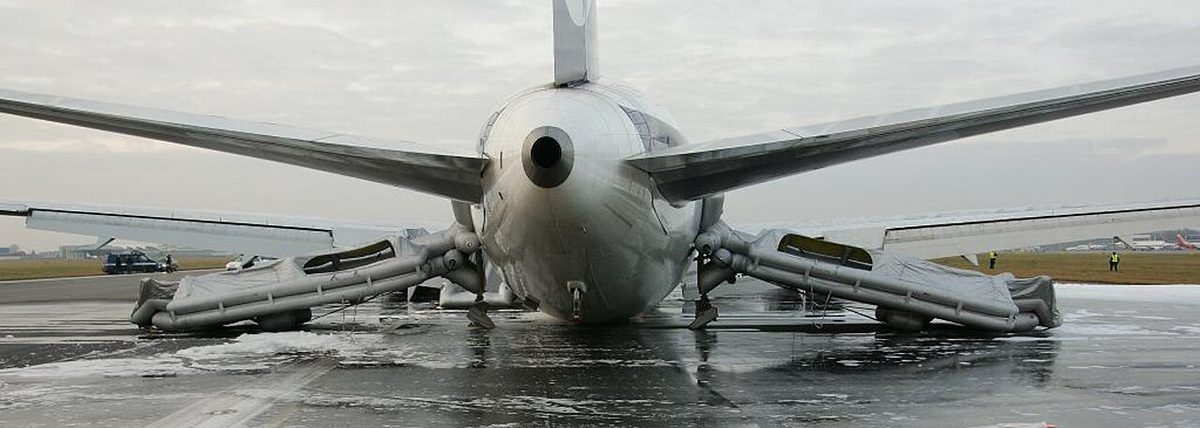
If the gear cannot be confirmed down, the crew plans for the worst case: a gear-up landing (belly landing) or a landing on a partial gear. The usual preparations are to declare an emergency, alert the rescue services, choose a long runway with good approach aids, reduce fuel and landing mass to lower the fire risk and the touchdown energy, and brief the cabin crew and passengers on the brace position and the evacuation. After the aircraft stops, the commander decides whether to order an emergency evacuation.
In a light aircraft a gear-up landing rarely injures the occupants and the aeroplane is usually repairable, but the occupants come first. On 1 November 2011 the Boeing 767 of LOT flight 16 landed on its belly at Warsaw after a hydraulic failure had ruled out normal extension and the crew could not lower the gear with the alternate system; all 231 occupants were evacuated without injury. The investigation found that an unnoticed tripped circuit breaker had disabled the alternate extension.
Gear-up landings also happen with serviceable gear that was never selected down, sometimes after the warning horn was silenced. The horn is only a last line of defence; the professional habit is a fixed check, such as "gear down, three greens" at a set point on every approach, tied to a physical action like touching the selector.
Flight with the landing gear down
An aeroplane may have to fly with its gear down when it cannot be retracted after take-off, after an emergency extension, on a ferry flight that must be flown with the gear extended, or in an emergency descent with suspected structural damage, when the A320 procedure asks the crew to consider extending the gear to fly at lower speed with more drag. The A320 shows a green FLT L/G DOWN memo when it is operated in this configuration.
The speed limit is VLE. The large drag increase raises fuel burn, shortens range and endurance, and reduces the climb gradient and ceiling. The fuel plan must be rebuilt from the gear-down performance data, not from the clean-aircraft figures.
Flapless and reduced flap landings
Flaps can fail to move after a hydraulic or electrical failure, jam mechanically, or be stopped by the aircraft's own protection. Transport flap systems detect asymmetry, runaway, uncommanded movement and overspeed and stop the drive, because asymmetric flaps produce a rolling moment that may be beyond the ailerons. On the A320, wingtip brakes lock the flaps or slats after such a fault and cannot be released in flight, although the other surfaces remain available. Many types have an alternate drive, an electric motor or another hydraulic system, that moves the flaps, often more slowly. Once a protection has stopped the system, the crew follows the checklist rather than recycling the lever.
A flapless landing is made with the trailing-edge flaps retracted; a reduced flap landing uses less than the normal landing setting. Both follow the same aerodynamics:
| Effect | Reason |
|---|---|
| Higher approach speed | Lower CLmax, so a higher stalling speed and reference speed |
| Longer landing distance | Faster threshold speed; kinetic energy grows with the square of speed |
| Higher nose attitude | Without flap the wing needs a higher angle of attack for the same lift |
| Speed harder to lose, longer float | Less drag |
| Better go-around climb | Less drag in the missed approach |
The checklist gives the speed increment and the landing distance correction, and the crew checks that the runway is long enough, including the brake energy for the faster touchdown. On aircraft with GPWS, the "TOO LOW FLAPS" alert is inhibited with the flap inhibit switch (FLAP MODE on the A320) for a planned flapless or reduced flap landing. Reduced flap is also chosen deliberately: operators may use less landing flap when the go-around climb gradient is limiting, accepting the longer landing distance, and some procedures recommend it after a pitch trim runaway.
Trim runaway and runaway stabiliser
A trim runaway is continuous, uncommanded movement of a trim system, for example through a stuck electric trim switch or a fault in the autopilot trim. In pitch it progressively loads the control column, and the aircraft moves further out of trim for as long as the runaway continues. In a light aircraft with electric trim the pilot first holds the controls against the runaway, disconnects the autopilot and electric trim with the disconnect switch, isolates the trim with its circuit breaker and re-trims manually as the flight manual prescribes.
Large aeroplanes trim in pitch by moving the whole trimmable horizontal stabiliser, which gives the large trim authority needed for fuel burn, CG and configuration changes. A runaway stabiliser can therefore build large pitch forces, and its first actions are memory items. Designs limit the risk: autopilot servos have torque limiters against a hard-over, manual trim inputs disconnect most autopilots, and on the 737 column-actuated cutout switches stop the main electric and autopilot trim when the column is moved against the trim direction.
The Boeing 737 recall items for a runaway stabiliser are:
- Control column: hold firmly.
- Autopilot and autothrottle (if engaged): disengage.
- Control column and thrust levers: control pitch attitude and airspeed.
- Main electric trim: reduce control column forces.
- If the runaway continues, both STAB TRIM cutout switches to CUTOUT.
- If it still continues, grasp and hold the stabiliser trim wheel.
Two 737 MAX accidents, Lion Air flight 610 on 29 October 2018 and Ethiopian Airlines flight 302 on 10 March 2019, involved repeated uncommanded nose-down stabiliser trim after an erroneous angle of attack signal. According to the investigators' preliminary report on the Ethiopian flight, the crew ran the runaway stabiliser checklist, set the cutout switches to CUTOUT and found that the manual trim wheel was not working. The revised checklist makes pitch control with the column and airspeed control with the thrust levers memory steps, and notes that reducing airspeed eases the effort needed for manual trim. The FAA's 737 Flight Standardization Board report requires runaway stabiliser training at least once every 36 months in recurrent training, and EASA's return to service of the MAX added three training areas of special emphasis: stabiliser trim, runaway stabiliser, and the flight control computer and MCAS functions.
Other types differ. On the Embraer E190 E1 the pitch trim runaway recall items are to press and hold the autopilot disconnect button and push in both pitch trim cutout buttons; the E190-E2 has no pitch trim runaway procedure. The A320 trims automatically in normal law, and its manual trim wheel drives the stabiliser mechanically, which is also part of its mechanical backup. One E-Jet operator's procedures show what follows the E190 E1 recall items: declare an emergency, request an altitude band with traffic separation, avoid over-using the trim, avoid configuration changes and land with a reduced flap setting.
Frequently asked questions
What is emergency gear extension?
Emergency or alternate gear extension lowers the landing gear when the normal system has failed. The most common method is free fall: the uplocks are released mechanically or electrically and the gear drops under its own weight, helped by springs or airflow, until the downlocks engage. Other types use a hand pump, an accumulator, a gas bottle or an electric pump. After a free fall extension the doors usually stay open, and after a genuine failure the gear is normally left down for the rest of the flight.
What is a tower fly-by?
A tower fly-by is a low pass along the runway past the control tower so that controllers or the fire service can look at the landing gear when the cockpit indications are doubtful. It can show whether each leg appears to be extended, but not whether it is locked. It costs time, fuel and low-level manoeuvring in an abnormal configuration, so it is worth flying only when the answer could change the landing plan.
What should a pilot do if the landing gear will not extend?
Fly the aeroplane first and give one pilot the troubleshooting. Check the indication itself, then use the checklist: recycle if permitted, then the emergency extension. If the gear still cannot be confirmed down, plan a gear-up or partial gear landing: declare an emergency, alert the fire service, reduce fuel and landing mass, brief the cabin on the brace position and evacuation, and keep watching the fuel state throughout.
Why does a flapless landing need a higher approach speed?
Flaps raise the wing's maximum lift coefficient. Without them the stalling speed is higher, so the reference speed and the approach speed must rise to keep the same margin. The aeroplane also flies at a higher nose attitude, has less drag to slow it down and touches down faster, and because kinetic energy grows with the square of speed, the landing distance and the energy the brakes must absorb increase markedly.
What is a runaway stabiliser on the Boeing 737?
A runaway stabiliser is continuous, uncommanded movement of the 737's trimmable horizontal stabiliser. The recall items are to hold the control column firmly, disengage the autopilot and autothrottle, control pitch with the column and speed with the thrust levers, and use main electric trim to reduce column forces. If the runaway continues, both STAB TRIM cutout switches go to CUTOUT, and if it still continues the pilot grasps and holds the trim wheel.
Test yourself on Landing Gear, Flap and Trim Malfunctions
The v1prep banks cover this topic in Operational Procedures (070), with a worked explanation for every answer. EASA ATPL, PPL, IR and CPL, the FAA written tests and A320/B737 type ratings.
Start practising →Sources and further reading
- FAA Airplane Flying Handbook (FAA-H-8083-3C), Emergency Procedures
- 14 CFR 25.729, Retracting mechanism (position indicator and warning device)
- EASA Easy Access Rules for Large Aeroplanes (CS-25)
- FAA Lessons Learned, Eastern Air Lines Flight 401, Lockheed L-1011 N310EA, Everglades, 1972
- NTSB AAR-79-07, United Airlines Flight 173, Portland, Oregon, 28 December 1978
- SKYbrary, B763, Warsaw Poland, 2011 (LOT Polish Airlines flight 16)
- EASA, Boeing 737 MAX Return to Service Report (January 2021)
- FAA Flight Standardization Board Report, Boeing 737
Library articles are written for study and exam preparation. They do not replace your aircraft's approved documentation, your operator's procedures or the regulations themselves.