Electromagnetism and Induction
Electromagnetism is the link between electric current and magnetism: a current produces a magnetic field, and a changing magnetic field induces an electromotive force in a conductor. The second effect, electromagnetic induction, is the principle on which generators, transformers and many motors work.
Electricity and magnetism are two sides of one phenomenon. A current flowing in a wire surrounds it with a magnetic field, and a magnetic field that changes near a conductor induces a voltage in it. Almost every rotating or switching electrical component in an aircraft rests on one of these two effects: relays and contactors, solenoid valves, motors and actuators, generators and alternators, transformers, magnetos and many sensors.
This article sets out the physics behind them: magnetic flux, the rules that give the direction of a field, a force or an induced current, Faraday's and Lenz's laws, mutual induction and eddy currents. The basic circuit laws are in electrical fundamentals and DC circuits, and the machines themselves in DC generators, motors and starter-generators and transformers, converters and AC motors.
Magnetic flux and fields
A magnet has two poles, north and south. Like poles repel and unlike poles attract. The region around a magnet in which its force acts is its magnetic field, pictured as lines of magnetic flux that leave the north pole, curve round outside the magnet and re-enter at the south pole. The lines never cross; where they crowd together the field is strong, and where they spread out it is weak.
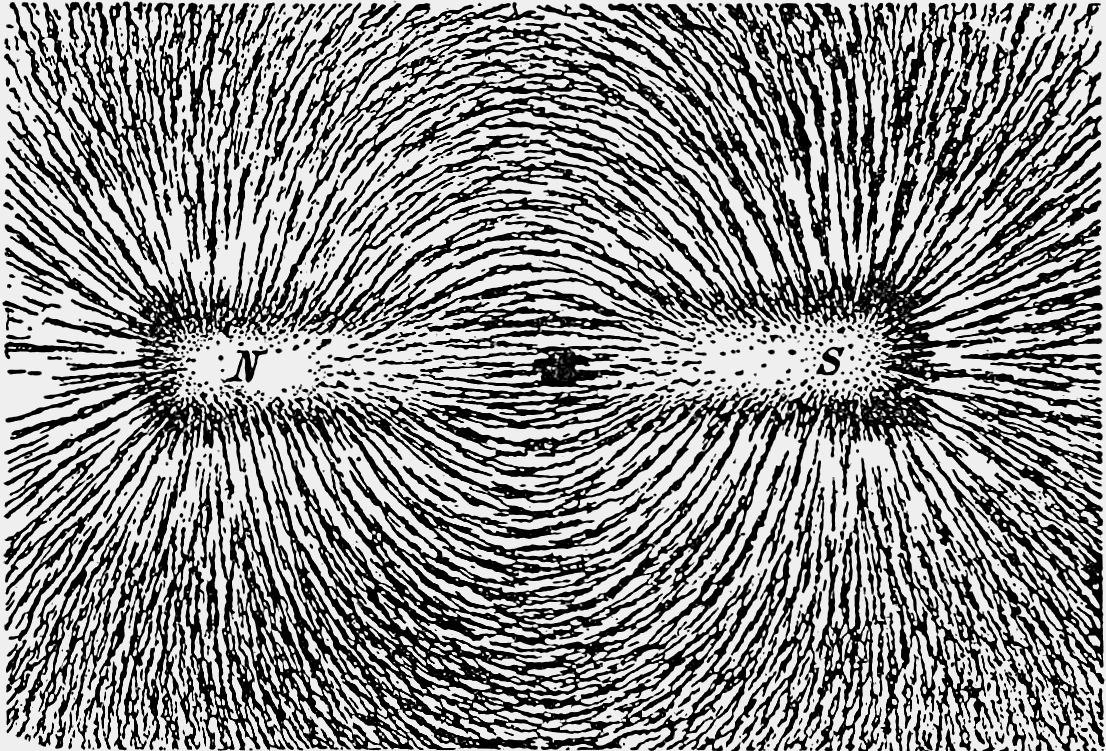
Magnetic flux (symbol Φ) is the total quantity of magnetic field passing through a given area, measured in webers (Wb). Flux density (B) is the flux per unit area, measured in teslas (T); the Earth's weak field is expressed in microteslas. Induction depends on changes in flux, so flux is the quantity that matters when a conductor moves through a field or a field changes around a coil.
Materials that can be strongly magnetised are called ferromagnetic: iron, steel, nickel and cobalt and their alloys. Aluminium, copper, brass and plastics are non-magnetic. Ferromagnetic materials are further divided by how they hold their magnetism:
- Hard iron, such as cobalt or tungsten steel, needs a strong field to magnetise it but then keeps its magnetism for a long time. It is used for permanent magnets, as in a magneto's rotor or a compass needle.
- Soft iron, such as silicon iron, magnetises easily in a weak field but keeps practically none when the field is removed. It is used for the cores of electromagnets, relays and transformers, which must magnetise and demagnetise with the current.
Heating a magnet above its Curie temperature, about 770 °C for iron, removes its magnetism, which does not return when it cools. The magnetic effects of the aircraft's own steel and electrical equipment on the compass are covered in the magnetic compass.
Right-hand grasp and corkscrew rules
A straight wire carrying a current is surrounded by a circular magnetic field in planes at right angles to the wire. Its direction is given by the corkscrew rule: a corkscrew driven forward in the direction of the conventional current turns in the direction of the magnetic field. Equivalently, grip the wire in the right hand with the thumb along the conventional current, and the fingers curl round in the direction of the flux. Reversing the current reverses the field. As in the rest of electrical theory, conventional current is taken to flow from positive to negative.
Winding the wire into a coil, a solenoid, adds the fields of all the turns together into one strong field along the coil's axis, shaped like that of a bar magnet, with a north pole at one end and a south pole at the other. The right-hand grasp rule gives the polarity: hold the coil in the right hand with the fingers curling the way the conventional current flows round the turns, and the thumb points to the north pole.
The strength of an electromagnet rises with the current and with the number of turns, and a soft iron core concentrates the flux and multiplies it many times. Placing iron inside a solenoid carrying direct current is the most efficient way to magnetise it, up to the point of saturation, beyond which more current adds little. When the current stops, a soft iron core loses its magnetism. This is the working principle of the relay, in which a small control current in a coil pulls in an armature that closes heavy contacts, and of its heavy-duty form, the contactor, which switches battery, generator and bus currents far too large to bring to the flight deck. Solenoid-operated valves, such as the crew oxygen supply valve of the A320, work the same way. See circuit protection and switching devices.
Fleming's left-hand rule: the motor effect
A conductor carrying a current across a magnetic field experiences a force, because its own field and the external field reinforce each other on one side of the wire and oppose on the other. The force is at right angles to both the field and the current, and its size is F = B × I × L: flux density times current times the length of conductor in the field. This is the motor effect.
Fleming's left-hand rule gives its direction. Hold the thumb, first finger and second finger of the left hand mutually at right angles:
- First finger: the magnetic Field, from north to south;
- seCond finger: the conventional Current;
- thuMb: the Motion, the direction of the force.
In a DC motor the forces on the conductors on opposite sides of the armature act in opposite directions and so produce a torque. Reversing either the field or the armature current reverses the rotation; reversing both leaves it unchanged, because the product B × I keeps its sign. This is why simply reversing the supply polarity to a series-wound motor does not reverse it.
Faraday's law of induction
Electromagnetic induction is the production of an EMF in a conductor whenever the magnetic flux linking it changes. Michael Faraday demonstrated it in 1831. The change can be brought about in three ways:
- relative motion between a conductor and a field, as in a generator, where the armature conductors cut the flux of the field poles, or an alternator, where a rotating field sweeps past fixed windings;
- a changing current in a neighbouring coil, as in a transformer: mutual induction;
- a changing current in the coil itself: self-induction.
Faraday's law states that the induced EMF is proportional to the rate of change of the flux linking the circuit. For a coil of N turns it is written EMF = −N × (rate of change of flux), the minus sign expressing Lenz's law. A faster change or more turns gives a larger EMF; a steady flux, however strong, gives none. A generator's output therefore rises with its speed, its field strength and the number of armature conductors, which is why its voltage regulator controls the field current: the speed is set by the engine and the windings are fixed.
The magneto of a piston engine uses induction twice. Its rotating permanent magnet induces current in a primary coil, and when the breaker points interrupt that current the field collapses so fast that a very high voltage is induced in the secondary winding of many turns (see piston engine ignition systems).
Fleming's right-hand rule: the generator effect
Fleming's right-hand rule gives the direction of the current induced in a conductor that moves through a magnetic field. The fingers of the right hand have the same meanings as before: first finger the field, second finger the induced conventional current, thumb the motion of the conductor.
| Rule | Hand | Used for | Thumb | First finger | Second finger |
|---|---|---|---|---|---|
| Fleming's left-hand rule | Left | Motors: force on a current in a field | Force (motion) | Field, N to S | Current supplied |
| Fleming's right-hand rule | Right | Generators: current induced by motion | Motion of conductor | Field, N to S | Current induced |
| Corkscrew rule | Right | Field around a straight wire | Current | Fingers curl with the field | |
| Right-hand grasp rule | Right | Polarity of a solenoid | Points to N pole | Fingers curl with the current |
Exam tip: left hand for motors, right hand for generators. In both rules the First finger is the Field and the seCond finger the Current; only the hand changes.
Lenz's law and back EMF
Lenz's law states that the induced EMF, and the current it drives, always act in the direction that opposes the change of flux producing them. It is the conservation of energy applied to induction: if the induced current helped the change along, a generator would drive itself and create energy from nothing. Instead a loaded generator resists being turned, and its drive must supply the mechanical power it converts; the more current it delivers, the harder it is to turn.
In a motor the same law produces back EMF. Once the armature turns, its conductors cut the field and the motor acts as a generator too, inducing an EMF that opposes the supply voltage and is proportional to speed. The armature current is set by the difference:
- armature current = (supply voltage − back EMF) / armature resistance.
At standstill there is no back EMF, so only the small resistance of the winding limits the current and the motor draws a large inrush current. As it speeds up, the back EMF rises and the current falls to what the load requires. Starting resistors and the behaviour of series- and shunt-wound motors follow from this; see DC generators, motors and starter-generators.
Self-induction is Lenz's law acting within a single coil. Any change of current in the coil changes its own flux and induces an EMF opposing the change, so an inductor resists changes of current while passing a steady current freely. The property is inductance, measured in henries. In an AC circuit it makes current lag voltage by 90° in a pure inductance, as described in AC electrical theory.
Mutual induction
Mutual induction occurs when a changing current in one coil produces a changing flux that links a second coil and induces an EMF in it, although the two are not electrically connected. The linking is far stronger when both coils share an iron core.
It is the operating principle of the transformer: alternating current in the primary winding sets up an alternating flux in the laminated core, and that flux induces an EMF in the secondary. The ratio of the voltages equals the ratio of the turns. Because only a changing flux induces anything, a transformer works on AC but not on steady DC. The induction motor also depends on it: the stator's rotating field induces currents in the rotor bars without any electrical connection to the rotor. Both are covered in transformers, converters and AC motors. Current transformers used for protection and metering, and linear variable differential transformers (LVDTs) that sense position, are further applications (see sensors, transducers and system indicators).
Eddy currents
A changing flux induces EMFs not only in windings but in any conductor it passes through, including the solid iron of a core. There they drive circulating currents called eddy currents, the core behaving like a short-circuited turn. They heat the core and waste energy.
The remedy is a laminated core: thin sheets of magnetic steel, insulated from each other by varnish or an oxide layer and stacked together. Each eddy current is confined to the thickness of one sheet, which cuts the loss dramatically. Silicon steel adds a higher resistivity and a narrow hysteresis loop, reducing the second loss that occurs as the core is magnetised back and forth every cycle. Eddy current loss and hysteresis loss together make up the iron losses of transformers, motors and generators. Laminations appear throughout aircraft electrical machines, from generator armatures to transformer cores.
Eddy currents can also be put to work. In the drag-cup movement of an engine speed indicator, a rotating magnet induces eddy currents in a metal cup around it; by Lenz's law they oppose the relative motion and drag the cup round against a hairspring, so that the pointer deflection depends on speed (see sensors, transducers and system indicators).
Note: induction explains two everyday cautions. A transformer is useless on steady DC, because a steady flux induces nothing; and a motor stalled by a jammed load has no back EMF, so it draws its full inrush current until the circuit protection trips or the winding overheats.
Frequently asked questions
What is Fleming's left-hand rule used for?
Fleming's left-hand rule gives the direction of the force on a current-carrying conductor lying in a magnetic field, the motor effect. Hold the thumb, first finger and second finger of the left hand at right angles to one another: the First finger points along the Field from north to south, the seCond finger along the conventional Current, and the thuMb gives the Motion. The right-hand rule does the same job for generators.
What does Lenz's law state?
Lenz's law states that an induced EMF always acts in the direction that opposes the change of flux producing it. It is an expression of the conservation of energy: a generator needs mechanical drive because the induced current resists the motion, and a turning motor generates a back EMF that opposes its supply voltage. The same opposition makes an inductor resist any change in the current through it.
What is the difference between Faraday's law and Lenz's law?
Faraday's law gives the size of an induced EMF: it is proportional to the rate of change of magnetic flux linking the conductor and to the number of turns of the coil, so a faster change or more turns gives more voltage, and a steady flux gives none. Lenz's law gives its direction: the induced EMF opposes the change that caused it. Together they are written as EMF = −N × (rate of change of flux).
What is back EMF in an electric motor?
When a motor's armature turns, its conductors cut the magnetic field, so the motor also acts as a generator. The EMF this induces, the back EMF, opposes the supply voltage and rises with speed. The armature current is set by the difference between supply voltage and back EMF divided by the armature resistance. At the moment of starting there is no back EMF, which is why a motor draws a large inrush current.
Why are transformer and motor cores laminated?
A changing magnetic flux induces EMFs in the iron core itself, which drive circulating eddy currents that waste energy as heat. Building the core from thin sheets insulated from one another confines those currents to small paths within each sheet and greatly reduces the loss. Silicon steel adds higher resistivity and a narrow hysteresis loop. Eddy current and hysteresis losses together are called iron losses.
Test yourself on Electromagnetism and Induction
The v1prep banks cover this topic in Aircraft General Knowledge (021), with a worked explanation for every answer. EASA ATPL, PPL, IR and CPL, the FAA written tests and A320/B737 type ratings.
Start practising →Sources and further reading
- FAA Aviation Maintenance Technician Handbook, General (FAA-H-8083-30B), Electricity and Electronics, magnetism and electromagnetism
- FAA Aviation Maintenance Technician Handbook, Airframe (FAA-H-8083-31B), Aircraft Electrical System
- EASA Easy Access Rules for Aircrew (Regulation (EU) No 1178/2011), ATPL and CPL theoretical knowledge learning objectives, subject 021
- FAA Pilot's Handbook of Aeronautical Knowledge (FAA-H-8083-25C), Chapter 7, Aircraft Systems
Library articles are written for study and exam preparation. They do not replace your aircraft's approved documentation, your operator's procedures or the regulations themselves.