Piston Engine Ignition Systems
The ignition system of an aircraft piston engine produces the high-voltage spark that lights the fuel/air charge in each cylinder at the right moment. In most engines it consists of two engine-driven magnetos, each firing its own spark plug in every cylinder, independently of the aircraft's electrical system.
A spark-ignition piston engine needs a high-voltage spark in every cylinder, timed to a few degrees of crankshaft rotation, thousands of times a minute. In aircraft that spark comes from magnetos: engine-driven generators that make their own high-voltage current and need nothing from the aircraft's battery or alternator. The engine therefore keeps running after a complete electrical failure, and the ignition switch works in a way that surprises many students: it does not switch a magneto on, it earths it to switch it off.
That design explains most of what pilots do with the ignition system: the magneto and dead cut checks before flight, the rule that every propeller is treated as live, and the way spark plug fouling is recognised and cleared.
Dual ignition
Certified aircraft piston engines have dual ignition: two separate magnetos and two spark plugs in every cylinder, one plug fired by each magneto. The arrangement has two purposes:
- Redundancy. If one magneto, one of its leads or one of its plugs fails, the other system keeps every cylinder firing.
- Better combustion. Two plugs light the charge at two points, so two flame fronts burn it in a shorter time and more completely, which gives slightly more power and smoother running.
Running on one magneto therefore always costs a little power. Combustion takes longer, peak pressure arrives later in the power stroke, and the rpm falls slightly. That small drop is the basis of the magneto check.
How a magneto works
A magneto is a self-contained alternating current generator combined with a step-up transformer. The engine turns a rotating permanent magnet inside a soft iron frame on which two coils are wound. The primary winding has relatively few turns of heavy wire; the secondary winding has many turns of fine wire.
As the magnet turns, the changing magnetic flux induces current in the primary circuit, which is completed through a set of breaker points opened and closed by a cam. At the instant of maximum primary current the cam opens the points. The primary current stops abruptly, the magnetic field collapses, and the rapid change of flux induces a very high voltage in the secondary winding. A condenser (capacitor) connected across the points absorbs the surge that would otherwise make them arc, and speeds the collapse of the field. The high voltage goes to a distributor, which sends it through a high-tension lead to the correct cylinder's spark plug, where it jumps the gap between the electrodes.
The spark plug has a metal shell screwed into the cylinder head, a ceramic insulator and the electrodes across which the spark jumps.
Each cylinder fires once every two crankshaft revolutions, so a magneto for a four-cylinder engine delivers two sparks per revolution.
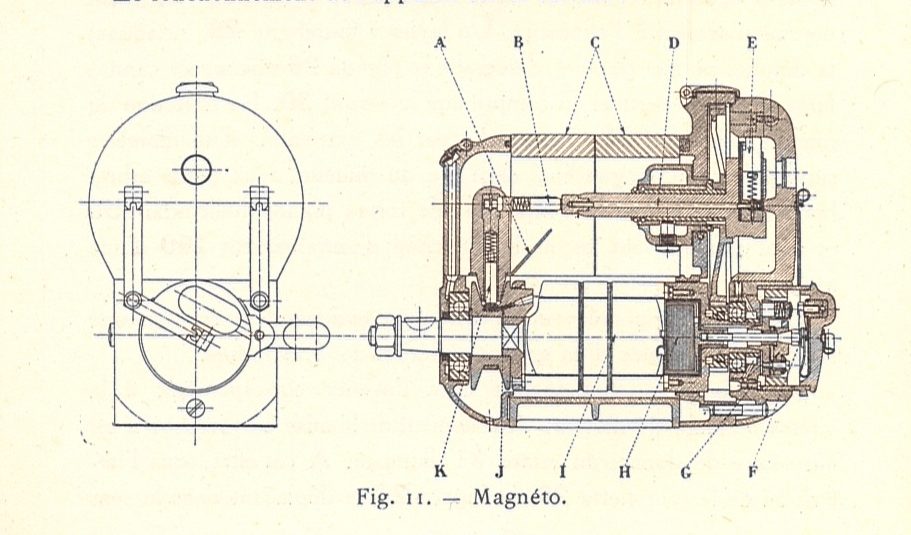
Impulse coupling and booster coils
A magneto's output depends on how fast its magnet turns. During starting the starter motor, or a hand swinging the propeller, turns the engine only slowly, and at that speed a magneto alone would give a weak spark. Two devices supply a better one.
The impulse coupling is a spring-loaded link in the drive to a magneto. At cranking speed pawls hold the magnet back while the engine turns on, winding up a spring. Near the firing point the pawls release and the spring flicks the magnet round at high speed, producing a strong spark. Because the magnet was held back, the spark is also retarded, occurring later than the normal advanced firing point. Once the engine is running under its own power the coupling disengages and the magnet turns at normal speed with normal timing.
A booster coil does the same job electrically on some engines. It is a battery-powered induction coil that feeds high-voltage current to the plugs during starting, until the magnetos can take over.
Ignition timing and kickback
The burning charge takes time to reach its peak pressure. To obtain peak pressure at the optimum point, some 8 to 10° after top dead centre, the spark must occur before top dead centre. The number of degrees by which it precedes TDC is the ignition timing, or ignition advance.
Two factors change the ideal timing:
- Engine speed. The flame burns at a roughly constant rate while the piston moves faster as rpm rises, so at higher rpm the spark must occur earlier.
- Mixture strength. A weak mixture burns more slowly, so it needs more advance to complete combustion at the right point.
In a typical light aeroplane engine the timing is set when the magnetos are fitted to the engine; there is no cockpit timing control. A magneto that is incorrectly timed affects every cylinder it fires, and on the magneto check it shows as a large but smooth rpm drop.
Kickback is the danger of an advanced spark at cranking speed. With the engine turning slowly, a spark timed well before TDC can ignite the charge while the piston is still rising, driving it back down and reversing the rotation. This can damage the starter, or injure a person swinging the propeller. The retarded spark from the impulse coupling prevents it, because the charge is lit only when the piston has reached, or nearly reached, TDC.
The P-lead and ignition switch
The ignition switch in a typical light aeroplane has the positions OFF, R, L, BOTH and START. Its connection to each magneto is a single wire, the P-lead (primary lead), from the magneto's primary circuit to the switch.
- With the switch at OFF, the P-lead earths the primary circuit. Opening the breaker points then no longer interrupts the primary current, the field does not collapse sharply, and no spark is produced.
- Selecting a magneto ON (R, L or BOTH) opens the switch, breaking the primary-to-earth circuit so that the points control the primary and sparks are produced.
The switch therefore works backwards compared with most electrical switches. If a P-lead breaks or comes loose, the magneto can no longer be earthed and it stays live whatever the switch position. In flight nothing changes, because the magneto keeps firing normally. On the ground the engine can start if the propeller is moved, even with the switch OFF and the key removed.
Warning: treat every propeller as live. A broken P-lead gives no symptom in normal running, and a single compression stroke with a live magneto can start the engine. Never stand in the propeller arc or move a propeller by hand unless the engine has been made safe as the flight manual and your operator require.
Magneto and dead cut checks
Two checks prove the ignition system before flight.
The dead cut check proves that the switch can still earth both magnetos. At low rpm the switch is moved briefly to OFF and immediately back to BOTH. The engine should falter as the ignition is cut. If it keeps running smoothly, a P-lead is not earthing its magneto. Many training texts put the check at idle before shutdown. ATPL texts also recommend it before the higher-rpm magneto check: if a pilot unknowingly has only one working magneto and selects it off at high power, the engine stops, and moving the switch back to BOTH relights it at a high throttle setting, with a torque reaction that can damage the engine and airframe.
The magneto drop check is carried out in the run-up at the rpm given in the flight manual, which loads the engine enough to reveal weak ignition. The pilot selects each magneto in turn, noting the rpm drop and returning to BOTH between selections. The flight manual gives the maximum permitted drop and the maximum difference between the two magnetos.
| Indication on one magneto | Most likely cause |
|---|---|
| Small, smooth drop within limits | Normal: one flame front instead of two |
| No drop at all | Broken P-lead on the magneto that should be off |
| Large drop with rough running | Fouled plug or defective lead on the magneto selected |
| Large but smooth drop | Magneto incorrectly timed |
Rough running is the key diagnostic clue. It means one or more cylinders have stopped firing on that side, which a single fouled plug or broken lead produces; a timing error affects all cylinders equally and gives a smooth drop.
Exam tip: "no drop" is a fault, not a pass. The magneto check tests whether the switch can turn each magneto off as well as whether each magneto works.
Spark plug and lead fouling
Spark plug fouling is a build-up of deposits on the plug's insulator and electrodes that lets the high voltage leak away instead of jumping the gap, so the plug misfires. AVGAS contains lead to raise its resistance to detonation; AVGAS 100LL is the low-lead grade, but even it leaves lead compounds behind. Lead fouling develops when the plugs run cool, at low power with a rich mixture, for example during a long taxi or a prolonged idle on the ground. A rich mixture also leaves carbon deposits.
On the run-up a fouled plug shows as an excessive drop with rough running on the magneto that fires it. The usual remedy is to lean the mixture and run the engine briefly at a higher rpm, as the flight manual describes, to burn the deposits off, and then repeat the check. If the drop is still excessive, the aircraft must not fly until the ignition system has been inspected.
Fouling is prevented rather than cured. The pilot leans the mixture for ground operations where the flight manual permits, avoids long periods at idle, and in a long glide descent opens the throttle to a cruise setting from time to time, which also keeps the engine warm and the carburettor heat effective.
Frequently asked questions
Why do aircraft piston engines have two magnetos?
Two independent magnetos, each firing its own spark plug in every cylinder, give redundancy: if one magneto, lead or plug fails, the other keeps every cylinder firing. Igniting the charge from two points also creates two flame fronts, which burn it faster and more completely and give slightly more power. That is why a small rpm drop is normal when only one magneto is selected during the run-up.
Does a piston engine stop if the master switch is turned off?
No. Each magneto is a self-contained generator driven by the engine, so the ignition does not depend on the battery, the alternator or the master switch. After a total electrical failure the engine keeps running normally, although radios, electric fuel pumps, flaps and some instruments are lost. The same independence means a magneto with a broken P-lead stays live even when every switch in the cockpit is off.
What does no rpm drop on the magneto check mean?
If the rpm does not fall at all when a single magneto is selected, the magneto that should have been switched off is probably still firing because its P-lead, the wire that earths it, is broken or disconnected. That magneto is live whatever the switch position, so the propeller could start the engine if moved by hand. The engine is stopped with the mixture control and the defect reported before further flight.
What is an impulse coupling on a magneto?
An impulse coupling is a spring-loaded drive between the engine and a magneto that helps starting. At cranking speed the magnet turns too slowly to make a good spark. The coupling holds the magnet back, winds up a spring and then releases it, flicking the magnet round fast to produce a strong spark that is also retarded, reducing the risk of kickback. Once the engine is running it disengages and the drive is direct.
What is a dead cut check?
A dead cut check proves that the ignition switch can still switch both magnetos off. At low rpm the switch is moved briefly to OFF and straight back to BOTH; the engine should falter as the ignition is cut. If it keeps running smoothly, a P-lead is not earthing its magneto, the propeller must be treated as live, and the engine is shut down with the mixture control and the defect reported.
Test yourself on Piston Engine Ignition Systems
The v1prep banks cover this topic in Aircraft General Knowledge (021), with a worked explanation for every answer. EASA ATPL, PPL, IR and CPL, the FAA written tests and A320/B737 type ratings.
Start practising →Sources and further reading
- FAA Pilot's Handbook of Aeronautical Knowledge (FAA-H-8083-25C), Chapter 7, Aircraft Systems
- FAA Aviation Maintenance Technician Handbook, Powerplant (FAA-H-8083-32B), Chapter 4, Engine Ignition and Electrical Systems
- FAA Airplane Flying Handbook (FAA-H-8083-3C), Chapter 2, Ground Operations
- EASA Easy Access Rules for Aircrew (Part-FCL), AMC and GM with the theoretical knowledge syllabus (021, Powerplant)
Library articles are written for study and exam preparation. They do not replace your aircraft's approved documentation, your operator's procedures or the regulations themselves.