Magnetic Compass
The aircraft magnetic compass is a heading instrument whose pivoted magnet system aligns with the horizontal component of the Earth's magnetic field. The direct-reading type needs no power and serves as the standby compass; the remote-indicating type senses the field with a flux valve and uses it to keep a gyro aligned with magnetic north.
The magnetic compass is the oldest heading instrument in the aircraft and the only one that needs no electrical power, vacuum or alignment. In a light aeroplane the direct-reading magnetic compass is the reference against which the heading indicator is set; in an airliner it sits on the windscreen centre post as the standby compass, with its deviation card beside it. The remote-indicating compass senses the field with a flux valve mounted away from the cockpit and uses it to keep a gyro aligned with magnetic north.
The direct-reading compass is simple and reliable, but it tells the truth only in steady, straight and level flight. Its errors come from the Earth's magnetic dip (see terrestrial magnetism) or from the aircraft's own magnetism, and both are exam favourites in EASA 022 Instrumentation and 061 General Navigation and in the FAA knowledge tests.
Construction of the direct-reading compass
A direct-reading compass consists of:
- a magnet system of several short magnets or a circular magnet, carrying the compass card graduated in degrees;
- a pivot, an iridium-tipped point resting in a jewelled cup, to keep friction low;
- a sealed, non-magnetic bowl filled with a transparent liquid that damps the card and, by buoying the magnet system, reduces its effective weight on the pivot;
- a sylphon tube or expansion chamber, a flexible bellows that absorbs the liquid's expansion and contraction with temperature, so the bowl neither bursts nor forms bubbles;
- a lubber line on the window against which the heading is read, integral lighting, and a compensating device of small corrector magnets.
The liquid must stay clear, have a low freezing point and low expansion, and have a low viscosity, so that it does not drag the card round in turns. A magnet's response to a field depends on its magnetic moment, pole strength multiplied by the effective length between the poles; high pole strength in short magnets gives a sensitive compass without a long, heavy magnet.
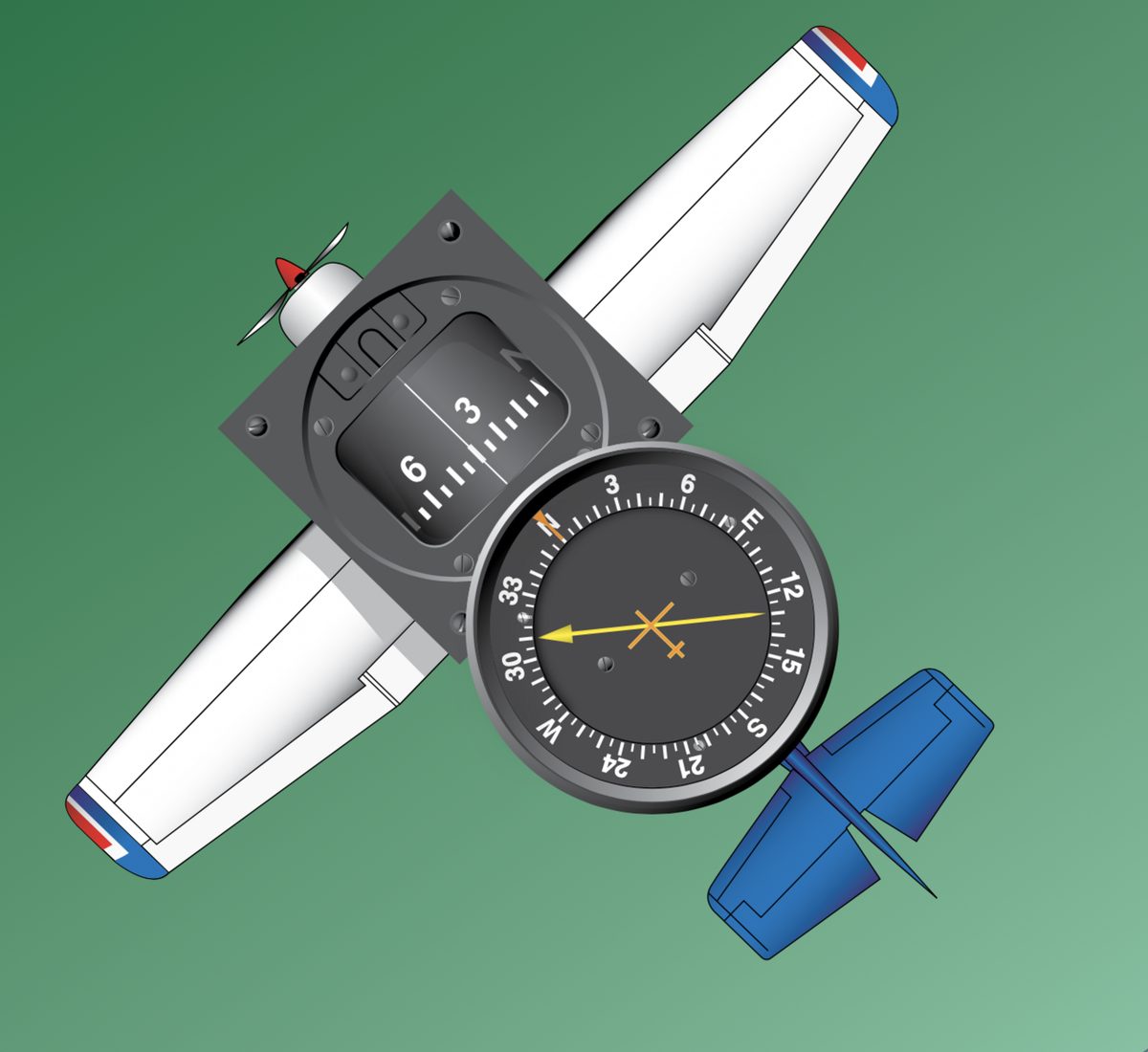
On the usual direct-reading compass the figures increase to the left, the reverse of a heading indicator, so it is easy to turn the wrong way. EASA exam texts call this standard instrument a vertical card compass. FAA handbooks keep the name vertical card magnetic compass for a variant whose dial, turned through gears by the magnet, faces the pilot like a heading indicator, with a small aircraft symbol as the lubber line.
On the Airbus A320 the standby compass sits on top of the windshield centre post with the deviation card above it. A pre-flight check, such as the FAA's instrument cockpit check, confirms that the bowl is full and free of bubbles, the card swings freely, a current deviation card is present, and the reading agrees with a known heading such as the runway direction.
Aperiodicity and pendulous suspension
A direct-reading compass must meet three requirements:
- Horizontality. The magnet system must lie nearly level to align with the horizontal component of the Earth's field. Left free it would dip with the field, so it has a pendulous suspension: its centre of gravity hangs below the pivot, and gravity opposes the pull of the vertical component. Equilibrium leaves a small residual tilt, usually quoted as about 2°, with the north-seeking end low in the northern hemisphere.
- Sensitivity. It must respond to a weak directive force, which calls for a high magnetic moment and low pivot friction.
- Aperiodicity. It must be dead-beat, settling on a new heading without prolonged oscillation. The liquid damps the swing, and keeping the short magnets close to the centre keeps the moment of inertia low.
The residual tilt matters: it leaves the centre of gravity offset from the pivot along the magnetic meridian, south of it in the northern hemisphere, and that offset is where every turning and acceleration error begins.

Acceleration errors (ANDS)
When an aircraft on an easterly or westerly heading accelerates, the pivot moves forward with the aircraft while the offset centre of gravity lags behind. Acting through the offset, the lag turns the magnet system in azimuth, and the card shows a turn that is not happening. Whenever the magnet rotates clockwise seen from above, the compass under-reads; anticlockwise, it over-reads.
| Hemisphere | Accelerating on E or W | Decelerating on E or W | Memory aid |
|---|---|---|---|
| Northern | Apparent turn towards north | Apparent turn towards south | ANDS: accelerate north, decelerate south |
| Southern | Apparent turn towards south | Apparent turn towards north | Reverse of ANDS |
On north and south headings the offset lies along the line of acceleration, so the card only tilts and does not turn: acceleration errors are greatest on 090° and 270° and nil on 000° and 180°. Accelerating on 090° in the northern hemisphere, the reading falls, for example to 075°; decelerating on 270°, it also falls, towards 255°. The error disappears once the speed is steady, and at the magnetic equator, where there is no dip, it does not occur at all.
The take-off roll, a go-around and the level-off at cruise all produce it; when the compass swings while the heading indicator and turn coordinator show no turn, the gyro instruments are right.
Turning errors (UNOS) and liquid swirl
In a turn the aircraft accelerates towards the centre of the turn and the offset centre of gravity is thrown outwards. In the northern hemisphere, turning through north, the magnet system is swung round in the same direction as the aircraft, so the card is sluggish and lags the true heading. Turning through south, it is swung the opposite way, so the card is lively and leads.
The roll-out technique follows: UNOS, undershoot north, overshoot south. Rolling out on a northerly heading, stop the turn before the compass reaches the target; on a southerly heading, continue until it has passed it. Turning errors are greatest through north and south and nil through east and west, the mirror image of acceleration errors. In the southern magnetic hemisphere the compass leads through north and lags through south, and the rule becomes ONUS. The size of the error grows with magnetic latitude. FAA handbooks teach leading or lagging the roll-out by about the latitude, adjusted by the normal roll-out lead of about half the bank angle: at 30°N, a left turn from east onto north is rolled out when the compass reads about 037°, the 30° of lag plus a lead of about 7°.
Liquid swirl adds a further effect. In a sustained turn the liquid is dragged round by the bowl and drags the magnet system with it, always in the direction of the turn. In the northern hemisphere it increases the lag through north and reduces the lead through south. At the magnetic equator it is the only turning error left; a low-viscosity liquid keeps it small.
The compass can therefore be read only in straight, level, unaccelerated flight, after the card has settled. The heading indicator is aligned with it every 10 to 15 minutes under those conditions, and if the heading indicator fails, a timed rate-one turn at 3° per second avoids the compass errors altogether.
Hard-iron and soft-iron magnetism
Iron, steel, nickel and cobalt and their alloys are ferromagnetic materials: they can be magnetised, and near a compass they deflect it. Aluminium, brass, copper and plastics are not and do not.
- Hard iron, such as cobalt or tungsten steel, needs a strong field to magnetise it but then keeps its magnetism indefinitely. An aircraft acquires hard-iron magnetism mainly from vibration and hammering during manufacture while it sits in the Earth's field. The resulting field is fixed in the airframe and turns with it, so its effect on the compass changes with heading. Because it acts against the Earth's weakening horizontal field, the deviation it causes grows towards the magnetic poles.
- Soft iron is magnetised easily by a weak field but keeps practically nothing when the field goes. Soft-iron magnetism in the airframe is induced by the Earth's field itself, so it changes with heading and with magnetic latitude; the part induced in vertical soft iron by the vertical component vanishes at the magnetic equator.
Current-carrying wires, radios, lights and motors add fields of their own, which is why some deviation cards give values with radios on and off. Magnetism can be removed by heating a material above its Curie temperature, the temperature above which it loses its ferromagnetism, by mechanical shock, or by an alternating field of steadily decreasing strength.
Compass deviation and the deviation card
Compass deviation, or magnetic deviation, is the angle between the magnetic meridian and the direction in which the compass magnets actually lie, caused by the aircraft's own magnetism. It is named east or plus when the north-seeking end lies east of the magnetic meridian, and west or minus when it lies west.
Analysed over a full circle of headings, deviation resolves into coefficients:
| Coefficient | Varies with heading as | Largest on | Main cause | Corrected by |
|---|---|---|---|---|
| A | Constant | All headings equally | Lubber line misaligned with the aircraft axis | Rotating the compass in its mounting |
| B | Sine | 090° and 270° | Fore-and-aft hard iron | Corrector magnets, on east or west |
| C | Cosine | 000° and 180° | Athwartships hard iron | Corrector magnets, on north or south |
A blue pole of hard-iron magnetism in the nose, for example, gives zero deviation on north and south, the maximum easterly deviation on 090° and the maximum westerly on 270°: a positive sine curve, coefficient B.
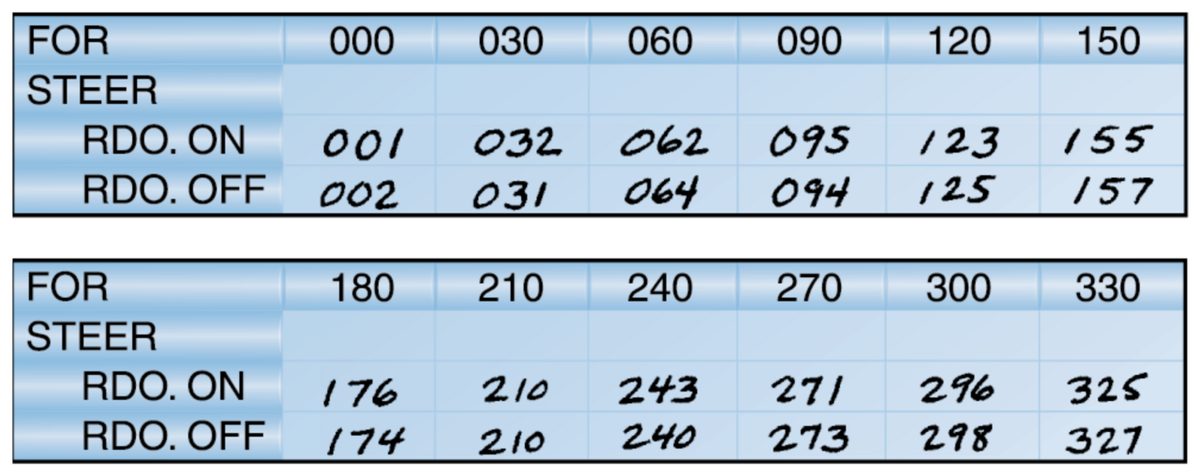
What cannot be removed is recorded on the compass deviation card as the compass heading to steer for each magnetic heading. CS 25.1327 and 14 CFR 25.1327 allow a direct-reading compass on a large aeroplane no more than 10° of deviation in level flight on any heading after compensation; a well-swung installation shows far less. The card is valid only for the aircraft as swung: a phone, headset, camera bag or metal tool placed near the compass adds deviation that no card accounts for.
The compass swing
A compass swing has three aims: to measure the deviation on a series of headings, to remove as much of it as possible, and to record the rest on the card. It follows any change to the aircraft's magnetic condition, such as a new compass, work on nearby magnetic or electrical equipment, a lightning strike, a large ferrous load or a large change of magnetic latitude, and is also done whenever the compass is in doubt and at the intervals of the maintenance programme.
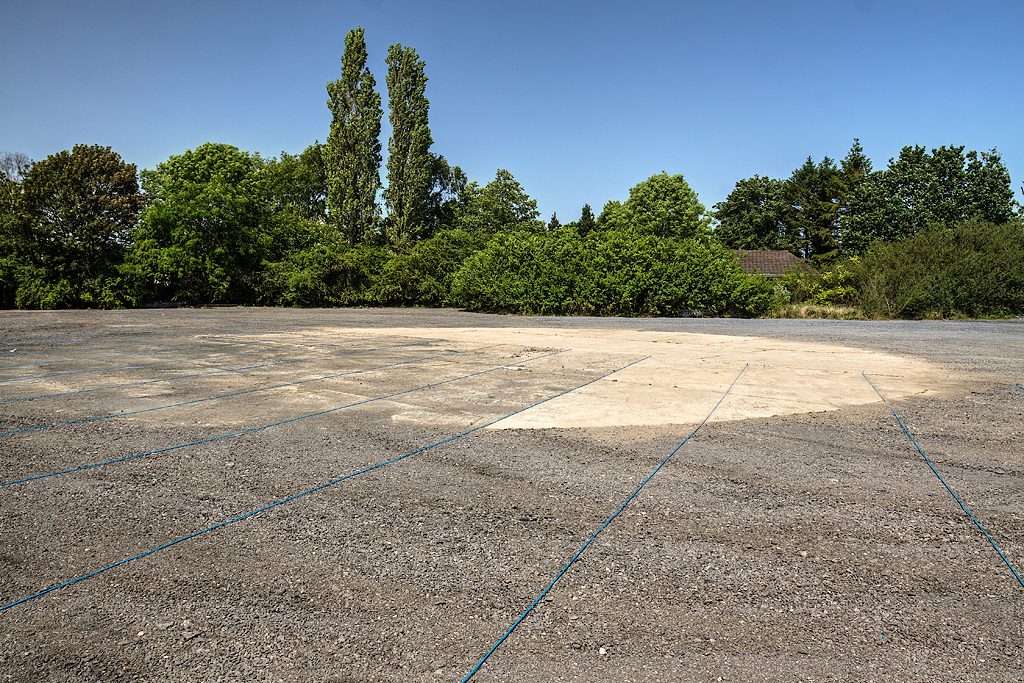
It is done on a compass swinging base, a site surveyed to be free of buried cables, ferrous material and other aircraft, where a painted compass rose or marked lines give known magnetic headings; a high-quality datum or landing compass may be used instead. The aircraft is set up as in flight: level, engines running, electrical and radio services on, no tools nearby. It is turned onto each heading in turn, typically every 30°; coefficient A is corrected by rotating the compass, B and C with the corrector magnets on the headings where each is largest. A check swing on 8 or 12 headings, every 45° or 30°, then gives the residual deviations for the card.
Remote-indicating compasses
The direct-reading compass has three limitations: its turning and acceleration errors, a magnet that must sit near the cockpit's electrical and ferrous disturbances, and an output that cannot be sent to other equipment. The remote-indicating compass, also called the gyro-magnetic or slaved gyro compass, overcomes all three.
Its detector unit, the flux valve, is mounted in a wing tip or the fin, clear of most aircraft magnetism. It hangs on a Hooke's joint that lets it swing about 25° in pitch and roll but not in azimuth, in an oil-damped case, so that it senses the horizontal component of the field. Three legs spaced 120° apart are saturated alternately by an AC excitation coil; the Earth's field unbalances them, and by Faraday's law each pick-up coil produces a voltage that depends on the field along its leg. Together the three voltages reproduce the direction of the field. That signal slowly slaves a directional gyro to magnetic north: the gyro gives a steady heading free of turning and acceleration errors, and the flux valve removes the gyro's drift. The result drives the HSI, the RMI and the autopilot.
A slaving annunciator shows the disagreement between gyro and flux valve. A small oscillation about the centre is normal; a steady off-centre indication means the magnetic monitoring has failed or the system needs synchronising, and after a failure the pilot selects free (DG) mode and resets the heading by hand against the standby compass in steady flight. Free mode is also used at high magnetic latitudes, where the horizontal field is too weak. A remote compass has far less residual deviation than a direct-reading one, but it is still swung. The FAA's AIM warns that magnetic materials on or under taxiways and ramps can pull a slaved compass off alignment during taxi, an error that may not correct itself; heading is checked before take-off.
Frequently asked questions
What does ANDS mean for a magnetic compass?
ANDS stands for accelerate north, decelerate south. In the northern hemisphere, accelerating on an easterly or westerly heading makes the direct-reading compass show an apparent turn towards north, and decelerating an apparent turn towards south, although the aircraft is flying straight. The error is greatest on east and west, nil on north and south, vanishes at the magnetic equator and reverses in the southern hemisphere.
What does UNOS mean for a magnetic compass?
UNOS stands for undershoot north, overshoot south, the northern-hemisphere rule for rolling out of a turn by the compass. Turning through north the compass lags behind the aircraft, so the roll-out must begin before the indication reaches the target heading. Turning through south it leads, so the turn continues past the indication. The error is nil through east and west. In the southern hemisphere the rule becomes ONUS.
What is a compass deviation card?
It is the card mounted next to the compass that records the deviation left after a compass swing. For each magnetic heading, usually in steps of 30 degrees, it gives the compass heading to steer, sometimes with separate columns for radios on and off. A card reading for 090 steer 095 means the compass must show 095 for the aircraft to fly 090 degrees magnetic, a deviation of 5 degrees west.
When must a compass swing be carried out?
A swing is needed whenever the aircraft's magnetic condition may have changed or the compass is in doubt, for example after a compass is installed or replaced, after modifications or repairs involving magnetic material or electrical equipment, after a lightning strike or heavy shock, before carrying a large ferrous load, after a large change of magnetic latitude or long storage on one heading, and at the intervals set by the maintenance programme.
What is the difference between hard-iron and soft-iron magnetism?
Hard iron, such as cobalt or tungsten steel, needs a strong field to magnetise it but then keeps its magnetism; an aircraft acquires it mainly from vibration and hammering during manufacture. Soft iron is magnetised easily by the Earth's field but keeps practically none, so its induced magnetism changes with heading and magnetic latitude. Both cause deviation, and both are measured and reduced during a compass swing.
Test yourself on Magnetic Compass
The v1prep banks cover this topic in General and Radio Navigation (061/062), with a worked explanation for every answer. EASA ATPL, PPL, IR and CPL, the FAA written tests and A320/B737 type ratings.
Start practising →Sources and further reading
- FAA Pilot's Handbook of Aeronautical Knowledge (FAA-H-8083-25), Chapter 8, Flight Instruments (magnetic compass)
- FAA Instrument Flying Handbook (FAA-H-8083-15B), Chapter 5, Flight Instruments
- EASA Easy Access Rules for Large Aeroplanes (CS-25), CS 25.1327 Magnetic direction indicator
- 14 CFR 25.1327, Magnetic direction indicator
- FAA Aeronautical Information Manual, Chapter 1 Section 1 (1-1-15, slaved compass heading errors from ground flux fields)
- EASA, Explanatory Note to ED Decision 2018/001/R, Part-FCL theoretical knowledge learning objectives (022 Instrumentation, 061 General Navigation)
Library articles are written for study and exam preparation. They do not replace your aircraft's approved documentation, your operator's procedures or the regulations themselves.