Cabin Safety and Passenger Management
Cabin safety covers the people, equipment and procedures that protect passengers in the aircraft cabin: the cabin crew and their minimum number, communication between flight deck and cabin, passenger signs and briefings, seat belts and restraints, the seating of passengers needing assistance, and control of portable electronic devices.
Cabin safety is the part of flight safety that happens behind the flight deck door. It covers the cabin crew, how they and the pilots talk to each other, the signs, briefings and restraints that prepare passengers for turbulence or an emergency, and the rules on who sits where and what they may carry and switch on. Most of it is routine, repeated on every flight so that it works when something goes wrong.
For pilots the subject matters twice. The commander is responsible for the safety of everyone on board from the moment he or she arrives on board until leaving the aircraft at the end of the flight, and the cabin crew are the commander's eyes and hands in the cabin. And many exam questions on operational procedures are about cabin crew numbers, signs, briefings, infants, reduced mobility passengers and electronic devices.
Cabin crew and minimum complement
Cabin crew are crew members, other than flight crew, who perform duties related to the safety of passengers. Service is part of their work, but their reason for being on board is safety: preparing the cabin, managing passengers, first aid, fighting fires and directing an evacuation.
The cabin crew minimum complement under EASA rules applies to aeroplanes with a maximum operational passenger seating configuration (MOPSC) of more than 19. Such an aeroplane needs at least one cabin crew member whenever one or more passengers are on board, and in general one for every 50 passenger seats, or fraction of 50, installed on the same deck, or the number set during certification if that is greater. The count depends on the seats installed, not on the passengers carried. Cabin crew must be at least 18, hold a cabin crew attestation and normally operate on no more than three aeroplane types. All crew must share a common language, and any additional crew members carried must be distinguishable from the cabin crew by the passengers.
The FAA counts differently. Under 14 CFR 121.391 an aeroplane with 10 to 50 passenger seats needs one flight attendant when its maximum payload is more than 7,500 lb (20 to 50 seats when it is 7,500 lb or less), 51 to 100 seats need two, and above 100 seats two plus one for each further 50 seats or part of 50. This is also based on seating capacity, not passengers carried.
| Passenger seats | EASA minimum cabin crew | FAA Part 121 flight attendants |
|---|---|---|
| 19 or fewer | none required | 1 from 10 seats (payload over 7,500 lb) |
| 20 to 50 | 1 | 1 |
| 51 to 100 | 2 | 2 |
| 101 to 150 | 3 | 3 |
| 151 to 200 | 4 | 4 |
Senior cabin crew member
When more than one cabin crew member is required, the operator nominates a senior cabin crew member, often called the purser or cabin manager. Under EASA rules the senior cabin crew member needs at least one year of experience as cabin crew and an appropriate course, including crew resource management. He or she leads the cabin team, takes part in the pre-flight briefing with the commander, and is the flight crew's main contact for the cabin report, passenger problems, medical events and emergencies.
Cockpit-cabin communication
Cockpit-cabin communication runs through a pre-flight briefing between the commander and the senior cabin crew member, covering flight time, weather, turbulence, security matters and any special procedures, and then through the interphone, call chimes and the public address system. The call systems distinguish routine from urgent. On the A320 the flight deck can call the purser or any station, and a cabin crew EMER CALL makes lights flash and three buzzers sound on the flight deck, except during take-off and landing, when they are inhibited. On the 737 the ATTEND switch sounds a two-tone chime in the cabin, and on the A320 an ATTND advisory button warns the cabin crew of an imminent take-off or landing.
Calls to the flight deck are restricted during critical phases. The FAA's sterile flight deck rule, 14 CFR 121.542, forbids non-essential duties and conversation during taxi, take-off and landing and all other operations below 10,000 ft except cruise. Cabin crew therefore call during these phases only for safety matters. Some aircraft show the sterile period in the cabin: on the Embraer E190-E2 an amber cabin light marks the phases from engine start to FL100 and from FL100 to engine shutdown.
Cabin secure report
Before take-off and before landing the cabin crew prepare the cabin: passengers seated with belts fastened, seat backs upright and tables stowed, cabin baggage stowed, galleys and their carts secured, aisles and exits clear, and cabin crew in their seats. The senior cabin crew member then gives the cabin secure report, or cabin report, to the flight crew. On the A320 the landing flow includes "cabin report ... receive": the crew check CABIN READY on the engine and warning display, or obtain the report from the purser. The flight crew confirm that they have the report before take-off and before landing, so that nobody is standing or unsecured if the aircraft must stop hard or go around.
Passenger signs
The passenger signs are switched from the flight deck. On the A320 the SEAT BELTS switch lights the FASTEN SEAT BELT and RETURN TO YOUR SEAT signs, and a second switch controls, depending on the aircraft, the NO SMOKING, EXIT or NO PORTABLE ELEC DEVICE signs. Each switch has three positions: ON; AUTO, in which the signs come on when the landing gear or the slats and flaps are extended; and OFF. If the cabin altitude rises above about 11,300 ft, all cabin signs except NO PED come on whatever the switch position. On the 737 a low tone sounds over the public address whenever the signs change.
Under 14 CFR 121.317 the fasten seat belt sign must be on during any movement on the surface, for each take-off and landing, and whenever the pilot in command considers it necessary, and passengers must obey it. Turbulence is the leading cause of non-fatal injuries in US airline operations, mostly to unbelted passengers and cabin crew, so crews leave the sign on in forecast turbulence and seat the cabin crew before a known encounter. The signs also appear in other procedures: SIGNS ON is a memory item in the A320 emergency descent, and under the EASA guidance for refuelling with passengers on board the seat belt signs are off and the no smoking signs on, so that passengers can leave quickly if needed.
Passenger safety briefing
Every passenger is briefed before take-off. Under 14 CFR 121.571 the passenger safety briefing covers smoking, the location of the emergency exits, the use of seat belts and the location and use of any required flotation equipment, supported by a safety briefing card at each seat; passengers in exit rows get an additional briefing. EASA rules similarly require safety briefings, demonstrations and cards, and where relevant the briefing adds life jackets and oxygen masks. Passengers needing special assistance receive an individual briefing.
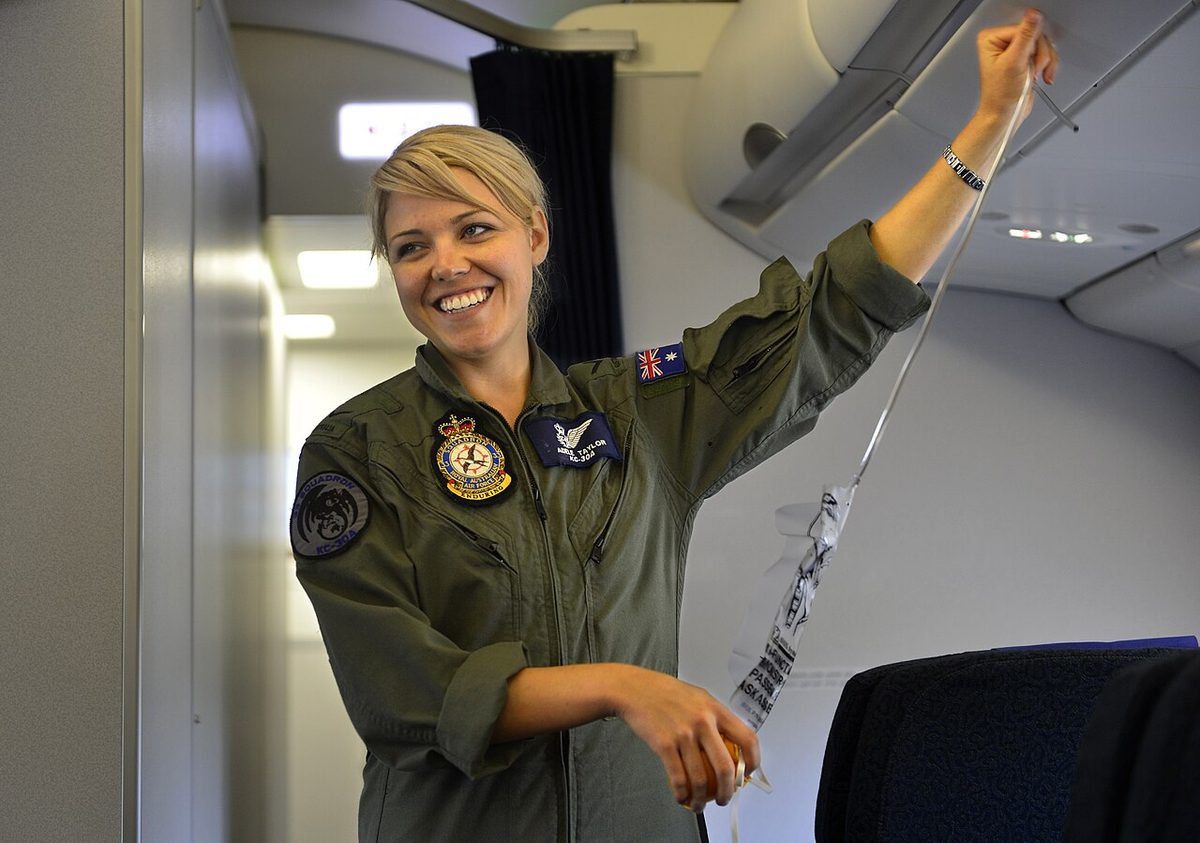
In a light aircraft the pilot in command gives the briefing: belts and harnesses, doors and how to open them, emergency equipment and what to do in an emergency landing. Familiarity is no excuse. A regular passenger still needs the briefing, because in an emergency people act on the most recent briefing, not on distant memory.
Seat belts, harnesses and infant restraints
Everyone on board must occupy an approved seat or berth with the belt fastened for taxiing, take-off and landing and whenever the commander considers it necessary. Under the FAA rules, for example, each required flight crew member keeps the seat belt fastened while at the station and the shoulder harness fastened for take-off and landing, and flight attendants sit at their stations with belts and harnesses fastened for take-off and landing. A five-point harness adds a crotch strap to the lap belt and two shoulder straps; the crotch strap stops the wearer sliding under the lap belt, and this type of harness gives the best protection against impact loads.
A seat may be shared only by an infant held by an adult, and the infant then needs a restraint of its own, the supplementary loop belt, fastened to the adult's belt, unless it travels in an approved child restraint device on a seat of its own. Under FAA rule 91.107 a child under two may be held by an adult, and a child restraint is permitted but not required. On the load sheet an infant under two carried on an adult's lap is covered by the adult's standard mass, while a child from two to under twelve years in a seat counts at 35 kg.
Passengers with reduced mobility
A person with reduced mobility (PRM) is a passenger whose mobility is reduced, for example by a disability, age or illness, and who needs special attention or assistance. Such passengers are carried on terms that keep the escape paths clear: they may not sit where they would impede the crew, obstruct emergency equipment or hinder an evacuation, which rules out exit rows and seats with direct access to an exit. They receive an individual briefing.
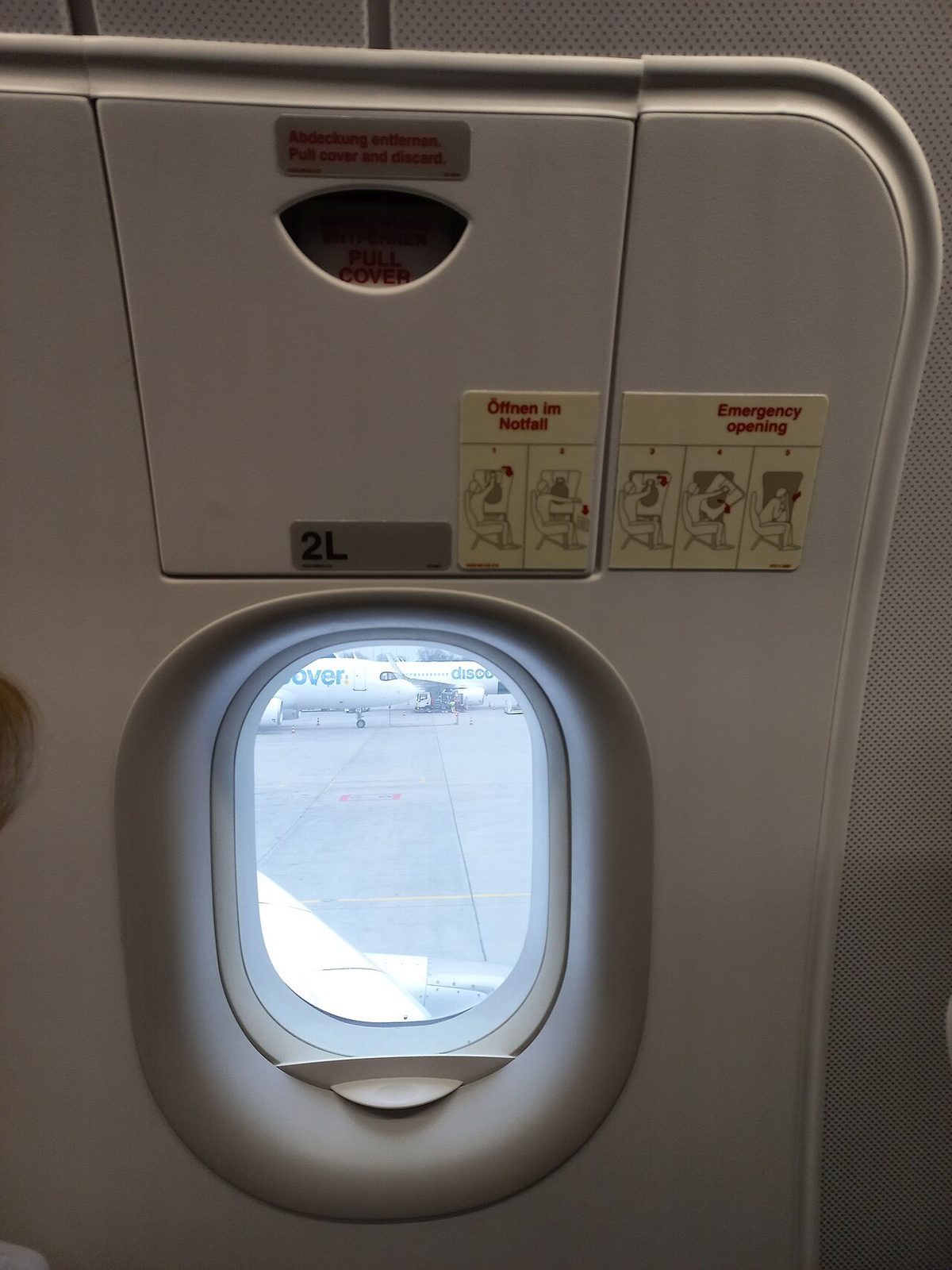
The same principle governs other special categories. Unaccompanied children, and infants with their adults, stay away from exits. Deportees and persons in custody are normally embarked first, before any other passengers, the commander is informed, and they too are kept away from the exits. The commander must not allow a person to be carried who appears to be under the influence of alcohol or drugs to the extent that the safety of the aircraft or its occupants is likely to be endangered.
Portable electronic devices
A portable electronic device (PED) is any electronic device, from a phone to a laptop, brought on board by crew or passengers and not part of the aircraft's approved configuration. The operator must take all reasonable measures to prevent the use of any PED that could adversely affect the aircraft's systems and equipment, and decides which devices may be used and in which phases, often in flight mode. The NO PED sign, where fitted, supports those rules. For the flight crew themselves, the FAA forbids personal use of wireless devices and laptops at their duty stations throughout the flight.
The bigger hazard today is the lithium battery. Spare lithium batteries and power banks must travel in cabin baggage with the terminals protected against short circuit, because a battery fire must be seen and fought quickly, which is impossible in the hold. Batteries up to 100 Wh need no approval; above 100 Wh and up to 160 Wh the operator must approve them and each passenger may carry at most two spares; above 160 Wh they may not be carried as baggage. See dangerous goods.
Frequently asked questions
How many cabin crew does an aircraft need?
Under EASA rules an aeroplane with more than 19 passenger seats needs at least one cabin crew member whenever a passenger is on board, and in general one for every 50 passenger seats, or fraction of 50, installed on the same deck, or the number set during certification if that is greater. Under FAA Part 121 it is one for 10 to 50 seats, two for 51 to 100, and above 100 two plus one per further 50 seats or part of 50.
What is a cabin secure report?
The cabin secure report tells the flight crew that the cabin is ready for take-off or landing: passengers seated with belts fastened, baggage stowed, galleys secured, exits and aisles clear and cabin crew at their stations. The senior cabin crew member gives it by interphone; on the A320 the flight crew may instead see CABIN READY on the engine and warning display. The flight crew confirm they have it before take-off and landing.
When must the fasten seat belt sign be on?
Under FAA rule 14 CFR 121.317 the fasten seat belt sign must be on during any movement on the surface, for each take-off and landing, and whenever the pilot in command considers it necessary, and passengers must comply while it is lit. Under EASA rules passengers must be seated with belts fastened for taxiing, take-off and landing and whenever the commander considers it necessary. Turbulence injuries mostly happen to people not strapped in.
How are infants carried on commercial flights?
Only an infant may share a seat, held by an accompanying adult and secured by its own supplementary loop belt attached to the adult's belt, or carried in an approved child restraint device on its own seat. Infants and the adults carrying them may not sit in exit rows. For mass purposes an infant under two on an adult's lap is covered by the adult's standard mass.
Can I use my phone on a plane?
Operators must take all reasonable measures to prevent the use of any portable electronic device that could adversely affect aircraft systems, and each airline decides which devices may be used and when, often in flight mode. Spare lithium batteries and power banks must travel in cabin baggage with the terminals protected, so that a fire can be seen and fought; batteries above 100 Wh need the operator's approval and those above 160 Wh are not allowed in baggage.
Test yourself on Cabin Safety and Passenger Management
The v1prep banks cover this topic in Operational Procedures (070), with a worked explanation for every answer. EASA ATPL, PPL, IR and CPL, the FAA written tests and A320/B737 type ratings.
Start practising →Sources and further reading
- EASA Easy Access Rules for Air Operations (Regulation (EU) No 965/2012), Parts ORO.CC and CAT
- 14 CFR 121.391, Flight attendants
- 14 CFR 121.317, Passenger information requirements, smoking prohibitions, and additional seat belt requirements
- 14 CFR 121.571, Briefing passengers before takeoff
- 14 CFR 121.542, Flight crewmember duties (sterile flight deck)
- 14 CFR 91.107, Use of safety belts, shoulder harnesses, and child restraint systems
Library articles are written for study and exam preparation. They do not replace your aircraft's approved documentation, your operator's procedures or the regulations themselves.